




Narrow Shoe Cabinet Buying Guide: Depth, Sizes and Styles That Fit a Small Entryway
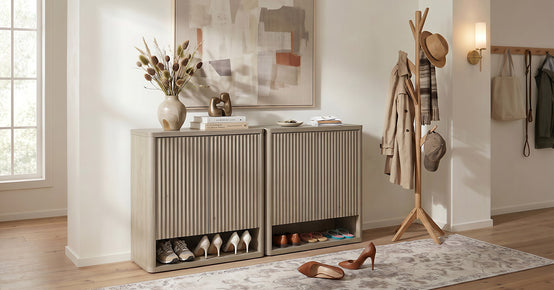
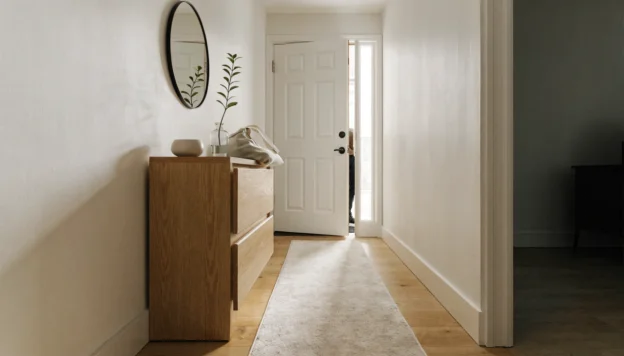
A narrow shoe cabinet is our go-to fix for the sneaker pile that forms by most front doors. Most of them sit 6 to 12 inches off the wall. A regular shoe rack sticks out 12 to 18 inches, which in a 36-inch hallway means you have to turn sideways to squeeze by.
Maybe you've got a corner behind the front door, a skinny apartment hall, or a gap by the coat hooks where only a narrow entryway shoe cabinet will fit. This guide is for you. We'll get into depth on how many pairs really fit, and boots.
Safety gets its own section too, since tall, shallow units should be anchored to prevent tip-overs. Our advice before any of that is pretty dull, but it saves a lot of returns: measure first, shop second.
How Narrow Is a Narrow Shoe Cabinet?

Everyone checks width first. We get why, but depth is what you'll actually bump into. We've seen 40-inch-wide cabinets almost disappear in a hallway just because they sat tight to the wall. Under about 12 inches deep, most stores will call it a narrow or slim shoe cabinet.
Past that, it's a standard cabinet, usually 12 to 15 inches deep, and shoe benches stick out more than that. The chart gives you a rough idea of where each type lands.
Narrow Shoe Cabinet Depth Chart
|
Cabinet Type |
Typical Depth |
Best For |
|
Ultra slim tilt-out cabinet |
Under 8 in |
Very tight hallways, spots behind doors |
|
Narrow shoe cabinet |
8 to 10 in |
Small apartment entryways |
|
Compact cabinet with shelves |
10 to 12 in |
Mixed shoes and some ankle boots |
|
Standard shoe cabinet |
12 to 15 in |
Big foyers, mudrooms |
|
Shoe storage bench |
14 to 18 in |
Halls wide enough for a seat |
Don't hold anyone to those numbers. Brands measure differently, and some include door handles in the depth while others don't, so check the spec sheet before you trust a listing.
How a Tilt-Out Cabinet Stays So Shallow

A sneaker on a regular shelf lies flat, heel against the back. That alone takes up 11 to 13 inches of depth for most adults, more than many hallways can offer.
Flip drawer cabinets cheat a little. They hold shoes tilted, nearly upright, so the length runs up and down instead of front to back. That's how a tip-out shoe cabinet gets away with being only 7 to 9 inches deep.
One catch, though. The outside depth isn't the space your shoe actually gets. Look for the inner compartment size on the spec sheet, every time.
Measure Your Small Entryway Before You Buy

All you need is a tape measure, a pencil, and maybe five minutes. We've seen a lot of returns that one quick check would have prevented.
Measure Depth, Not Just Width
Start at the wall and measure to the edge of the normal walking path; that's the most depth you can spare. While the tape's out, get the open wall width and the height up to whatever's above, like a mirror, a hook, or a light switch.
Check Doors, Baseboards and Vents

It's usually the little things that ruin a delivery day, so we'd run through this quick list before ordering:
• Door swing: the front door and any nearby closet door should open all the way without hitting anything.
• Baseboards: older houses often have chunky ones, and those can hold a cabinet an inch away from the wall.
• Radiators and vents: heat isn't kind to leather or to the glue in your soles.
• Outlets and switches: make sure you can still get to them.
• Drawer swing: flip bins tip out 6 to 10 inches, so leave room for that.
Keep a Clear Walking Path
In public buildings, walking routes need at least 36 inches of clear width under the ADA accessible route standards. Your home doesn't have to follow that. It's still a useful number to aim for, especially in a busy hall.
We'd aim to keep 30 to 36 inches clear once the cabinet's in. Try it with the drawers open as well, because a hall that feels fine with everything closed can get tight the moment a bin tips out.
Types of Slim Entryway Shoe Storage

No style wins everywhere. Think about your hallway and what's actually on your family's feet, and try not to fall for the prettiest photo. A wide mix of slim entryway shoe storage makes it easy to compare depths side by side.
Tilt-Out Shoe Cabinet With Flip Drawers

This is the one we suggest most for really tight spots. Nobody sees the shoes behind the closed front, and the flat top ends up being where the keys and the mail land, which is half the reason people love these.
Sneakers, flats, and loafers fit fine. Chunky high tops and most boots won't, so keep that in mind. The Opus tilt-out shoe cabinet with double flip drawers is a nice real-world example of how a shallow profile can still hide two rows of everyday pairs.
Two Door Narrow Cabinet With Shelves

Behind the hinged doors, you get flat shelves. It's a bit deeper than a flip cabinet, but it copes with more kinds of shoes.
The adjustable shelves are what sell it. You can bump one shelf up for ankle boots and leave the rest low for flats. We think the Cas two-door slim shoe cabinet for 20 pairs is a nice example of how much this layout fits into a small footprint.
Tall Narrow Shoe Cabinet
Some hallways have almost no floor but plenty of wall going up. That's where a tall narrow shoe cabinet makes sense. It stacks everything vertically, and one unit can often hold the whole family's everyday shoes.
Height comes with risk. The taller and shallower the unit, the more it needs a wall anchor, so we'd skip this style if drilling isn't an option for you.
Open Rack or Wall Mounted Shelf

Open racks win on airflow and speed. Soaked shoes dry out faster, and nobody has to open a door to grab a pair. The catch is that everything's on show, and dust collects on every pair.
A wall-mounted shelf lifts shoes off the floor, making sweeping much easier. You'll need to put screws in the wall, though, so if you rent, send your landlord a quick message first. Our shoe cabinet vs shoe rack comparison goes into both options in more detail.
How Many Shoes Can a Narrow Shoe Cabinet Really Hold?

Take "holds 24 pairs" with a grain of salt. Plenty of brands test with small women's flats. Put men's size 11 sneakers in there instead, and you might lose a third of that number, or even half.
Count only what you actually wear in a normal week. Snow boots in July and the shoes you wore to your cousin's wedding can go live in a bedroom closet.
|
Household Size |
Daily Pairs to Store Near the Door |
|
1 person |
4 to 8 pairs |
|
2 people |
8 to 12 pairs |
|
3 to 4 people |
12 to 20 pairs |
|
5 or more people |
20 pairs or more |
Shoe Type Fit Check
|
Shoe Type |
Fits an Ultra Slim Flip Cabinet? |
Better Choice |
|
Flats and sandals |
Yes |
Any narrow cabinet |
|
Standard sneakers |
Usually |
8 to 10 in flip drawer cabinet |
|
Men's size 11 and up |
Check the inner size |
Deeper flip bin or shelves |
|
High tops |
Sometimes |
Adjustable shelves |
|
Ankle boots |
Rarely |
Cabinet with shelves |
|
Tall boots |
No |
Boot tray or closet |
|
Heels |
Usually |
Shelves with enough height |
Try this before you buy. Grab your biggest pair and measure it heel to toe, then across the widest part. If the compartment in the specs is smaller than that, the cabinet isn't for you.
Materials, Doors and Airflow
A shoe cabinet has a rough life. It gets muddy soles in spring, wet boots all winter, and gym shoes that never quite dry, so the material matters more than most people expect when they're scrolling through photos.
Engineered Wood
MDF and particleboard are what you'll see most, in just about every finish, and they're budget-friendly. The weak spot is the edges. Water from wet soles gets into a raw edge, and the board swells for good, which is why we look for sealed or banded edges.
There's also a US rule, TSCA Title VI, that requires MDF and particleboard to meet EPA formaldehyde emission limits. Careful makers usually print a compliance label on the box or the product page, and we always check for it.
Solid Wood and Metal
Solid wood is heavier and stronger, and it costs a bit more. It also moves. Wood swells and shrinks with humidity, so wwekeep it away from radiators and aront ddoorsthat lletsnow blow in all winter.
Metal is the one we'd pick for a house full of wet boots, because water just doesn't bother it and a single wipe cleans it. It looks great in modern or industrial rooms. Next to warm wood tones, it can come across as a little cold.
Rattan and Slatted Doors

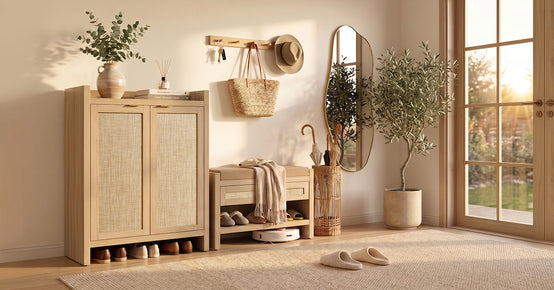
Woven and slatted doors are a nice compromise between open and closed. You don't see the clutter much, air keeps moving, and honestly they just look nicer, more like furniture than storage.
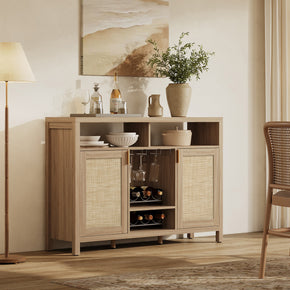
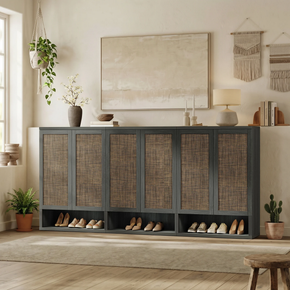
We like the Savanna rattan shoe cabinet for 24 pairs, mostly because the cane doors breathe and the shelves move. Rattan does hold onto dust. Run a soft brush over it once a week, and you're fine.
Keeping a Closed Shoe Cabinet Fresh

Your shoes come home damp a lot of the time, sometimes soaked. That's why mold is a real concern. The EPA mold and moisture guide puts it simply: control moisture,, control mold, and dry wet items within 24 to 48 hours.
We'd leave wet shoes on a mat by the door for a few hours first. After that, airflow does the work. Vent slots, an open back, or a few holes in the side panels all help. Leave a finger's width between pairs, too.
Anchoring and Tip-Over Safety

Tall and shallow means top-heavy. Pull out the flip drawers, and that weight moves forward even more, and a loaded unit can come over if a child tugs on a drawer.
A national study of tip-over injuries to children treated in US emergency rooms shows how real this risk is at home. With a tall, narrow cabinet, anchoring isn't optional.
The wall strap or bracket in the box is there for a reason, so use it. A stud is best. If there isn't one where you need it, use drywall anchors rated for the load, and ask at the hardware store about fixings for plaster or brick.
Clear the Hallway First
Before buying anything, take a hard look at the hallway. Often, the problem is a vacuum that never made it back to the closet, a console table that's too big, or five pairs of the same sneakers by the door.
Moving rarely worn shoes to a closet frees up surprising space. Finding a new home for anything that doesn't belong in the entry helps too. These entryway shoe storage hacks have some clever ideas for hooks, trays, and the space under a table.
A narrow cabinet works best when it holds only the shoes you need by the door.
Common Mistakes When Buying a Narrow Shoe Cabinet
• Going by the pair count alone. Look at what shoe size and style the listing used.
• Buying the shallowest one you can find. If it's too shallow, heels stick out, and the doors won't close.
• Forgetting about drawer swing. Flip bins need open space in front of them.
• Ignoring airflow. Wet shoes shut in a sealed box trap moisture and start to smell sooner than you'd think.
• Skipping the wall anchor. Of all these, it's the one that can actually hurt someone.
• Rushing the assembly. Loose screws are why flip drawers start to sag after a few months.
Best Narrow Shoe Cabinet for Your Space

|
Your Situation |
Recommended Style |
Depth to Look For |
|
Ultra-narrow hallway |
Tilt-out cabinet with flip drawers |
6 to 8 in |
|
Small apartment entry |
Closed flip-out or door cabinet |
8 to 10 in |
|
Family of four or more |
Tall cabinet with adjustable shelves |
10 to 12 in |
|
Renters who cannot drill |
Low freestanding rack or bench |
Any; keep it short |
|
Large sneakers or boots |
Slightly deeper cabinet with shelves |
11 to 13 in |
For closed storage with a clean, modern look, we like the Cas shoe cabinet with black doors in hallways that open straight into the living room.
Final Takeaway

If we had to boil it down, the best narrow shoe cabinet isn't the skinniest one out there. It's the shallowest one that still fits your biggest shoes, can be anchored, and leaves room for people to walk by.
Measure your depth, hold the biggest pair in the house up against the specs, think about airflow, and work out where the anchor goes. Once that's done, start with small-space entryway furniture.
FAQs
What is a good depth for a narrow shoe cabinet?
For most small entryways, we'd say 8 to 10 inches. You can go under 8 with a flip drawer model. If you've got big sneakers or boots to store, we'd bump that up to 10 or 12.
How many pairs of shoes fit in a slim shoe cabinet?
Fewer than the box claims, almost always. It comes down to:
• Shoe size and width
• Low tops versus high tops or boots
• Flip bins versus flat shelves
• How many dividers sit inside
With large shoes, expect roughly 30 to 50 percent fewer pairs than the listing claims.
Are narrow shoe cabinets good for men's large shoes?
Some are fine, and some really aren't. In our experience, men's size 11 is about where ultra-slim flip models start to struggle. Look for deeper bins, dpull-out dividers or adjustable shelves, and compare the ibin's interiorwith your longest shoe.
Do slim shoe cabinets need to be anchored to the wall?
Yes. Kids climb, and a tall, shallow cabinet with open flip drawers can come down on them. That's why there's an anti-tip kit in the box. Use it even if the cabinet feels solid.
How do I stop a shoe cabinet from smelling?
• Dry shoes fully before storing them
• Choose vented, slatted or rattan doors
• Leave a little space between pairs
• Wipe shelves every few weeks
• A cedar block or charcoal bag helps too
Is a shoe rack or shoe cabinet better for a small entryway?
It depends on who sees your hallway. If it's just family, a rack is faster and lets wet shoes air out. If guests walk straight into it, we'd pick a shoe cabinet, since it hides the pile and keeps the dust off.
What can I use instead of a shoe cabinet in a very narrow hallway?
More than you'd think. We've had good luck with over-the-door organizers in rentals, and a wall-mounted shelf is great if you're allowed to drill. A slim basket under a console table hides the daily pairs. For more options, browse these hallway shoe storage ideas.


Looking for something else?
Bookcase Weight Capacity: How to Prevent Sagging Shelves
LEARN MORE
How Deep Should a TV Stand Be? A Guide for Consoles, Cables, and Ventilation
LEARN MORE
Are Soft-Close Dresser Drawers Worth It? A Practical Buying Guide
LEARN MORE
Best Nightstand Height and Placement for an Adjustable Bed
LEARN MORELooking for something else?

Why Adjustable Shelves Matter When Buying a Shoe Cabinet
LEARN MORE
How Wide Should a Sideboard Be Compared With Your Dining Table?
LEARN MORE
How Deep Should a Bookcase Be? Pick by Book Size and Room Clearance
LEARN MORE


Further reading
Dresser Dimensions Guide: Standard Width, Height and Depth by Type
Fluted Nightstand Guide: Meaning, Sizes, Styles and Care Tips


