How Deep Should a Bookcase Be? Pick by Book Size and Room Clearance
Most homes: 10 to 12 inches handles paperbacks through standard hardcovers. Paperbacks only? 8 to 10 does the job. Art books, binders, records — that's 12 to 16 territory. And the thing nobody tells you in the store: deeper isn't automatically better. Every inch past what your stuff actually needs is floor space you paid for and storage you'll never touch.
Quick version: ignore the headline number and judge usable inches. A "12-inch" case usually gives you 10.5 to 11 inches of real shelf. Paperbacks want 8 to 10, hardcovers 10 to 12, art books and binders 12 to 18. Measure your tallest item, add an inch, measure your walkway, buy only as deep as both allow.
Depth is the dimension nobody checks until it's too late. People measure height, measure width, haul it home — then the hardcovers stick out past the front edge, or the case eats a foot of hallway they needed to walk through. I've watched both happen in the same living room. This guide fixes that, with numbers you can verify before you buy.
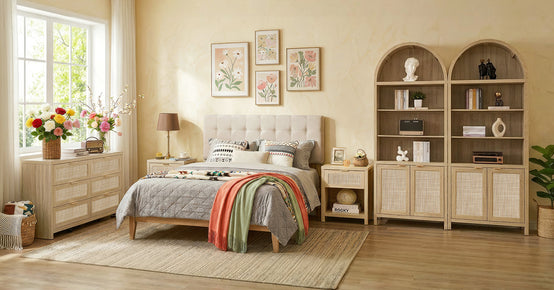
A tall bookcase doing its job — books sitting flush with the shelf edges, no overhang, no wasted depth.
What "Bookcase Depth" Really Means
The number on the listing is exterior depth — the whole box, front to back, frame and all. Your books don't get all of it. What they stand on is usable depth, and it's always smaller. The back panel takes a bite, the face frame takes a bite, door hardware takes a bite if there are doors. On a typical 12-inch bookcase you lose an inch to an inch and a half. Call it 10.5 to 11 inches you can genuinely use.
Common formats, front to back: mass-market paperback about 4 inches. Trade paperback 5 to 6. Hardcover 6 to 8. Big art book 10 to 12. Standard binder 11 to 12. So a 12-inch case with 11 usable inches holds a hardcover with room to spare — barely.
Listings tell you which number they're giving if you know the code words. "Overall depth" or "exterior depth" means the full box. "Shelf depth" or "interior depth" means the surface your books sit on. Only one number on the page? Treat it as exterior and knock an inch and a half off in your head before deciding your books fit.
The back panel and face frame eat an inch or more — usable depth is always less than the headline number.
Standard Depths, in Plain Numbers
Most residential bookcases land between 10 and 12 inches deep, averaging 11 to 12. That range covers what most people own without swallowing the room. Match your stuff below.
Paperbacks and mass-market novels — 8 to 10 in (20 to 25 cm). A paperback runs about 4 in deep; 8 in gives one tidy row with breathing room.
Standard hardcovers — 10 to 12 in (25 to 30 cm). Hardcovers run 6 to 8 in; 10-plus keeps spines flush instead of overhanging.
Large art and coffee-table books — 12 to 14 in (30 to 36 cm). Oversized books reach 10 to 12 in deep and want the whole shelf.
Binders and archive boxes — 15 to 18 in (38 to 46 cm). A standard binder is 11 to 12 in deep and needs clearance to slide out.
Vinyl records — 12 to 14 in (30 to 36 cm). LP sleeves are 12 in square; 13-plus keeps them fully supported.
Decor and mixed display — 12 to 16 in (30 to 41 cm). Vases and frames come in every size; deeper shelves hold a composition without crowding.
Notice something? Nobody's telling you to buy the deepest case "just in case." Almost nobody needs more than 14 inches at home. Go deeper and you're not buying storage — you're buying a cave where things go to be forgotten.
One shelf, five sizes: paperbacks, hardcovers, art books, binders, and records each want a different depth.
Too Shallow: The Overhang Problem
A too-shallow shelf announces itself the day books go in. Spines hang past the front edge, covers snag your sleeve walking past, the case looks like it's wearing clothes a size too small. Worse — a book hanging two inches off the edge becomes a lever the shelf was never built for, and dust settles on every exposed top edge.
The fix is just arithmetic. Grab your deepest item — usually the tallest art book or a binder — measure it front to back, add at least an inch. That inch does two jobs: keeps the book fully supported, and gives your fingers room to pull it out. This is exactly why the 10-to-12-inch standard exists, by the way.
Books hanging past the edge are a warning sign — the case is too shallow for what it holds.
Too Deep: The Wasted-Space Problem
Too deep is sneakier because it feels like a bargain. Three things go wrong, slowly. Books drift to the back and leave a dead strip up front — a 16-inch shelf holds the same single row of paperbacks as an 8-inch one while eating twice the floor. The back row goes invisible: stuff slides behind other stuff, and you end up buying duplicates of books you already own. And every extra inch of depth is an inch of room you can't walk through, swing a door into, or furnish.
A media collector on a home-theater forum said it straight: the standard 28 cm (11-inch) shelving sold everywhere was way too deep for his discs and small books. It was eating his room. He wanted 14 cm — about five and a half inches. For discs and paperbacks, he was right. Depth beyond your contents isn't storage; it's rent paid in floor area.
A deep shelf with books pushed to the back: the front half is paid-for space doing nothing.
The Double-Row Trick
Extra depth has one legit trick: two rows of small books on one shelf. People with deep cases have done this for years — some stack 2x4 lumber along the back so the rear row of paperbacks sits raised and visible above the front row. Stadium seating for books. It works. For a big paperback collection it honestly doubles what a shelf holds.
Count the cost first, though. Double rows only work for books you find by spine — paperbacks yes, daily reference books no. The back row goes dark and dusty no matter what. My rule: double-row only genres you find by author name, and only when floor space is genuinely scarce.
Two rows of paperbacks on one deep shelf — the classic double-row hack, back row raised like stadium seating.
Depth Keeps It Standing, Too
Most depth guides skip this part: depth is what keeps the bookcase upright. A guy planning a 2,200-book library once asked why commercial cases run 12 inches deep when 8 would hold his books and save material. The veteran woodworkers told him: freestanding cases are 12 inches deep because that's roughly the floor for tip-over stability. Built-ins can go shallower — the wall holds them up. A freestanding case has only its footprint.
Tall plus shallow deserves your respect. A tall case under 10 inches deep, loaded heavy up top — that's a tip-over waiting for a toddler or a big dog to set off. Wall anchoring isn't optional here. Ask around: people who've owned 11-inch-deep bookcases for years will tell you the depth handles books fine, but the anti-tip strap is non-negotiable. Every SICOTAS bookcase ships with an anti-tip kit in the box. Put it on the wall day one. Be extra careful with the deeper arched models, where the curved top pushes the visual weight upward.
One more thing stealing your usable depth: the baseboard. Skirting boards stick out half an inch to an inch from the wall, so the case never sits flush — it leans back slightly, the gap behind collects dust, and your measured walkway just lost another inch. Measure from the face of the baseboard, not the wall. Or scribe the case to fit.
Baseboards push the case off the wall — that gap is depth you measured but cannot use.
Tall plus shallow is the tip-over combination. The anti-tip strap takes fifteen minutes and removes the risk.
Room Clearance: Do the Floor Math
Depth is a floor-plan decision before it's a storage decision. A 16-inch-deep case in a 36-inch hallway leaves 20 inches to walk through. Passable, but try it with a laundry basket — or two people passing. Standard guidance says around 36 inches of clear walkway for comfort. In a daily-use hallway, anything under 30 inches of clear space starts feeling like an obstacle course.
Do this math before you shop, not after the delivery truck leaves. Find the narrowest point — the hallway, the gap by the bed, the door swing — and subtract the case's exterior depth, plus an inch for the baseboard gap, plus an inch for comfort. A main path needs at least 30 inches of clear walkway left. A 16-inch-deep case leaving 24 inches beside the sofa? That's a return waiting to happen. A tape measure costs way less than return shipping.
In a hallway, every inch of case depth is an inch of walkway gone — measure the path, not just the wall.
The 5-Minute Worksheet
Grab a tape measure. Five minutes, and it prevents both mistakes.
First: pull your deepest item off the shelf (usually the tallest art book or a binder) and measure it front to back. Add 1 inch. That's your minimum usable depth.
Second: add 1.5 inches to that. That's the minimum exterior depth you'll accept on a listing.
Third: measure your space — from the face of the baseboard to the walkway edge, the door swing, or the furniture opposite. Subtract the exterior depth. You need 30 inches of clear walkway left on a main path.
Fourth: check which depth the listing quotes. Only one number? Treat it as exterior, and confirm the real shelf depth in the Q&A or manual before ordering.
Last: the stability check. Case over 60 inches tall and under 12 inches deep? Make sure it ships with anti-tip hardware — and that you've got a wall to anchor it to.
Five minutes with a tape measure beats a return label every time.
What SICOTAS Bookcases Actually Measure
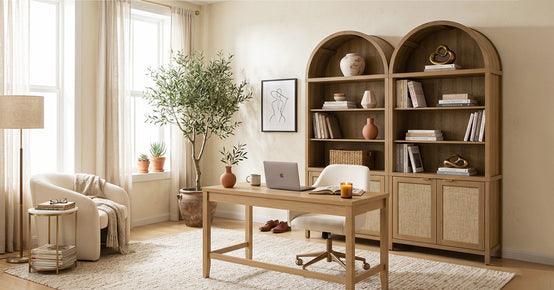
Honest context: the current SICOTAS bookcase range runs deeper than the 10-to-12-inch residential standard. Good news if your collection mixes hardcovers, art books, and decor — but run the worksheet above before falling for the arch.
Savanna Arched Bookcase, 84.2 inch — 16.1 in deep, 35.5 × 84.2 in. Deepest of the range; generous for art books and double rows. Check your walkway first.
Savanna Arched Bookcase with Doors — 16.1 in deep, 35.5 × 84.2 in. Same footprint with doors; the swing needs clearance out front, not just the case depth.
Paperbacks and standard hardcovers? The Stria at 12.5 inches exterior is the natural pick — near standard, easy on floor space. Shelving art books, records, or binders next to your novels? The Savanna models' 16.1 inches give every format a full seat. Either way: measure first, browse the SICOTAS bookcases collection, and match the case to your worksheet — not the photo.
FAQs
How deep should a bookcase be?
10 to 12 inches for most homes. Paperbacks are fine at 8 to 10, standard hardcovers at 10 to 12 — only art books, binders, or records justify 12 and up. And remember: listings quote exterior depth, so subtract about 1.5 inches for the usable shelf your books actually stand on.
What's the standard depth of a bookcase?
About 11 to 12 inches exterior, leaving roughly 10 to 11 inches of usable shelf after the back panel and face frame take their cut. The standard exists for a reason — it fits what most people own (hardcovers up to 8 inches deep) without wasting floor space.
Is a 12-inch-deep bookcase too deep for paperbacks?
A bit, but no disaster. A paperback's only 4 inches deep, so a 12-inch shelf leaves empty space up front. Keep one neat row aligned to the front edge, or double-row for capacity. Just don't go deeper than 12 for a paperback-only collection.
How deep do shelves need to be for hardcovers?
Ten to 12 inches of usable shelf — in practice, a 12-inch-deep case. Standard hardcovers run 6 to 8 inches deep, so they sit fully supported with an inch or two left for pulling books out. Drop under 10 usable inches and hardcover spines start hanging past the edge.
Can a bookcase be too deep?
Yes. Past about 14 inches at home, extra depth stops being storage and starts being waste. Books slide back and leave a dead strip in front, things vanish behind other things, and every extra inch is floor you can't walk on. Buy only as deep as your biggest items need.
What's the best bookcase depth for a small room or hallway?
Eight to 10 inches for paperbacks and small books, keeping the footprint tight. Measure from the face of the baseboard, subtract the case depth, keep 30 inches of clear walkway. In a really tight hall, a 6-to-9-inch narrow case with one row of paperbacks beats a standard case that turns the hall into an obstacle course.
How do you measure bookcase depth — internal vs external?
Tape from the front edge straight back to the wall side: that's exterior. Then measure just the shelf surface, back panel to front edge: that's usable (interior). The 1-to-1.5-inch gap is the back panel, face frame, and door hardware. Judge your books by the usable number, your room by the exterior one.
Do tall bookcases need wall anchoring?
Tall ones, always — tall-plus-shallow most of all. Over 60 inches tall and under 12 inches deep can tip if a kid climbs it or weight shifts forward. Use the anti-tip kit in the box — every SICOTAS bookcase includes one — into a stud or proper anchor, day one.