



Mid Century Sideboard Guide: How to Choose the Right Size, Wood and Style
If you've ever stopped dead at an estate sale in front of a mid-century sideboard, you know the look: a long, low cabinet on skinny legs. Most come in warm teak or walnut. We're fans because they swallow the good plates and board games without hogging the room.
It all goes back to the mid-century modern design movement, roughly the 1930s to the mid-1960s, when designers turned their backs on carved swirls and heavy trim and let wood look like wood. We think that's why a 1962 sideboard still sits happily next to a brand new sofa.
Below is what we'd check before buying, plus vintage tips and the mistakes we see most.
What Is a Mid-Century Sideboard?

People ask us what a sideboard is all the time. Our answer: a cabinet that grew sideways instead of up, with a flat top you'll use every day. Most have a mix of doors and drawers, and the classic ones sit on tapered legs.
Back then, they lived in the dining room, stuffed with the good china and the tablecloth your family only used at Thanksgiving. These days we see them pulling duty as TV stands, bar cabinets, record storage,e and entry tables, too.
Sellers use the name for genuine 1950s and '60s pieces and for new mid-century modern sideboard designs that borrow the look. We'd always check the materials line before getting attached.
Sideboard vs Credenza vs Buffet: What Is the Difference?
We've seen the exact same cabinet listed as a sideboard, a credenza, a buffet, and a media console. Take the table below as a rough guide.
|
Term |
Classic Use |
Typical Shape |
Where You See It Today |
|
Sideboard |
Dining storage and serving |
Long and low, often on legs |
Dining room, living room, hallway |
|
Credenza |
Storage in offices and living spaces |
Long and low, often with sliding doors |
Living room, home office, TV wall |
|
Buffet |
Serving food and storing tableware |
Close to a sideboard, sometimes taller |
Dining room |
|
Media console |
Holding a TV and electronics |
Usually lower than a sideboard |
Living room |

We wouldn't get too hung up on the label. A piece sold as a mid-century credenza can do the same job as one sold as a sideboard. For the dining room side of the debate, see these buffet vs. sideboard differences.
What Makes a Sideboard Mid-Century Modern?
One detail alone won't tell you much, since plenty of modern furniture has tapered legs. Spot three or four of the features below on one cabinet, though, and you're almost certainly looking at the real style.
Long, Low Shape
Everything about these cabinets runs sideways, so your eye travels along the wall instead of up it. We find that alone calms a busy room. The long top fits a lamp, a record player, and a plant.
Tapered or Splayed Legs

The skinny legs are usually what catches people's eye first. They taper toward the floor, and on some pieces they also kick outward a little, which is what we mean by splayed. We like how the floor showing underneath makes even a seven-foot sideboard look lighter.
Clean Fronts and Simple Hardware

Most originals we've seen have flat doors with recessed finger pulls or small carved wood handles. If there are chunky moldings or curly brass knobs, it's almost always a different style.
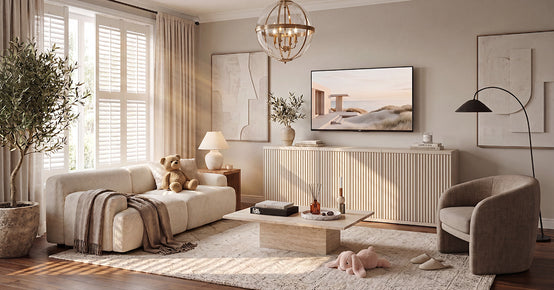
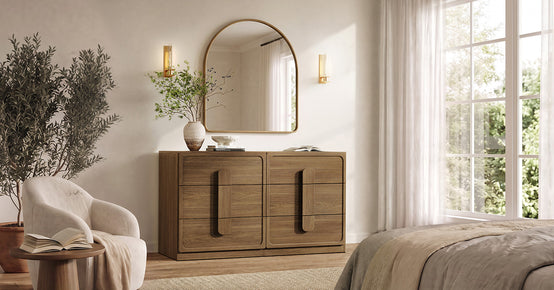
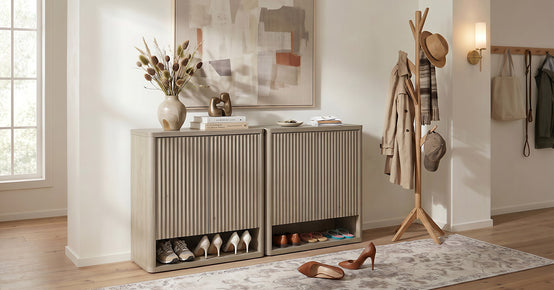
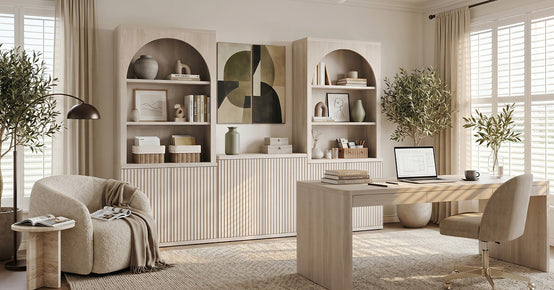
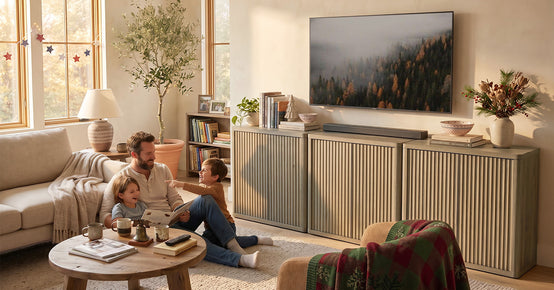
Texture shows up too. Reeded and fluted fronts appeared on some period pieces, and they are back in fashion. The Stria fluted sideboard with three drawers is one current take on that look.
Warm Wood Tones
Teak and walnut show up on most of these pieces, with rosewood on the rarer ones. Some makers threw in a bit of contrast too, and we're big fans of the black legs, brass pulls,s and white lacquer panels.
Mid-Century Sideboard Dimensions: What Size Do You Need?

No single standard size exists. Newer pieces mostly fit the width bands below, while older ones often run longer.
|
Sideboard Width |
Best For |
|
Under 48 inches |
Entryways, small dining rooms and apartments |
|
48 to 60 inches |
Everyday storage in most rooms |
|
60 to 72 inches |
Standard dining and living room walls |
|
Over 72 inches |
Large rooms, long walls and big collections |
Many 1960s British sideboards are five to seven feet long, and we've found short ones are hard to come by. For a small wall, we'd usually point you toward a new piece.
Height and Depth
Sideboard height usually lands between 28 and 36 inches. We'd go lower if the TV sits on top or the cabinet tucks under a window. Taller ones work better as a serving surface next to a dining table.
Depth is the number most people forget. Sideboard depth is usually 16 to 20 inches, and we'd go shallower in a narrow dining room.
One trick we always share: tape the footprint on the floor with painter's tape before you order. Leave it down for a day or two. If you keep stepping on the tape, it's too big.
Pick the Right Storage Layout
We always say to think about what goes inside first. A beautiful front won't help if your favorite serving platter doesn't fit behind the doors, and we see that happen more than you'd think.
Drawers

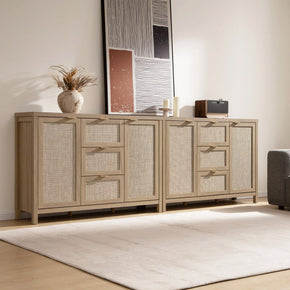
Drawers suit small, flat things. Flatware, napkins, placemats, remotes, and chargers end up there sooner or later. The Cas sideboard with drawers and doors gives you both kinds of storage in one piece, which we think suits most households.
Closed Cabinets

Doors are for the bulky stuff: plates, serving bowls, glassware and the board games nobody puts back properly. Adjustable shelves help a lot here, like the ones inside the Savanna two-door sideboard cabinet.
Sliding and Tambour Doors

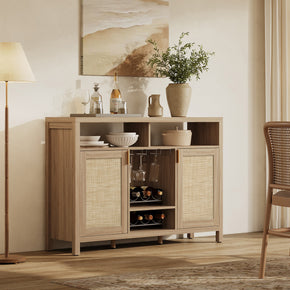
Sliding doors and roll-up tambour doors are classic mid-century features. They don't swing out, which helps when dining chairs sit close to the wall.
Open Shelves
We use open bays for books, ceramics, or a stereo. They look good. They also show the mess. We'd save them for things you enjoy looking at.
Teak vs Walnut vs Rosewood vs Oak: Which Wood Is Right?

People ask us which wood is best pretty much every week. Our honest answer: none of them wins on every count. We'd go with the color you'll enjoy over your morning coffee and how much polishing you'll realistically do.
Teak
Our team has a soft spot for teak, and we're clearly not alone. It's the wood you'll find most at estate sales, since British and Danish workshops used so much of it in the sixties. New teak is golden brown, and teak darkens with age until it's closer to honey.
It's naturally oily, so in our experience a wipe of teak oil twice a year is plenty.
Walnut
We tend to suggest walnut for darker, cozier rooms. It's more chocolate than honey, with the odd black streak, and we think a walnut sideboard looks great beside a gray sofa.
One thing we always warn people about: unlike teak, black walnut lightens with age in direct sun, so we'd keep it away from a bright bay window.
Rosewood
Rosewood is what collectors get excited about, and we see why in person. The grain is bold and swirly, and the color is deep reddish brown. Vintage pieces like the Arne Vodder sideboards made for Sibast usually sell well above a similar teak sideboard.
There's also a legal catch most guides skip. Brazilian rosewood is protected, and rosewood trade rules call for papers to sell or ship some pieces. Anything acquired before June 11, 1992 can usually still be sold in the US with paperwork proving the date.
Oak
Oak is the lighter option, and we like it in Scandinavian and Japandi rooms with white walls and linen. The grain is more open. It also shows dust less than walnut does, which we've found makes a real difference in homes with pets.
Solid Wood vs Veneer: What Really Matters
Some buyers tell us they want solid wood or nothing, and we understand the instinct. It's more complicated, though. Some of the best-known vintage sideboards are veneered, with a thin sheet of real wood glued over a steadier core.
We actually like good veneer, because it lets a maker run one unbroken grain pattern across four doors. That's hard to pull off with solid boards. The Forest Service's own research backs plywood cores up too: plywood's cross-layered veneers help limit how much a panel swells and shrinks.
|
Construction |
Strengths |
Check Before Buying |
|
Solid wood |
Can be sanded and repaired |
Cracks, warping and weight |
|
Wood veneer on plywood |
Stable with rich grain |
Chips or lifting at the edges |
|
Wood veneer on MDF or particleboard |
Smooth, stable and common |
Swollen edges and sagging shelves |
|
Printed finish on MDF |
Budget friendly |
Peeling and repeating fake grain |
Our habit is to skip the tag and check the drawers, the edges, and the weight. That tells us more about the build than any label.
Vintage vs New Mid Century Sideboards
Our team will always have a weak spot for an old piece with patina and a story. New has perks too, like exact sizes, smooth drawers, and an easy return if the color looks off at home.
What to Check on a Vintage Sideboard

• Maker marks inside a drawer or on the back, such as a G Plan stamp
• Dovetail joints at the drawer corners
• Drawers that slide straight without sticking
• Veneer that's flat (we walk away from bubbles or lifted edges, since water usually got in)
• Any water rings, sun fading, or a leg that rocks when you lean on the top
• Signs of heavy sanding, which can cut right through thin veneer
Patina is fine. We'd never sand away light fading or the odd glass ring on a sixty-year-old cabinet; to us, that's part of the charm. Peeling veneer, split panels and wobbly joints are a different story. We'd budget for a restorer if you see those.
Shipping a rosewood piece abroad is another matter. You might need a permit from the US Fish and Wildlife Service before it goes anywhere.
What to Check on a New Sideboard
Most new sideboards have MDF, particleboard,d or plywood in them somewhere, and we don't see that as a problem. What we'd look for is a TSCA Title VI label, usually on the back panel or the box. It means the composite wood met federal formaldehyde limits.
We also check shelf weight ratings, since thin shelves sag under dinner plates, and we look for anti-tip straps in the hardware bag, especially with kids or a climbing cat around.
Danish vs British Mid Century Sideboards
Danish furniture caught on outside Denmark in the mid-20th century, and its sideboards set the look for pretty much everyone else. Whenever we see a good Danish piece, the slim frame, carved-in handles, and very neat joinery stand out. Hans Wegner pieces cost the most.
British makers such as G Plan, McIntosh and Younger borrowed the idea and built it a bit chunkier. G Plan even hired Danish designer Ib Kofod Larsen for its Danish range. British pieces are often longer and easier to find.
Where to Use a Mid-Century Sideboard
Dining Room

The dining room is where sideboards started, and it's still where we see most of them. Plates and linens go inside, and on holidays the top becomes a buffet line for the roast and the pie. To plan the whole room, browse our dining room storage furniture.
Living Room and TV Wall

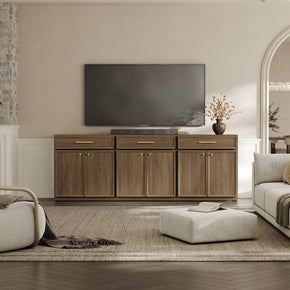
We think a long, low sideboard makes a great media console. Before you put a TV on one, check the top's weight rating and look for a cord hole in the back. The Prelude sideboard with doors is one we like for hiding game consoles and the blinking router.
Leave some breathing room around electronics, though, because they run hot in a closed cabinet.
Entryway, Office and Record Storage

A shallow sideboard by the front door catches keys, mail, and the dog's leash. In a home office we like one for hiding the printer. If you're storing records, bring a tape measure, since LPs need about 13 inches of clear height and depth inside.
How to Style a Mid-Century Sideboard

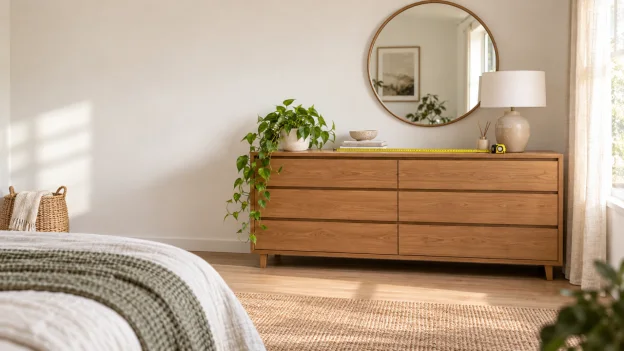
We keep the top light when we style one, since the grain is already busy enough. Usually that means a third of the top left clear, then one tall lamp beside a mid-size vase and a couple of books lying flat.
We like to finish with a round mirror or one piece of art centered above. With other wood in the room, matching the warm or cool undertone is enough.
Common Mistakes When Buying a Mid-Century Sideboard
• Falling for the look before measuring the wall
• Paying extra for "solid wood" without checking how it is built
• Ignoring inside shelf height, which decides what actually fits
• Trusting a G Plan or Danish claim with no label or proof
• Buying a vintage piece with sanded-through veneer
Final Takeaway
We don't think the oldest or longest sideboard is automatically the best. We'd go for the one that fits the wall, holds what you own, and survives years of drawers yanked open by kids, guests, and whoever's hunting for the bottle opener.
Measure before anything else, sort out your storage layout, and save the fun part, picking the wood, for last. Our mid-century style sideboards and credenzas make it easy to compare shapes and finishes once you've got your numbers.
FAQs
What makes a sideboard mid-century modern?
It's rarely one feature. We look for a few of these turning up together:
• Long, low shape
• Legs that taper or splay outward
• Warm wood like teak or walnut
• Flat fronts with simple or recessed handles
• Sliding or tambour doors on many models
What is the difference between a sideboard and a credenza?
Very little, in our view. Stores swap the two words all the time, and we've seen the exact same cabinet listed both ways. If anything, credenzas lean toward sliding doors and started out in offices, while sideboard is what most people call the one in the dining room.
What is a standard mid-century sideboard size?
There isn't one standard size. Most new pieces we come across are 48 to 72 inches wide, 28 to 36 inches tall, and 16 to 20 inches deep, but older British and Danish ones can run longer, sometimes past 80 inches.
How deep should a sideboard be?
We'd say 16 to 20 inches for most rooms. In a hallway or a tight dining room, we'd go down to 12 to 15 inches, so nobody squeezes past with a plate in each hand.
Can you use a mid-century sideboard as a TV stand?
Absolutely, and it's one of our favorite uses. Before the TV goes on, we check the top's weight rating, whether the screen will sit near eye level from the sofa, and how cords will get out the back. With small kids, we'd strap both to the wall.
Is teak or walnut better for a mid-century sideboard?
• Teak, if you like golden brown that slowly deepens toward honey
• Walnut, if you want darker, cooler tones and can keep it out of strong sun
• We honestly don't think either one wins. Both last decades with dusting and coasters, so pick the color you'd rather wake up to.
Are mid-century sideboards solid wood?
Most aren't, which surprises a lot of people. A good number of originals have real wood veneer over a plywood or chipboard core, with solid wood kept for the legs and edges. That was usually deliberate, since veneered panels moved less and the grain could be matched.
How can you tell if a vintage mid-century sideboard is real?
We'd start with the top drawer, pulled all the way out, then the back panel, since that's where makers like G Plan tended to stamp their name or add a paper label. Dovetailed corners, grain that matches across the doors,s and a reassuring heft are good signs too.


Looking for something else?
Bookcase Weight Capacity: How to Prevent Sagging Shelves
LEARN MORE
How Deep Should a TV Stand Be? A Guide for Consoles, Cables, and Ventilation
LEARN MORE
Are Soft-Close Dresser Drawers Worth It? A Practical Buying Guide
LEARN MORE
Best Nightstand Height and Placement for an Adjustable Bed
LEARN MORELooking for something else?

Why Adjustable Shelves Matter When Buying a Shoe Cabinet
LEARN MORE
How Wide Should a Sideboard Be Compared With Your Dining Table?
LEARN MORE
How Deep Should a Bookcase Be? Pick by Book Size and Room Clearance
LEARN MORE


Further reading
Dresser Dimensions Guide: Standard Width, Height and Depth by Type

Fluted Nightstand Guide: Meaning, Sizes, Styles and Care Tips


