

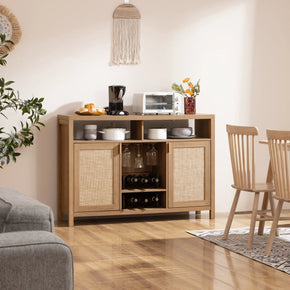



Shoe Cabinet vs Shoe Rack: Which Shoe Storage Option Is Better?
Shoes pile up fast. By the front door, on the closet floor, halfway down the hallway, where nobody put them on purpose. And when you finally decide to deal with it, two options keep coming up: a shoe cabinet or a shoe rack. They solve the same mess — just not the same way. A rack is about airflow and grabbing your shoes on the way out the door. A cabinet is about hiding the lot of it and making the entrance look like you've got it together. So “shoe cabinet vs shoe rack” isn't really a which-is-better question. It's a which-is-better-for-you question — your space, your pile of shoes, how tidy you actually need that entrance to look. Let's get into it.
What Is a Shoe Rack?

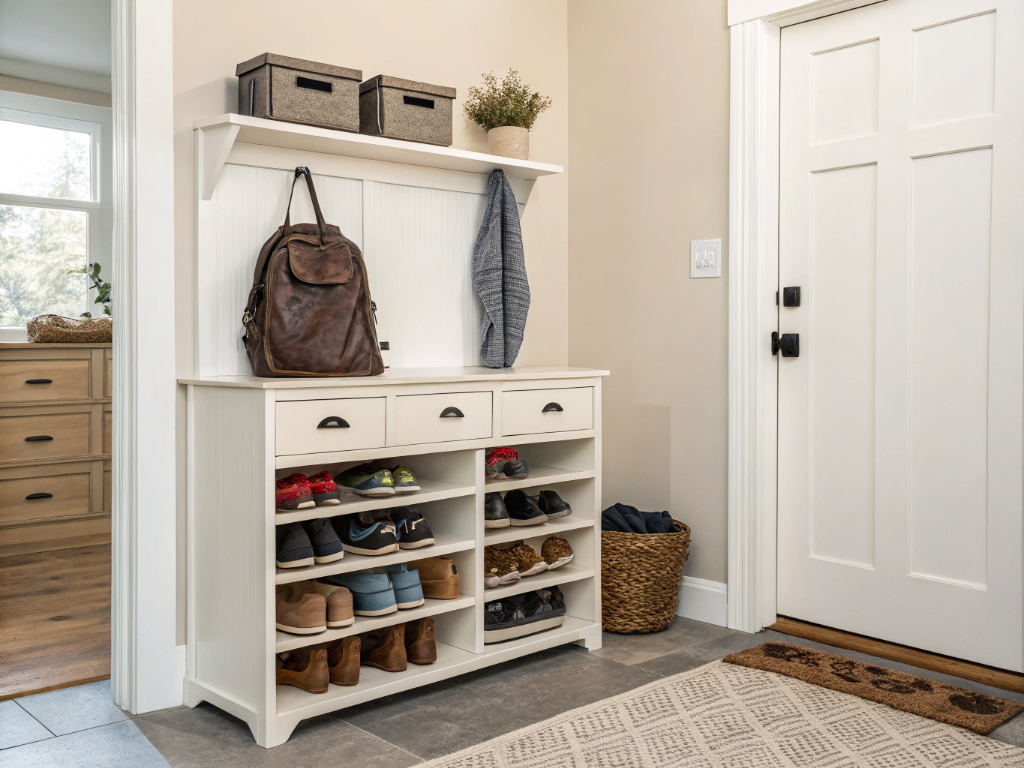
A shoe rack is open-frame storage — usually tiered — that holds your shoes out where you can see them and grab them. No doors. No drawers. Just shelves, basically.
Key Features of a Shoe Rack
Most racks are cut from the same cloth: open-shelf structure, lightweight, made of metal, wood, bamboo, or plastic. They're at their best with the shoes you actually wear — sneakers, slippers, the kids' stuff, whatever's in heavy rotation — and they'll go just about anywhere—closet, entryway, garage, bedroom, mudroom. The open design is the whole selling point, really. Air circulatesthrough the shoes, so a damp pair dries out rather than festering in a sealed box.
Best For
Go with a rack if you'd rather have convenience than concealment. If you rent or move a lot. If the budget's tight. Or if you're storing shoes that genuinely need to breathe. It's the no-fuss option, and there's nothing wrong with that.
What Is a Shoe Cabinet?

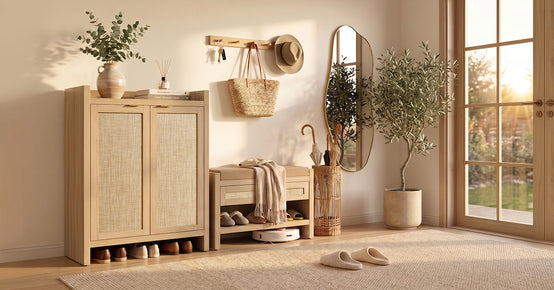
A shoe cabinet is the furniture version of the same idea — enclosed storage, doors or flip drawers or compartments, shoes completely out of sight. Think of it as a dresser, but for your feet. A Cas shoe cabinet with smooth-close doors is a good example of the breed: a closed front, shelves you can move around inside, and a finished look that reads as part of the room rather than as “storage.”
Key Features of a Shoe Cabinet
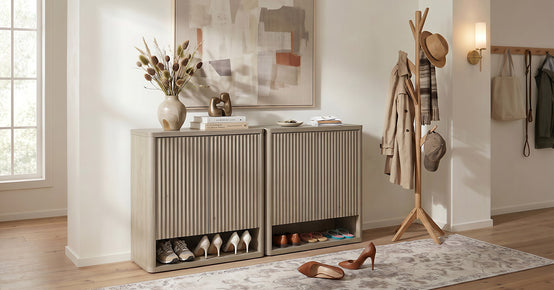
Cabinets are closed, or close to it. They hide shoes from view, they tend to double as actual hallway furniture, and they come in a handful of formats — tilt-out flip drawers, swing doors, adjustable shelves, sometimes a bench seat built right in. Two payoffs come with that. The shoes stay protected from dust. And the entryway loses the visual mess that was bugging you in the first place.
Best For
A cabinet suits modern homes, apartments, family entryways — anyone who just can't live with visible clutter. IKEA puts it well: a shoe cabinet keeps a hallway neat, clean, and calm by tucking the shoes behind doors. That's the whole appeal for design-minded buyers, right there.
Shoe Cabinet vs Shoe Rack: Quick Comparison Table

Before the detail — here's the fast version. The two are side by side, on the points that actually decide which one you buy.
|
Feature |
Shoe Rack |
Shoe Cabinet |
|
Structure |
Open shelves, no doors |
Closed doors or flip drawers |
|
Best for |
Daily access and airflow |
Hidden, tidy storage |
|
Ventilation |
Better — shoes air out |
Lower unless slatted or vented |
|
Appearance |
Casual, shoes visible |
Cleaner, more like furniture |
|
Dust protection |
Lower — shoes exposed |
Better — shoes shielded |
|
Cost |
Usually cheaper |
Usually higher |
|
Best placement |
Closet, mudroom, garage |
Hallway, entryway, living area |
|
Small-space use |
Good if it goes vertical |
Good if slim or tilt-out |
|
Cleaning |
Quick wipe-down |
Wipe shelves plus air the interior |
When a Shoe Rack Is the Better Choice

A rack wins any time function and access matter more than hiding the shoes away.
You Need Quick Daily Access
Rushing out the door, an open rack is just faster. No doors. No drawer to shuffle through. The pairs you wear every day sit there in plain sight, one grab and you're gone.
Your Shoes Need Airflow

Damp sneakers. Rain-soaked school shoes. Sweaty gym pairs. An open rack lets all of that dry out. Seal it into a closed cabinet instead, and you're basically asking for trapped moisture and the smell that comes with it.
You Want a Budget-Friendly Option
Racks are just cheaper—fewer panels, no doors, no drawer mechanisms to pay for. NYT Wirecutter put in more than 30 hours testing racks — stability, capacity, how easy they were to assemble — and the short version is that a sturdy, no-frills rack often does the job without the cabinet price.
You Rent or Move Often
Racks are light. They don't need wall mounting, they break down in minutes, and they move without a fuss. If you rent, or you're in a place that isn't forever, that matters more than it sounds.
You Need Closet Shoe Storage
Inside a closet, nobody's looking at the storage — so capacity wins over style, every time. A rack can be stacked, height-adjusted, and slid right under your hanging clothes. It organizes the space without touching how the room actually looks.
When a Shoe Cabinet Is the Better Choice

A cabinet wins whenever the storage is on display, and the space has to stay tidy.
You Want a Cleaner Entryway
Doors shut, clutter gone. That's simple. The entrance instantly looks like someone meant it to look that way — and that matters most when your front door opens straight into the living room with nowhere to hide.
You Have a Narrow Hallway

Slim and tilt-out cabinets stack shoes vertically while barely touching your floor depth. IKEA’s hallway storage guide makes the point that shallow cabinets are the go-to for tight entryways — they take back the wall without eating into the walkway you actually need.
You Need Dust Protection
An open rack leaves everything exposed — dust, pet hair, and sun. A cabinet shields it all, which makes it the obvious pick for shoes you don't wear often and want to find clean when you finally do.
You Want Storage That Looks Like Furniture

A cabinet gives you a surface. Mirror, lamp, a tray for keys, a plant — suddenly it's earning its spot. The Savanna 2-door shoe cabinet for up to 24 pairs is built for exactly that double life: real capacity behind doors that actually look good sitting in a hallway.
You Have a Family Shoe Pile
More people, more shoes — and it adds up fast. A cabinet hides everyone's pairs behind one clean front, so a household of four doesn't turn into a four-person heap by the door every single evening.
Open Rack vs Closed Cabinet: What’s the Real Difference?

The obvious answer is open versus closed. But it runs deeper than that — it comes down to airflow, what you can see, how you clean it, and how fast you can get at your shoes.
Open Rack
An open rack is built for one set of things: visibility, airflow, fast access, and low price. It's a practical organizer and nothing more — and honestly, that's the point of it.
Closed Cabinet
A closed cabinet is built for a different set: visual calm, dust protection, design continuity. It's an organizer and a piece of furniture at once, pulling double duty.
Semi-Open Options

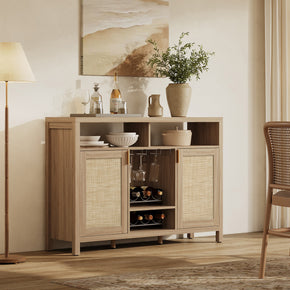
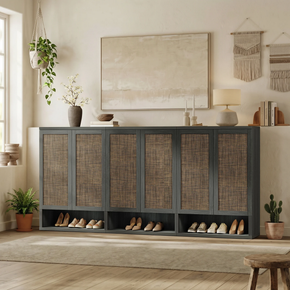
And then there's the middle ground, which people forget exists. Slatted doors. Rattan fronts. Ventilated cabinets, open cubbies. These hybrids hand you some concealment without fully sealing the shoes off from air — a sensible compromise if you genuinely can't pick a side.
Shoe Cabinet vs Shoe Rack for Small Spaces

This is where most people are actually shopping. Small entryways, tight hallways, apartments. And the answer shifts depending on the exact spot.
Best for Narrow Hallways
A slim cabinet usually takes this one. It sits close to the wall, hides the shoes, and keeps a narrow hallway from feeling cramped and messy at the same time, which a rack full of visible shoes can't quite manage.
Best for Small Closets
Inside a small closet, the rack wins more often than not. It stacks, it adjusts for height, it slides under your hanging clothes — it squeezes storage out of space a cabinet would just waste.
Best for Studio Apartments
Depends on what's visible. If the entryway is part of the living area, go cabinet — keep the shoes hidden. If the shoes live in a closet, a rack is completely fine. Nobody's seeing it.
Best for Tiny Entryways
For the genuinely tiny entrance, consider a wall-mounted cabinet, a really narrow rack, or a compact shoe bench that adds a seat without much else.
Shoe Cabinet vs Shoe Rack for Different Shoe Types

What you own should drive what you buy. Different shoes want different things.
Sneakers
A rack handles daily sneakers fine. But for a real collection, drop-front boxes or a cabinet protect them better — The Container Store leans on modular drop-front boxes for exactly that reason: pairs stay visible and dust-free, and you don't unstack the whole tower to get one.
Boots
Boots need height, and they need air. A rack, a boot tray, or a proper boot rack usually beats a shallow cabinet — tall boots won't sit nicely in low compartments, and they slump out of shape if you crush them.
Heels
Open shelves and angled racks display heels and keep them easy to grab. A cabinet keeps the dust off if you wear it rarely. Either works — it just comes down to how often the heels actually come out.
Kids’ Shoes
Open racks and baskets win for kids. Low, visible, and easy enough that a child will actually put their own shoes away. A fiddly cabinet? It just won't get used, and you'll be back to the pile.
Formal Shoes
The formal pairs you wear a few times a year belong in a cabinet or a box. Closed storage keeps them clean between the rare outings — that's the entire job.
Shoe Cabinet vs Shoe Rack for Style and Home Decor

Function aside, the two send completely different style signals. A cabinet suits modern, minimalist, polished rooms — it reads as furniture, not storage. A wood rack fits natural or casual spaces. A metal rack belongs in the garage, the mudroom, the utility room, anywhere toughness beats good looks. Rattan or slatted cabinets split the difference, difference, and ventilation in one. And here's the thing, a cabinet gives you that a rack doesn't — a top surface. Style it with a mirror, a tray, a lamp, and a plant. Just don't overcrowd an open rack if the area's visible from the living room, because a crammed rack quietly undoes the whole tidy look you were chasing.
Shoe Cabinet vs Shoe Rack for Families

Families need two things that storage usually makes you choose between: capacity and speed. More people, more pairs — and a cabinet hides that volume far better than an open rack ever will. But the rack speeds up the morning scramble. So the honest answer for most households is a hybrid—a cabinet for the bulk, a rack or a tray for the daily pairs. Give everyone a shelf, basket, or compartment of their own, and keep the kids' shoes low where they can reach them. For a busy entryway, something like the Savanna shoe bench with a seat and concealed storage also gives you somewhere actually to sit while everyone gets their shoes on — and with kids underfoot, trust me, that's not a small thing.
Hybrid Shoe Storage: When You Need Both

Plenty of homes don't have to pick a side. The smartest setups just combine the hidden storage with the easy-access kind.
Entryway Cabinet Plus Daily Shoe Tray
Cabinet for the bulk of the shoes, a small tray for the wet or daily pairs. The entrance stays clean — but you're not opening a door every single time you leave the house.
Closet Rack Plus Hallway Cabinet
A rack inside the closet for the overflow, a cabinet near the front door for whatever's in rotation. Out-of-sight storage and on-display storage, each one doing the job it's actually good at.
Shoe Bench Plus Cabinet
For families and mudrooms, pair a shoe bench with a cabinet — seating, hidden storage, capacity, all in one corner. The best shoe organization setup usually isn't a single product. It's the right combination of them.
How to Choose Between a Shoe Cabinet and a Shoe Rack

Run any contender through this checklist before you commit to anything.
Count Your Shoes First
Don't buy storage before you know how many pairs have to fit. It's the step everyone skips — and it's the one that decides whether you bought the right size or the wrong one.
Measure the Space
Width, depth, height. Then the bits people forget — door swing, drawer clearance, how much hallway you actually need left to walk through. Measure first. Fall in love second.
Think About Ventilation
Damp shoes need air. If you're storing wet or frequently worn pairs, lean toward an open rack or a ventilated, slatted-front cabinet — not a fully sealed one.
Decide Whether You Want Shoes Visible
Honestly, this one question settles most of the debate. If visible shoes genuinely bother you, get a cabinet. If you don't mind seeing them, a rack's fine. That's it.
Check Stability and Capacity
Wobble is the number one complaint about cheap racks. Look for a sturdy frame, joints that hold, and an honest pair count. Storage that dumps your shoes on the floor isn't storage — it's a problem you paid for.
Match the Storage to the Room

A hallway wants a polished cabinet. A closet wants a rack. A garage wants tough metal shelving. Match the piece to where it's going. And for a bigger, modern entryway that needs serious capacity, a Zura modular shoe cabinet set scales up the whole cabinet approach without losing that clean, furniture-like look.
Maintenance Tips for Shoe Cabinets and Shoe Racks

A bit of upkeep keeps either one working for years. For a rack: wipe the shelves now and then, put a tray under wet shoes, don't overload it, and rotate pairs so nothing sits crushed. For a cabinet: clean the inside of the compartments, air it out occasionally, drop in an odor absorber — charcoal, baking soda, whatever — and never, ever shut wet shoes in a sealed cabinet. For both: clean shoes before they go away, sort by season, and let go of the pairs you never actually wear. Storage always works better when there's just less of it to deal with.
Final Verdict: Which One Should You Choose?
Go with a shoe rack if you want affordable, open, easy-access storage that lets your shoes breathe — it's the right call for closets, mudrooms, and the pairs you wear daily. Go with a shoe cabinet if you want a tidy, polished entryway where shoes are hidden and protected. And if you've got a busy household, honestly? Get both. A cabinet for the hidden bulk, a rack or tray for whatever's in rotation. The shoe cabinet vs shoe rack thing was never really about which one is better. It's about matching the storage to your space, your pile of shoes, and how you want that entrance to feel the second you walk through the door.
FAQs
Is a shoe cabinet or a rack better?
Neither one wins outright — it depends entirely on the home. A cabinet is better for hidden, tidy entryway storage and keeping dust off. A rack is better for airflow, fast access, and a lower price. And for many households, the real answer is both: a cabinet for most shoes, a small rack or tray for the daily pairs.
Is it okay to keep a shoe rack in the entrance?
Yes — as long as it isn't blocking the doorway or the path you walk through. For a cleaner look, a slim cabinet or a neat rack beats letting shoes pile up loose. Keep it to one side of the entrance. Not dead in the way.
Where should a shoe rack be placed as per Vastu?
Some Vastu sources point to the west or southwest of the home for a shoe rack and advise steering clear of the north, northeast, and east zones. Woodsala lays this out as traditional guidance — worth knowing if it matters to you, though it's a custom, not a hard design rule.
Where to put shoes at the entrance?
To one side of the entrance — never straight in the walking path. Use a cabinet, a rack, a tray, or a bench, whatever the space allows. And wet or muddy shoes? Those sit on a tray or a mat until they're dry. Not straight into a closed cabinet, or you'll regret it.
What is the difference between a rack and a cabinet?
A rack is open shelving — no doors, shoes on show. A cabinet is enclosed and has doors, drawers, or compartments. Racks are about access and airflow; cabinets are about hiding the mess and looking clean. That's the whole difference, and every other trade-off between the two falls out of it.
Are shelves cheaper than cabinets?
Usually, yeah. Open shelves and shoe racks cost less — fewer panels, and no doors, hinges, or drawer mechanisms to pay for. Cabinets run higher because they're more furniture-like, and all those doors and flip drawers add to the build.
What are the three types of cabinets?
For home storage in general, the three common cabinet types are base, wall, and tall. For shoe storage specifically, it's flip-drawer cabinets, door-front cabinets, and bench-style cabinets — each one suited to a different entryway and a different amount of space.
What is the difference between an open rack and a cabinet?
An open rack displays shoes and lets air circulate freely around them. A cabinet hides shoes and shields them from dust and sun, but it may need airing out so odors don't get trapped. Open rack: access and airflow. Cabinet: concealment and protection. Pick the trade you'd rather make.
Sources
1. IKEA, global home furnishings retailer, IKEA — Shoe Cabinets
2. IKEA, global home furnishings retailer, IKEA — 7 Shoe Storage Ideas for a Tidy Hallway
3. The Container Store, home organization and storage retailer, The Container Store — Boot and Shoe Storage
4. NYT Wirecutter, independent product review publication, NYT Wirecutter — The Best Shoe Rack
5. The Spruce, home and lifestyle publication, The Spruce — 36 Clever Shoe Storage Ideas to Tidy Up Small Spaces
6. Woodsala, home furniture and decor resource, Woodsala — Vastu Tips for Placing a Shoe Rack
7. Better Homes & Gardens, home and lifestyle publication, Better Homes & Gardens — Woven Storage Materials and Home Organization


Looking for something else?

Furniture Materials Guide: Picking the Right Material Room by Room
LEARN MORE
How to Mix Wood Tones Without Making a Room Look Mismatched
LEARN MORE
18 College Apartment Furniture Ideas That Save Space and Money
LEARN MORE
Types of Entertainment Centers: 11 Designs and How to Pick One
LEARN MORELooking for something else?

Curio Cabinet Decor Ideas: How to Style a Display Cabinet Without the Clutter
LEARN MORE
Curved Furniture: How to Style, Measure, and Buy It in 2026
LEARN MORE
What Is Rattan Furniture? A Buyer Guide to Types and Care
LEARN MORE


Further reading

How to Choose a Nightstand for a CPAP Machine

How to Choose a Shoe Cabinet for Men's Sizes, High-Tops, and Bulky Shoes


