Bookcase Weight Capacity: How to Prevent Sagging Shelves
TeamSICOTAS
TeamSICOTAS
0 comment

Bookcase Weight Capacity: How to Prevent Sagging Shelves

The Short Answer

Every shelf has a breaking point, and it comes down to four things: what the board is made of, how thick it is, how far it stretches between supports, and what holds it up. Get those four right and the headline capacity takes care of itself. Get them wrong, and no headline number on the listing will save your books.
At a Glance
Judge per-shelf strength, not the big total on the listing. Shorter spans, thicker shelves, and stiffer materials (plywood or solid pine over plain MDF) carry far more before sagging. Heaviest items go on the bottom, tall units get anchored to the wall, and if a bookcase won't tell you its shelf specs, walk away.
Confession: I used to shop bookcases the same way most people do — height, width, does the finish match the coffee table. Shelf capacity? Never crossed my mind. Then the books went in, and about a year later the middle shelf had this gentle, unmistakable bow. Once a shelf takes a set, it never straightens back out. So read the bookcase the way it actually fails: one shelf at a time.

Per-Shelf Rating vs Total Capacity

"500-pound capacity" sounds like plenty. Until you remember that's spread across five shelves and a cabinet base, and the number that actually touches your books is the per-shelf rating — how much a single shelf takes before it starts bowing. Two bookcases with the exact same total can act like completely different animals once you actually load them up.
Books are heavy in a way people underestimate. One foot of tightly packed hardcovers can run 20 pounds or more. One collector weighed 40 cm of large hardback histories and got 21 kg — roughly 46 pounds on less than sixteen inches of shelf. Load three shelves like that and you've got about 140 pounds on boards that might be rated for way less.
  • Per-shelf first, total second. If the listing only gives a total, divide it by the shelf count — then treat the honest limit as lower, since those totals are usually tested under perfect conditions.
  • Published ratings are all over the map. Flat-pack shelves commonly carry 10 to 30 kg per shelf depending on material and span, and the solid-wood units sit higher up that range.
  • SICOTAS lists overall dimensions, unit weight, materials, and hardware for its bookcases. Use those numbers plus the span and material rules below instead of leaning on one headline figure.

Span: The Measurement That Matters Most

One number. If you take one number from this guide, take span — the unsupported distance between a shelf's supports. Sag climbs fast as span grows: a shelf that sits flat at 60 cm can bow visibly at 90 cm. I've watched a wide 80 cm case sag under one row of paperbacks while two narrow 40 cm units with the same books stood straight for years.
The math backs it up. Kamba's shelf-capacity reference measures load per metre of shelf: light decor about 10 kg per metre, a normal row of books about 30 kg per metre, packed books or vinyl records about 60 kg per metre. An 80 cm shelf therefore carries roughly 8, 24, or 48 kg at those levels — but only if the shelf is stiff enough to hold its shape first. Their rule for an unsupported 18 mm MDF shelf: light decor only to about 68 cm of width, a normal row of books only to about 47 cm.
Shelf width
Light decor (~10 kg/m)
Row of books (~30 kg/m)
Packed books or records (~60 kg/m)
60 cm (24 in)
6 kg
18 kg
36 kg
80 cm (31 in)
8 kg
24 kg
48 kg
100 cm (39 in)
10 kg
30 kg
60 kg — expect visible sag in MDF
Read that as load, not permission. The heavy stuff goes on the shorter spans. Prefer narrower cases, or ones with a center divider that splits one long span into two short ones. Every bookcase in the current SICOTAS range runs around 30 to 36 inches wide with five shelves — a moderate span — and all ship with adjustable shelves plus an anti-tip kit in the box.

Material and Thickness

Second lever: material. Kamba's testing puts plywood and solid pine at roughly six times the stiffness of MDF at the same thickness. No wonder sagging threads all tell the same story — nearly always the same trio: particle board or MDF, a wide span, and a full load of books.
Most bookcases at this price level are engineered wood, SICOTAS included, and engineered wood behaves a lot like MDF. That's fine for normal book loads at moderate spans — just respect the span guidance instead of fighting it. Thickness helps too, but it can't rescue a span that's twice too long.
  • Engineered wood / MDF: fine for books at moderate spans; get nervous with wide shelves and very heavy loads.
  • Plywood or solid pine: roughly six times stiffer than MDF — the safest bet for a serious, heavy collection.
  • Don't sleep on the back panel. A sturdy back braces the whole case against racking; a paper-thin back that arrives rolled in a tube braces absolutely nothing.

Fixed vs Adjustable Shelves

This one surprises people. Fixed shelves get glued or screwed into the sides, which stiffens the entire cabinet — every fixed shelf works like a brace holding the sides apart. Adjustable shelves just sit on pins and add zero structure. So the strongest common setup is the hybrid: one or two fixed shelves (usually top and bottom) locking the box together, adjustable ones in the middle for flexible spacing.
Then check the pins themselves. Metal beats plastic. Four per shelf beats two. Pins in metal sleeves beat pins wobbling in bare holes. And the forum veterans' trick for extra strength: screw a 25 by 38 mm batten under the shelf, long dimension vertical. It's ugly underneath and nearly doubles the stiffness — for the price of a strip of wood.
The Pin Test
Pull one shelf out — in the showroom, or mentally from the manual. Metal pins, four per shelf, seated firmly: that is the setup that holds. Plastic pins in bare holes on a tall case meant for books is the first thing you will end up upgrading.

Where Heavy Items Should Go

Low. Heavy books, records, and photo albums live on the lowest shelves, and it's not even a close call. It drops the center of gravity so the case is more stable. Bottom shelves are usually fixed or sit closest to the base frame — the strongest part of the case. And any slight deflection down low is way less visible than the same bow at eye level.
Collectors get records wrong all the time: they are among the densest things people shelve, and a full cube of LPs can top 30 kg. Give them a short, low shelf, and don't stack them two deep — the back row becomes unreachable and the load doubles without you noticing.
  • Bottom shelves: heavy books, records, albums — the dense stuff.
  • Middle shelves: everyday books, the ones you actually reach for.
  • Top shelves: light decor, plants, framed photos — things you dust twice a year.

Anchoring Counts as Capacity

Nobody wants this thought: a bookcase's weight capacity is meaningless if the case itself tips over. Tall bookcases are top-heavy by design, and a full top shelf only makes it worse. Every SICOTAS bookcase ships with an anti-tip kit in the box — use it. Into a stud if you can find one, the correct wall anchor for your wall type if you can't.
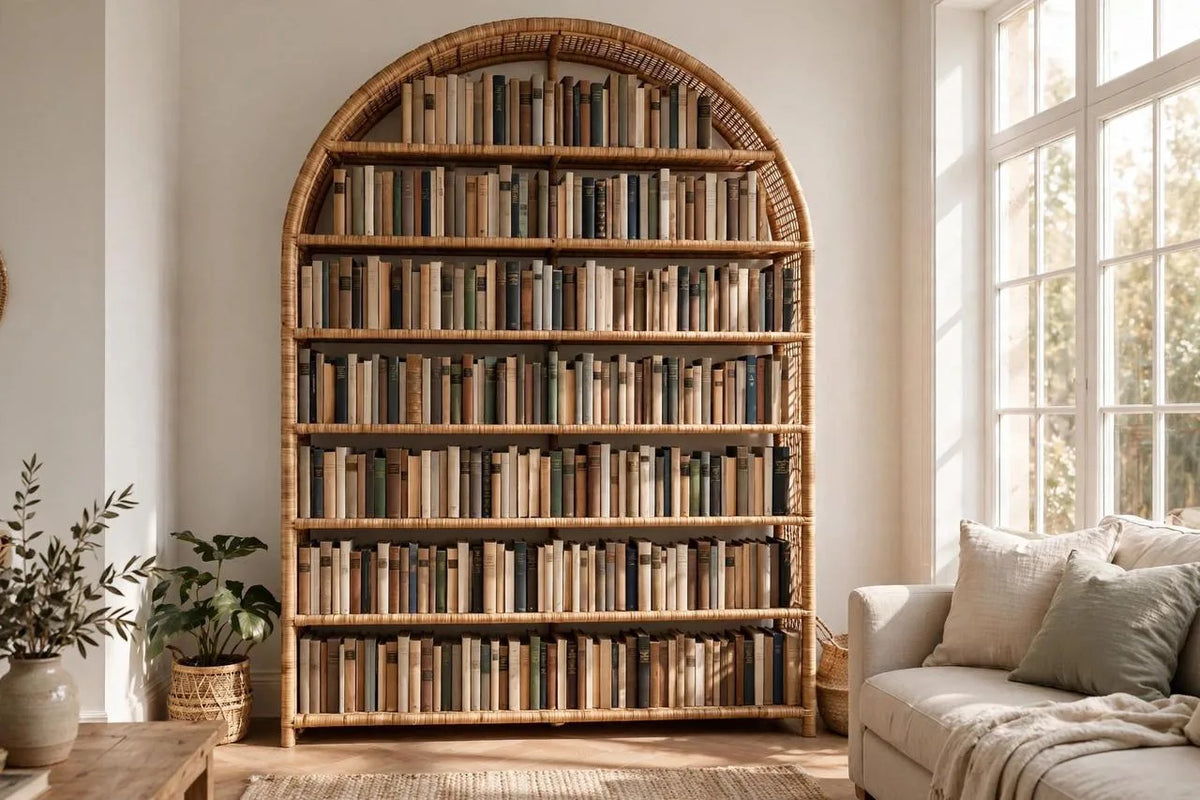
The Savanna Arched at 84.2 inches weighs 114 pounds empty — loaded with books, that can double. Anchoring takes about fifteen minutes: the cheapest safety upgrade in furniture.

Red Flags When You Are Shopping

Ninety seconds on the listing page. Run through these:
  1. No shelf specs at all. If the listing won't state per-shelf rating, material, or thickness, assume the worst and keep scrolling.
  2. Very wide shelves — over about 90 cm (36 in) — with no center support, in MDF or particle board. That's a sag guarantee, not a risk.
  3. Plastic pins, two per shelf, on a tall case marketed for books. The hardware tells you exactly what the maker thinks of the load.
  4. A total-capacity headline with no per-shelf breakdown anywhere on the page.
  5. No anti-tip hardware mentioned. Every serious bookcase includes it now; its absence says plenty.
  6. A paper-thin back panel. If the back arrives rolled up in a tube, it's decoration, not bracing.

Match the Bookcase to Your Contents

Count your heavy shelves — packed books, records, oversized art books — versus your light ones — paperbacks, decor, plants — then check the shortlist below. Every model has five shelves, adjustable shelving, and an anti-tip kit included.
Model
Overall (W x H x D)
Shelves
Closed storage
35.5" x 84.2" x 16.1"
5, adjustable
None — open display
35.5" x 84.2" x 16.1"
5, adjustable
2-door cabinet base
33.3" x 77.6" x 12.5"
5, adjustable
2 fluted doors
32.3" x 82.2" x 13.8"
5, adjustable
2-door cabinet
30.7" x 70.9" x 14"
5, adjustable
2-door cabinet base
Heavy vinyl collection? The shorter spans and lower profile win — the Savanna 5 Shelf at 70.9 inches keeps the center of gravity low. Mixed library? The tall arched models work, heaviest volumes down low. Door models hide clutter while open shelves show off the good stuff.
Browse the SICOTAS bookcases collection to match a model to what you own.

FAQs

How much weight can a bookcase shelf hold?
Short answer? It depends — on span, material, and thickness. As a ballpark, flat-pack shelves are commonly rated 10 to 30 kg per shelf, and the Kamba guide measures load per metre: about 10 kg/m for light decor, 30 kg/m for a normal row of books, 60 kg/m for packed books or records. Look for the per-shelf figure on the product listing or in the manual, and go conservative on wide MDF spans.
How do I stop my bookshelf shelves from sagging?
Shorten the span, stiffen the shelf, or lighten the load — ideally all three. Shift heavy books to shorter or lower shelves, add a center support, or screw a 25 x 38 mm wooden batten under the shelf with the long dimension vertical — the forum-favorite spine trick. And for the next purchase: narrower cases, thicker shelves, stiffer materials like plywood or solid pine.
Should heavy books go on the top or bottom shelf of a bookcase?
Bottom. Every time. It lowers the center of gravity so the case is more stable, the bottom shelf is usually the strongest part of the case, and any slight deflection barely shows down low. Top shelves are for light decor and plants.
What is the best shelf material that won't sag under books?
Plywood and solid pine — the testing Kamba references puts them at roughly six times the stiffness of MDF at the same thickness. Engineered wood (MDF/particle board) is fine for normal book loads at moderate spans, but keep it away from wide unsupported spans.
How thick should a bookshelf shelf be to hold heavy books?
Thicker beats thinner, sure — but thickness alone can't rescue a span that's too long. An 18 mm MDF shelf is generally only trusted to about 47 cm of width under a normal row of books, per the Kamba reference. For heavy collections, stack the odds: decent thickness plus short spans plus stiff material. All three, not just one.
Do I need to anchor my bookcase to the wall?
Yes — especially the tall ones. A loaded tall bookcase is top-heavy and can tip with real force behind it. Every SICOTAS bookcase ships with an anti-tip kit; put it into a stud, or use the correct wall anchor for your wall type. Fifteen minutes of work, worth every second.
How do you fix a sagging bookshelf shelf without replacing it?
Unload it first — non-negotiable. Then add stiffness underneath: a wooden batten screwed along the underside (long dimension vertical), a center support bracket, or vertical battens fixed to the back panel screwed through into the shelves. Then redistribute the load — heaviest items to the bottom — or the sag will just come back.
Are SICOTAS bookcase shelves adjustable?
Yes. All five bookcases in the current SICOTAS bookcases collection — the Savanna Arched, Stria, and Cas models included — have five adjustable shelves, and every unit includes an anti-tip kit backed by a 360-day replacement warranty.


Looking for something else?

20 Small Media Room Ideas for a Cozy, Space-Smart Setup

20 Small Media Room Ideas for a Cozy, Space-Smart Setup

LEARN MORE
18 Jewelry Storage Ideas for a Tangle-Free Collection

18 Jewelry Storage Ideas for a Tangle-Free Collection

LEARN MORE
10 Coffee Table Alternatives That Work Better in Small Living Rooms

10 Coffee Table Alternatives That Work Better in Small Living Rooms

LEARN MORE
15 Home Theater Furniture Ideas That Make a Room Work

15 Home Theater Furniture Ideas That Make a Room Work

LEARN MORE

Read more from Blogs

Looking for something else?

Open vs Closed Floor Plan: Which Layout Suits Your Home?

Open vs Closed Floor Plan: Which Layout Suits Your Home?

LEARN MORE
Whitewashed Wood Furniture: Getting the Finish Right at Home

Whitewashed Wood Furniture: Getting the Finish Right at Home

LEARN MORE
18 Accent Table Decor Ideas That Work in Real Rooms

18 Accent Table Decor Ideas That Work in Real Rooms

LEARN MORE

Read more from Blogs

You may also like

Savanna Console Table
$149.99
-4%
Savanna Shoe Cabinet, 2 Doors
Regular price $239.99 Save 4% Sale price $229.99
Cas Black Shoe Cabinet Entryway
$259.99
-12%
Cas Shoe Cabinet with Storage
Regular price $294.99 Save 12% Sale price $259.99
-12%
Savanna Entryway Bench
Regular price $169.99 Save 12% Sale price $149.99
-3%
Savanna Tall Shoe Cabinet,30 Pairs Shoes
Regular price $319.99 Save 3% Sale price $309.99

Further reading