Why Adjustable Shelves Matter When Buying a Shoe Cabinet
TeamSICOTAS
TeamSICOTAS
0 comment

Why Adjustable Shelves Matter When Buying a Shoe Cabinet

“Holds 24 pairs” looks like a promise on the listing. Unbox it, stand your knee-highs upright, and not one slot clears them. So the boots camp on the floor beside it. Clutter: officially back.
Those pair counts cheat — they measure flats, flats, and more flats. Your closet runs sneakers, heels, ankle boots, and one tall pair begging for vertical room. Only adjustable shelves swallow that whole mix, because you set every shelf yourself. This guide: measure shoes by height, read the hole spacing like a spec sheet, steal the boot-mode trick, and run the pair-count math with your eyes open.

Your wardrobe audit: count shoes by height, not by pairs

Close the tabs. Stand in front of your actual shoes and count height, not pairs — pair counts flatter, height never lies. A shelf clears your tallest boot or it doesn’t. No angle, no squinting, no loophole.
Pull out everything headed for the cabinet — boots included — and sort it into height piles. Flats, sneakers, heels, ankle boots, tall boots. Measure the tallest in each pile, heel to top: five numbers, that’s your shelf map. Then count pairs per pile, because the tall pile eats space like it pays no rent.
My rule: the two tallest piles are always the problem. Every single time. Fixed shelves hand you five identical slots and dare the boots to fit. Adjustable ones hand you the whole vertical box and say: your call.

Shelf height math: how much room each shoe really needs

The formula is dead simple and never changes: shoe height, plus an inch for your fingers, plus whatever the shelf above steals. Run every pair through it and you get this:
Shoe type
Typical shoe height
Shelf clearance to allow
Flats and sandals
3-4 in
4.5 in
Low sneakers
5-6 in
7 in
High-top sneakers
7-8 in
8.5 in
Pumps and block heels
7-9 in
9.5 in
Ankle boots
9-11 in
11.5 in
Knee-high boots
15-17 in
Remove a shelf (see boot mode)
Spot the cliff at knee-high? Everything up to ankle boots behaves on a normal shelf. Knee-highs want double — that cliff is the entire reason adjustable shelves exist. A forum poster nailed it: his mid-height boots needed nine inches of clearance, and the fixed shoe boxes on his shortlist simply couldn’t deliver.

Hole spacing: the spec nobody reads

Adjustability lives in the holes — little rows drilled up both side walls, pins dropping in, shelves resting on the pins. The gap between holes is your tuning knob. Most cabinets drill them 1.25 to 2 inches apart. The good ones hit 4.5 cm — a hair under two inches — and strangle nearly all the dead air.
Nitpicking? Run the numbers. Sit one sneaker shelf a single hole too high and you’ve burned two inches of dead air above every pair, across four shelves — most of a shelf, vaporized. Tight spacing lets every shelf hug its shoes. When you shop: zoom the interior photos and count holes. More holes, more control.
While you’re zoomed in, hunt a per-shelf weight rating. Boots are the heaviest thing in most homes, and four pairs of leather boots on one shelf is genuine labor. A listing that prints “3 kg per shelf” actually tested its pins and panels. No number anywhere? Bottom shelf takes the heavy stuff — down there the cabinet frame carries the load.

Removable divider vs adjustable shelf: not the same thing

Listings mash these two together, so cut it straight. A removable divider is a vertical panel splitting one shelf into sections. It stops pairs toppling sideways; pull it out when you want the full width back. Height? Never touches it. An adjustable shelf is the horizontal panel you slide up and down to set clearance. Dividers fix sideways mess. Shelves fix vertical fit.
Mixed wardrobe answer: adjustable shelves everywhere, plus a divider or two on the low levels where flats and sandals start wandering.
Read “removable shelves” carefully before you buy. Does the shelf lift out completely, or just slide between holes? Both help. Only the full pull-out unlocks boot mode — the one you actually want for knee-highs.

Boot mode: giving boots a full-height bay

“Boot mode” is what owners call it: yank one shelf, keep a double-height bay for tall boots. Five minutes of work, done once:
Empty the shelf you are pulling. Lift it off the pins and stash it somewhere flat — cabinet floor, behind another shelf — it waits there until the seasons change. Stand your tallest boots upright in the fresh bay; knee-highs ask roughly 17 inches. Build the bay at the bottom: boots are heavy, low weight keeps the cabinet planted. Then set the shelf above it for the next-tallest group — usually ankle boots or heels.
Upright is the whole game. It keeps the boots’ shape. Fixed shelves force people to lay boots sideways, which burns the boot’s full length and creases the shaft. Boot mode deletes that workaround entirely.

Reconfiguring when your collection changes

Here is where fixed shelves die: wardrobes never sit still. Winter drags in boots, summer swaps to sandals, kids jump a size every few months. Fixed shelves punish every change. Adjustable ones swallow all of it in about ten minutes.
Clear the shelf. Pop four pins out of their holes, push them into the new row at your target height, drop the shelf back down. Shoes on. Finished.
Twice a year with the seasons and the cabinet never fights back. One SICOTAS review said it best: every shelf adjustable, so his boots, her boots, and the toddler’s shoes all landed in one unit — and the layout kept shifting as the family changed. That sentence is the whole pitch. The cabinet grows up with the wardrobe.

The capacity tradeoff, with honest numbers

Now the part listings bury. A tall boot bay eats the vertical space of two normal shelves. Headline count drops — no way around it. Take a cabinet rated 24 pairs across six adjustable shelves, open one double-height bay for knee-highs, and you land near 18 to 20 real pairs. One level, gone.
Stings — until you meet the alternative. That 24-pair sticker assumes flats on every level. Cram four tall boots into a fixed-shelf cabinet and real capacity becomes 24 minus the boots now living on your floor. Adjustability trades a few sticker pairs for a cabinet that actually takes your wardrobe. That trade wins, every time.
Flip it around: zero tall boots at home? Run tight 4.5-inch levels top to bottom and you can beat the sticker number, since it assumed average spacing. Adjustable shelves don’t cap your capacity — they hand you the dial. Maximum pairs on one end, maximum fit on the other.
My rule of thumb
a 24-pair cabinet holding YOUR 24 beats a 30-pair cabinet holding thirty strangers’ flats. Buy for your tallest shoe first. Let the pair count catch up.

Shoe cabinet comparison grid

Current SICOTAS shoe cabinets below, dimensions verified off the product pages. Stack your audit numbers from section one against each cabinet’s height and width — your tallest shoes, your wall. Where a row doesn’t state the adjustability detail, open that product page before you buy.
Cabinet
Dimensions (W x H x D)
Pairs
Doors
Best for
Savanna Shoe Cabinet, 24 Pairs
32.4 x 41 x 14.8 in
24
2 rattan
Mixed wardrobe; 6 adjustable shelves verified
Savanna Shoe Cabinet, 30 Pairs
47.24 x 40.94 x 14.76 in
30
3
Large family collection, wide wall
Terra 3-Door Shoe Cabinet
45.59 x 38.98 x 14.17 in
See PDP
3
Wide, lower-profile entryway
Terra Black Shoe Cabinet, 2 Doors
31.49 x 38.97 x 14.17 in
See PDP
2
Narrow hallway, compact footprint
Cas Shoe Cabinet with 3 Doors
47.2 x 44.5 x 14.5 in
See PDP
3
Tallest option at 44.5 in high
Cas Shoe Cabinet with Doors
See PDP
See PDP
Doors
Black entryway; adjustable shelf verified

Which cabinet fits your wardrobe

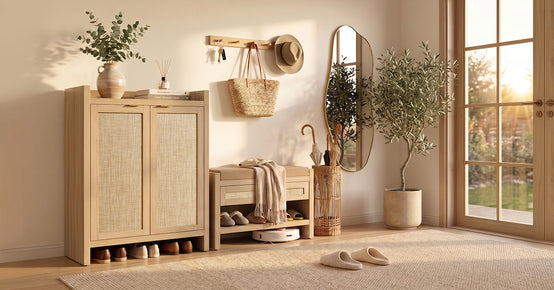
Tallest shoes decide first — that order is the whole game. Mostly flats and sneakers plus two or three boots? The Savanna 24-pair fits the brief: six adjustable shelves, verified, so run tight 4.5-inch levels for the flats and crack one boot bay without guessing.
Big family where the count genuinely matters? The Savanna 30-pair is the widest body in the range at 47.24 inches — more pairs per level before you move a single shelf. Serious knee-high collectors should look at the tallest boxes, including the 44.5-inch Cas three-door: one removed shelf leaves the deepest bay possible.
Wall space tight? The black Terra two-door is 31.49 inches wide and slides into hallways the wide bodies can’t enter. Still deciding? Browse the full SICOTAS shoe storage collection and line the interiors up side by side — count pin holes in the photos and picture your tallest boots standing in the tallest bay.

The bottom line

One cabinet fits flats, sneakers, heels, and boots. It was never the sticker pair count — it’s whether the shelves move. Audit by height, read the hole spacing, plant the boot bay at the bottom, reconfigure with the seasons. Do that, and the cabinet stops being a box your shoes almost fit and starts being the reason your entryway stays clear. Wardrobe first — then the cabinet at sicotas.com that matches it.

FAQs

Are adjustable shelves worth it in a shoe cabinet?

For most homes, yes — the second your wardrobe mixes heights. Tight levels for the flats, one tall bay for the boots, same cabinet. Only if every shoe you own is one single type do fixed shelves suffice. Most of us run flats, sneakers, heels, and boots side by side, and that mix is exactly what adjustability was built for.

How do adjustable shelves work in a shoe cabinet?

Four small pins, one shelf, holes up both side walls. Moving a level is a three-minute job: lift the shelf, pull the pins, set them into a new row of holes, drop the shelf back. No tools. No drilling. Done.

Can you fit tall boots in a shoe cabinet with adjustable shelves?

That’s the signature move — yes. Pull one shelf all the way out for a double-height bay around 17 inches, and most knee-high boots stand upright. Bay goes at the bottom for stability. Ankle boots at 9 to 11 inches sit fine on a normally spaced shelf with nothing removed.

Do adjustable shelves reduce how many pairs a cabinet holds?

The sticker number, a little. A boot bay swallows two shelves’ worth of vertical, so a 24-pair cabinet lands around 18 to 20. But that figure matches your real wardrobe — the 24 assumed flats on every level. The adjustable setup usually stores more of what you actually own.

How much space should I leave between shelves for sneakers vs. heels vs. boots?

Shoe height plus an inch for your fingers. In practice: roughly 4.5 inches for flats, 7 for low sneakers, 8.5 for high-tops, 9.5 for heels, 11.5 for ankle boots. Knee-highs need a shelf pulled and about 17 inches of air.

What's the difference between adjustable shelves and removable shelves?

Adjustable slides between pin holes to change a level’s height. Removable lifts out of the cabinet completely — that opens the tall bay for boots. Plenty of cabinets do both: adjust for everyday tuning, remove for boot mode. Read the listing closely so you know which “removable” it means.

Can I add adjustable shelves to a shoe cabinet that doesn't have them?

Not well, realistically. You would need to drill pin holes dead level across both side walls, and most finished cabinets lack the wall thickness for it. If the boots don’t fit today, swapping in a cabinet with adjustable shelves built in beats any retrofit.

How often should I reconfigure the shelves?

Twice a year handles most homes: boots out for cold weather, boots back into storage. Plus whenever sizes change — kids make that one frequent. Ten minutes a shuffle, no tools.


Looking for something else?
What Is Rattan Furniture? A Buyer Guide to Types and Care

What Is Rattan Furniture? A Buyer Guide to Types and Care

LEARN MORE
21 Nightstand Alternatives That Work in Real Bedrooms

21 Nightstand Alternatives That Work in Real Bedrooms

LEARN MORE
26 Reading Nook Ideas for Adults That You Will Actually Sit In

26 Reading Nook Ideas for Adults That You Will Actually Sit In

LEARN MORE
Liquid error (snippets/recommend-article line 11): invalid url input

Biophilic Furniture: What It Is and How to Pick It

LEARN MORE

Read more from Blogs

Looking for something else?

Color Coordinated Bookshelf: How to Arrange Books by Color Without Losing Track of Them

Color Coordinated Bookshelf: How to Arrange Books by Color Without Losing Track of Them

LEARN MORE
New Home Furniture Essentials: What to Buy First, Room by Room

New Home Furniture Essentials: What to Buy First, Room by Room

LEARN MORE
26 Bedroom Coffee Bar Ideas That Actually Work at Home

26 Bedroom Coffee Bar Ideas That Actually Work at Home

LEARN MORE

Read more from Blogs

You may also like

Savanna Console Table
$149.99
-4%
Savanna Shoe Cabinet, 2 Doors
Regular price $239.99 Save 4% Sale price $229.99
Cas Black Shoe Cabinet Entryway
$259.99
-12%
Cas Shoe Cabinet with Storage
Regular price $294.99 Save 12% Sale price $259.99
-12%
Savanna Entryway Bench
Regular price $169.99 Save 12% Sale price $149.99
-3%
Savanna Tall Shoe Cabinet,30 Pairs Shoes
Regular price $319.99 Save 3% Sale price $309.99

Further reading