How Wide Should a Sideboard Be Compared With Your Dining Table?
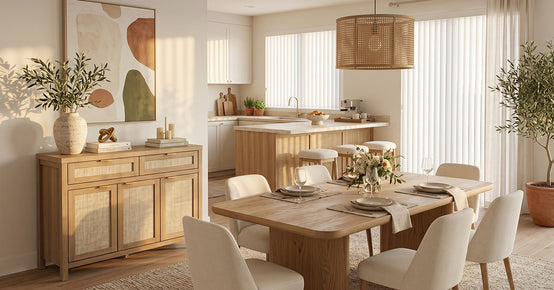
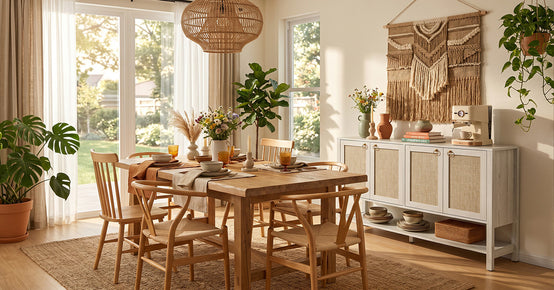
Walk into a dining room that feels "off" and the culprit is rarely the paint. It's the sideboard. Too narrow, and the wall looks like it's missing a tooth. Too wide, and the chairs start a turf war with the cabinet doors.
Short version: start at roughly two-thirds the length of your dining table. Then the room barges in with opinions — the wall length, how the chairs pull out, which way the doors swing — and the number moves. The rule first, then the reality check that actually decides the purchase.
Start With Your Table's Length
Tape measure, end to end of the table. That number is the anchor for everything. A 48-inch apartment table and a 96-inch farmhouse table aren't just different sizes — they belong to different universes. Here are the sideboard widths that look intentional next to each common table length:
Your table length
Sideboard width that works
48 in
30–36 in
60 in
38–45 in
72 in
44–54 in
84 in
50–63 in
96 in
58–72 in
Notice the overlaps. A 44-inch sideboard sits happily next to a 60-inch table or a 72-inch one — the ranges are fuzzy on purpose, and your wall and walkways do the narrowing.
The Two-Thirds Rule, and Where It Breaks
Ask enough designers and the answer converges: make the sideboard roughly two-thirds as long as the table, give or take a 60–70 percent band. Much shorter and the piece reads like an afterthought — a small box parked next to a big table, looking faintly embarrassed. Push past three-quarters and the two pieces stop complementing each other and start competing.
The catch nobody mentions at the store: proportion rules assume a normal room, and dining rooms are rarely normal. That 72-inch table of yours might sit in a narrow room that leaves all of 40 inches of usable wall. No ratio on earth is worth blocking a doorway over. Treat two-thirds as the opening bid. The room always negotiates back.
The Wall Gets a Vote Too
The step everyone skips: measure the actual wall. Not the whole wall — the usable stretch. Door trim to window casing, minus the thermostat, minus the vent, minus that light switch nobody remembers until the cabinet covers it. A sideboard spanning roughly 60 to 75 percent of that usable width looks settled. Under half and it floats. Wall to wall and the room feels stuffed.
Then leave four to six inches at each end. That's the difference between "placed" and "squeezed in." And when the table's number and the wall's number disagree — and they will — the wall wins. A 54-inch sideboard your table "wants" is meaningless if the wall only offers 48. Measure in this order: the gap from the table edge to the wall; the usable wall width between trim, vents, and switches; how much depth the walkway can spare; and the door and drawer swing — mime them on your floor plan before you buy, not after. If the chairs, the people, the doors, and the drawers can't all function at once, the piece is wrong.
Clearance Decides the Purchase
The measurement that kills more sideboard purchases than any other: the gap between the table edge and the sideboard front. Thirty-six inches is the comfortable standard. That's the number where a seated diner can push back, someone can walk behind the chairs, and the sideboard doors still swing open — all at once.
Tight on space? You can cheat down to 18–24 inches. Just know the trade: nobody passes behind a seated diner anymore, and the drawers only open when the chairs are empty. One more number to keep in the back of your head: 12 inches between a pulled-out chair and the cabinet front, or every dinner ends with chair backs kissing wood. European guides call 60 cm — about 24 in — the absolute minimum from neighboring furniture so doors and drawers can open. Clearance is the boss. Width is the intern.
Can the Sideboard Be Wider Than the Table?
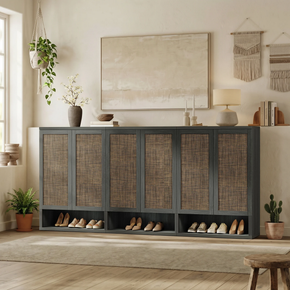
Yes — and sometimes it should be. A long, low sideboard stretching past a small round table can anchor a big empty wall beautifully. The two pieces don't have to match in length; they have to balance in the room.
Wayfair's buying guide puts it well: don't be afraid to make the width different from the table's, because there are no rules here. The rule that matters is clearance. A 60-inch sideboard beside a 48-inch table is a completely fine buy, provided the wall holds it and 36 inches of walkway survive.
Centered on the Wall, or Aligned With the Table?
This is the detail that separates rooms that look designed from ones that look accidental. When the sideboard sits opposite the table, line it up with the table — not the wall. It matters most in lopsided rooms where the table isn't centered. A sideboard squared to the wall while the table sits two feet to the left reads like a mistake.
The exception: the adjacent wall. If the sideboard lives around the corner from the table, center it on its own wall and don't think twice. Nobody compares alignment around a corner.
Opposite the table? Align with the table, not the wall.
Three Rooms, Three Answers
Theory's fine. Let's run three real rooms through all of it.
Room 1: 60-inch table in an 11-by-13-foot dining room.
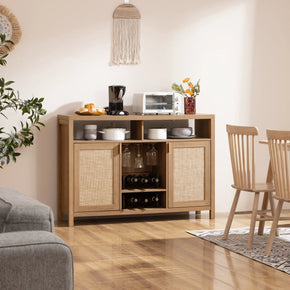
The ratio hands you a 38–45-inch range, the wall offers nine usable feet, and nothing constrains anything. Clearance cooperates too — 36 inches from the table edge still leaves the room easy to move through. The answer lands mid-range: a 43.5-inch piece like the Savanna Sideboard with Doors. Proportion, wall, and walkway all agree.
Room 2: 72-inch table in a 10-foot-wide room.
Now the 44–54-inch range collides with reality. A 36-inch-deep table plus 36 inches of clearance on the sideboard side leaves roughly 48 inches of wall. So you buy at the bottom of the range — 44 to 48 inches — and you hold the depth to 16 inches or less. The ratio wanted more. The room said no. The room is always right.
Room 3: 48-inch table in a small apartment nook.
Finally, the range and the wall agree at 30–36 inches. The answer is a 29- to 31-inch piece. The Prelude Sideboard with Doors at 29.18 inches and the Stria Sideboard with 2 Doors at 30.9 inches both land inside the range and keep the depth shallow.
Small nook, narrow piece: 30 inches of sideboard beside a 48-inch table.
Width Gets Attention, Depth Gets Regret
Everyone obsesses over width. Almost nobody thinks about depth until it's too late. A 20-inch-deep cabinet in a nine-foot-wide room dominates the walkway no matter how perfect its width is. In tight rooms, hold the depth to 12–16 inches. Standard rooms can handle 16–20. Measure depth against the walkway, not the wall. The wall doesn't walk.
Height stays quieter: thirty to 36 inches is the standard band, and a top a few inches above tabletop height makes serving natural. Lower pieces read calmer and leave air above for art or a mirror. Hanging something over it? Let the bottom edge sit 6–8 inches above the surface, and keep the art to 60–75 percent of the sideboard's width.
The Tape Test Before You Buy
Five minutes, one roll of painter's tape. Mark the sideboard's footprint on the floor — width by depth — exactly where it would stand. Pull every chair out, like someone just stood up mid-meal. Walk the path behind the chairs. Can you pass without turning sideways? Now mime the doors and drawers opening. Do they clear the chair backs?
Five minutes of tape beats five years of regret. Anything collides, you go narrower or shallower — never wider.
Side profile of a shallow sideboard — slim depth keeps the walkway alive.
Round Tables Change the Math
Everything above quietly assumed a rectangular table, because that's what the two-thirds rule was built for. A round 48-inch table seats four, but it reads smaller than a 48-inch rectangle — no long edge for the sideboard to echo. With round tables, lean on the wall percentage instead of the table ratio: let the sideboard span 60–75 percent of the usable wall, and treat the 36-inch clearance as sacred. A 40-inch sideboard beside a 48-inch round table looks generous rather than oversized, because the circle leaves visual slack a rectangle doesn't.
Square tables split the difference. A 42-inch square reads compact from every angle, so a 30- to 36-inch sideboard keeps the composition tight. The trap is going too narrow to "play it safe" — a 24-inch console next to a 42-inch square table looks lost even when the walkway math works. When in doubt, take the wider end of your range.
Three Width Mistakes Worth Avoiding
The same three mistakes, year after year. Skip them.
Buying for the table and ignoring the wall. You fall for a 54-inch sideboard that matches your 72-inch table. It arrives. The wall gives you 46 inches. Measure the wall before you fall in love with a width. Love is blind; tape measures aren't.
The chair blind spot. People count clearance from the table's edge and forget the chairs exist. The 36-inch rule assumes occupied chairs — pulled out, with actual humans in them. Tucked chairs lie about how much room you really have. Every time.
Going narrow to "play it safe" in a big room. An undersized sideboard doesn't read as cautious; it reads as unfinished, and you'll notice it daily. If the room can take 50 inches, buy 50 inches. Save your caution for the clearance math, where it actually protects you.
Match a SICOTAS Sideboard to Your Table
Run the numbers first, then shop the width your room gave you. Every width below comes straight from the actual SICOTAS product page — no rounding, no guessing:
Start from the sideboards collection and filter by the width your tape test approved — not the width the ratio suggested. The ratio got you to the store. The room closes the deal.
Shop by the width your room approved.
FAQs
How wide should a sideboard be compared to a dining table?
Start with roughly two-thirds the table's length — a 60-inch table pairs with a 38- to 45-inch sideboard, a 72-inch table with 44 to 54 inches. Then sanity-check the wall: the sideboard should span 60–75 percent of the usable wall, and 36 inches of clearance must survive between the table edge and the cabinet front. When the ratio and the room disagree, the room wins.
Should a sideboard be longer or shorter than the dining table?
Usually shorter — about two-thirds of the table's length reads as balanced. But a sideboard can run longer than the table when it's anchoring a big empty wall, as long as walkways stay clear. The two bad extremes: a piece so short it disappears next to the table, or one so long it pinches the passage.
What is the two-thirds rule for sideboard size?
Make the sideboard about two-thirds as long as the dining table; some designers use a 60–70 percent band. It's a proportion starting point, not a law — wall length and chair clearance get to move the final number up or down.
How much space should be between a dining table and a sideboard?
Thirty-six inches is the comfortable standard — a diner can push back, someone can walk behind, and the doors open. Tight rooms can get away with 18–24 inches if nobody passes behind seated diners. And keep at least 12 inches between pulled-out chairs and the cabinet front.
Can a sideboard be wider than the dining table?
Yes. A long, low sideboard stretching past a small table can anchor a big wall beautifully — the width doesn't have to match the table, it has to fit the wall and preserve clearance. Check both before you buy; the wider piece earns its place when the room supports it.
How deep should a dining room sideboard be?
Sixteen to 20 inches is standard. In tight rooms, hold to 12–16 inches deep — depth compresses a small room faster than width. Either way, confirm the doors and drawers open with the chairs pulled out.
Should a sideboard be centered on the wall or aligned with the dining table?
Opposite the table, align it with the table — especially in rooms where the table isn't centered. A wall-centered piece beside an off-center table just looks like a mistake. Around the corner on an adjacent wall, center the sideboard on its own wall.
What height should a sideboard be relative to a dining table?
Sideboards typically run 30–36 inches tall — a few inches above tabletop height, which makes serving comfortable. Lower pieces feel calmer and leave room above for art or a mirror, hung 6–8 inches above the surface.
Start at roughly two-thirds the table's length — a 60-inch table pairs with a 38- to 45-inch sideboard, a 72-inch table with 44 to 54 inches. Then sanity-check the wall: the sideboard should span 60–75 percent of the usable wall, and 36 inches of clearance must survive between the table edge and the cabinet front. When the ratio and the room disagree, the room wins.
Should a sideboard be longer or shorter than the dining table?
Usually shorter — about two-thirds of the table's length reads as balanced. But a sideboard can run longer than the table when it's anchoring a big empty wall, provided the walkways stay clear. The two bad extremes: a piece so short it disappears next to the table, or one so long it pinches the passage.
What is the two-thirds rule for sideboard size?
Make the sideboard about two-thirds as long as the dining table; some designers use a 60–70 percent band. It's a proportion starting point, not a law — wall length and chair clearance get to move the final number up or down.
How much space should be between a dining table and a sideboard?
Thirty-six inches is the comfortable standard — a diner can push back, someone can walk behind, and the doors open. Tight rooms can get away with 18–24 inches if nobody passes behind seated diners. And keep at least 12 inches between pulled-out chairs and the cabinet front.
Can a sideboard be wider than the dining table?
Yes. A long, low sideboard stretching past a small table can anchor a big wall beautifully — the width doesn't have to match the table, it has to fit the wall and preserve clearance. Check both before you buy; the wider piece earns its place when the room supports it.
How deep should a dining room sideboard be?
Sixteen to 20 inches is standard. In tight rooms, hold to 12–16 inches deep — depth compresses a small room faster than width. Either way, confirm the doors and drawers open with the chairs pulled out.
Should a sideboard be centered on the wall or aligned with the dining table?
Opposite the table, align it with the table — especially in rooms where the table isn't centered. A wall-centered piece beside an off-center table just looks like a mistake. Around the corner on an adjacent wall, center the sideboard on its own wall.
What height should a sideboard be relative to a dining table?
Sideboards typically run 30–36 inches tall — a few inches above tabletop height, which makes serving comfortable. Lower pieces feel calmer and leave room above for art or a mirror, hung 6–8 inches above the surface.