Best Nightstand Height and Placement for an Adjustable Bed
A regular bed never moves, so its nightstand math is simple. An adjustable bed rewrites that math every time you press the button. That nightstand height that feels perfect flat on your back? It turns into a half-asleep stretch the moment you raise the head for reading. Shop for the flat position alone and you'll feel it every single night.
The fix is simple, though it kills the standard advice. Throw out "match the mattress." Your nightstand has to serve every position you actually live in: flat, head raised, and that halfway TV lean. Here's how to measure for all three — then pick with real numbers in hand.
Your Bed Has More Than One Height
Grab the tape measure before the shopping cart. Your mattress travels through a range on an adjustable base, and the nightstand has to cover all of it. Measure the mattress top in three positions — fully flat, your usual reading angle, fully raised — and write every number down. The spread surprises most people: a thick mattress on an adjustable base can end up several inches higher at full raise than it sits flat.
Now factor in your pillow, because nobody reaches for water off a bare mattress. Propped on a pillow, your head sits four to six inches higher — and that changes the reach that feels comfortable. The old rule still works; it just has to apply to your most-used position. Fall asleep reading with the head up every night? Then raised is your true target, not flat.
The three-number worksheet
Flat: ___ in. Reading angle: ___ in. Fully raised: ___ in. Shortlist nightstands with tops within 2 inches of the number you use most, and never more than 4 inches below your highest number — below that, the raised position becomes a stretch every evening.
The Raised Head Changes Your Reach
Most guides skip this part, and it matters. Raise the head and two things happen together: the mattress near your shoulders lifts, and on many bases the whole sleeping surface slides. Wall-hugger designs glide back toward the wall as they rise, so you stay close to your nightstand. Standard designs push outward instead — away from the wall — quietly adding several inches between you and the table.
Several inches sounds trivial at noon. At 2 a.m., half asleep and groping for water, it's a chasm. If your base isn't a wall-hugger, just assume the raised position adds a few inches to your reach and plan around it. Some owners cheat by nudging the nightstand closer to the bed — that works, as long as the moving mechanism still clears it. More on clearance below.
Can You Use a Regular Nightstand With an Adjustable Bed?
Yes. No specialty product required — a regular nightstand does the job if it passes three checks. One: the height has to serve your most-used position, not merely the flat one (details below). Two: the frame needs room to move, so leave a few inches between nightstand and bed frame or the mechanism will clip the furniture. Three: it must be genuinely sturdy. The base shifts and vibrates as it articulates, and a light, tippy table slowly walks across the floor. Solid wood or metal on a wide base doesn't.
What fails: a tall fixed unit bought for the raised position that turns into a stretch — or a wall — once the bed goes flat, and anything deep or wide enough to block the frame's travel. Slim profiles earn their keep in this spot. Space between mattress and headboard is tight, and the nightstand shouldn't be wrestling the bed for it.
Buy for Your Most-Used Position
The old rule — nightstand top within 2 inches of the mattress top — still holds, but it must hold at the position you actually use. Adjustable beds usually come with thicker mattresses, and the common guidance runs 25 to 30 inches measured flat, matched to your most common sleep height. If you fall asleep reading with the head raised every night, match the raised position, not the flat one.
Unsure? Err a touch tall. A top sitting an inch or two above the mattress beats one sitting below it — reaching down into a low nightstand from a raised bed is the mismatch people complain about most. Furniture builders hear the reverse regret too: folks who built nightstands dead-level with the mattress, then wished they'd added two or three inches. Mattresses only thicken over time, so a vintage 22-inch nightstand can end up nearly a foot under a modern thick setup.
Three Height Strategies That Actually Work
Three numbers in hand, three ways to play it. None is the old "match the mattress top" rule — that one assumed a mattress that never moves.
Go tall and fixed
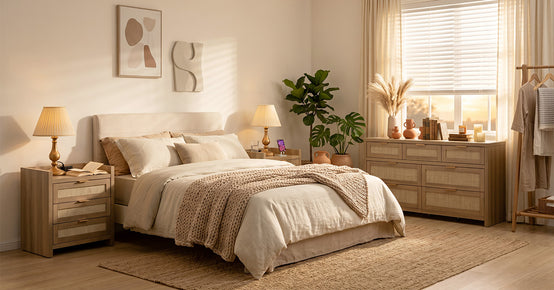
If raised is your main position, buy for raised. Adjustable beds usually pair with thicker mattresses, and tall setups generally want nightstands 30 inches and up so the top stays within easy reach with the head lifted. A fixed unit in the 25 to 30 inch range covers the flat position nicely. The Crescent Nightstand, 3 Drawers at 26.6 inches high lands in the middle: tall enough for a raised head, not ridiculous next to a flat bed.
Go adjustable
An adjustable-height side table — a C-table, say — is the honest answer when your bed travels through a big range. Some rise to 50 inches, covering even fully raised positions. The tradeoff is storage: mostly a single surface, no drawers. Lamp, phone, and water? Plenty. Need drawers? Wrong category.
Go wall-mounted
A floating nightstand ignores the bed entirely. Bolted to the wall at your ideal height, it never moves while the mattress rises and falls — and the floor stays clear, so the tilting base mechanism never bumps a furniture leg. The catch is commitment: the height is locked in at install time. Measure twice, mount once.
Stability Matters More Than You Think
An adjustable base moves, shifts, and hums — and that motion travels into anything touching or crowding the bed. So build quality matters more here than beside a static bed. Solid construction, a wide stance, real weight. Lockable casters are a bonus for serial rearrangers; for everyone else the goal is simpler: a nightstand that doesn't budge.
Adopt one safety habit: drinks live on the nightstand's stable surface, never balanced on the bed near controls or electronics. A spill into the base wiring or the remote is the expensive kind of accident — and entirely preventable. A raised-edge top or a simple tray keeps glasses and bottles where they belong.
Don't Let the Frame Hit the Furniture
Adjustable bases move — that's the whole point — and the frame's corners sweep an arc as the head rises. Leave a few inches between the nightstand and the bed frame, not just the mattress. Tucked tight against the mattress looks tidy, but the frame can clip the table when the head comes up — especially on non-wall-hugger bases pushing outward.
Run the five-minute test: raise the bed to full, then check every side of the nightstand. Clearance at full raise means clearance everywhere. Tape the nightstand's footprint on the floor with painter's tape before you buy — it costs nearly nothing and catches clearance problems before furniture arrives.
Drawers Still Need to Open
Drawers surprise adjustable-bed owners twice. First: a drawer that glides open fine with the bed flat can smack a raised mattress — the edge lifts straight into the drawer's path. Second: fishing through a low drawer from a raised position means bending at an angle nobody finds comfortable.
Before buying, measure the drawer extension against your raised mattress edge. Shallow top drawers are the safest bet for middle-of-the-night grabs. And go by real interior numbers, not the drawer count: the Crescent's main drawer interior runs 7.5 inches high and 11.4 deep — genuinely usable — while some nightstands hide drawers barely tall enough for a paperback.
Cords, Remotes, and the 2 A.M. Test
An adjustable bed drags accessories with it: a wired or wireless remote, the base's power cord, sometimes a massage function with its own cable. All of it lives at the bedside, and all of it drifts toward the nightstand. Plan for that. A built-in charging station earns its keep here: the Prelude Nightstand with Charger Station pairs two drawers with an AC outlet and USB port at 25.3 inches high, while the Savanna Nightstand with Charger throws Type-C into the mix at 26.57 inches.
Park the bed remote somewhere it can't slide behind the nightstand — a raised-edge tabletop or a small tray beats fishing between furniture at midnight. And route the base's power cord where the moving frame can't pinch it. Cord damage on an adjustable base is a lesson you pay for.
The 5-Minute Placement Test
Put the bed in your most-used position — usually the reading angle, not flat.
Set the candidate nightstand's height beside the bed (a stack of books at that height works).
Lie down and reach: water glass, remote, phone. No shoulder lifting allowed.
Raise the bed to full. Check frame clearance on all sides and drawer swing.
Lower to flat. If the nightstand still feels right, you've found your height.
Do this tape test before the nightstand arrives, not after. Five minutes of measuring beats boxing up furniture that almost fits — and with an adjustable bed, "almost fits" is precisely where the expensive surprises hide.
What height should a nightstand be for an adjustable bed?
Measure the mattress top at your most-used position — usually the reading angle — and stay within 2 inches of it. Most adjustable setups land between 25 and 30 inches. Mostly sleep flat? Buy for flat. Fall asleep reading? Buy for raised.
Can you use a regular nightstand with an adjustable bed?
Yes — if two things check out. The top sits within a couple inches of your mattress at your most-used position, and the frame clears the nightstand at full raise. Plenty of regular nightstands pass both.
Should the nightstand be level with the mattress when the bed is flat or raised?
Whichever position you use most — for most people, the reading angle, neither fully flat nor fully raised. Matching flat-only is the classic mistake; it leaves you stretching every evening.
How do I keep my nightstand within reach when the head of the bed is elevated?
First check whether your base is a wall-hugger — those slide back and keep you close. If not, the bed pushes outward as it rises, adding 3 to 5 inches to your reach. Compensate with a taller nightstand, a wall-mounted unit, or by nudging the nightstand a few inches toward the bed — while keeping frame clearance.
What's the best type of nightstand for an adjustable bed — fixed, adjustable-height, or wall-mounted?
Fixed tall nightstands (25–30 inches) suit most people and keep the storage. Adjustable-height tables handle big position ranges but usually lack drawers. Wall-mounted units ignore bed movement entirely but lock you into one height. Choose by how much your bed moves and how much storage you need.
How much clearance should there be between a nightstand and an adjustable bed frame?
A few inches between the nightstand and the moving frame, verified at full raise — not just against the mattress. Raise the bed all the way up and check every side before committing.
Will a non-wall-hugger adjustable base push me too far from my nightstand?
It can — these bases extend outward as the head rises, moving you several inches from the nightstand. If yours does that, plan the nightstand's position and height for the raised case, not the flat one.
Where should I put the bed controls, power cords, and chargers?
Give the remote a dedicated home — a tray or a raised-edge tabletop — so it can't slide behind the furniture. A nightstand with a built-in charging station, like the Prelude or Savanna models, keeps device cables off the floor; route the base's own power cord where the moving frame can't pinch it.