



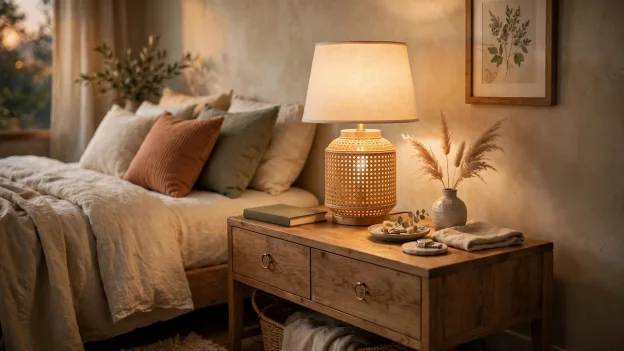

How to Match a Nightstand to Your Bedside Lamp Size and Weight
Base diameter at its widest — most bedside bases run 5 to 8 inches, sculptural ones past 10.
Shade diameter at its widest, usually the bottom rim — most bedside shades land between 10 and 15 inches.
The larger of the two, plus an inch of clearance per side, is the lamp's real footprint.
The Tag Number Is Not the Number That Matters
Nightstands are sold by advertised width. Lamps are sold by total height. Neither tells you if they work together, because the fit lives in two numbers that rarely appear on a product page: the lamp's true footprint and the shade's overhang.
Start with the base — wrap your tape around the widest part, then do the same for the shade (that’s usually the bottom rim). Here’s the thing about shades: they’re deliberately wider than the base, typically one and a half to two times as wide. And it’s the shade that really decides whether things fit — it’s what hangs over edges, blocks your drawers, and catches your elbow in the middle of the night.

[Measure base and shade at their widest points.]
Designers all land on the same rule: keep the shade inside the table's edges. If it sticks out past the edge, that lamp belongs on a bigger table. An overhanging shade throws visual weight outside the lamp's support, steals the reach zone where your hand lands in the dark, and turns every drawer pull into an obstacle course.
[Shade past the edge? Wrong table.]
Do the Usable-Top Math
A 31-inch-wide nightstand does not give you 31 inches of surface. Subtract the front strip where drawers pull toward you, the back strip where the cord drops, and margins so things don't slide off in the dark — about 1.5 inches per side and 2 inches at the back. A 31.3-inch top becomes roughly 28 inches of real working width.
Now subtract your life: phone (3.5 by 7 inches), paperback (4 by 7), water glass (a 3-inch circle you won't knock over). Most people need an essentials zone of 8 to 10 inches beside the lamp, every night.

The formula: usable width minus essentials must exceed the lamp's footprint. On the Crescent Nightstand with 3 Drawers (31.3 inches wide), usable width lands around 28 inches; reserve 9 for phone, book, and water, and 19 inches remain for the lamp — plenty for a 13-inch shade with clearance. On a compact 20-inch table, usable width is around 17 inches, minus 9, leaves 8: a 12-inch shade never fit that table. The tag just never said so.
Check depth too — a shade that fits side to side can still hang over a shallow front edge. Fine for looks, risky for elbows.
Three Proportion Rules
Fit is physics. Proportion is what makes it look intentional.
The one-third rule: the lamp's widest point — usually the shade — should run about one-third the nightstand's width. On a 30-inch table, a shade around 10 inches. Bend the rule slightly and nobody notices. Shatter it, and the lamp either swallows the table or disappears against it.

Then the base-to-table bands. Under 20 inches wide: a 5 to 7 inch base. Twenty to 30 inches: 7 to 10. Over 30: 10 to 14. Wider bases are steadier bases — and a base too small for its shade looks every bit as wrong as it behaves.
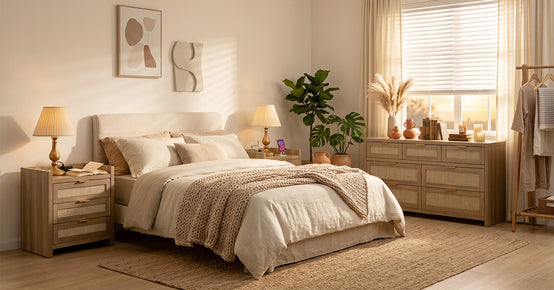
Height against the bed comes next. Sit up and picture where your eyes land — that's where the shade's bottom edge wants to be: 20 to 24 inches above the mattress, or 24 to 27 inches of lamp all told on a standard nightstand. Sanity-check it against the headboard; the lamp should run roughly two-thirds that height. And check in this order: footprint first, then width proportion, then height.
Weight Changes Everything
A ceramic lamp with a linen shade runs 8 to 12 pounds; solid brass can push 15. On a light, narrow table, that's basically a tipping machine — the center of gravity has moved up and out. Stability has to come from the table itself: its assembled weight and stance width. A 60-pound nightstand like the Crescent resists tipping far better than a 25-pound flat-pack, and a 90-pound piece like the Prelude Nightstand with 2 Drawers and Charger Station barely notices a heavy lamp. Wider tops spread the footprint; narrow ones concentrate it.
Do the wobble test on arrival: set the lamp where it'll live, press the top front corner with one finger. If the opposite back leg lifts, the pairing's wrong. Also check the edge profile: a flat top gives full depth, while a raised gallery rail eats an inch or two and shoves wide shades outward. And the lamp isn't the only load — lamp plus hardcover plus a full water glass on one corner adds up fast. Park the lamp toward the back-outside corner.

Plan the Cord Before You Place the Lamp
The cord exits at one fixed point and drops to the outlet, crossing whatever happens to be in its path — usually the drawer fronts. So put the lamp nearest the outlet, letting the cord fall straight down the back. A diagonal cord snags the top drawer's pull and slowly drags the lamp toward the edge. Wrong-side outlet? A slim cord channel down the back leg costs a few dollars — install it before the lamp goes on.
Then the switch. You'll operate this half-asleep, so it must be reachable from the pillow without sitting up. If reaching it means leaning across the lamp, past the water glass — the placement fails even if the measurements passed.

Charging changes the math. A phone charging on top eats 3.5 by 7 inches plus a snaking cable — but a nightstand with a built-in station moves it all off the top. The Prelude's AC outlet plus USB and Type-C ports charge the phone inside the station while the lamp keeps the tabletop. In the usable-top formula, a charging station hands back the inches you reserved for the phone — that alone can decide whether a lamp fits.
The Drawer You Can't Open
The failure nobody finds until move-in day: the lamp fits, the shade clears, and then the top drawer front hits the lamp base. Check two clearances with the lamp in place: open the top drawer fully — front and pull must clear the base by an inch. Deep drawers are worse here; the Crescent's main drawer interior is 7.5 inches high and 11.4 deep, so its tall front travels right under your lamp. Second, check the shade rim against the pull — a wide shade near the front edge forces you to reach around it every single time. Usually the fix is placement, not replacement: just slide the lamp to the back-outside corner.
Cabinet-door tables have their own version of this: the door's swing arc. Mark it on the tabletop with a sticky note and keep the lamp's footprint outside the mark. Ninety seconds, permanent peace.

Two Sides, One Decision
Two nightstands means two lamps that read as a pair: identical tables want identical lamps — or at least identical shade heights. Different tables cut you some slack: a wide one and a narrow one can each wear their own shade size, provided the heights line up. A 13-inch shade on the 31-inch table next to a 10-inch shade on the 24-inch one reads as deliberate — because each lamp is following its own table's rule.
Chase light symmetry, not furniture symmetry: shade bottoms level above the mattress, bulbs matched at 2700K–3000K, both switches within pillow reach. Couples, take note — one side's CPAP machine versus the other's stack of novels changes the usable-top math per side. Measure each side separately.

Two Nightstands, Measured Against Your Lamp
The Crescent Nightstand with 3 Drawers is your wide option: 26.6″H × 31.3″W × 16.4″D, 60 lb. Once you account for margins, you’re looking at about 28 by 13.5 inches of actual usable surface — plenty for a shade up to around 11 inches plus a real essentials zone. The flat top uses the full depth, those 60 pounds keep a heavy ceramic lamp right where you put it, and the big main drawer (7.5″H × 11.4″D) swallows books and chargers so the top stays clear. If you’ve got a substantial lamp and the full nightly kit, this is your table.
The Prelude Nightstand with 2 Drawers and Charger Station is the compact heavyweight: 25.3″H × 25.4″W × 15.3″D, 90 lb. You get roughly 22.5 by 12.5 inches of usable top — good for a shade in the 8 to 9 inch range. The built-in charger (AC plus USB and Type-C) gets your phone and its cable off the surface entirely, which effectively gives you more room than the tape measure suggests. At 90 pounds it’s the steadier of the two, and 25.3 inches sits nicely against a standard mattress. This one’s for a modest lamp plus some serious overnight charging.
|
Crescent, 3 Drawers |
Prelude, 2 Drawers + Charger |
|
|
Tabletop (W × D) |
31.3″ × 16.4″ |
25.4″ × 15.3″ |
|
Overall height |
26.6″ |
25.3″ |
|
Weight |
60 lb |
90 lb |
|
Shade it carries |
up to ~11″ |
up to ~9″ |
|
Drawer interior |
7.5″H × 11.4″D |
5.3″H × 11.2″D |
|
Charging |
none built in |
AC + USB + Type-C |
|
Best for |
big lamp + full essentials |
compact lamp + charging needs |
Browse the nightstands collection to compare tops, weights, and charging: nightstand collection
The 5-Minute Fit Worksheet
● 1. Base diameter at widest point.
● 2. Shade diameter at widest point.
● 3. Larger number + 1″ per side = lamp footprint.
● 4. Top width/depth minus 1.5″ sides, 2″ back = usable top.
● 5. Reserve 8–10″ for essentials (skip phone's share if built-in charger).
● 6. Usable minus essentials must exceed footprint; check depth too.
● 7. Shade ≈ 1/3 of table width.
● 8. Shade bottom at sitting eye level; lamp ≈ 2/3 headboard height.
● 9. Lamp in place, open top drawer: 1″ clearance at base and pull.
● 10. Press front corner — back leg lifts, pairing fails.
Pass all ten and buy with confidence. Fail one and you know which number to fix: a slimmer shade, a wider table, or a charging station.
It's 2 a.m. Your hand finds the lamp base in the dark, and the light lands on your page. The water glass stays put; the phone's charging out of sight. Nobody thinks about any of this — which is the whole point.

FAQs
What lamp base suits a 20-inch-wide nightstand?
Stick with a 5- to 7-inch base on a 20-inch table — you’ve got roughly 17 inches of actual working width there, so anything wider starts shoving your essentials off to the side. And keep that shade around 8 inches or under.
Can the lampshade hang over the edge?
Honestly, it shouldn’t. When the shade hangs over the edge, you’re putting weight outside where the lamp’s actually supported, you lose that reach zone where your hand lands in the dark, and the top drawer becomes a pain to open. Either go with a slimmer shade or a wider table — one of them’s got to give.
How much weight can a nightstand top hold?
Go by how much the table itself weighs once it’s put together. A solid 60 to 90-pound nightstand isn’t going anywhere under an 8 to 15-pound lamp, but a lightweight flat-pack? Different story. Quick test: press down on the front corner and watch the back leg — if it lifts, you’ve got a problem.
How tall should the bedside lamp be?
You want the bottom of the shade right around eye or shoulder level when you’re sitting up in bed — usually that means 20 to 24 inches above the mattress, or about 24 to 27 inches of total lamp height. Don’t forget the headboard either; aim for roughly two-thirds of its height.
Which side of the nightstand should the lamp go on?
Put it nearest the outlet so the cord drops straight down behind the table. If that cord runs across the drawer fronts, it’ll snag and slowly drag the lamp toward the edge — not what you want. And make sure you can reach the switch without getting out of bed.
Can a heavy lamp sit on a nightstand with drawers?
Sure, as long as the table’s heavy enough and you’ve checked the clearances. Here’s the real test: open that top drawer all the way with the lamp sitting in place. You need about an inch of clearance at the base and around the pull. Tall drawer fronts need a little extra attention here.
Do both bedside lamps need to match?
Here’s the trick — match the light, not the furniture. Get both shade bottoms at the same height, use the same bulb temperature (somewhere in that 2700K to 3000K warm range), and make sure both switches are reachable from bed. The tables themselves? Those can be totally different styles and it’ll still look right.
Best setup for a big lamp plus phone charging?
You’ve got two good options: go wide with something like a 31-inch top (the Crescent handles a substantial lamp plus all your nightly stuff), or go electric with a charger-station table. The Prelude’s got AC plus USB and Type-C built in, which basically gives you back the footprint your phone charger was eating up.


Looking for something else?
How to Choose a Shoe Cabinet for Wet Shoes and Muddy Entryways
LEARN MORE
Freestanding vs. Wall-Mounted Shoe Cabinets: Which Is Safer and Easier to Install?
LEARN MORE
Shoe Cabinet Base Clearance: Will Your Robot Vacuum Fit Under It?
LEARN MORE
How to Choose a Nightstand for a Rental: Small Footprint, Easy Moving, and Useful Storage
LEARN MORELooking for something else?
How to Match a Nightstand to Your Bedside Lamp Size and Weight
LEARN MORE
Nightstand Leg Height for Robot Vacuums: A Bedside Clearance Guide
LEARN MORE
How to Choose a Buffet Cabinet for a Coffee Bar: Heat, Cords, and Spill Protection
LEARN MORE


Further reading

Attic Bedroom Ideas: Furniture for Sloped Ceilings

What Is Wicker? Wicker vs Rattan Explained


