



Freestanding vs. Wall-Mounted Shoe Cabinets: Which Is Safer and Easier to Install?
When the Cabinet Gave Up at 2 a.m.
My cousin mounted a floating shoe cabinet in his hallway last spring. Forty-eight hours later — 2 a.m., a drywall plug surrendered, and two dozen shoes avalanched onto the floor. His wife discovered the mess at sunrise. Married men know that look.
We keep treating this as a décor choice. It isn't. One routes sixty to eighty pounds of shoes straight into your floor — the easiest structural job in the house. The other hangs all of it off six small metal bits gripping your wall, and every yanked door and climbing toddler loosens them a fraction more.
Physics in a decorating costume, more or less.
How Each Type Actually Carries the Load
Freestanding: straight down, floors don't argue
A wide, low cabinet packed with shoes? Shove it and it shrugs — all that weight goes straight down into the floorboards. The tall skinny tower is a different animal: a kid yanking a door open like a ladder rung, a dog shoulder-checking the corner. Lateral force is the weak spot. That tiny nylon strap in the hardware bag — the one everyone leaves in the drawer — is the difference between a shrug and an urgent-care visit. Ten minutes, one stud.
Wall-mounted: every anchor fighting a peel
Nothing touches the floor, so nothing tips — the big selling point. The catch: all the weight now lives in four to six anchors, each fighting a constant prying force. Every door tug pries the top edge outward a little more. Six lag bolts in real studs outlast your mortgage. Six plastic plugs in bare drywall have an expiration date nobody prints on the box.
What Your Wall Has to Handle
Wood studs: the lottery ticket
Solid lumber behind the paint, sixteen inches on center — best-case wall, full stop. A lag screw driven two inches into a real stud holds hundreds of pounds per anchor. Don't trust the finder alone: a thin pilot hole where the cabinet covers it. Solid resistance and real wood shavings? Lumber. Fine powder and no resistance? You've drilled into hope.
Drywall alone: the numbers lie
Sure, the packaging says toggle bolts in half-inch drywall rate fifty to a hundred pounds per anchor. Those numbers were born in a lab, on a panel nobody touches, in a building nobody lives in. Your hallway has slamming doors and handles kids swing off like monkey bars. A family cabinet on drywall plugs alone is a countdown you can't hear. I'd call the printed rating a fishing story — technically documented, generously optimistic.
Masonry and concrete: the forever anchor
Brick, cinder block, poured concrete. Sleeve anchors driven into masonry do not come back out — ever. The toll: a hammer drill, masonry bits, and an afternoon of noise your neighbors won't forgive. Own the place and the tools, though, and nothing holds like masonry. Nothing.
Steel studs: the heartbreak special
The finder beeps with confidence, you drive the screw, and it strips — because you've anchored into what is, structurally, a soda can. Steel studs are the heartbreak special. Can't verify what's actually back there? Then a loaded cabinet has no business hanging on it. Renters, the old trick: knock along the wall for the hollow-to-solid shift every sixteen inches, then make your pinhole test where the cabinet covers it anyway.
The Baseboard Problem Nobody Warns You About

The baseboard silently murders wall-mounted installs.
The cabinet wants to hang flat, but the baseboard juts out half to three-quarters of an inch — exactly where the bottom edge wants to live. Every fix is annoying: float the cabinet six to ten inches up, notch the back around the molding, or accept the gap and its dust shelf. A contractor friend once shimmed a floating cabinet over chunky colonial trim: three hours, four shims, one pencil-sized gap. Billed for all of it.
Freestanding skips the circus: the cabinet back sits about three-quarters of an inch off the wall, so the trim never enters the picture. Looks planted. Isn't — the strap stays non-optional.
Capacity and Depth: What Actually Fits Inside

Measure interior depth first, not last
A men's size 12 sneaker runs about thirteen inches. Freestanding cabinets give fourteen to fifteen inches of interior depth — boots welcome. Wall-mounted runs six to ten — boots need not apply. No organizer folds a shoe in half. Shallow suits flats, loafers, kids' shoes; a household half in tall boots needs full-depth freestanding, or a separate boot plan.
Pair counts are poetry
The box says "24 pairs." It counted with ballet flats. Call it two-thirds of the printed number and you won't be disappointed. The real hero is adjustable shelving: drop one shelf low and suddenly there's a boot compartment the marketing photo never showed. And nobody's shoe collection has ever, in history, shrunk.
The one measurement that matters
Measure your longest shoe against interior depth, count by type instead of by pair, and leave slack. The difference between shoes in the cabinet and shoes in a sad pile beside it.
Cleaning Under and Around It

No contest: wall-mounted.
Eight to twelve inches of daylight underneath; the mop goes straight through. Freestanding grows a gray dust mustache along its base within a month, and getting behind it means unloading every shelf and dragging the unit out. Anyone living with a shedding dog already knows this math.
Renters: The Drill Question

Renting collapses this debate into one question: can you put holes in this wall?
No? Freestanding — zero holes, zero deposit drama. Some slim units run barely seven inches deep; tuck one behind the door and your landlord never knows it exists.
"With permission"? Wall-mounting isn't impossible, just gated. Get it in writing first — a text counts, keep the screenshot. Lease bans holes outright? Debate's over: freestanding.
Child Safety: Tipping Is the Whole Conversation

Kids get hurt by tipping furniture every year; shoe cabinets are hallway height, interesting, extremely climbable.
A wall-mounted cabinet fixed into studs cannot tip forward; the geometry refuses. But the risk relocated into the anchors. Drywall-only plugs with a climbing child hanging off them can pull straight out, and then you've traded a tip-over for something worse. Studs, or don't wall-mount.
Freestanding has one commandment: the strap, every time. Kids or a big dog in the house, and it goes on before a single shoe goes in. The danger profile is specific: around forty-one inches tall, under fifteen deep, a toddler treating the open door as gym equipment — leverage that walks a loaded cabinet onto a small person. Working rule: over thirty inches tall with kids around gets anchored to a stud. No debate.
What Installation Actually Costs

Freestanding: basically free
Thirty to sixty minutes with the included Allen key, ten more for the strap. Extra cost: roughly zero dollars and one podcast episode.
Wall-mounted: priced in Saturday
Stud finder (twenty-five to forty bucks), drill, level, anchors — ten to twenty more. One to two hours of your Saturday; hired out runs eighty to a hundred and fifty. Compare installed cost, not sticker price.
Freestanding vs. Wall-Mounted: The Comparison Grid

|
Factor |
Freestanding |
Wall-Mounted |
|
How it carries load |
Straight down into the floor |
Everything hangs on the wall anchors |
|
Wall requirement |
1-2 small holes for the anti-tip strap |
Studs best; masonry OK; bare drywall risky |
|
Floor space used |
Full footprint, always |
None — the floor stays clear |
|
Cleaning underneath |
Unload everything, drag it out |
Mop goes straight through |
|
Child safety |
Strap required; tall/slim riskiest |
Can't tip in studs; anchors are the risk |
|
Renter-friendliness |
Excellent — none needed |
Written permission; patch at move-out |
|
Capacity and depth |
Full depth (14-15 in); fits boots |
Shallower (6-10 in); flats and sneakers |
|
Install time |
30–60 min, strap adds 10 |
1–2 hours |
|
Install cost |
About $0 extra |
$35–60 DIY, $80–150 hired |
|
Moveability |
Carry it room to room |
Patch holes, unmount, remount |
|
Baseboard issue |
Hidden gap behind |
Float over trim or notch it |
|
Best for |
Renters, strapped kids' rooms, boot owners |
Owned homes, easy mopping, minimalists |
Two SICOTAS Cabinets, Two Different Answers
SICOTAS only builds freestanding — the entire lineup. So the real question isn't floor-or-wall; it's which freestanding profile fits your life, installed by somebody who read the safety section. "Freestanding" is a starting position, not a safety rating — a tall slim tower without a strap is the most dangerous unit in this comparison.

Savanna Shoe Cabinet, 24 Pairs Shoes: the tall, slim one
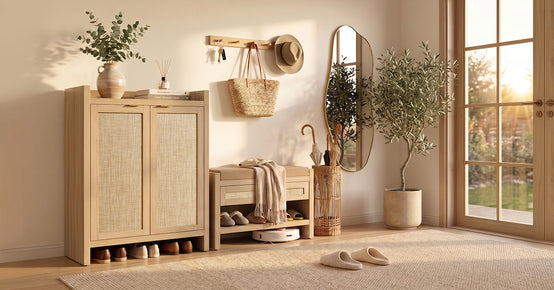
On paper: 32.4 inches wide, 41 tall, 14.8 deep, two doors, six adjustable shelves, room for roughly 24 pairs. FSC-certified engineered wood with woven rattan fronts, sized for narrow entryways. Blunt safety read: forty-one inches tall, under fifteen deep, high center of gravity — the toddler danger profile with a name tag. Little kids in the house? Strap goes into a stud on day one, before the shoes. The tall bay swallows boots; judge real capacity yourself — 24 pairs is marketing math.
Cas Shoe Cabinet with Doors: the wide, low one
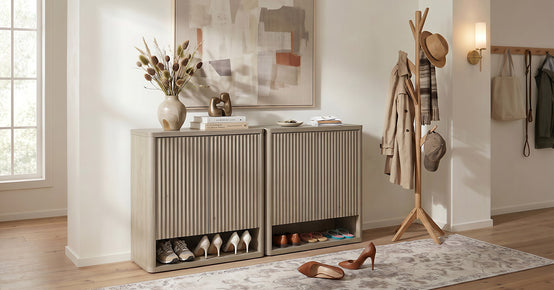
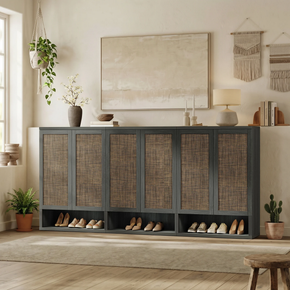
The Cas: 65.6 wide, 44.5 tall, 14.5 deep. Four doors, adjustable shelves, up to 50 pairs — the family workhorse. Wide and low means it resists tipping by shape alone. Strap it anyway with kids around, and it holds fifty pairs asking nothing of you. Boring is good. Boring is safe.
FAQs
Q1: Bought a freestanding cabinet already — can I just lag-bolt the back to the wall?
Don't — the back panel isn't a mounting rail. Screw it in, load it with shoes, and the panel tears out eventually, probably at the worst moment. The anti-tip strap exists for exactly this. Ten minutes.
Q2: How do I actually find out what's behind my paint?
Stud finder first, then a small pilot hole where the cabinet covers it. Solid resistance plus wood shavings in the flutes — that's a stud. Fine powder, zero resistance — not a stud. Don't buy anchors until you know.
Q3: My cabinet is short and wide — am I seriously supposed to strap that too?
Way lower risk, sure, but not zero — a determined kid can walk a squat cabinet across the floor inch by inch. Got kids or pets? Strap it anyway.
Q4: Renting an apartment — is wall-mounting completely out?
Not necessarily — plenty of landlords say yes to small anchor holes. Get it in writing, even a text, and keep the screenshot. Lease bans holes outright? Debate's over: freestanding.
Q5: If I float a cabinet, how high should it actually sit?
Eight to twelve inches off the floor. Mop fits underneath, top shelf stays reachable. Do the reach test before you drill, not after.
Q6: I've got tall boots — will a wall-mounted cabinet really fit them?
Only if the interior is deep enough, and usually it just isn't. Most wall-mounted units run six to ten inches deep — fine for flats and sneakers, a non-starter for boots. Measure your tallest pair against the interior depth first. The number doesn't negotiate.
Q7: Toddlers in the house — what's genuinely the safest setup?
Bolted into studs, a wall-mounted cabinet physically can't tip forward — geometry forbids it. Freestanding instead? Then low, wide, and the strap goes on before a single shoe. Same stud either way. Non-negotiable.
Q8: Can I trust the drywall anchor weight ratings on the box?
On paper, a toggle in half-inch drywall rates fifty to a hundred pounds per anchor. But the box never met your hallway — doors slam, kids swing off handles, toddlers climb. Light loads only, or drill into a stud. There's no third option that doesn't end in regret.


Looking for something else?

10 Simple Ways to Style Modern Coastal Furniture at Home
LEARN MORE
21 Room Divider Ideas to Split a Space Without Building a Wall
LEARN MORE
16 Bedroom Bench Ideas That Actually Fit Your Room
LEARN MORE
Guest Room Furniture: How to Choose It Plus 10 Ideas That Work
LEARN MORELooking for something else?

21 Hallway Mirror Ideas to Brighten a Dark, Narrow Space
LEARN MORE
How to Clean Wood Furniture and Keep the Finish Intact
LEARN MORE
Furniture Distance From a Fireplace: How Far Is Safe?
LEARN MORE


Further reading

Shoe Cabinet Base Clearance: Will Your Robot Vacuum Fit Under It?
Freestanding vs. Wall-Mounted Shoe Cabinets: Which Is Safer and Easier to Install?


