






Shoe Cabinet Base Clearance: Will Your Robot Vacuum Fit Under It?
Why "It Has Legs" Is Not an Answer

Tall legs are a promise. The approach path is the delivery.
You spot a shoe cabinet on four legs and your brain takes the shortcut: robot goes under, done. Then it wedges in halfway, beeps its little distress call, and gives up — or slips under the front edge and catches on something the product photos never showed. Leg height is one number in a five- or six-number equation: the front apron, a center support rail, adjustable feet that shift when leveled, legs too narrow for a 13-inch robot to turn, the LiDAR turret above the robot's body. Comparing leg height to robot height is a guess; this guide trades the guess for a five-minute measuring routine. A shoe cabinet lives right where a robot vacuum pulls its weight — the entryway, where grit and dried mud land every day. If the robot can't get underneath, that strip turns into a permanent dust line, hand-cleaned forever. At SICOTAS, the shoe storage line includes raised designs that leave the floor open underneath — the feature this check is built around.
Know Your Robot's Real Height

Measure the robot first — it's the one variable you can't change, and you want its maximum height, which is almost never just the body. On most modern robots the tallest point is the LiDAR turret: that small spinning tower on top that maps your rooms. Here's the easy part — the spec sheet's overall height already includes it. Trust the spec sheet, not the marketing headline.
On most robots, that little spinning tower on top is the tallest thing on it.
Consumer Reports put the current generation at roughly 2.875 to 4.75 inches tall. A few real numbers: eufy RoboVac 11S, about 2.85; Roborock Saros Z70, 3.14; Dreame X60 Max Ultra, 3.13; eufy Omni C20, 3.35; iRobot Roomba 694, 3.54; SwitchBot K11+ Pro, 9.2 cm (about 3.62). The eufy C20 listing quietly admits what matters: at 3.35 inches tall it needs 3.54 inches of clearance — nominal height is not working height, straight from the manufacturer. Flip your robot over or pull up its spec page, note the number, and add the operating margin from the next section. That sum is the only number that counts.
The Operating Margin Nobody Adds

A 3.5-inch robot does not fit through a 3.5-inch gap — not in a real house.
Floors aren't lab tables: the robot bounces over thresholds and rug edges, its suspension compresses and rebounds, and one crumb under a wheel lifts the whole body for a split second. So add half an inch to a full inch above the listed height — that's your required clearance. A 3.5-inch robot means 4 to 4.5 inches of real, measured space.
One popular shoe cabinet manual advertises a 4.72-inch elevated base as passable for most robotic vacuums — fair for slim 2.85 to 3.3-inch robots once the margin is in. But take a 3.62-inch model, add half an inch of operating room, and you're at 4.12 inches against a 4.72-inch opening. Still fits — but now the margin is doing real work.
Find the Cabinet's Lowest Point

The lowest thing under there is usually a rail or apron, not the legs themselves.
Leg height is the number they print. The real number is whatever hangs lowest between the legs. Get on the floor with a tape measure. Four suspects: the front apron — the rail between the front legs just under the doors, often an inch or more below the leg tops, and the first thing your robot meets; center support rails — wide cabinets love a middle rail or fifth leg, and a robot coming in from the side can clear the legs and smack it anyway; adjustable feet — turning them changes the height, so measure after leveling, since leveling usually drops one corner; anti-tip hardware — straps and brackets mount high and rarely get in the way, but a sagging strap or drooping cable can hang into the opening — tuck everything flat.
The smallest of these is your cabinet clearance — not the leg height off the spec sheet.
Measure after leveling, at the lowest rail — not the leg tops.
The Approach Path: Front, Side, and the Turn

Whether the robot can enter and turn comes down to leg spacing — not just pass-through height.
Clearance is the vertical problem. The approach is horizontal, and it fails just as often. A robot vacuum runs roughly 13 to 14 inches across, and it doesn't drive straight lines under furniture. It enters, turns, backs out — so it needs width between the legs, not just height under the rails. Measure the clear gap between the inside faces of the legs on the entry side. Under 14 inches: most full-size robots can't get in at all, however tall the opening. 14 to 18: it enters but probably can't turn — a slower straight pass with dusty corners. Over 18: free movement.
Then the side approach. A cabinet pushed against the wall loses its side entries — fine, as long as the front gap is wide. But in a hallway niche with walls on both sides, the robot gets exactly one way in and one way out — keep that lane clear of the shoe rack, swinging doors, and the laundry basket.
Baseboards and Rugs Steal Clearance

A rug under the legs changes the height and the approach at once.
Every entryway has two number-thieves. First, the baseboard: it sticks half an inch to three-quarters of an inch off the wall, so the cabinet sits half an inch forward and the robot's path behind it shrinks by the same amount. Worse — a rear stretcher bar near the floor might clear on open floor but stay out of reach when the baseboard holds the cabinet too far forward. Measure the approach with the cabinet where it will actually live, not the middle of the room. Second, the rug, which does two opposite things at once: it lifts the robot by the pile height (eating clearance) while compressing under the legs (tilting the cabinet and dropping one side of the opening). Picture it: a half-inch rug under a 4-inch opening leaves an effective 3.5 inches for a robot that needs 4. Fail. Keep rugs out from under the legs — or use a low-pile mat and re-measure where it will live.
Cords and Loose Laces

Cables and laces near the opening cause more stuck robots than anything else.
The entryway is where charging cables live. Phone chargers, headphone cables, the stray laptop cord — and a robot vacuum treats every one of them as prey. Eufy's support guidance is blunt: keep small items, cables, and loose objects off the floor so the roller brush doesn't tangle. A shoelace dangling from a bottom-shelf shoe is the same hazard wearing a different costume. And under a raised cabinet, it matters more — a tangled robot is harder to rescue, and it can drag a cable and knock something over. Before you call the fit a success, do a cord sweep: the opening plus a two-foot perimeter. Run chargers up the wall or into a basket on top of the cabinet; tuck laces inside the shoes.
When Clearance Fails: The Closed-Base Alternative

A closed base gives up under-cabinet access in exchange for a sealed edge the robot cleans right up to.
Sometimes the numbers just don't work: the cabinet sits flush on the floor, or its legs are two inches tall and purely decorative. That's not a bad purchase: a closed-base cabinet with a recessed toe kick is a legitimate alternative, and in some entryways the better one. The trade: lose the under-cabinet cleaning zone, gain a sealed base dust can't get under. The robot cleans right up to the toe kick and moves on — no stuck robots, no cord rescues, no measuring. What you give up is the airy look — and the overflow shoe space underneath.
Two SICOTAS Cabinets, Checked Against the Method

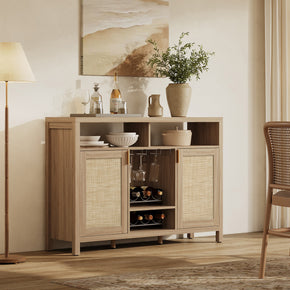
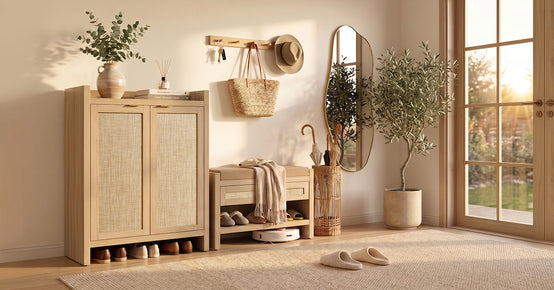
A raised rattan-front cabinet leaves the floor open for the robot's path.
Here's the method on two real cabinets from the Shoe Storage Cabinets & Benches collection (). Start with their published dimensions, then run the five-minute check against the product page's dimension drawing and underside photos — leg height, apron depth, and center rails all show up there.
|
Model |
Savanna Shoe Cabinet, 24 Pairs Shoes () |
Savanna Shoe Cabinet, 30 Pairs Shoes () |
|
Overall dimensions |
41" H x 32.4" W x 14.8" D |
40.94" H x 47.24" W x 14.76" D |
|
Capacity |
24 pairs |
30 pairs |
|
Material |
Engineered wood, matte |
Engineered wood, matte |
|
What to verify on the PDP |
Leg height and front-apron depth on the drawing; leg spacing across 32.4" width |
Leg height and any center rail on the drawing; the 47.24" width likely includes a middle support |
|
Robot-fit notes |
Fewer entry lanes; confirm the between-leg gap clears 14 inches |
More entry options, but check the middle rail |
The 24 Pairs Shoes fits a one-to-two-person household and a compact entryway; the 30 Pairs Shoes covers three to four people with its wider body. The counterintuitive bit: wider isn't automatically better for robot fit. A center support rail on a 47-inch cabinet can split the opening into two lanes, each too narrow on its own. The dimension drawing settles it — compare its leg and rail heights against your robot's number.
The 5-Minute Fit Check

Five measurements, one decision — cabinet in final position, rug where it will live:
Robot number. Your robot's listed height plus 0.5 to 1 inch of operating margin — that's your required clearance.
Cabinet number. The lowest point of the underside: legs, apron, center rail, feet after leveling. Take the smallest — that's your actual clearance.
Compare. Actual has to meet or beat required. Smaller? Stop here and look at the closed-base alternative.
Entry width. Clear gap between the legs on the approach side: under 14 inches is a no-go for full-size robots, 14 to 18 lets them enter but not turn, over 18 means free movement.
Perimeter sweep. Clear cords, laces, and small objects from the opening plus a two-foot border; confirm the baseboard gap, and re-check if a rug sits under the legs.
All five pass — schedule the robot and stop thinking about it. One fails? Now you know which one.
Quick Fit Reference

|
Your robot's height + margin |
Cabinet's lowest point |
Verdict |
|
Under 3.5" |
4.5" or more |
Fits comfortably |
|
3.5" to 4" |
4" to 4.5" |
Fits; re-check after leveling and with the rug in place |
|
Any height |
Under 3.5" |
Will not fit; consider a closed-base cabinet |
|
Any height |
Entry gap under 14" wide |
Will not enter; clearance height does not matter |
FAQs
How much clearance does a robot vacuum need under the cabinet?
Add 0.5 to 1 inch of operating margin on top of your robot's listed height. A 3.5-inch robot wants 4 to 4.5 inches of measured clearance at the cabinet's lowest point.
Does the LiDAR turret change the height I should measure?
No. The spec sheet's overall height already includes the turret — read the spec number, add your margin, use the total.
My cabinet legs are 4 inches tall. Is that enough?
Maybe. The legs aren't the measurement — check the front apron, the center support rail, and the feet after leveling. If the lowest point only just matches your robot's need, re-check with the rug in place.
Can a robot vacuum turn around under a shoe cabinet?
Roughly 18 inches of clear leg width for free turning; 14 to 18 lets it enter and reverse out. Under 14, most full-size robots can't get in.
Do rugs under the cabinet cause problems?
Yes. The pile raises the robot while the rug compresses under the legs and tilts the cabinet. Keep rugs out from under the legs — or re-measure with the rug in place.
What if my shoe cabinet sits flush on the floor?
That's fine. A closed base seals the floor so dust never gets underneath, and the robot cleans right up to the toe kick. You trade the open look for zero rescue missions.
Will the robot knock the cabinet over?
Rarely. A loaded cabinet is heavy and stable. The risky combo is a tall, lightly loaded cabinet on a slick floor — anchor it with the included anti-tip strap.
Should I pick the cabinet or the robot first?
Cabinet first when the entryway layout is fixed; verify the robot with the five-minute check. Already own the robot? Measure it and filter cabinets by required clearance.


Looking for something else?

10 Simple Ways to Style Modern Coastal Furniture at Home
LEARN MORE
21 Room Divider Ideas to Split a Space Without Building a Wall
LEARN MORE
16 Bedroom Bench Ideas That Actually Fit Your Room
LEARN MORE
Guest Room Furniture: How to Choose It Plus 10 Ideas That Work
LEARN MORELooking for something else?

21 Hallway Mirror Ideas to Brighten a Dark, Narrow Space
LEARN MORE
How to Clean Wood Furniture and Keep the Finish Intact
LEARN MORE
Furniture Distance From a Fireplace: How Far Is Safe?
LEARN MORE


Further reading
Shoe Cabinet Base Clearance: Will Your Robot Vacuum Fit Under It?

Freestanding vs. Wall-Mounted Shoe Cabinets: Which Is Safer and Easier to Install?


