









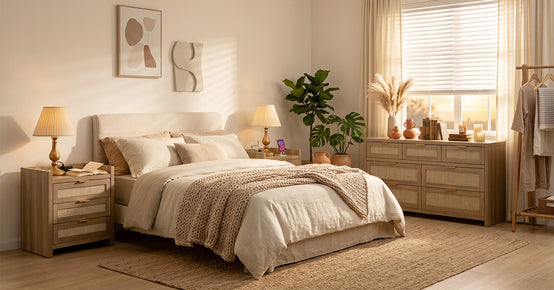





How to Choose a Nightstand for a Rental: Small Footprint, Easy Moving, and Useful Storage
Most nightstand guides are written for homeowners who'll keep the thing for a decade. Renters live differently — the average renter moves every two to three years, so your nightstand isn't a fixture. It's cargo. It has to squeeze through a 30-inch doorway, survive a stairwell, come apart and go back together without wobbling, and still hold your lamp and phone.
I learned this the expensive way. My second apartment had a beautiful solid-wood nightstand that weighed as much as a golden retriever — two people, three flights of stairs, one scraped wall, part of my deposit gone. The joints never recovered, and by the third apartment it rocked every time I set down a glass of water.
So this guide asks a different question than most: not which nightstand looks best, but which one will still be standing after your second move? Every measurement below comes from real product specs — and the checklist at the end is the one I wish someone had handed me before move two.
Measure the Room You'll Actually Have

Rental bedrooms lie. The listing says 10 x 12 feet — then you find a radiator under the window and a closet door swinging into the room. Before you glance at a single nightstand, grab three numbers:
Bed-to-wall clearance: measure from the edge of your mattress to the nearest wall or door swing. Under 18 inches is a tight squeeze — you'll want a nightstand no deeper than 15 inches.
Mattress top height — your nightstand surface should sit within about 2 inches of the mattress top, above or below. A 26-inch nightstand next to a 24-inch mattress is fine; next to a 28-inch one you'll reach down in the dark.
Narrowest doorway on the route. Measure between the building entrance and your bedroom — the whole path. If it's 28 inches, a 31-inch-wide nightstand only fits if you angle it, or not at all assembled.
Footprint Math: What "Compact" Really Means for Renters

"Compact" on a product page usually means "smaller than our biggest model," nothing more. For a renter, the footprint (width × depth) has to leave 24 inches of walkway between bed and wall.
Quick math: multiply width by depth. A 25 × 15-inch nightstand claims 375 square inches — about 2.6 square feet, which is reasonable in a 120-square-foot bedroom. A 31 × 16-inch model takes 3.4 square feet — which matters when the closet door needs swing room.
Depth deserves extra attention. Rental bedrooms run narrow, so the walkway disappears first. Fifteen inches deep instead of 17 gives back 2 inches of passing room. That's the difference between brushing past and walking past. Height is more forgiving — 22 to 28 inches works with most bed frames.
Drawers or an Open Shelf? Decide by What You Actually Store

This is where most people buy wrong. They pick based on looks, then discover their stuff doesn't fit. Start with what actually lives on your nightstand right now.
Pick drawers for small things that migrate — chargers, earbuds, medication, reading glasses, lip balm. Two or three shallow drawers beat one deep drawer. And interior height matters more than count — 6 inches fits a paperback standing up, 4 inches doesn't.
Pick an open shelf if you mostly park big flat things — a laptop you close at night, magazines, a water carafe. Open shelves are also lighter, with fewer moving parts to break in a move. No drawer glides to bend.
The renter's compromise is drawers plus a charging setup: the drawers hide the small stuff, and a built-in charging station solves the classic rental problem — one outlet, usually behind the bed. A power strip snaking across the floor is a trip hazard your landlord will notice.
The Second-Move Test: Assembly, Disassembly, and Fastener Fatigue

This is the section other guides skip, and it decides whether your nightstand survives rental life. Almost every nightstand under $300 ships flat-pack with cam-lock fasteners — and cam locks survive roughly two to three assembly cycles. Each disassembly crumbles the particleboard around the fastener; by the third move the joints go soft. Bolted frames with machine bolts into metal inserts dismantle repeatedly without losing rigidity — while cam-and-dowel tolerates only one or two disassemblies.
Ask these questions before buying:
● How many parts? Fewer panels mean fewer fasteners to fatigue. Twelve parts outlast thirty.
● How long is assembly? Forty-five minutes is standard. Over an hour means more joints and more failure points.
● Can it move assembled? The best renter move is no disassembly at all: light enough to carry, narrow enough for your doorways, and you skip the fastener problem entirely.
Can You Carry It Alone? Weight and Carry Points
Rental moves usually happen with minimal help — you, maybe one friend, a borrowed dolly. Know the assembled weight before moving day. Under 45 pounds is a comfortable one-person carry up stairs; 45 to 65 needs two people; over 65 means disassembling. The two picks below weigh 42 and 60 pounds respectively. That gap decides whether you wait for help or just go. Pull the drawers out before carrying: 5 to 10 pounds lighter instantly, and no drawer sliding open mid-stairwell. Check for carry points too. A slight top overhang or recessed base gives your fingers purchase halfway up the stairs.
Packed Size: The Number Nobody Checks
Lease ends, the new place isn't ready, and your stuff sits in storage for three weeks — suddenly packed size matters more than assembled size. The shipping box runs 2 to 4 inches larger than the product in each dimension, and it has to fit your car trunk or the storage unit's last free corner. Check one box or two — a pair sometimes ships as two boxes, easier to stack but harder to track — and keep the original box for the first year. On a 12-month lease you'll likely move before the cardboard degrades, and the fitted foam is the safest way to transport flat-pack furniture.
Wall Attachment When You Can't Drill

A loaded nightstand with drawers pulled open can tip forward — a real hazard with kids or in earthquake zones. But most anti-tip kits need a screw into a wall stud — and renters often can't drill.
Adhesive furniture straps — heavy-duty pads hold well on smooth painted walls and remove cleanly. Not as strong as a screwed strap, but they cut tip risk.
Museum putty under the front feet shifts the balance point back. It's invisible, removable, and it stops the piece creeping on hard floors.
Keep heavy items low. Books and the charging brick in the bottom drawer, light stuff up top. A bottom-heavy nightstand hardly tips at all.
Ask the landlord — many say yes to two small screw holes if you promise to fill them at move-out. A $4 tube of spackle is cheaper than a tip-over. And if the product includes an anti-tip kit, keep it in the hardware bag — your next apartment might allow drilling.
Protect the Floors, Protect the Deposit

Floor damage is the most common deposit deduction, right after wall holes. Every drawer pull shifts the piece a millimeter. Over a year that's a visible arc of scratches on hardwood. The fix costs almost nothing — felt pads on every contact point, replaced yearly since they compress and collect grit; a small rug on soft wood; reusable furniture sliders on moving day. Never drag a loaded nightstand across the floor.
Photograph your floors on move-in day — including where the nightstand will sit. Timestamped photos are your defense if the landlord later claims damage.
Two Nightstands That Survive Rental Life

Both picks below are real products with published specs — each earns its spot for a different rental scenario.
Savanna 3 Drawers Nightstand — *Best for solo movers.* At 42 pounds it's light for a three-drawer piece — 18 pounds lighter than the next pick, the difference between carrying it yourself and waiting for help. The 26.57" H × 24.8" W × 15.36" D footprint suits tight bedrooms; three drawers (main interior 6.06 inches tall, 21.1 inches wide) give real storage, with metal roller glides and safety stops. Assembly runs about 45 minutes with the included wrench, and SICOTAS lists a charger option — handy when the bedroom's only outlet hides behind the bed. Backed by a 360-day replacement warranty and 60-day returns.
Crescent Nightstand with 3 Drawers — *Best for maximum storage per square inch.* At 26.6" H × 31.3" W × 16.4" D it's wider, but packs serious capacity: main drawer interior 7.5 inches tall, 11.4 inches deep, 30.1 inches wide — paperbacks upright plus chargers and notebooks. The 60-pound weight means two people on stairs. Metal roller glides, drawer safety stops, engineered wood with a matte finish, same 45-minute assembly and 360-day warranty. If your rental bedroom doubles as an office, this one swallows desk overflow easily.
Browse the full nightstands collection to compare footprints, and check each product page for packed dimensions before ordering.
Move-Day Checklist for Your Nightstand

● Empty every drawer and shelf — even "just a few things" add weight and become projectiles.
● Remove the drawers and wrap each in a towel or moving blanket. Label them if you own more than one nightstand.
● Bag and tape all hardware inside the largest panel, and photograph the bag's contents.
● Wrap corners with cardboard or bubble wrap. Corners take every hit in stairwells.
● Measure the new doorway before the truck arrives — if it won't fit assembled, disassemble at the old place, not the hallway.
● Lay felt pads before positioning in the new room — much harder to lift a loaded nightstand later.
● Re-tighten every fastener after reassembly — then again after a week. Wood settles, and screws back out.
FAQs
What size nightstand fits a small rental bedroom?
Measure bed-to-wall clearance first. Under 24 inches, stay under 15 inches deep and 26 inches wide. A 25 × 15-inch footprint fits a lamp and phone without blocking the walkway.
Can I take apart a flat-pack nightstand and rebuild it after moving?
Yes, but budget for fastener wear. Cam-lock joints survive two to three disassembly cycles — metal-to-metal hardware lasts longer. Bag all hardware labeled and photograph the assembly steps the first time.
How heavy is too heavy for a rental nightstand?
Under 45 pounds is a comfortable solo carry up the stairs. 45–65 needs two people or drawer removal. Over 65, plan to disassemble. Check assembled weight, not shipping weight.
How do I stop a nightstand from scratching rental floors?
Felt pads on every contact point, replaced yearly — plus furniture sliders on moving day. Never drag a loaded nightstand — not even an inch.
Can I anchor a nightstand to the wall in a rental?
If drilling is banned, use heavy-duty adhesive furniture straps and removable putty under the front feet, and store heavy items in the bottom drawer. Some landlords allow small screw holes if you fill them at move-out time. Ask first — don't assume.
Is a nightstand with a charging station worth it for renters?
Usually, yes. Rental bedrooms often have just one outlet behind the bed, and a built-in charger kills power-strip clutter. Just note that the hardware adds weight on moving day.
Should I buy one nightstand or a pair for a rental?
Start with one and live with the room for a month — rental bedrooms are often asymmetric. A radiator or closet door can turn a second nightstand into a walkway blocker overnight.
What if there is no outlet near the bed at all?
Then the charging station matters more than the drawers. Run a flat extension cord under a rug from the nearest outlet (never across a walkway), or pick a nightstand with a built-in charger.


Looking for something else?

How to Choose a Shoe Cabinet for Wet Shoes and Muddy Entryways
LEARN MORE
Freestanding vs. Wall-Mounted Shoe Cabinets: Which Is Safer and Easier to Install?
LEARN MORE
Shoe Cabinet Base Clearance: Will Your Robot Vacuum Fit Under It?
LEARN MORE
How to Choose a Nightstand for a Rental: Small Footprint, Easy Moving, and Useful Storage
LEARN MORELooking for something else?

How to Match a Nightstand to Your Bedside Lamp Size and Weight
LEARN MORE
Nightstand Leg Height for Robot Vacuums: A Bedside Clearance Guide
LEARN MORE
How to Choose a Buffet Cabinet for a Coffee Bar: Heat, Cords, and Spill Protection
LEARN MORE


Further reading

Attic Bedroom Ideas: Furniture for Sloped Ceilings

What Is Wicker? Wicker vs Rattan Explained


