



How to Fit a Dresser Inside a Closet: Measurements and Layouts
Small bedrooms all share the same contradiction — a closet floor sitting completely bare while the dresser hogs the only good wall. And that floor? Easily the least-used square footage in the whole house. The dresser? Bulkiest thing in the room. Shove the two problems together and they both shrink at once.
Tucking a dresser inside a closet sounds odd until you see it done right — then it looks obvious. This guide covers the measurements that decide whether it works, how sliding, hinged, and missing doors change the math, and two SICOTAS dressers measured against real closet dimensions.
A low dresser tucked into a reach-in closet — clothes still hanging above, floor space back where it belongs.
Why a Dresser in the Closet Works Better Than You Think
The honest reason is floor space, and it's not close. A dresser eats roughly six square feet — usually the exact wall you wanted the bed against. Get it into the closet and that wall is yours again. Apartment Therapy ran a guest-room story where a queen bed swallowed the floor and the closet sat far bigger than any guest would ever need. In went the dresser. Suddenly the whole room could breathe again.

Then there's the dead-space math — most reach-ins run one rod and one shelf, with the lower half left to collect shoe piles. A chest of drawers turns that void into real storage — the writer behind The Homes I Have Made calls it one of her favorite small-space moves.
And the look. A dresser filling the closet opening, topped with a board cut to span the full width, reads like custom built-in millwork. For a fraction of what millwork costs. Guests will swear you hired someone.
Tape, measure, repeat — closet, dresser, and every doorway in between.
Measure Three Things Before You Spend a Cent
Fall in love after you grab the tape measure. Three measurements decide everything.
● First, the closet: wall-to-wall width at the back, and depth from the back wall to the door frame. The interior, not the doorway — people mix these up constantly.
● Second, the dresser: full width, height, depth, including any overhanging top. Listings report the widest point. Trust it.
● Third — the one everyone forgets — the opening and the route. Closet door width first — then every hallway and stair turn in between. A dresser that fits the closet on paper can still refuse a hallway corner. Wider opening, deeper closet — easier move. Cheap furniture sliders help more than you'd think.
The sticky-note version: closet, dresser, opening. All three have to agree. Measure twice, or haul it back.
The Fit Rules: What Actually Works in Real Closets

A standard reach-in runs about 24 inches deep. Most dressers clock in under 20, and that four-inch gap is your drawer budget — the room the drawers need to pull open. Closet shallower, dresser deeper? Check that budget before delivery day. Not after.
A standard rod sits around 66 inches off the floor. A low dresser in the 26 to 32 inch range leaves 34 to 40 inches of hanging space above — plenty for shirts and kids' clothes. That's why low, wide dressers win in closets. They keep the rod usable. A tall dresser in a closet is just a wall with drawers.
Give it two to three inches of breathing room per side, unless you're going full-opening built-in — then tight is the point. And remember: product-page depth is the outside of the piece. SICOTAS's standard drawer depth guide notes a medium drawer runs about 16 inches deep, a large one about 18, the rest going to panels, slides, and clearances. Plan around the interior.
Low dresser, happy rod: the hanging space above stays fully usable.
Reach-In vs Walk-In: Two Different Layouts
Most closets are reach-ins, four to six feet wide. The classic layout: low dresser under the rod on one side, longer hanging items on the other. In a kids' room it's nearly perfect — short clothes, rod still fits everything, drawers at kid height.
Wide enough reach-in? Center the dresser in the opening. A dresser filling the full door width with a plywood topper spanning wall to wall looks convincingly built in — and closes the gap behind a shallow dresser where small items vanish. You know the gap.

A walk-in lets you walk around the piece, so run it along the back wall between hanging zones, or anchor one end like an island. Keep about 30 inches of clear walkway in front. You need to open the drawers and stand there simultaneously — obvious until you're doing it sideways.
Walk-in luxury: a wide dresser anchoring the back wall between hanging zones.
Drawer Clearance: Sliding, Hinged, or No Doors
Here's the trap: the dresser fits, but its drawers can't open. You discover this on move-in day. Pull every drawer fully open before declaring victory. All of them.
With bypass sliding doors, only half the closet is reachable at a time — so the drawer bank must sit behind the accessible half. Slide both doors aside and check. Removing one slider is a popular fix: hides half the closet, leaves drawers permanently reachable.

Hinged doors give the full opening; the swing is the issue. Make sure it clears the bed. Bifolds need floor space to fold. Or remove the doors entirely — no clearance math, effortless access, stronger built-in look. A curtain above the opening is the softer middle ground.
Full extension, every drawer, before you call it done.
Sliding doors? Park the drawer bank behind the half you can open.
Choosing the Dresser Shape That Fits Inside
Low and wide beats tall and narrow in a closet. The rod owns the height. Don't fight it. Around 26 to 31 inches tall, it slides under the rod and keeps the top usable for folded stacks or a tray. Bonus storage most people never count.
Sixteen to eighteen inches of depth hits the sweet spot for a reach-in — deep enough for real clothing, shallow enough to leave pull-out room in 24. Anything past 20 belongs in a walk-in or against a bedroom wall.

Modular dressers are made for awkward spaces. Independent units carry through narrow doorways one at a time, split across both closet sides, or line up as a single run. Add a unit later instead of replacing everything. And since there's no stepping back inside a closet to peer into a half-open drawer, smooth full-travel roller glides matter more here than in a bedroom.
Don't waste that top — trays, a plant, hooks above.
Light, Air, and the Moisture Question
Closets are dark — and a dresser in a dark closet is one you won't touch. A ten-dollar motion-sensor LED strip under the shelf solves it. Warm light — 2700 to 3000 kelvin — and the nook feels like a dressing area, not a cave.

Leave an inch or two behind the dresser for airflow. Don't shove it against an exterior wall. That's the entire moisture strategy. With that gap and normal humidity, a closet dresser runs no more risk than a bedroom-wall one.
The ten-dollar fix: a motion-sensor LED strip under the shelf.
Doors gone? A curtain keeps it soft and simple.
Two Dressers Measured for Closet Duty
Two SICOTAS dressers fit the closet brief, from opposite directions. The Crescent Modular 9 Drawers Dresser is the low, flexible pick: each unit runs 26.6 inches high, 31.3 wide, 16.4 deep, three units lined up for nine drawers. Independent units carry through tight doorways one at a time, and a fourth can widen the run later. Smooth roller glides, scratch-proof water-resistant finish, FSC-certified wood. The renter's answer.
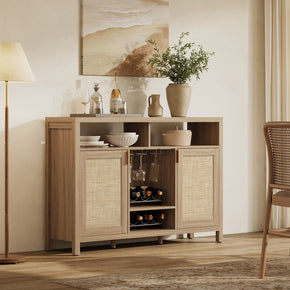
The Savanna Dresser, 7 Drawers is the one-piece statement — 31.34 high, 56.88 wide, 17.72 deep, seven rattan-front drawers on metal roller glides. Inside, the drawers run 6.88 high by 15.16 deep by 24.61 wide. The 119-pound build packs a drawer safety stop. Just over 31 inches tall, it slides under a standard rod — and it's wide enough to fill a reach-in opening for the built-in look.
● Crescent Modular 9-Drawer
● Savanna 7-Drawer
● Overall dimensions
● 26.6"H x 31.3"W x 16.4"D per unit (3 units)
● 31.34"H x 56.88"W x 17.72"D
● Drawers
● 9, in independent modular units
● 7, rattan fronts
● Drawer glides
● Smooth roller glides
● Metal roller glides
● Best closet fit
● Narrow reach-ins, split layouts
● Standard reach-ins, full-opening built-in
● Standout trait
● Add a 4th unit to widen the run
● Drawer safety stop, 119 lb build
● Compare depths and widths against your own closet numbers in the full dressers collection — that's where tape-measure math meets reality.
● Full-opening fit: a wide dresser that reads as custom built-in.
Three Layouts That Actually Work

● The under-rod lowboy. Best for narrow reach-ins, and the most common win. Low modular dresser under the rod, short items above, one side kept for anything long. Bedroom wall stays free. Done by lunch.
● The full-opening built-in. Best for standard reach-ins with wow factor. Center a wide dresser in the door opening, cut a plywood topper to span wall to wall. Looks like millwork. Costs a weekend.
● The walk-in wall. Run the dresser along the back wall between hanging zones, or split modular units to flank a center mirror. Keep 30 inches of walkway in front — non-negotiable.
Move-In Day Checklist
Empty the closet completely and pop out wire shelving or low rods in the dresser's zone. Mark the footprint with chalk or a spare bedsheet, then mime opening every drawer — yes, mime. Check the delivery route against the carton dimensions, and keep furniture sliders handy.
Slide the dresser in, leaving an inch or two of airflow behind it. Open every drawer to full extension. Confirm nothing hits a door, frame, or track. Then the fun part — LED strip, topper, hooks or pegboard above. Stand back and admire.
FAQs
Can any dresser go inside a closet?
Almost — but depth is the bouncer. Keep the dresser at least two inches shallower than the closet depth so the drawers open fully, and check the width against the interior and the door opening. Low dressers — 26 to 32 inches — are the easiest fit, because they keep the rod usable.
What size dresser fits a standard reach-in closet?
About 24 inches deep — so stay under 20, with 16 to 18 the sweet spot. The Crescent Modular at 31.3 inches per unit and the Savanna at 56.88 wide cover the common cases between them. Measure yours, pick your fighter.
Will my drawers open fully behind sliding closet doors?
Only behind the half you can open — that's the bypass-slider trick. Slide both doors aside, stand where you dress, pull every drawer to full extension. Track blocking one? Shift the dresser or remove a slider.
Should I remove the closet doors?
You don't have to — but it's the simplest fix for stubborn clearance issues, and it looks intentional. Store the doors flat somewhere dry, or hang a curtain above the opening for a softer feel.
How tall can the dresser be with clothes hanging above it?
A standard rod sits around 66 inches — stay under about 34 inches of dresser and you keep roughly 32 inches of hanging space for shirts and pants. Shorter is more forgiving — when in doubt, go lower.
Will a dresser in the closet cause moisture or mold?
Not with basic care — an inch or two of airflow behind it, off exterior walls, normal indoor humidity. That's the whole plan. A closet dresser is no riskier than a bedroom-wall one.
Can a modular dresser split across two closet sides?
Yes, that's the point of modular. The Crescent's units are independent — two on one side and one on the other, or all three as one run. Add a unit later as needs grow.
Is putting a dresser in the closet renter-friendly?
Completely renter-friendly. No screws, no trim pulled off, no carpentry. Store the doors safely, stick to battery LED strips, and the whole thing reverses in an afternoon.


Looking for something else?
TV Stand With Doors vs. Drawers: Which Storage Works Better
LEARN MORE
Bookcase With Doors vs. Open Shelves: Which One Should You Buy?
LEARN MORE
Buffet Cabinet With Drawers vs. Doors: Which Storage Mix Should You Choose?
LEARN MORE
Tilt-Out vs. Shelf Shoe Cabinets: Which Fits More in a Narrow Entryway?
LEARN MORELooking for something else?

Nightstand With Drawers vs. Open Shelf: Which Storage Layout Should You Buy?
LEARN MORE
How Much Weight Can a Dresser Hold? What to Check Before You Buy
LEARN MORE
How to Buy a Rattan Buffet Cabinet That Will Hold Up to Daily Use
LEARN MORE


Further reading

How to Organize Dresser Drawers So Every Drawer Has a Job

Bureau vs Dresser: Names, Sizes and What to Buy Today


