





Buffet Cabinet With Drawers vs. Doors: Which Storage Mix Should You Choose?
The Short Answer: Drawers for the Small, Doors for the Tall
Here's the version I'd give a friend. Fits in your palm? Drawer. Taller than a wine bottle? Door.
Drawers win the grab-and-go game — flatware, napkins, candles, that corkscrew that keeps vanishing on you. Doors take the big awkward stuff: platters, tureens, the stack of plates you're not carrying with one hand.
Every opening type should match what lives inside.
|
At a Glance
Drawers for small, flat, daily-use items; doors and shelves for tall, bulky, occasional ones. Get the mix wrong and a third of the cabinet quietly goes to waste.
|
The Real Inventory: What a Buffet Cabinet Actually Holds
Before anything else — be honest about what you're actually stuffing in there. Most dining rooms keep the same lineup, and everything in it has a natural home. Hand a shallow drawer something tall and it'll spit it right back at you.
|
Item
|
Typical size
|
Natural home
|
|
Flatware sets
|
Tray ~13 × 9 × 2 in
|
Drawer
|
|
Cloth napkins, placemats
|
Folded ~12 × 9 in, stack 2–3 in
|
Drawer
|
|
Wine opener, serving tools, candle lighter
|
Pocket-size
|
Drawer
|
|
Short candles and holders
|
Under 8 in tall
|
Drawer
|
|
Charger plates
|
13 in across, stack ~3 in
|
Shelf behind doors
|
|
Dinner plates
|
10.5–12 in, a dozen stacks ~4 in
|
Shelf behind doors
|
|
Platters and tureens
|
14–18 in long, 6–8 in tall
|
Shelf behind doors
|
|
Tall vases, pitchers, candlesticks
|
10–18 in tall
|
Tall door bay
|
|
Wine bottles
|
12 in tall
|
Tall door bay
|
|
Tablecloths, runners, board games
|
Bulky folded stacks
|
Shelf behind doors
|
Inventory first, compartments second.
Drawers: The Small-Item Specialists
What drawers do better than anything? Visibility. Yank one open and the entire layer's right there — no crouching, no fishing behind the salad plates for a napkin ring.
Flatware's the classic case. A standard tray runs about 13 × 9 inches and stands 2 tall; a chaotic drawer turns into a labeled map. Napkins and placemats fold down to roughly 12 × 9 and stack up 2 to 3 inches. Everything you grab mid-meal — corkscrew, spare knives, the candle lighter — that all belongs to drawer real estate.
What drawers punish
Still, drawers have a mean streak. They're shallow by design, most giving you only 3 to 4 inches of real depth. A vase will never stand in that. Stack plates too high and the drawer just refuses to shut. Load it with heavy platters and it becomes a sled you'll grow to hate. That's the deal.
A flatware tray turns a shallow drawer into a map.
Doors and Shelves: Room for the Bulky and the Tall
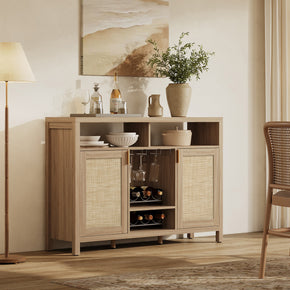
Behind a door you're trading visibility for volume. Plate stacks. 13-inch chargers. Platters pushing 18 inches long that would have killed a drawer on day one.
Doors also hide the gorgeous-but-awkward stuff — the ice bucket that earns its keep twice a year, the holiday tureen, the leaning tower of tablecloths. The catch? A shelf is a front-row universe. Whatever sits behind the first row becomes archaeology. Stash the daily napkins behind a door and you'll be cursing that cabinet within a month.
Shelves swallow platters no drawer could hold.
Tall Clearance: The Vase-and-Pitcher Problem
This is the number-one buying mistake, and honestly, nearly everybody makes it. Most buffet interiors hand you 10 to 13 inches between shelves. Plates? Fine. A 16-inch vase? Dead on arrival. Wine bottles stand 12, tall pitchers 9 to 10, candlesticks anywhere from 6 to 12, and that display vase you've been eyeing can hit 18.
Tall stuff needs a door bay with a fixed tall section — or a removable shelf. One bay handles the height duty; everything else stays at plate level.
|
The 2-minute tall test
Line up your five tallest dining pieces and measure them. Two or more over 12 inches means any cabinet without a tall door bay is the wrong one, no matter how good it looks.
|
Tall pieces need a door bay with real vertical clearance.
Access Frequency: Daily Items vs. the Holiday Shelf
Let's be honest — you don't open every compartment equally. Map your actual week, not the fantasy one. Placemats, napkins, candles, the everyday flatware — the Sunday-to-Friday stuff — belongs in the easiest openings, usually the center drawers and the top shelf.
The holiday layer — good silver, the turkey platter, the crystal — can live behind doors you open twelve times a year. That's fine. What I've noticed: buffets almost never fail on size. They fail because daily stuff got buried behind a door while holiday stuff hogged the prime drawer.
Daily items earn the easiest openings; holiday pieces wait behind doors.
Hardware Wear: Hinges vs. Drawer Glides Over the Years
Every cabinet has two moving parts, and they age like completely different species. Ball-bearing drawer glides get cycle-tested to 50,000–100,000 opens and closes, rated 75 to 100 pounds — a flatware drawer barely tickles them. Drawers don't die from weight. They die from slamming.
Hinges tell the opposite story: they fail gradually and constantly. European concealed hinges wander after years of handle yanks, and a door that keeps kissing the frame ends up parked half-open. Good news, though — five minutes with a screwdriver, twice a decade, and you're golden.
Glides shrug off daily traffic; hinges need the occasional tune-up.
Which SICOTAS Sideboard Has Your Mix
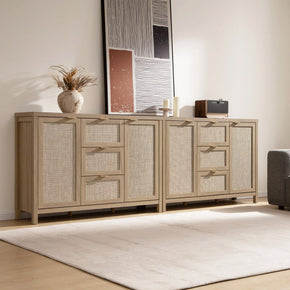
The SICOTAS homepage carries the full sideboard range — compact 29-inch cases up to 51-inch statement pieces, all 33 to 35 inches tall. Here's how the five core models split on drawers vs. doors.
|
Cabinet
|
Size (H × W × D)
|
Drawer-door mix
|
Best for
|
|
33.9 × 43.5 × 14 in
|
Drawer bank plus door bays
|
Balanced households
|
|
|
35.43 × 51.57 × 14.02 in
|
Widest case; full drawer bank and tall bays
|
Entertainers with platters and tureens
|
|
|
35.4 × 34.2 × 13.9 in
|
Door-forward with arched fronts
|
Display-minded rooms with tall vases
|
|
|
34.1 × 30.9 × 15.6 in
|
Two-door, shelf-forward
|
Plate stacks and bulky serving pieces
|
|
|
33.5 × 29.18 × 13.98 in
|
Compact 29-inch width
|
Small apartments
|
The Savanna Sideboard with Doors is the safe middle — 43.5 inches of width carries a real drawer bank without starving the door bays.
Match the drawer-door split to your inventory, not your wish list.
Scenario Picks: Who Should Buy Which Mix
The entertainer
The host's life: chargers, two platters, a tureen, candlesticks in three different heights. Go doors-heavy with one tall bay, and keep a drawer bank for the mid-course tools. The 51.57-inch Savanna Sideboard Cabinets swallows all of it — tall bay and drawers never fight over the same space.
The family
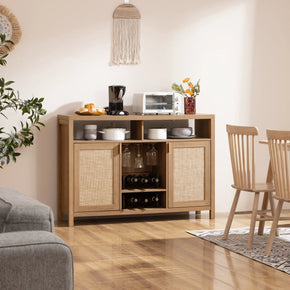
Daily chaos. Placemats, off-limits candles, board games, the takeout-menu pile. Go drawers-heavy: drawers forgive mess and they hide it fast. Center drawers take the daily kit; one door bay handles games and holiday overflow. The Stria Sideboard with 2 Doors gives you that bay at 15.6 inches, the deepest in the line.
The small apartment
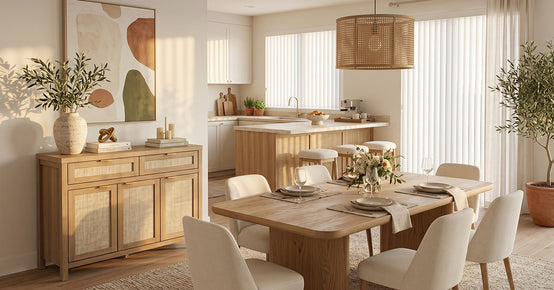
One cabinet, every job. A compact 29-inch case like the Prelude Sideboard with Doors — shelves that hold plates by day and swallow the overflow by night. The drawer takes the flatware tray and the small daily tools. Everything else has to earn its shelf.
Small apartments need one cabinet that does every job.
The Decision: Five Questions Before You Buy
-
What are your five tallest pieces? If two clear 12 inches, a tall door bay isn't optional.
-
What do you reach for between courses? Corkscrew, extra knives, napkins — those earn drawers.
-
How do the plates stack? A dozen dinner plates needs 4 inches of shelf height and a full foot of width. That's a door bay, not a drawer.
-
Who opens it most? Kids and daily chaos point at drawers; occasional hosting points at doors.
-
Will you ever touch a hinge? If the honest answer's no, put the daily stuff on glides and the yearly stuff behind doors — where the sag annoys you least.
Let the inventory choose the cabinet.
Final Word
So stop asking drawers-or-doors. Ask what goes where. Small, flat, daily: drawer. Tall, bulky, occasional: door. Get that assignment right and even a modest cabinet feels twice its size. Get it wrong, and the prettiest sideboard on the block becomes furniture you argue with. Browse the SICOTAS sideboard collection and match a mix to your inventory.
FAQs
Q: Should a buffet cabinet have drawers or doors?
Honestly, the split matters more than the verdict. Small flatware and napkins earn a drawer — you see the whole layer in one glance. Platters, tall vases, plate stacks? They earn a door; they need volume no drawer can give. Drawers-only rejects anything tall. Doors-only buries the small tools.
Q: What should you store in buffet cabinet drawers?
The daily-grab kit, basically. Flatware trays, folded napkins and placemats, short candles, tools like the corkscrew and the extra knives. Most buffet drawers top out at 3 to 4 inches of usable depth, so measure anything before committing. Tall pieces won't fit.
Q: What goes behind buffet cabinet doors?
The bulky and the tall: plate and charger stacks, platters up to 18 inches, tureens, folded tablecloths, vases, wine bottles. You get volume instead of visibility — so keep the everyday items out of the back row, where they just turn invisible.
Q: How much vertical clearance do vases and pitchers need?
Measure first, always. Wine bottles stand 12 inches tall, pitchers run 9 to 10, display vases can reach 18. And since most buffet shelves offer only 10 to 13 inches between tiers, anything over 12 inches needs a dedicated tall bay.
Q: Are drawers or doors better for everyday dining items?
Drawers take the daily round, no contest. Everything's visible at a glance — no crouching, no digging. Doors belong to the holiday layer: the good silver, the turkey platter, the crystal that comes out maybe a dozen times a year.
Q: Do drawer glides or cabinet hinges last longer?
Glides do — under daily use, at least. Ball-bearing slides get cycle-tested to 50,000–100,000 cycles and carry ratings of 75 to 100 pounds. Hinges aren't weak; they just drift and sag with the years. The tradeoff: a five-minute screwdriver reset every now and then.
Q: Which drawer-door mix suits a small dining room?
Something like the 29-inch Prelude Sideboard with Doors — one drawer for the flatware tray, adjustable shelves for everything else. When one cabinet does every job, single-purpose layouts just eat space.
Q: Can you store wine bottles in a buffet cabinet?


Looking for something else?

20 Small Media Room Ideas for a Cozy, Space-Smart Setup
LEARN MORE
18 Jewelry Storage Ideas for a Tangle-Free Collection
LEARN MORE
10 Coffee Table Alternatives That Work Better in Small Living Rooms
LEARN MORE
15 Home Theater Furniture Ideas That Make a Room Work
LEARN MORELooking for something else?

Open vs Closed Floor Plan: Which Layout Suits Your Home?
LEARN MORE
Whitewashed Wood Furniture: Getting the Finish Right at Home
LEARN MORE
18 Accent Table Decor Ideas That Work in Real Rooms
LEARN MORE


Further reading

How to Choose a Dresser for Sweaters, Denim, and Bulky Clothes
The category name is not the answer. Drawer count is a weak capacity proxy. Bulky clothing fit is controlled by usable drawer height, width, extension, bottom support, and the way each garment is ...

Adjustable vs. Fixed Bookcase Shelves: Which Is Better for Real Storage?
The Short Answer
Neither wins outright — the best bookcase usually has both. Fixed shelves make the case rigid: at least one shelf locked into the sides (ideally near the middle) stops the who...

One-Drawer vs. Two-Drawer Nightstands: Which Is More Useful?
One drawer or two — sounds like a coin flip till you've lived with the wrong one. Two months in, that single drawer has quietly become a junk drawer. Or the bottom drawer of your two-drawer unit h...


