



TV Stand With Doors vs. Drawers: Which Storage Works Better
TeamSICOTAS
TeamSICOTAS
0 comment

TV Stand With Doors vs. Drawers: Which Storage Works Better

Ask any owner: the TV stand looked perfect in the photos, then the real gear moved in — a console that runs hot, a router with blinking lights, four remotes, a tangle of HDMI cables, and game cases with nowhere to live. Where does each thing go so the setup works every night, not just on delivery day?
This guide stays inside closed storage and answers which devices belong behind doors, which in drawers, and how to handle heat, remote signals, cables, and cleaning. Start from your gear, not from the media console furniture.
If you are still shopping, browse the TV stand collection with this guide open and check each piece against your device list.
Doors for gear, drawers for small stuff.

Start With a Device Inventory

Before you pick a side, list what you actually own. One AVForums buyer customized an IKEA Besta with drawers, then regretted it: the drawers ate the bay space his Denon receiver and centre speaker needed. Inventory big gear first.
Walk your living room and write down every item that will live in or around the stand. Then sort each one into its job:
Your device
Best storage
Why
Game console (PS5 / Xbox / Switch dock)
Doored cabinet
Runs hot; needs air volume around it
AV receiver / amplifier
Doored cabinet
Largest and hottest box; needs a full bay
Soundbar
On top of the stand
Drivers need clear air; do not box it in
Router / modem
Ventilated cabinet or open
Runs warm 24/7; hates being sealed in
Streaming stick / box
Drawer or behind door
Tiny, cool, easy to lose
Game cases / Blu-rays
Drawer
Small, uniform; drawers keep them filed
Controllers / headsets
Drawer
Grab-and-go daily items
Remotes
Drawer
Always disappearing; one drawer ends the hunt
Batteries, charging cables, manuals
Drawer
Small accessories belong in shallow storage
Spare HDMI cables
Drawer
Coiled cables fit a drawer better than a shelf
The split is clear: big, hot electronics want cabinet volume behind doors; small, cool, frequently handled items want drawers.

Sort by Heat First, Then by Siz

Heat decides this purchase. Closed cabinets trap warm air, so consoles, AV receivers, routers, and cable boxes — the heat producers — must be separated from remotes, discs, controllers, and cables, which run cold.
The heat rule
Heat producers vs. cool accessories: consoles, receivers, routers, and cable boxes run warm — they need ventilated doored cabinets with clearance, never sealed drawers. Remotes, game cases, controllers, batteries, and cables run cold and belong in drawers.
Owners improvise around bad heat planning all the time. On ResetEra, one owner with three consoles behind closed doors simply opens the doors whenever he plays. On Ask MetaFilter, a buyer drilled vent holes and added quiet 120 mm USB exhaust fans. Plan airflow at purchase time, not after the first thermal shutdown.
Open doors vent heat: plan airflow before you buy.

What Doors Do Best, What Drawers Do Best

With heat sorted, judge each storage type by job — doors and drawers are specialists, not rivals.
Job
Doors
Drawers
Large electronics
Winner. A full cabinet bay swallows a receiver or console with room to spare
No — drawers eat the bay space big gear needs
Small daily items
Usable, but items get lost in deep dark cabinets
Winner. One pull and everything is visible
Ventilation
Winner, with planning. Cabinet volume holds air; add vents or fans
Poor — drawers are tight boxes around warm gear
Cable access
Winner. Open both doors and every plug is reachable
Cables behind a drawer pull get pinched and tangled
Child and pet safety
Good — doors with latches keep hands off
Winner. A drawer closes flush and hides everything
Dust control
Good — sealed doors block dust
Winner. Enclosed on five sides
Quick grab of one item
Slower — open door, reach past other gear
Winner. Pull, grab, push
Bulk overflow storage
Winner. Deep cabinets hold baskets and spare gear
Limited by drawer depth
Doors are the garage, drawers the toolbox: you want both, in the ratio your inventory dictates. Console-heavy list? Weight toward doors. Remote-and-controller-heavy? Weight toward drawers.

Drawer Depth: The Number That Matters

Most buyers check the stand's overall depth and stop there. The number that decides whether drawers work is the drawer's interior depth, front to back, in usable space — slides and the back panel eat an inch or two of it.
  • 4–5 inches of interior depth handles remotes, phones, and loose batteries.
  • 5–6 inches fits game controllers standing upright and stacked game cases.
  • Below 4 inches is a junk tray: fine for remotes, useless for controllers.
Before you buy, ask the seller for the drawer's interior measurements, not the stand's exterior ones. Remember the AVForums buyer's regret: every drawer bay is a bay that cannot hold a receiver. If your list has a receiver or centre-channel speaker, reserve a full cabinet bay for it first.
A deep drawer with dividers keeps controllers sorted.

Door Swing and Front Clearance

Drawers slide straight out. Doors sweep an arc. That arc is the cost of choosing doors, and it is measured in floor space.
A hinged door swings through a radius roughly equal to its width — often 12 to 18 inches per door. Two doors at once can claim three feet of floor, so a coffee table 20 inches away gets slid back every time you change a disc.
Leave at least 18 to 24 inches of clear floor in front of any doored cabinet you plan to open regularly. Tape the door arc on the floor before the stand arrives and walk your normal path. Drawers need only their pull-out length, usually 12 to 16 inches.
Adjustable shelves decide whether a tall console fits upright. The Stria TV Stand with Storage up to 100Inch TV has 15 mm adjustable shelves inside its two-door cabinet — check them against your tallest device before assembly.

IR Signals and Solid Doors

Solid wood doors block infrared: the beam cannot pass through a closed wooden door, so the cable box behind it will ignore you.
Three fixes, from cheapest to most complete:
  • Move the receiver. If the box has an external IR sensor input, stick the tiny sensor outside the cabinet.
  • Add an IR repeater kit. A small receiver outside the doors relays your remote's signal to emitters stuck inside — about the price of a pizza.
  • Switch to Bluetooth or RF remotes. Fire TV, Roku, and modern cable remotes pair over Bluetooth or RF, which sail straight through doors. Game controllers already use Bluetooth, so consoles behind doors never had this problem.
Glass-front doors pass IR while hiding clutter, but that choice belongs to the open-versus-closed conversation — settle the remote question before you load the cabinet.
Solid doors block infrared remote signals.

Cable Routing: Where Doors Earn Their Keep

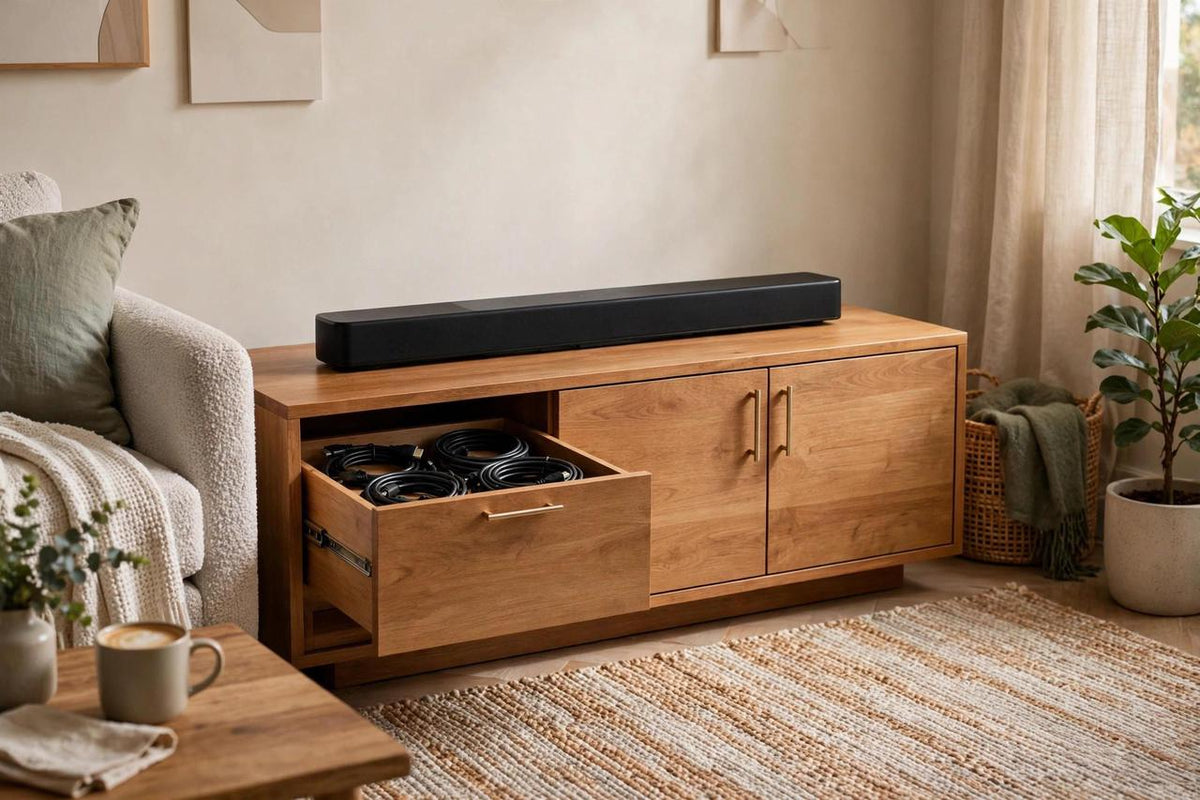
Cables are the tiebreaker nobody expects. Behind doors, every plug is reachable — open the cabinet and the power strip, HDMI runs, and router are right there. Behind a drawer, cables get pinched in the slides.
Shop for round cable ports in the back panel and depth to park a power strip flat. Honest flag: the Stria TV stand's product Q&A confirms it has no cable management holes — plan a drilled port or adhesive raceways.
Open doors put every plug within reach.

Cleaning: Closed Storage Stays Cleaner

Dust is the quiet argument for closed storage, and drawers win the fine print. A drawer is enclosed on five sides, so remotes and controllers stay clean for months. A doored cabinet blocks most dust but breathes through its gaps.
Wipe the cabinet interior and device tops monthly, and pull each device out twice a year to clear the dust its fan has collected. Two minutes of compressed air on the console vents beats any cabinet feature. Drawers need almost nothing.
A monthly wipe keeps cabinet and gear dust-free.

Three Sample Layouts That Work

The Gamer Setup

Two consoles and a stack of controllers. Park the PS5 and Xbox in the door bays with doors ajar during long sessions — the ResetEra owner's trick, formalized. Controllers, headsets, and game cases go in the drawer with a divider tray. Keep the router out; gamer routers run warm and the consoles already heat the bay.
The gamer layout: consoles vented, controllers in the drawer.

The Streamer Setup

Soundbar on top, streaming box and router in the cabinet. The small, cool streaming box can live in a drawer; the router gets a ventilated door bay, with an IR repeater handling the cable box beside it. Spare HDMI cables coil in the second drawer, sorted by length.
The streamer layout: hidden router, remotes in the drawer.

The Minimal Setup

One soundbar, one streaming stick, two remotes — barely a cabinet's worth, which is why a hybrid with one door bay and one drawer fits. The stick hides behind the door, the remotes live in the drawer. Buy the smallest piece that holds your actual inventory.

SICOTAS Picks: Match the Stand to Your Inventory

Every dimension below comes from the actual SICOTAS product page. Match the storage mix to your inventory:
SICOTAS stand
Storage mix
Dimensions
Best for
Drawer + 2 doors
30 in W x 34 in H x 14 in D
The best-of-both pick: drawers for accessories, doors for gear
2 doors
30.9 in W x 34.1 in H x 15.6 in D
Door-heavy setups; top panel holds up to 77 lbs, 15 mm adjustable shelves inside
Open shelves + 2 door cabinets
59 in W x 26 in H x 15.5 in D
Contrast point: 23 in middle bay, 15 in end bays, 4 cable holes — for gear that must breathe
Doors (61.3 in wide)
61.3 in wide
Wide-wall setups; confirm depth with the seller before ordering
Fit note: the Savanna drawer model suits TVs up to 100 inches per its product name, but check your TV's stand width against the 30-inch top. A wide TV on a narrow stand is a tipping risk.

The Short Answer

Doors and drawers do not compete for the same job. Doors take big, warm electronics that need cabinet volume and reachable cables; drawers take small, cool accessories you grab daily. The buyers who regret their purchase chose a storage ratio — all drawers, all doors — before listing their gear.
List the gear, sort it by heat, reserve cabinet bays for the warm stuff, and let the leftovers decide your drawer count. Shop the TV stand collection with that list in hand, and check drawer depth, cable ports, and door swing before you check the price.
The stand that fits your inventory.

FAQs

Is a TV stand with drawers or doors better for a gaming setup?

A hybrid wins. Give consoles door bays with airflow (leave doors ajar during long sessions), and keep controllers, headsets, and game cases in drawers with divider trays.

Can you put a PS5 or Xbox inside a TV stand with closed doors without overheating it?

Yes, with ventilation planned. Leave clearance around the console, keep cabinet vents unblocked, and leave the doors open during long gaming sessions — that is what real owners actually do. For a permanent fix, add quiet USB-powered exhaust fans so airflow runs whenever the console does.

Do TV stand doors block the TV remote signal?

Solid wood doors block infrared, so a traditional remote cannot reach a box hidden behind them. Fix it with an IR repeater kit, or switch to a Bluetooth or RF remote (Fire TV, Roku, most modern cable remotes), which pass through doors. Game controllers already use Bluetooth.

Are drawers or cabinets better for storing game discs and controllers?

Drawers, with an organizer tray. Game cases file neatly, controllers stand upright in 5–6 inches of drawer depth, and one pull puts everything in view. In a doored cabinet, small items slide to the back and disappear into the dark.

What is better for cable management — a TV stand with drawers or doors?

Doors, by a clear margin. Open the cabinet and every plug, power strip, and HDMI run is reachable. When shopping, look for cable ports in the back panel — and note the Stria TV stand has none, per its own product Q&A, so plan a drilled port or raceways.

How do you keep a closed-door TV stand cool for an AV receiver?

Give it a full cabinet bay with clearance on all sides, keep the vents clear, and leave the doors open while it runs hot. For a permanent solution, mount quiet USB exhaust fans that switch on with the receiver. Never seal a receiver inside a drawer — tight boxes and heat are a bad pair.

Should I get a TV stand with both drawers and doors, or just one type?

If your inventory has both big electronics and small accessories — and most do — yes. The Savanna TV Stand with Drawer up to 100Inch TV pairs a drawer with two doors for exactly this split: accessories in the drawer, gear behind the doors.

Which is easier to keep clean — drawers or doors?

Drawers edge it out: enclosed on five sides, they keep remotes and controllers dust-free for months. Doored cabinets block most dust but breathe through their gaps, and warm electronics attract dust the way a porch light attracts moths. Wipe cabinet interiors monthly and pull devices out twice a year for a vent cleaning.


Looking for something else?

How to Choose a Bookcase for Plants Without Damaging the Shelves

How to Choose a Bookcase for Plants Without Damaging the Shelves

LEARN MORE
How to Choose a Bookcase for Board Games: Shelf Depth, Height, and Access

How to Choose a Bookcase for Board Games: Shelf Depth, Height, and Access

LEARN MORE
7 Best Narrow Nightstands for Small Bedrooms With Real Storage

7 Best Narrow Nightstands for Small Bedrooms With Real Storage

LEARN MORE
Chest of Drawers vs Dresser: Key Differences and Which One to Choose

Chest of Drawers vs Dresser: Key Differences and Which One to Choose

LEARN MORE

Read more from Blogs

Looking for something else?

Narrow Shoe Cabinet Buying Guide: Depth, Sizes and Styles That Fit a Small Entryway

Narrow Shoe Cabinet Buying Guide: Depth, Sizes and Styles That Fit a Small Entryway

LEARN MORE
11 Best Mid-Century Modern TV Stands for Style and Real Storage

11 Best Mid-Century Modern TV Stands for Style and Real Storage

LEARN MORE
Mid Century Sideboard Guide: How to Choose the Right Size, Wood and Style

Mid Century Sideboard Guide: How to Choose the Right Size, Wood and Style

LEARN MORE

Read more from Blogs

You may also like

New
-25%
Alina Dresser and Nightstands Bedroom Set, Large Storage
Regular price $1,139.99 Save 25% Sale price $849.99
New
-21%
Alina 27.6'' W Nightstand with 3-Drawer, Curved Edge
Regular price $289.99 Save 21% Sale price $229.99
New
-20%
Stria Modular Large Dresser and Nightstand with Charger Set
Regular price $1,489.99 Save 20% Sale price $1,189.99
New
-20%
Crescent Modern TV Stand for TVs up to 70"
Regular price $424.99 Save 20% Sale price $339.99
New
-20%
Crescent Modern Bedroom Sets, Large Storage
Regular price $1,164.99 Save 20% Sale price $929.99
-17%
Crescent Modern Dresser for Bedroom Storage, 64'' Wide
Regular price $649.99 Save 17% Sale price $539.99

Further reading