The Short Answer: Depth Saved vs. Shoes Lost
In a tight hallway? Tilt-out wins, no contest. They're 6 to 10 inches deep — wall-mounted ones can be as shallow as about 5 inches — where a shelf cabinet needs 12 to 14 inches just so an adult shoe lies flat. When your passage is only 30 inches wide, that handful of inches is the difference between shuffling past sideways and walking through like a normal person.
The catch: that slim profile costs you shoe freedom. Every shoe sits in a tilt-out bin at one fixed angle, and the angle doesn't negotiate. Chunky trainers. High-tops. Anything above roughly a men's 10 or 11 — it either won't go in, or it'll shove the dividers around. Shelf cabinets hog more floor space (no arguing with that), but their adjustable shelves swallow whatever your household actually wears. Full breakdown below, measured the way your hallway will feel it.

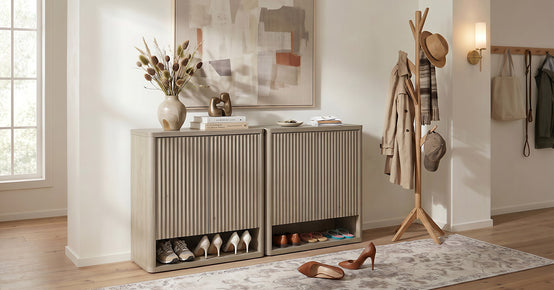
A slim tilt-out cabinet keeps a narrow entryway walkable.
How Each Type Stores Shoes
Pull the front of a tilt-out cabinet and the compartments swing forward. Your shoe stands on its heel, leaning back — that's the whole trick behind the slim profile. Filing shoes upright instead of stacking them, basically.
A shelf cabinet? Think bookshelf. Shoes rest flat or heel-down on horizontal shelves, and most of those shelves slide: raise one tier for tall ankle boots, lower another to squeeze in an extra row of flats.
Exterior Depth: What the Cabinet Takes From Your Hallway
Tape measure first. Wall to whatever's opposite — usually the far door frame, or the edge of the stairs if you're unlucky. A standard interior doorway is about 30 inches (762 mm). Once a cabinet creeps past roughly 12 inches deep, a single-file passage starts feeling cramped.
Typical ranges: tilt-outs sit at 6 to 10 inches deep, wall-mounted ones near 5. Shelf cabinets need 12 to 14 — the case has to out-measure your longest shoe. That 4-to-8-inch gap? It's the entire reason tilt-outs exist.

Measure from the wall to the nearest obstacle before you buy.
Usable Depth: What the Inside Actually Gives You
Open a tilt-out and the shoe's standing on its heel, leaning back — so what each shoe actually gets is a diagonal pocket, not a flat rectangle. Published figures put the effective tilt-front depth at roughly 17 to 20 cm (about 7 to 8 inches). Fine for everyday sneakers and flats, as long as the shoe's propped up rather than lying down.
Shelf cabinets are a different story: usable depth is basically the whole interior. An adult shoe wants 30 to 33 cm (roughly 12 to 13 inches) of interior depth to lie flat without the toe jamming the door — and since the cabinet runs 12 to 14 inches deep, the math just works. Built around the shoe. Nothing lost to tilt angles.
The Opening Envelope: The Hidden Depth Tilt-Outs Don't Advertise
Here's the part nobody puts on the box: a tilt-out door has to swing forward and down before you can reach anything. While it's open, that swing — the opening envelope — sticks out roughly 12 to 18 inches from the wall. In a narrow hallway, an open tilt-out bin blocks foot traffic exactly the way an open dishwasher does.
Shelf doors swing out too, sure. Difference is you shut them the second the shoes are in. Tilt-out bins? They seem to stay half-open through the entire morning rush.

An open tilt-out bin swings well beyond the cabinet's slim closed depth.
Shoe-Length Limits: What Fits and What Doesn't
Tilt-out bins put a hard ceiling on shoe size. Reviews of a 17-cm-deep tilt-out report around 4 pairs total — two per bin — and nothing above a size 7. Chunky trainers, stiff-soled shoes: reviewers called them pointless for the bins. One summed it up as great for kids' shoes, not adult footwear.
Rule of thumb — flats, loafers, sandals, low-profile sneakers up to about a men's 9 slide in without a fight. But a tall collar, a thick sole, a rigid build? The shoe starts arguing with the divider. One owner's husband wore size 11; his shoes kept pushing the middle divider upward. Her own size-5s caused zero trouble. So if anyone at home wears a 10 or bigger, hold their longest shoe against the bin's interior diagonal before you commit.
High-Tops and Bulky Trainers
High-tops are the classic tilt-out reject. A high-top stands 7 to 9 inches tall, and leaned back inside a bin, the collar rams straight into the compartment ceiling. Bulky runners fail differently — the thick sole and padded heel eat up the bin's diagonal space, the shoe wedges halfway in, and the door won't close flat.
Shelf cabinets don't care about either. A tier with about 6 inches of clearance takes adult sneakers easily, and since the shelves usually adjust, a high-top just means dropping the tier below an inch or two. If your rotation is mostly sneakers and high-tops, the shelf cabinet's extra floor depth buys you zero daily frustration.

Test bulky shoes against the bin's diagonal space, not just the cabinet depth.
Boots: The Real Deal-Breaker
Boots are where the two formats properly part ways. A tilt-out bin just can't hold a boot upright — full stop. Owners cope by laying boots sideways across the bins, or yanking the middle dividers out. Even then? Awkward. One family found the bottom section of each compartment only managed 2 pairs of boots plus trainers after the dividers came out.
Shelf cabinets were built for boots. A boot needs 12 to 16 inches of tier clearance to stand upright, and adjustable tiers let you give one section to boots while everything else stays at sneaker height. Compact tilt-out units can't fit boots flat, period. If someone in the house wears boots half the year, shelves are the only sane answer.

Boots stand upright on a shelf; in a tilt-out bin they go sideways.
Capacity by Shoe Type: How Many Pairs Each Really Holds
Raw pair counts lie — they're marketing. A 4-compartment tilt unit, about 51 inches tall, holds roughly 8 pairs. A wide 3-bin tilt cabinet claims 18 to 24. Mid-size shelf cabinets land around 24 to 30 pairs. But the only number that matters? How many pairs of your actual shoes fit.

Adjustable shelves adapt to whatever your household actually wears.
Cleaning and Ventilation: Which Interior Is Easier to Live With
Cleaning's simpler on shelves. Flat surface, quick wipe, move on. Tilt-out bins have pivot joints, divider slots, angled corners — dust collects in all of them, and pulling a loaded bin out for a proper clean needs both hands.
Ventilation goes to the shelf cabinet as well. Humidity loggers show a closed, unvented cabinet can hit 70 to 80 percent relative humidity within 20 to 30 minutes of the shoes going in; open tiers stay near room levels. Run a closed tilt-out and you'll want activated charcoal sachets (swap every 2 to 3 months) or cedar blocks (light sanding, monthly). Wet or muddy shoes? Keep them out of the tilt-out entirely — owners warn moisture warps the bin wood. Rain-day shoes dry on an open floor tray first.

Tilt-out bins need their pivot slots and corners wiped regularly.
Anchoring and Safety
Anchor both. But with tilt-outs it's not optional. Pull a bin open and the shoes' weight shifts forward of the base — that's precisely why these ship with wall straps or brackets. Owners say an unanchored tilt cabinet feels wobbly; one owner found her anchored unit had quietly pulled away from the wall. Check the anchors yearly.
Tall baseboards cause their own trouble. Deep skirting stops the cabinet sitting flush, which adds lean and strains the anchors. Shim the gap, or buy a cabinet with an adjustable back rail. Small kids in the house? Anchor every freestanding cabinet regardless of format — and pick bins with soft-close pivots so little fingers stay unpinched.

Anchor every tilt-out cabinet to the wall and re-check the fixings yearly.
Which SICOTAS Cabinet Fits Your Hallway
The
SICOTAS homepage stocks both formats in the entryway range. Match the format to your hallway and your shoes. Not just the look you like.
The Decision: 4 Measurements Before You Buy
Hallway width, minus door swings. Measure wall to obstacle, then subtract every door that swings into the passage. Under 30 inches of clear walkway — the tilt-out's 6 to 10 inches is your friend.
Your longest shoe. Not the average — the longest one in the house. Anything topping a men's 10? Rotation full of high-tops and boots? Lean shelf cabinet.
Boot season length. Boots worn for months, not weeks — the tilt-out's sideways-boot workaround gets old fast. Shelves win.
The swing test. Open your front door, walk your morning route with a bag, and picture a bin swung 15 inches out from the wall right where you turn. If it collides, go shelf. Or wall-mount.

Compare the closed depth and the open swing before you decide.
Final Word
When the hallway's the constraint and the collection cooperates — flats, loafers, sandals, low sneakers under about a men's 9 — tilt-out. When the collection's the constraint — bulky trainers, high-tops, boots, big feet — shelf cabinet. Hallway measured, shoes measured, swing checked: then order. Browse the full range of
SICOTAS shoe cabinets to compare both formats side by side.

The right cabinet disappears into the entryway and keeps the shoes out of sight.
FAQs
What is the difference between a tilt-out and a shelf shoe cabinet?
Tilt-out bins pivot forward and hold shoes upright on their heels — that's how the cabinet stays just 6 to 10 inches deep. A shelf cabinet rests shoes flat or heel-down on horizontal shelves behind doors, needing about 12 to 14 inches of depth so an adult shoe fits lengthwise.
How deep does a tilt-out shoe cabinet need to be compared to a shelf cabinet?
Tilt-outs run 6 to 10 inches deep; wall-mounted versions can be as shallow as about 5 inches. Shelf cabinets need 12 to 14 inches so a shoe lies flat inside. One thing people forget: the tilt-out's open swing reaches about 12 to 18 inches out from the wall while you're actually using it.
Which holds more pairs — a tilt-out or a shelf shoe cabinet?
Per inch of floor, tilt-outs punch above their weight: a 3-bin tilt cabinet claims 18 to 24 pairs, a slim 4-compartment unit holds about 8. Mid-size shelf cabinets hold 16 to 30 pairs. Catch is those counts assume flat-friendly shoes — bulky pairs that won't fit the bins drag a tilt-out's real capacity down fast.
Can you fit boots in a tilt-out shoe cabinet, or do you need shelves?
Boots you wear regularly? You need shelves. They only go into a tilt-out sideways, dividers out — fine once, miserable daily. A shelf cabinet with adjustable tiers sets aside 12 to 16 inches of clearance so boots stand upright while everything else stays at sneaker height.
Which is better for a narrow hallway: a tilt-out or a shelf shoe cabinet?
Tilt-out — provided the passage runs under about 30 inches wide and the shoes are flat-friendly. That 6 to 10 inch closed depth keeps the walkway open. But an open bin swings 12 to 18 inches into the hallway, so a shelf cabinet with quick-closing doors can feel less in the way during the morning rush.
Do tilt-out shoe cabinets cause odor or smell more than shelf cabinets?
Closed tilt-outs do trap more moisture — readings show a closed, unvented cabinet hitting 70 to 80 percent humidity within 20 to 30 minutes of shoes going in. Shelf cabinets air out faster. With a tilt-out, use activated charcoal sachets (replace every 2 to 3 months) or cedar blocks (light sanding monthly). And never put wet shoes into a closed bin.
Are shelf shoe cabinets easier to clean than tilt-out cabinets?
Yes — flat shelf, quick wipe, done. Tilt-out bins have pivot joints, divider slots, angled corners that gather dust, and a loaded bin needs two hands to pull out for a deep clean. Wet or muddy shoes stay on an open floor tray first, too: moisture can warp tilt-bin wood.
Which is safer for kids: a tilt-out or a shelf shoe cabinet?
Both have to be anchored. Tilt-outs carry extra forward-tip risk — an open, shoe-loaded bin moves weight past the cabinet's base — so the wall straps are non-negotiable, and worth re-checking yearly. Soft-close pivots on the bins keep little fingers from getting pinched.