













Color Coordinated Bookshelf: How to Arrange Books by Color Without Losing Track of Them
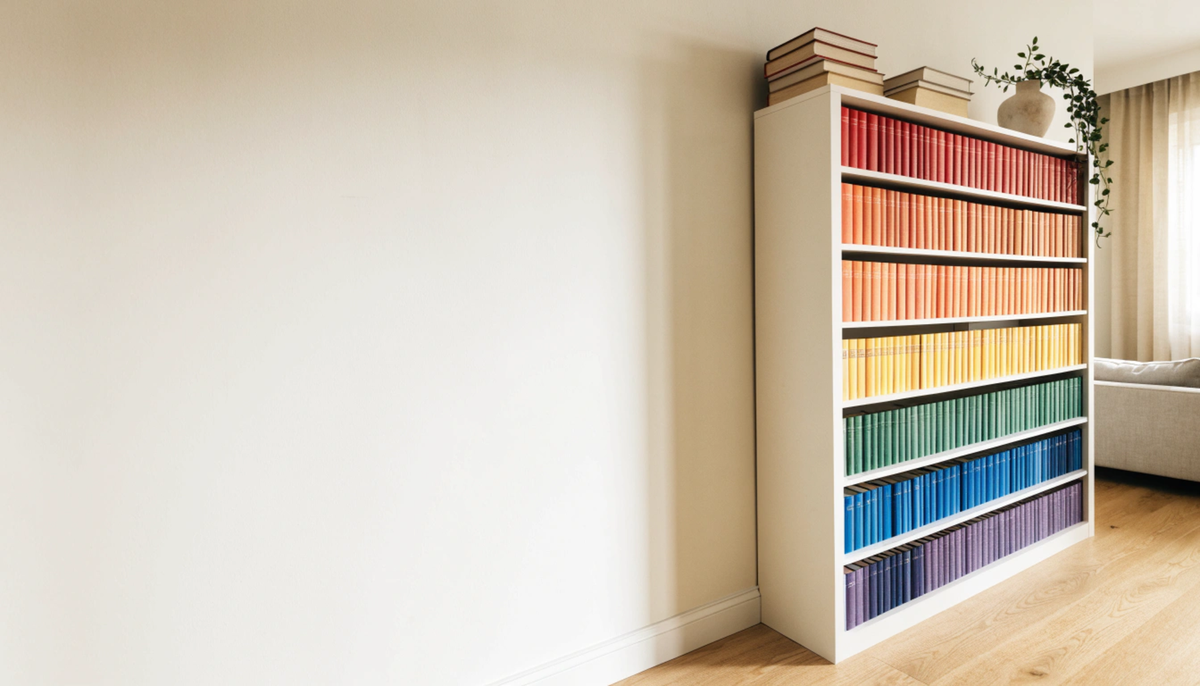
A color-coordinated bookshelf sorts books by spine color: no authors, no titles, no subjects. Most people go in rainbow order, running red through to violet.
It photographs well. It also starts arguments. Plenty of people love the look. Plenty of others swear you will never find a book again.
Below you get the full method. You also get the neutral spines nobody plans for, five newer options if the rainbow feels tired, and the slow problem that wrecks a color-coded bookshelf after a year or two.
What Is a Color-Coordinated Bookshelf?

The idea is simple enough. Everything comes off the shelf. You sort by spine color, then put it all back so the colors run in one flow.
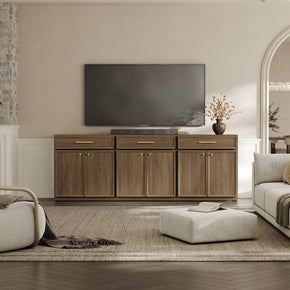
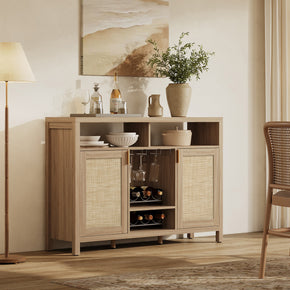
Some people run a full ROYGBIV gradient across every shelf. Others just block one or two colors—both count. Neither needs a custom built-in, and ordinary display furniture that suits a color-coordinated bookshelf does the job.
Color-sorted shelves turn up constantly on Pinterest and Instagram. The same idea now shows up beyond books, in pantries, closets, and bathroom cabinets. Books are still where most people notice it first.
Should You Color Code Your Bookshelf?
Why People Organize Books by Color
For most people, it comes down to looks. A wall of sorted spines turns a messy shelf into something worth showing off, and the whole job costs you one afternoon.
There is a practical side too. Plenty of readers remember covers better than authors. If you can picture the blue paperback but not who wrote it, color is a real filing system.
It also makes tidying easy. Kids can put a book back in the right block without knowing the alphabet.
Where Color Coding Falls Short
If you own a large working library and pull specific titles often, color slows you down. The problem doubles when you share shelves with someone who doesn't remember spines the way you do.
Series get split apart, which annoys some readers more than anything else. Volume three ends up two shelves away from volume one.
The fix is a hybrid, and it is what most long-term color coders end up doing anyway. Rainbow one bookcase, keep reference books, and series grouped normally on another.
How to Color Coordinate Your Bookshelf in 7 Steps
Fair warning: it gets much messier before it gets tidy. Clear a weekend afternoon, and don't start this an hour before guests arrive.
1. Empty Every Shelf

Take all the books off and lay them out on the floor, spines facing up, in loose rows. You need to see every spine at once.
2. Sort Into Color Piles

One pile per color. Red, orange, yellow, green, blue, purple, pink, brown. Neutrals get their own group. Do not agonize over the borderline ones yet.
Multicolor spines go with the dominant color. Trust your eye rather than the label.
3. Cull What You Will Not Read Again
This is the easiest moment you will ever get to thin a collection. Duplicates. Textbooks you outgrew. That one you kept because somebody gave it to you.
Bag them up for a charity shop or a friend while they are still off the shelf.
4. Sort Each Pile Dark to Light

Within each color, run darkest to lightest. Deep burgundy to bright red to coral. Forest green to sage.
That gradient inside each block is what separates a shelf that looks planned from one that looks like a pile of colored books.
5. Decide Where Each Block Lands
Count your piles before loading anything. If greens fill half the collection, they need more than one shelf.
Put neutrals and heavy hardbacks low, since the bottom shelf usually sits behind furniture anyway. Save eye level for the colors you actually want people to see.
6. Load the Shelves in Order

Load it the way you read a page. Left to right, top row down. Red sits in the top left corner, and violet finishes the run.
This is the slow part. You will pull books out and swap them three or four times before a shelf sits right.
7. Break Up the Rows
Row after row of upright spines gets dull. Lay a few books flat and stack them, biggest one on the bottom.
Stagger those stacks so they zig-zag down the bookcase instead of lining up in a column.
The Neutral Problem: Black, White and Beige Spines

Nearly every guide skips this bit, and it is exactly where people get stuck. Count your spines. Black, white, cream and brown almost always outnumber the rainbow ones.
Three options work.
- Treat cream as its own color and block the neutrals along the bottom shelf.
- Shift them onto a second bookcase so only one unit goes full rainbow
- Hide them behind closed doors and leave the open shelves for color
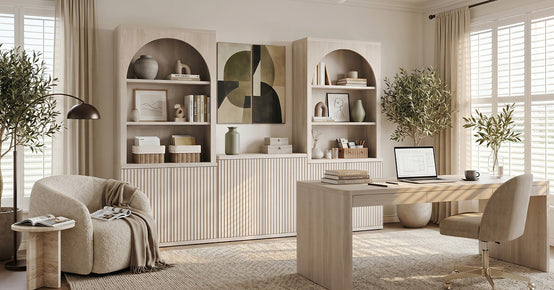
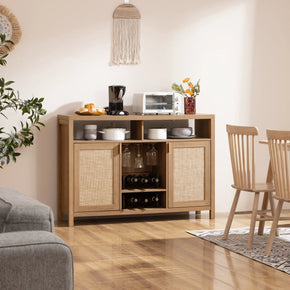
That's why a bookshelf with two closed lower doors works so well for this trend. Put neutral spines and oversized books behind the doors, and let the open tiers carry the gradient.
How to Style a Color Coded Bookshelf So It Looks Curated
Leave Some Shelf Empty

A packed shelf can read as clutter even when the colors are perfect. Leaving some space fixes that, and two-thirds full is a common place to start.
The right ratio depends on your shelves. A wide span holds emptiness better than a narrow one. Tall books eat the visual space that short ones leave alone.
Storage needs come first if you own more books than shelf. A full bookcase that holds your library beats a styled one that sends half the books to a box. Adjust the ratio to the shelf you actually have.
Mix Upright Rows with Flat Stacks
Alternate upright rows with flat stacks. The change of direction gives your eye somewhere to rest between color blocks.
Add Objects in Matching Tones
Small objects sitting on the horizontal stacks pull the whole thing together. A vase. A framed photo. A stone you picked up somewhere. A small plant.
Match each one to the color block underneath it. A terracotta pot in the orange section reads as deliberate.
Keep the Shelf Itself Neutral

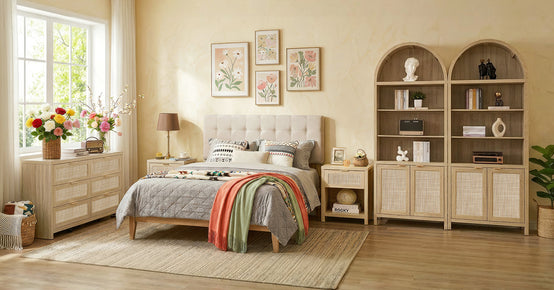
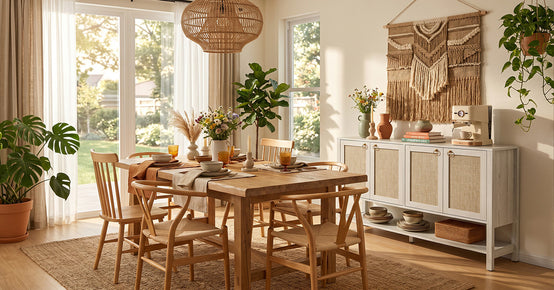
Rainbow spines need a quiet backdrop. White, black, grey, or pale wood all do the job. A white bookshelf with rattan door panels leaves the colors room to work instead of fighting them.
A busy or brightly painted bookcase fights the books. Pick one thing to be loud.
Bookshelf Trends Beyond the Rainbow

Designers have started calling the full rainbow a bit overdone. Five alternatives keep turning up instead, and all of them suit home office shelving as easily as a living room wall.
Single-Color Blocking

Pick one color and group only those. Orange Penguin classics are the classic example, and vintage Pelicans do the same in blue.
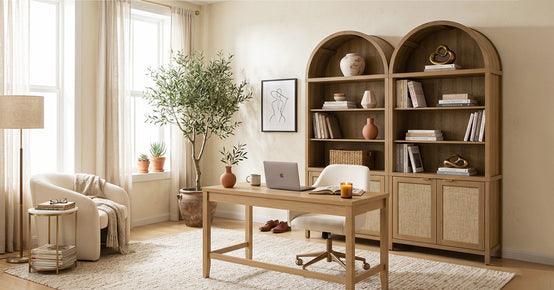
A three-tier arched bookcase with a fluted front suits this well, since the arch frames a single block of color like a display case.
Group by Theme Instead
Shelve books that belong together in your head: everything you read one summer, everything about one city, everything a friend gave you. The shelf tells a story rather than showing a gradient.
Vintage and Muted Spines
Old cloth bindings in faded beige, dusty pink and soft green feel much calmer than new spines. Charity shops are stuffed with them, and they barely cost anything.
Pages Out

Treat this one as decoration, not storage. Flipping books so the page edges face out takes color out of the room instead of adding it, which suits minimalist and Scandinavian spaces.
Findability goes with it. Every search means pulling books out and turning them around, and that handling wears bindings over time. The rest of this guide is built on keeping track of what you own, and this method works against that.
Reserve it for a short stretch or a small section. One shelf styled that way for a photo or a season is a different thing from a whole wall you have to live with.
Wrapped or Removed Dust Jackets
Kraft paper, leftover wallpaper, or simply pulling the jackets off gives you a uniform look from mismatched books. Best for rooms where the books are decor rather than daily reading.
What Ruins a Color Coded Bookshelf Over Time
One weakness never gets a mention in these guides. It creeps up on you.
Keep the Shelf Away from Direct Sun

Light fades book spines, and the damage is cumulative and irreversible.Conservation guidance on book care recommends keeping books away from windows and skylights, and using curtains or blinds when that isn't possible.
Window glass is a weaker safeguard than people assume. The same guidance notes that glass alone does little to block ultraviolet radiation. Visible light fades things too, so blocking UV alone does not solve the problem.
Some dyes and pigments fade faster than others. That is how an evenly graded rainbow shelf turns patchy while the rest of the shelf looks fine.
Shift the bookcase off the sunny wall. A sheer curtain helps if you cannot. Once a spine fades, nothing brings it back.
Do Not Overpack the Shelves

Crammed shelves warp covers and swallow small paperbacks behind bigger ones. Keep books of a similar height together so they hold each other up. Use bookends to fill in where a color block runs short.
Outgrown the case? Add a taller bookshelf with adjustable shelves instead of cramming more into the same run.
Shelve Oversized Books Spine Down
Heavy oversized books belong flat on the shelf, spines facing out. CCAHA conservation guidance puts atlases and similar volumes in that group.
If a large book has to go in vertically, set it spine down rather than spine up. The same guidance explains why. Spine up lets gravity pull the text block away from its binding. Spine down makes the title harder to read, which is the trade.
Anchor Tall Bookcases to the Wall
Anchor the bookcase. Follow the instructions that came with it, since the maker specifies the hardware and the fixing points. CPSC advises anchoring furniture with drawers, doors or shelves regardless of its shape.
Proportions are not a safety test. A wide, low unit loaded with books still carries weight high up once the top shelves fill. Height against width tells you nothing reliable about whether a piece will go over.
Match the fastener to the wall. A stud is the strongest fixing, though plenty of walls do not offer one where you need it. Drywall, plaster and masonry each take different hardware, and the anchor kit instructions cover which to use.
Children in the house raise the stakes rather than changing the advice. Anchor it either way.
How to Keep a Color Coded Bookshelf Working
Books keep arriving. That is where most rainbow shelves quietly fall apart.
Leave a little gap at the end of every color block. A new title then slides in without you moving the whole shelf. Two or three inches does it.
Accept that a few books will always be out of place. Whatever you are reading, whatever you lent out. Nobody notices except you.
For findability, photograph the finished shelf on your phone. Searching the picture beats scanning a wall of spines when you are hunting for one title.
Final Takeaway
A color-coordinated bookshelf earns its keep if you think in pictures and your books are there for pleasure, not reference.
Sort by color first. Then sort by shade inside each color. The neutrals need a plan of their own. Keep the bookcase quiet, leave gaps, and lay a few stacks flat.
Move it away from the window, and the fading slows down. Light damage adds up over time, so less exposure buys you more years before the colors shift. Nothing stops it completely.
FAQs
How to color coordinate your bookshelf?
Empty the shelves first. Sort every book into color piles, then reload in rainbow order from left to right, working each color from dark to light.
Neutral spines get their own section. Leave a bit of space on each shelf, and lay a few stacks flat to break up the rows.
What is the bookshelf rule?
There is no single rule, but the two-thirds guide comes up most: fill about two-thirds of a shelf and leave one-third empty. Some designers split it three ways instead: books, objects, and space.
Neither is a hard law. Both exist to stop a shelf looking crammed.
Why do people organize their books by color?
Mostly for the look, and because sorting them is oddly satisfying. Beyond that:
- Some readers recall a cover color long before they recall the author
- A messy shelf gets instant order with no cataloging system behind it
- Kids can put books back correctly without reading a single spine
- The bookcase stops being storage and becomes the focal point of the room
How to arrange a bookshelf aesthetically?
Vary the rhythm and the shelf stops looking flat. Swap between upright rows and flat stacks, stagger the stacks so they never line up, and sit small objects on top of the flat piles.
Keep heavier and larger books low, and leave breathing room on every shelf.
What are the latest bookshelf trends?
The full rainbow has been running for over a decade, so designers are moving toward quieter looks:
- One color blocked on its own instead of the full spectrum
- Books grouped by theme or memory rather than shade
- Vintage cloth bindings collected in faded, muted tones
- Pages turned outward for a neutral, texture-led shelf
- Dust jackets wrapped or pulled off for a uniform finish
How can I organize my books by color?
Use ROYGBIV and work the way you read: left to right, top to bottom. Red starts in the top left corner and violet ends the run.
A color that runs long should spill onto the next shelf rather than get squeezed. A color you barely own can just fold into its neighbor.
How to style a bookcase full of books?
Take some books off first. Packed edge to edge, a bookcase gives the eye nowhere to land, and no amount of styling fixes that.
Then add three or four objects at different heights, keep them close in tone to the books around them, and leave a shelf or two plain.
Should books be pushed to the back of a bookcase?
No. Line the spines flush with the front edge of each shelf instead. It looks neater, and the books are easier to grab.
Pushing them back also creates a dust ledge in front, and it makes small paperbacks disappear behind taller neighbors.
Sources
- Library of Congress – Storing Your Books
- Library of Congress – Limiting Light Damage in Collections
- Conservation Center for Art and Historic Artifacts – Preventive Care of Book Collections
- Slate – Arranging Your Books by Color Is Not a Moral Failure
- VERANDA – Really, It Is Ok to Arrange Books By Color
- Apartment Therapy – I Organize My Books Like a Library Instead
- Reactor – The Deeply Personal Art of Organizing Your Books
- U.S. Consumer Product Safety Commission – Anchor It! Tip-Over Prevention Center


Looking for something else?

Burl Wood Furniture: The Complete Buying Guide
LEARN MORE
What Is a Hope Chest? Meaning, History, and Modern Uses
LEARN MORE
What Is a Foyer? Meaning, Purpose and Design Guide
LEARN MORE
GREENGUARD Gold Certified Furniture: What It Really Means for Your Home
LEARN MORELooking for something else?

How to Clean a Mirror Without Streaks: Simple Step-by-Step Guide
LEARN MORE
21 Above-Bed Decor Ideas for a Stylish Bedroom Wall
LEARN MORE
Furniture Materials Guide: Picking the Right Material Room by Room
LEARN MORE


Further reading

18 Decorative Storage Box Ideas That Hide Clutter Well

How to Store Comforters Without Losing Space or Loft


