





What Size Nightstand for a King Bed? A Simple Buyer's Guide

My parents bought a king bed in 2018 and spent the next six months wondering why something felt off about the bedroom. New headboard, new duvet, a fresh coat of paint. Still wrong. It took a visiting friend about forty-five seconds to figure it out: the nightstands were 18-inch pieces they’d had since their queen bed years. Next to a 76-inch king frame, they looked like side tables from a different room that nobody had gotten around to swapping out.
Nightstand shopping goes wrong the same way every time. Someone finds a piece they like, checks the style and the price, and orders it. It arrives, and something is off. Too low for the new mattress. Too narrow beside the frame. Occasionally both.
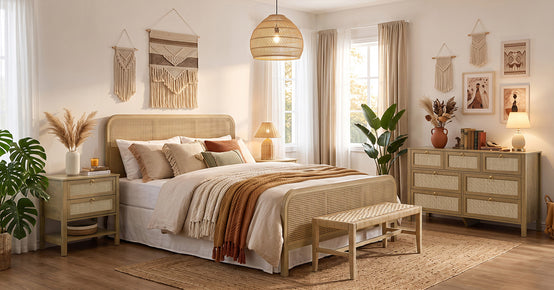
The fix is simple and boring: measure before you shop. Two numbers. Floor-to-mattress top for the height. Available wall space for the width. Those two measurements solve most of the sizing problem before a single product page is opened. This guide covers why those numbers matter, which ranges work best for a king bed specifically, and a few decisions that consistently trip people up. If you want to see what bedside pieces for king beds look like in practice, browsing a range built for a bedroom scale is a good starting point.
Quick Reference: What Size Nightstand for a King Bed?
|
Dimension |
Best Range |
Also Works |
Avoid |
|
Width |
24–30 inches |
Up to 40” in large rooms |
Below 24” — looks undersized beside a king |
|
Height |
Level with the mattress top |
1–3 inches above |
More than 3–4 inches below the mattress |
|
Depth |
16–20 inches |
Up to 24” in spacious rooms |
Under 14” — not enough surface for daily use |
|
Gap from bed |
3–6 inches |
Flush if space is tight |
More than 8” away — hard to reach at night |
Why Size Matters More With a King Bed

A queen bed is forgiving about what sits beside it. A slightly narrow nightstand next to a queen looks a little light but not wrong. A king is less forgiving. That 76-inch frame has real visual weight, and the pieces on either side either hold their own or they do not.
Put a 20-inch nightstand beside a king, and the room will feel slightly off without anyone being able to say exactly why right away. The nightstand looks like something that arrived before the king bed did, and nobody got around to replacing it. The bed ends up dominating in a way that feels unfinished. It is not disastrous. But it is the difference between a room that looks pulled together and one that almost does.
The Right Scale Makes the Room Feel More Balanced

A king bed anchors the bedroom. Everything else around it — the dresser, the headboard, the pieces on either side — needs to relate to that anchor. House Beautiful’s nightstand styling guide consistently shows wider, more substantial pieces beside king beds, particularly when the headboard is tall, or the frame carries visual weight. The nightstand does not need to be oversized. It just needs enough presence to belong beside what it is sitting next to.
A Good Fit Improves Daily Function Too

Getting the size right is not just about how the room looks. A nightstand that sits too low means reaching down and leaning over the edge of the mattress every time you want your phone or a glass of water. One that sits too high means you have to propped yourself up awkwardly to reach across. A surface that is too narrow gets crowded fast. Small inconveniences. But small inconveniences that happen twice a day, every day, add up.
Start With Nightstand Height First

Width gets most of the attention when shopping for nightstands. Height is actually the dimension that determines whether the piece is comfortable to live with. Get the height wrong, and you will notice it every single night. That is not an exaggeration. Figure that out first.
The Best Rule: Match the Top of Your Mattress
Measure from the floor to the top of your mattress. Not the floor-to-frame distance. Not an estimate. The actual top surface — including any topper, any thick quilted cover, anything that adds height to the sleeping surface. Write that number down. A nightstand whose tabletop lands at roughly the same level will feel natural to reach from a lying position. That is the whole principle.
Platform Beds vs. Taller Beds With Box Springs

Platform beds sit low — sometimes as low as 14 to 16 inches from the floor to the mattress. A standard 26-inch nightstand beside a 16-inch mattress looks like a side table that was brought in from another room. The reverse problem: a bed on a full box spring with a thick pillow-top might sit at 30 inches, and a standard nightstand at 24 inches suddenly becomes the short piece.
The mistake is measuring the frame height and assuming the mattress adds a predictable amount. It does not. An 8-inch frame, a 14-inch mattress, and a 3-inch topper put the sleeping surface at 25 inches. The same frame with a 10-inch mattress and no topper puts it at 18. Measure the actual top every time.
Height Guide by Bed Type
|
Bed Setup |
Mattress Height |
Nightstand Height |
Notes |
|
Standard platform bed |
16–18 inches |
18–22 inches |
Aim close to the mattress height |
|
Standard bed with box spring |
22–25 inches |
22–26 inches |
Measure the actual mattress top |
|
King with thick pillow-top |
26–30 inches |
25–30 inches |
Measure before buying |
|
Tall bed + high box spring + topper |
28–32 inches |
27–32 inches |
A taller nightstand is usually needed |
|
California king (standard height) |
22–26 inches |
Same as standard king |
Width may need adjusting |
How Much Higher or Lower Is Okay?

A little variation in either direction is fine in practice. BHG’s nightstand guide suggests keeping the nightstand within a few inches of mattress height — slightly above works well, slightly below is acceptable, especially with taller beds. The point where it stops working is roughly a 4- to 5-inch gap in either direction. Below that threshold, you are clearly reaching down; above it, you are reaching up and across. Both positions feel mildly awkward at 11 pm and aggressively annoying at 3 am.
Choose the Right Nightstand Width for a King Bed

Once height is sorted, width is the next call. King bed owners consistently default to standard nightstand sizes designed for smaller beds — and end up with pieces that look like they were downgraded from the bedroom down the hall.
Standard Width vs. Wide Nightstands
Standard nightstand width across most guides is 20 to 24 inches. That range was built around full and queen beds, which suits it well. Against a 76-inch king frame, a 20-inch nightstand reads as visually thin. Not wrong, exactly. Just light. As if the bed won the room, and the nightstand arrived, hoping not to be noticed.

Twenty-four to thirty inches is where most king bed setups land well. The Spruce’s nightstand sizing guidance puts the standard range at 21 to 29 inches and notes that the lower end suits smaller beds. With a king at 76 inches wide, staying at 24 or above keeps the piece from reading as something borrowed from a different room.
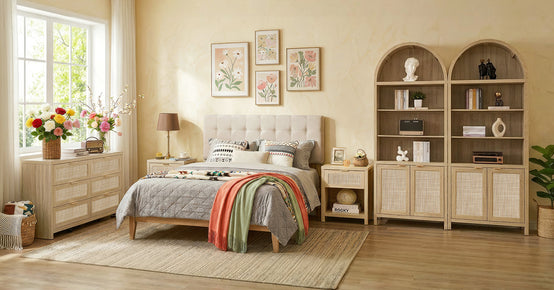
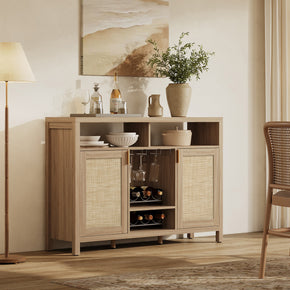
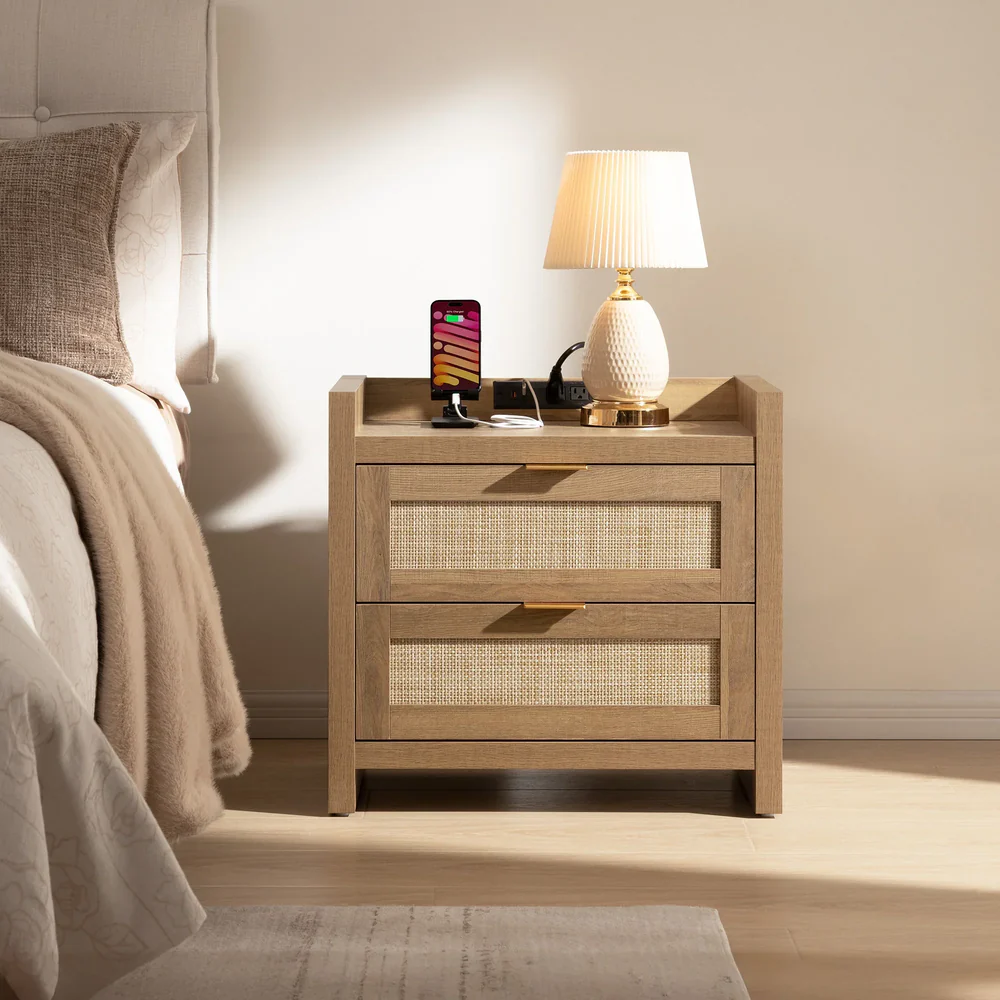
In a spacious primary bedroom, going wider — up to 36 inches — or using a small dresser as a bedside piece can look intentional and generous rather than oversized. A wide, drawer-rich option like the Savanna 2-Drawer Rattan Nightstand earns its width beside a king: enough surface for a lamp, a glass, and a phone without looking immediately crowded, and drawers that absorb the daily overflow that would otherwise live on top.
When to Go Narrower
Two situations justify a narrower beside a king. First: the walkway is tight — under 24 inches — and a deeper or wider nightstand makes it worse. Second: the bedroom is genuinely small, and the king is already the dominant piece; adding a wide nightstand would turn the room into a furniture obstacle course. In both cases, getting the height right is the most important single factor, because a properly matched height compensates for a significant width deficit.
When to Go Wider
Go wider when the room has space for it, when the bed frame or headboard is visually heavy, when you need more surface for the things that actually live on your nightstand, or when more drawer storage would genuinely be used. A 30- to 36-inch piece beside a king in a large bedroom looks considered and generous. That same piece in a small bedroom with narrow walkways looks like a problem. The room dictates the answer here more than any proportional rule.
Do Not Ignore Nightstand Depth

Depth gets skipped more than any other nightstand measurement. Width gets checked. Height gets checked. Then the piece arrives and sticks further into the room than expected, the walkway tightens, and a drawer cannot open without hitting the dresser on the other side. Ten seconds with a tape measure before ordering prevents all of this.
Standard Depth for Side Tables and Nightstands
Most nightstands fall within the 16- to 20-inch depth range. That covers most bedroom layouts without crowding walkways. Under 14 or 15 inches, and the top starts to feel narrow for daily use — a lamp plus a phone plus a glass of water does not leave much room. Above 24 inches, and you are looking at something closer to a small dresser, which is fine in a spacious room but significant in a tighter one.
How Much Surface Space Do You Really Need?

Think about what is on your Prelude nightstand right now. Not what you intend to put there. What is actually there? For most people: a lamp, a phone on a charging stand, a glass of water, a book, maybe reading glasses, and sometimes a small tray for jewelry. That collection needs a surface area of at least 16 by 16 inches to avoid looking immediately crowded. If a smaller piece has been causing surface overflow — items on the floor, on the window ledge, stacked on top of each other — the depth is probably part of the problem.
Avoid Blocking Walkways

The deeper the nightstand, the more it extends into the space beside the bed. In a large bedroom, this barely registers. In a smaller bedroom where the king already takes up most of the floor area, a nightstand adding another 20 inches toward the wall can make the path to the bathroom feel like squeezing between parked cars. Architectural Digest’s nightstand recommendations factor in walkway width, room size, and proportional scale when selecting a bedside piece. The nightstand depth decision and the available room layout need to be considered together rather than separately.
How Far Should a Nightstand Sit From the Bed?

Smaller decision than height or width, but worth getting right. Placement affects both how reachable the nightstand is and how the overall bed setup reads when styled.
Three to Six Inches Is the Target
A three- to six-inch gap between the edge of the mattress and the front face of the nightstand keeps everything within easy reach while leaving enough visual breathing room for the mattress and nightstand to read as two separate pieces. In well-styled bedroom photos, this gap is almost always visible and deliberate. It is what keeps the setup from looking compressed.
Leave Enough Room to Walk Comfortably
The nightstand depth and the walkway width need to be weighed together. If the path beside the bed is 28 inches and the nightstand is 20 inches deep, that leaves 8 inches of walking room. That is not enough — not for daily use, and especially not for the half-awake 2 am trip to the bathroom. A 24- to 30-inch clear path beside the bed is comfortable. Less than that starts to register as cramped, even if it looks fine from across the room.
Matching Nightstands or Mismatched Nightstands?

No universal right answer. But there are clear situations where each works better and ones where each falls flat.
Why Matching Nightstands Look Balanced With a King Bed

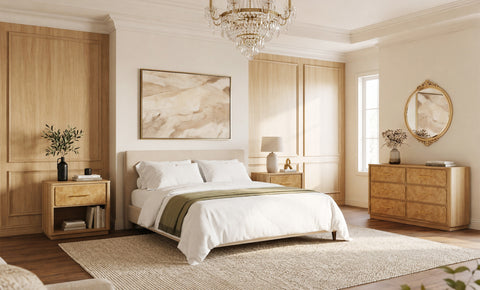
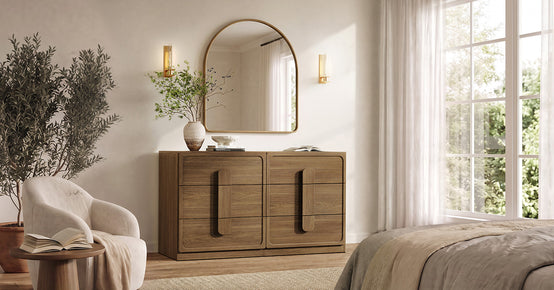
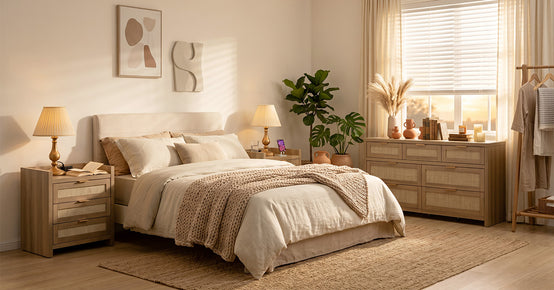
Two identical pieces on either side of a king create symmetry, and symmetry does something specific for large beds: it frames them. The bed looks anchored rather than dominant. Matching nightstands are the lower-risk, lower-effort path for most people — find one piece that works, buy two. For a primary bedroom that should feel calm and composed rather than collected and layered, matching is usually the right default. Collections like the Crescent Nightstand Collection are built for exactly this use case — pieces designed to work in pairs at matching heights and proportions, so both sides of the bed read as intentional rather than assembled.
When Mismatched Nightstands Work Better
Mismatched nightstands done well look more personal than matched ones — more like a room that developed over time rather than a set that was purchased and placed. The keyword is done well. Two pieces of similar approximate height and comparable width, with at least one shared design thread, read as collected and intentional. Two pieces of wildly different scale and finish read as unfinished. The same general logic applies: if the mismatch is controlled, it looks deliberate. If it is random, it is just a gap in the plan.
How to Make Mismatched Nightstands Feel Intentional
One consistent element across both sides is enough. Same wood tone. Same hardware finish. Same lamp style. Same approximate height, even if the shapes differ. The matching detail does not have to be the nightstand itself — it can live in the styling on the surfaces above. When one thread runs consistently across both sides, the different nightstands read as a choice rather than a coordination problem.
Nightstand Storage: What Do You Actually Need?

Storage is usually the last thing considered when shopping for a Savannah 3 drawers nightstand, and the first thing to cause problems after the piece arrives. A beautiful nightstand with no drawers and a surface that fits exactly one lamp will have everything else piled on top of it within two weeks. Buy for how you actually live, not how you intend to.
Drawers, Shelves, or Both?
Drawers hide things. Shelves display things. Both are useful, but they serve different purposes. Real Simple’s nightstand selection guide recommends at least one drawer for daily bedroom storage — a closed drawer keeps the surface cleaner over time without requiring sustained organizational discipline. Open shelves are good for books and items accessed frequently. A nightstand with one drawer and one open shelf tends to cover both uses well for most people, without requiring any particular tidiness habits.
Best Storage Setup for Everyday Use
One drawer is the minimum. Two drawers suit two people sharing the bed with different storage needs. The honest test: list everything you reach for in the first ten minutes of waking and the last ten minutes before sleeping. All of that needs to be accessible from the nightstand, either on the surface or in the top drawer. If it does not fit, the piece is too small for the actual routine.
Best Nightstand Styles for a King Bed

Style matters — but less than size. A nightstand in the right dimensions that does not perfectly match the room’s aesthetic will still function and look decent. The wrong size in the right style will look off every day. Size first. Style second. That is the order.
Wood Nightstands for Warmth and Balance
Wood nightstands are the most versatile choice beside a king bed, and there is a straightforward reason for that: natural wood tones add warmth that counterbalances the visual weight of a large frame. They work with upholstered headboards, metal frames, and painted furniture, across almost every bedroom style from modern to vintage. A wood nightstand in the 24- to 30-inch width range is probably the most common well-functioning choice beside a king bed. That is not a coincidence.
Metal or Glass Side Tables for Lighter Visual Weight

When the king bed is already doing a lot of visual work — a large upholstered headboard, heavy bedding, substantial frame — metal or glass side tables give the eye somewhere to rest. They take up less visual weight even at the same physical dimensions as a wood piece. In a smaller bedroom where the king is already pushing the boundaries of the floor plan, that lighter quality helps the room feel less packed. The trade-off: less warmth, and they tend to show surface clutter more than wood does.
Floating Nightstands for Modern Platform Beds
Wall-mounted floating nightstands solve the height problem neatly for platform beds — they can be installed at exactly the right level without being constrained by what is available in freestanding furniture. They also clear the floor, which makes low-profile rooms feel more open. The practical trade-offs are real: they need proper wall anchors, they cannot be repositioned easily, and the installation has to be right, or the whole thing eventually works loose. For a permanent setup with a fixed platform bed, they often work better than any freestanding option.
Oversized Nightstands or Small Dressers

In a bedroom large enough that a king does not dominate every square foot, an oversized nightstand or a small dresser used as a bedside piece can look excellent. More surface area, more storage, more visual presence beside the bed. The requirement is that the room can absorb the added footprint without the walkway suffering. Roughly: if there are still 30 or more inches of clear path beside the bed after the piece is placed, the room probably supports the larger format.
Common Mistakes to Avoid
Picking a Nightstand That Is Too Low
The most common sizing error in nightstand purchases. Almost entirely caused by not measuring the floor-to-mattress height before browsing. The product looks fine in the listing. It arrives and sits noticeably below the mattress surface. The reach is awkward. Returning furniture is a significant hassle. Thirty seconds with a tape measure before opening a website eliminates this. That is the whole fix.
Going Too Narrow Next to a King Bed
A 20-inch nightstand is not categorically wrong beside a king. But it tends to look like it arrived before the king bed did, and nobody got around to replacing it with something that actually fits the scale. With a frame spanning 76 inches, the pieces on either side need sufficient width to look intentionally placed rather than incidentally present. Twenty-four inches is the floor for most setups.
Focusing Only on Looks, Not Storage
The nightstand that photographs beautifully but provides nowhere for daily items to go will have a cluttered surface permanently. Everything that should have gone in a drawer ends up on top; the styled surface from the product photo disappears within a week, and the piece ends up looking worse in real use than an uglier but more practical option would. Buy for the routine, not for the photo.
Forgetting to Measure the Bed Height First
Repeated in every nightstand guide because it is almost universally skipped. People measure wall space; they check room dimensions; they do not measure from the floor to the top of the mattress. That single measurement — thirty seconds, one tape measure — is the only one that determines which nightstand height actually works. Do it before any browsing begins. Not halfway through. Before.
Simple Nightstand Size Guidelines by Bed Type
|
Bed Type |
Bed Width |
NS Width |
NS Height |
Notes |
|
Twin |
38" |
16–22” |
Match the mattress top |
Small room; narrower pieces work |
|
Full / Double |
54" |
18–24” |
Match the mattress top |
Mid-range width |
|
Queen |
60" |
20–26” |
Match the mattress top |
Upper standard range looks right |
|
King |
76" |
24–30” |
Match the mattress top |
Larger scale needed; measure first |
|
California King |
72" |
24–30” |
Match the mattress top |
Slightly narrower; room layout key |
Final Buying Checklist Before You Order
|
Checklist Item |
When |
Why It Matters |
|
Measure floor to mattress top |
Before browsing |
Determines the height range you’re shopping in |
|
Measure wall space on each side |
Before ordering |
Maximum width that fits without crowding |
|
Check walkway width |
Before ordering |
Depth + walkway must leave a comfortable passing room |
|
Decide: matching or mismatched |
Before choosing a style |
Affects which products to filter for |
|
List what lives on the surface |
Before choosing a size |
Determines the minimum surface and storage needed |
|
Check drawer and door clearance |
Before finalizing |
Drawers need room to open fully |
|
Confirm the lamp size fits the top |
Before buying lamp + stand |
The oversized lamp reduces the usable surface to almost nothing |
Wrapping Up
The nightstand sizing question for a king bed has a short answer that covers most situations: 24 to 30 inches wide, height matched to the mattress top. Two numbers. Most of the work is done.
Everything after that — depth, placement, storage, style, matching versus mismatched — follows from those two measurements and from the actual constraints of the room. It does not need to be complicated. It just needs to happen before any browsing begins, rather than after a piece arrives only to turn out to be the wrong size for a different bedroom.
Measure first. The right nightstand becomes obvious once you know what you are actually looking for.
FAQs
What width nightstand looks best with a king bed?
Most king beds look proportionally right with nightstands in the 24- to 30-inch range. Wider pieces — up to 36 or 40 inches — can look intentional and generous in larger rooms. Under 24 inches tends to look undersized beside a 76-inch frame. The bed width is the variable that raises the floor above the standard 20-inch recommendation.
How tall should a nightstand be next to a king bed?
As close to the top of the mattress as possible. Measure from the floor to the top of your mattress — including any topper — and find a nightstand whose tabletop is within a few inches of that height. Slightly above works well. Slightly below is acceptable within about 3 or 4 inches. Beyond that gap in either direction, the daily reach starts to feel awkward.
Can a nightstand be lower than the bed?
Yes, within limits. A 2- to 4-inch drop below mattress height is generally acceptable. A larger gap — 5 or more inches below — tends to feel awkward in daily use, particularly when reaching for things while lying down. The bigger the gap, the more frequently you notice it.
Are matching nightstands better for a king bed?
Not necessarily better, but usually easier. Matching nightstands frame the bed symmetrically and create a clean, composed look with minimal decision-making. Mismatched can work equally well if the pieces are close in height, comparable in scale, and share at least one consistent design element across both sides.
Can I use side tables instead of nightstands?
Yes, if storage needs are genuinely minimal — a lamp and a phone, nothing more. Most people have more than that beside the bed. Chargers, books, glasses, and small daily items accumulate fast. A proper nightstand with at least one drawer tends to be more practical over time, because the surface stays clear rather than slowly filling up.
What depth should a king bed nightstand be?
Between 16 and 20 inches works for most bedrooms. The constraint is walkway width: the nightstand depth plus the space between the piece and the nearest wall or furniture should leave at least 24 to 30 inches of clear walking room beside the bed. Check that before committing to a deeper piece.
How far should a nightstand be from the bed?
Three to six inches from the edge of the mattress. Close enough for comfortable reach. Far enough for a visible gap between the two pieces. In tight rooms, flush against the frame is an acceptable trade-off, but the gap looks better and makes the setup feel more composed when space allows.
What if my bed is very tall because of a thick mattress or box spring?
Measure the actual floor-to-mattress-top distance and buy a nightstand that matches it. A thick mattress or stacked base can push the total bed height to 28, 30, or even 32 inches, which may require a taller nightstand than most standard options offer. Standard sizing averages are not reliable here. The actual measurement is the only one that matters.
Sources
1. The Spruce — Nightstand Sizes: What to Know Before You Buy. Standard nightstand dimensions cover width, height, and depth across bed sizes.
2. House Beautiful — Nightstand Ideas for Every Style and Space. Styling and scale guidance covering proportion relative to bed size and matching versus mismatched approaches.
3. Real Simple — How to Choose the Right Nightstand. Practical selection guidance covering surface area, storage recommendations, and daily use considerations.
4. Architectural Digest — The Best Nightstands, Tested and Reviewed. Style options and room-size considerations, including guidance on walkway planning.
5. Better Homes & Gardens — Nightstand Buying Guide. Height-matching guidance and acceptable range above and below the mattress level. Replaces HGTV (deprecated URL format).


Looking for something else?

Furniture Materials Guide: Picking the Right Material Room by Room
LEARN MORE
How to Mix Wood Tones Without Making a Room Look Mismatched
LEARN MORE
18 College Apartment Furniture Ideas That Save Space and Money
LEARN MORE
Types of Entertainment Centers: 11 Designs and How to Pick One
LEARN MORELooking for something else?

Curio Cabinet Decor Ideas: How to Style a Display Cabinet Without the Clutter
LEARN MORE
Curved Furniture: How to Style, Measure, and Buy It in 2026
LEARN MORE
What Is Rattan Furniture? A Buyer Guide to Types and Care
LEARN MORE


Further reading

How to Choose a Nightstand for a CPAP Machine

How to Choose a Shoe Cabinet for Men's Sizes, High-Tops, and Bulky Shoes


