




What Is a Bouclé? A Simple Guide to Bouclé Fabric, Uses, and Care
Shopping for an accent chair lately? Odds are half of them were boucle. This is the soft, looped fabric with the bumpy, almost curly surface that has taken over sofas, beds, and cream-colored chairs in nearly every showroom. People love it for one simple reason: it feels cozy and looks a little sculptural, all at once. Designers call it one of the most popular upholstery materials around right now, and it isn’t slowing down.
One quick spelling note before we dig in. Bouclé and boucle are the same fabric — the accent mark is just the correct French version, and folks search both. When people ask what exactly is a bouclé fabric, they're talking about this same looped, textured material. This guide walks through what bouclé actually is, how it's made, where it works, what it costs, and how to keep it looking good.
What Is Boucle?

Bouclé fabric (or boucle) is two things wearing one name: a yarn, and the fabric woven from it. The yarn gets spun with loops and curls running along its length. Weave that, and the loops climb to the surface, lending the cloth its bumpy, unmistakable texture. Nothing else feels quite like it. Want to see where it sits in a real room? Browsemodern Sicotas upholstered furniture, and the soft, looped pieces jump right out.
Boucle meaning
Blame the French again. Boucle comes from boucler, which means to curl or to loop — the entire fabric summed up in a single word. Small loops, little knots, a raised and slightly irregular surface. That’s boucle.
How to pronounce bouclé
Say it, boo-clay. That last bit rhymes with the color clay, not with the “cle” in cycle. Worth flagging, because a lot of people read the word for months before they ever hear it out loud.
Boucle yarn vs boucle fabric
One word, two meanings. Boucle can refer to the curled, looped yarn itself or to the finished fabric woven from it. Call a sofa boucle and you mean the fabric. A knitter saying "boucle" usually refers to the yarn in their hands.
What Does Bouclé Fabric Look and Feel Like?
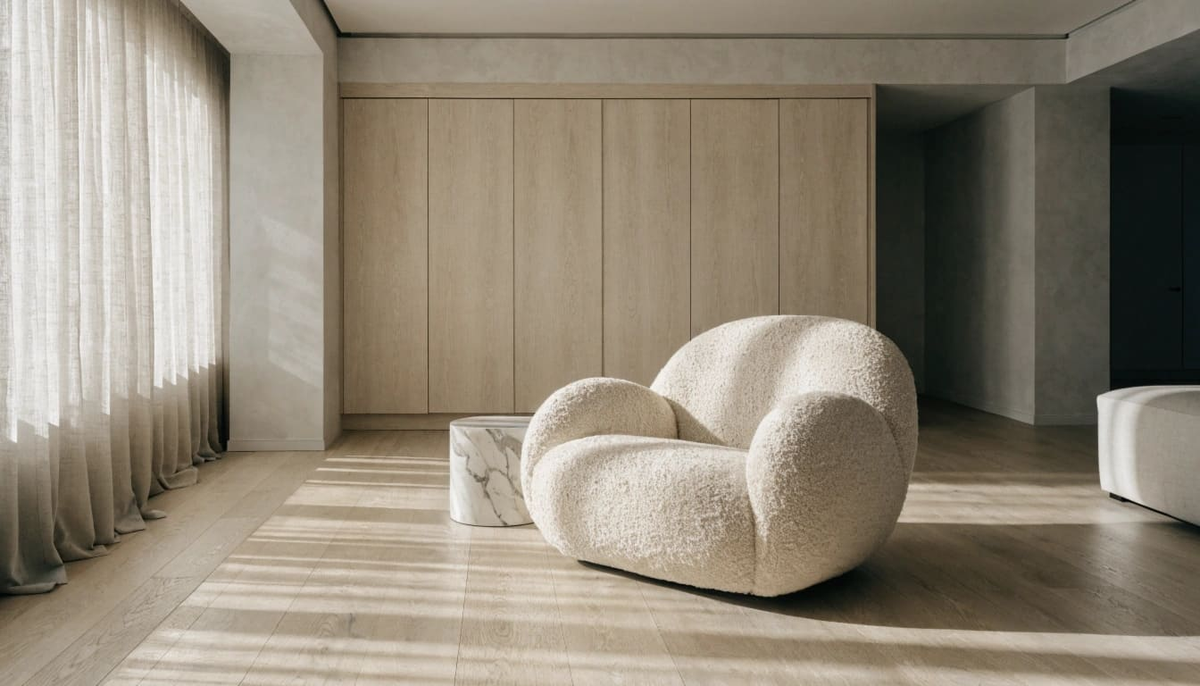
Touch it, and the loops hit you first — soft, bumpy, a touch springy under the hand. Up close, the surface looks curly and uneven, almost like tiny knots crowded together, yet from across a room, it reads as rich rather than messy. Run your hand across a bouclé sofa and you feel it give slightly, then spring back; settle into a bouclé chair and the loops hold a soft, padded warmth instead of the flat coolness of plain woven fabric. Some bouclé is plush and cloud-like. Tighter weaves feel firmer, more structured. Texture is the whole game either way. It throws visual interest and depth into neutral interiors without a single bold color or pattern doing the work, and that's exactly why designers keep reaching for it.
How Is Boucle Fabric Made?

It all starts with the yarn. Bouclé yarn takes at least two strands and treats them differently. One gets pulled tight for strength. The other is fed in loosely, so it buckles into loops. Weave that looped yarn and the curls rise, building the uneven, three-dimensional surface.
After that, the fiber decides everything else. Wool, cotton, mohair, alpaca, silk, polyester, acrylic, rayon, or some blend. Your pick sets how soft it feels, how warm it runs, how long it lasts, what you pay, and whether it belongs on a winter coat or a family sofa. Fiber content is really what makes bouclé more or less durable and expensive. This is why bouclé can range from affordable synthetics to very pricey wool or mohair blends.
A Brief History of Boucle
Boucle grew up in two places at once — fashion and furniture — and both stories count.
Boucle in fashion
The luxury name came off the runway. When Coco Chanel reopened her couture house in the 1950s, she built her now-iconic structured jacket from boucle-style tweed, and the look turned into shorthand for quiet elegance. Jackie Onassis and others kept it there for decades.
Boucle in mid-century furniture

Furniture beat fashion to it, actually. Back in 1948, Eero Saarinen wrapped his groundbreaking Womb Chair in boucle — a chair Florence Knoll had asked him for, something “like a basket full of pillows” she could curl up in. The plush, looped fabric made the curved shell feel exactly that inviting, and mid-century modern design never looked back.
Why is the boucle popular again?
So why now? Look at how we decorate today — neutral, curved, cozy. Boucle hits all three. It warms up minimalist rooms that would otherwise feel cold and flat, and it photographs like a dream, which never hurts any trend.
Common Types of Boucle Fabric
Wool boucle

The original, and still the benchmark. Wool boucle runs warm, soft, and tough in a way that synthetics keep chasing. You’ll find it on coats, jackets, and pricier furniture, and on wool throws, which offer natural stain and fire resistance for free.
Cotton boucle
Lighter on the hand, and more breathable than wool. Cotton boucle suits softer home decor and warm-weather clothing, and it won’t feel as dense when you sink into it.
Mohair boucle

Mohair comes from Angora goats and brings a quiet sheen and serious durability. Mohair boucle carries a silky edge in its texture that nudges a piece straight toward luxury.
Synthetic boucle
Polyester and acrylic boucle fill furniture showrooms for solid reasons — cheaper, harder-wearing, and easy to treat for stain resistance. Performance boucle almost always lives here, which makes it the sensible choice when life gets messy.
Blended boucle
A lot of today’s boucle mixes fibers on purpose — wool’s softness married to polyester’s muscle, say. The idea is to grab the best of each and land somewhere balanced on feel, durability, and price.
What Is Boucle Used For?

Furniture is where most people first meet it. Boucle wraps sofas, armchairs, swivel chairs, ottomans, benches, beds, and headboards, and it looks its best on curved, sculptural shapes — a cushioned single-seat accent chair in boucle might be the easiest way to bring the texture home. Past seating, it shows up in pillows, throws, curtains, and bedding, all low-stakes ways to test the trend before you commit to a whole sofa. Fashion uses it too, on jackets, coats, skirts, suits, hats, and cold-weather accessories. One thing to know: upholstery-grade boucle is woven tighter and heavier than the fashion kind, built to take a beating.
Why Is Boucle So Popular in Home Decor?

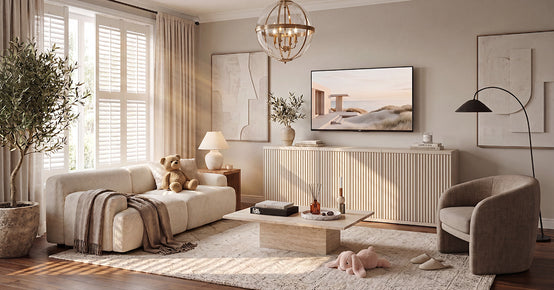
It pulls its weight in neutral rooms. Boucle drops texture into white, beige, cream, taupe, and soft gray spaces that would otherwise fall flat, so you get depth without leaning on bold color. It softens hard-edged or sculptural furniture too — a down-filled three-seater sofa in boucle feels warmer and more welcoming than the same frame in leather. The fabric drops happily into mid-century modern, Scandinavian, Japandi, modern organic, and Parisian rooms, and those raised loops catch the light in a way that always reads rich on camera.
Is Boucle a Good Fabric?
Mostly yes — with one honest catch. If you're chasing texture, softness, warmth, and a high-design look, bouclé hands you all of it. Where it falls short is a home with claw-happy pets or constant food spills. The bigger thing to know is that quality matters here more than with almost any other fabric — a dense, well-built bouclé and a cheap fuzzy lookalike do not age the same. So check the fiber blend, weave density, and backing before you buy. The full trade-offs are below.
Advantages and Disadvantages of Boucle
Start with the wins. Bouclé is soft and cozy; it adds visual interest without prints; it flatters curved furniture; it comes in loads of fibers and colors; and the upholstery-grade stuff can be genuinely tough. Unlike sheepskin or sherpa, a good bouclé won't shed or mat, and it sits about as close to nonshedding as fabric gets.
Now the downside, because it's real. Those same loops that make bouclé special can snag, break, or pill the second they catch a claw, a ring, or a zipper. The texture hoards dust, crumbs, and pet hair more than smooth fabric does. Cheaper bouclé flattens and looks tired fast. And since white bouclé furniture has been absolutely everywhere, some shoppers already side-eye it as trend-heavy.
Boucle vs Similar Fabrics
Boucle vs sherpa

Boucle gives you looped yarn and a nubby, knotted surface. Sherpa is the fluffy one — fleece-like, built to fake real sheep’s wool — so it comes off more casual and piled next to boucle’s neat little loops.
Boucle vs tweed
Tweed is a woven fabric you know by its flecked, patterned face, often with color threaded through. Boucle is all loops and raised texture. They’re cousins in fashion history — Chanel smudged the line between them — but they aren’t the same cloth.
Boucle vs chenille
Chenille is soft and velvety, a fuzzy pile that lies pretty flat. Boucle feels nubbier and more irregular, with loops you can actually see. Chenille reads smoothly. Boucle reads textured. Simple as that.
How to Clean and Care for Boucle

Care is easy as long as you stay gentle. When cleaning bouclé furniture or a bouclé sofa, a few habits do most of the work:
-
Vacuum often with a soft brush attachment on low suction, pulling dust and crumbs out of the loops before they bed in.
-
Blot spills as soon as they happen with a clean cloth, and never rub — rubbing drives the stain deeper and tugs at the loops.
-
Keep harsh cleaners and bleach away, since they wreck both the texture and the color; a mild, fabric-safe cleaner does the job when the care label signs off.
For a bouclé sofa or a delicate garment, a professional clean beats an aggressive DIY attempt. And trim those claws, because pets and loops are the worst matchup bouclé has going.
How to Style Boucle in Your Home

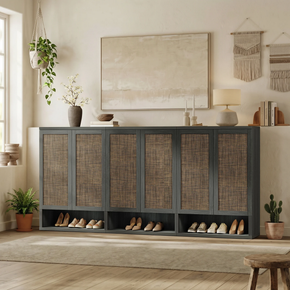
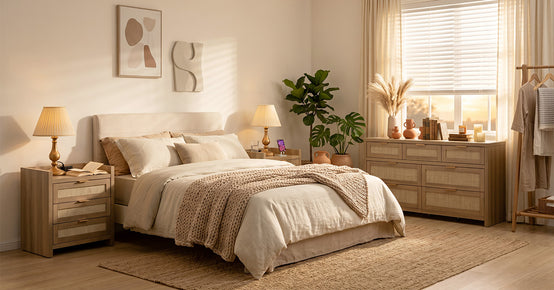
Not sure yet? Start small. Boucle pillows, a bench, or an ottoman swap out far more easily than a whole sofa later, and a flip-top entryway storage bench in a soft weave drops the texture right where you come through the door. Balance is the other half of it — set boucle against smooth stuff like wood, leather, marble, or linen so the room doesn’t turn into one big fuzzball. In a bedroom, dig through a bedroom furniture collection and slide a boucle bench at the foot of the bed, playing softly against the flat tops of nightstands and dressers. Got kids or pets? Go darker — charcoal, camel, olive, brown — because those forgive daily life far better than cream ever will.
Should You Buy Boucle Furniture?

Buy it if your room feels flat, cold, or hard, and you’re after warmth and texture — that’s exactly the problem boucle was born to fix. Hold off, or shop carefully, if you need low-maintenance upholstery for a house full of pets and toddlers, where smooth leather, microfiber, or a tight performance weave will simply last longer. Love the look but live a hectic life? Reach for upholstery-grade or performance boucle over a flimsy, fashion-weight one. Compare your options across a living room furniture range and match the fabric to how you actually live, not to how the catalog photo looks.
FAQs
Is boucle a good fabric?
Yes, if warmth, texture, and a soft high-design look are what you’re after. For furniture that gets used daily, pick upholstery-grade or performance boucle instead of a thin, fashion-weight fabric. The one place it stumbles is a home with scratching pets.
What are the disadvantages of boucle fabric?
The looped surface snags and pills, and it hoards pet hair, dust, and crumbs more than smooth fabric. Light colors flash every speck of dirt, and cheaper boucle flattens with use. Pets and those loops? Genuinely the worst pairing.
What exactly is a boucle?
A looped yarn — and the nubby, curly fabric woven out of it. Those loops riding on the surface are the whole reason boucle feels raised and textured. Take away the curls, and you’ve got nothing left of its identity.
Is boucle a summer or winter fabric?
For clothing, wool and mohair boucle are best for fall and winter because they trap warmth. Furniture boucle works all year — you’re not wearing the sofa. Honestly, the fiber decides it: a cotton-synthetic blend feels far lighter than dense wool boucle.
Is a boucle expensive?
It spans the whole range. Wool, mohair, silk, and designer upholstery bouclé sit at the top, while basic polyester bouclé costs much less and usually cleans more easily. So bouclé gets more expensive as fiber quality, weave density, and fabric weight increase — the word 'bouclé' on its own doesn't set the price.
Which is the most expensive fabric?
Vicuña tends to win that crown, trailed by fine cashmere, top-grade silk, premium wool, and rare handwoven cloth. Rarity, where the fiber comes from, and how much hand labor goes into it, drive the cost. Boucle doesn’t play in that league.
What are the most unhealthy fabrics to wear?
No single villain, really. People with sensitive skin often choose to limit low-grade synthetics and fabrics loaded with chemical finishes. When you’ve got the choice, breathable, certified, skin-friendly materials are the safer call.
Does Chanel use tweed or bouclé?
Both — and the line genuinely blurs. Chanel is famous for tweed jackets, but plenty of that tweed is made from textured, looped yarns that behave like boucle. The two are tied tight in fashion history without ever being the same.
Sources
-
Knoll – The Womb Chair at 75 Years
-
Nest Casa – Why Bouclé Furniture Is More Than a Trend
-
Iris von Arnim – Bouclé: Definition and Origin
-
Eastern Accents – Bouclé: Timeless Design
-
Helen Kaminski – What Is Bouclé Wool?


Looking for something else?

Burl Wood Furniture: The Complete Buying Guide
LEARN MORE
What Is a Hope Chest? Meaning, History, and Modern Uses
LEARN MORE
What Is a Foyer? Meaning, Purpose and Design Guide
LEARN MORE
GREENGUARD Gold Certified Furniture: What It Really Means for Your Home
LEARN MORELooking for something else?

How to Clean a Mirror Without Streaks: Simple Step-by-Step Guide
LEARN MORE
21 Above-Bed Decor Ideas for a Stylish Bedroom Wall
LEARN MORE
Furniture Materials Guide: Picking the Right Material Room by Room
LEARN MORE


Further reading

18 Decorative Storage Box Ideas That Hide Clutter Well
18 Decorative Storage Box Ideas That Hide Clutter Well
Decorative storage boxes do two jobs. They swallow the small clutter that piles up on every surface. They also add material and shape to a roo...

How to Store Comforters Without Losing Space or Loft
Storing comforters comes down to four things. Clean and bone dry. Loosely folded, and sitting in something that breathes. Miss any one, and next season you pull out something that smells like a dam...

Furniture Distance From a Fireplace: How Far Is Safe?
Furniture distance from a fireplace answers two questions with one number. Keep anything that can burn at least 3 feet from heat sources.The U.S. Fire Administration gives that message for fireplac...


