



What Is a Daybed and When Does It Make Sense for a Small Space

Here's a story. My sister moved into a 480-square-foot studio in Brooklyn a few years back. She didn't want a bed taking up half the room. She also didn't want to sleep on a sleeper sofa — she'd done that in college, and her back never forgave her.
She bought a daybed. Problem solved. Sort of.
The daybed worked fine as a couch. Sleep was fine too. What she didn't anticipate was how much styling mattered. For the first month, it just looked like a twin bed shoved against a wall. Three pillows and a throw later, it finally looked intentional.
That's the thing about daybeds. They're useful. They're also fussier than you'd think. So if you're wondering whether one makes sense for your place — or you've just never been sure what a daybed actually is — this walks through what I've learned, what the museums will tell you about them, and when they earn a spot in a small room. If you're pairing a daybed with other bedroom pieces, the Bedroom Furniture collection is a decent place to start.
1. So What Actually Is a Daybed?
 More specifically, it's a piece of furniture with the frame and mattress of a bed, but with side panels and a back that make it read as seating. You sit on it during the day. You sleep on it at night. Nothing folds out. Nothing transforms. It just sits there and does both jobs.
The design isn't new — not even close. The Britannica entry on daybeds traces them to the 16th century, when they first showed up as carved or upholstered pieces with a long seat and one inclined end. The Met's collection of French daybeds has examples from the 1750s — serious, hand-carved pieces intended for lounging in court. The V&A has a Tilliard daybed from roughly the same era with the full Rococo treatment.
So it's old. It's also been popular long enough that it's been reinvented every century. What's changed is mostly the look. The core idea — you sit on it, you sleep on it, it stays in one piece — hasn't moved.
Practical version of the same answer: a daybed is what you buy when you want a guest bed but don't have a guest room, or when a sofa plus a bed won't both fit in the same space.
2. Daybed vs. Sleeper Sofa vs. Regular Bed

People mix these up constantly. Here's how they actually differ.
A regular bed is built for one job: sleep. The frame's optimized for a mattress sitting on top, and that's it. Push it against a wall, and you can technically sit on it, but it'll never feel right.
A sleeper sofa tries to do both jobs and compromises on both. The cushions you sit on are the wrong firmness for sleep. The mattress folded inside is thinner than a real one and sits above a metal bar frame that you will feel at 3 am. I've slept on maybe a dozen in my li,fe and I can count on one hand how many were actually comfortable.
A daybed sits in the middle. Real mattress. Real sitting-height frame. No moving parts. That's why it sleeps better than most sleeper sofas and looks more put-together than a twin bed on its own.
Imagine a twin bed with arms and a tall back. Add throw pillows. That's basically it.
|
📌 The one thing that actually matters A daybed always uses a real mattress. Sleeper sofas use a folded insert sitting on a metal frame. That's why daybeds sleep more comfortably than almost any convertible couch — and it's the single most important difference between the two. |
3. When a Daybed Actually Earns Its Place

Not every room needs one. But in the right layout, they're hard to beat. Here are the situations where I'd actually recommend one.
Studios and One-Bedrooms
In a studio, a daybed can replace the sofa entirely. You lounge on it, you sleep on it, and you stop needing two separate pieces of furniture to do similar jobs. Apartment Therapy specifically recommends swapping a traditional bed for a daybed when you're tight on square footage.
In a one-bedroom, the math's different. You've already got a proper bedroom. The question becomes whether the living room needs a daybed that doubles as an occasional guest bed — and for most people, yes, it does. Beats blowing up an air mattress every time your in-laws visit.
The Guest Room That's Really an Office

This is probably the most common case. You've got a spare room. Eighty percent of the time, it's an office or a workout nook or somewhere your kid does homework. Twenty percent of people sleep there.
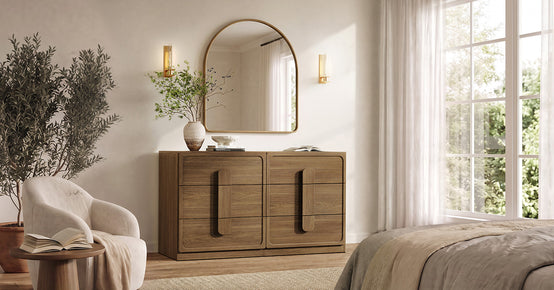
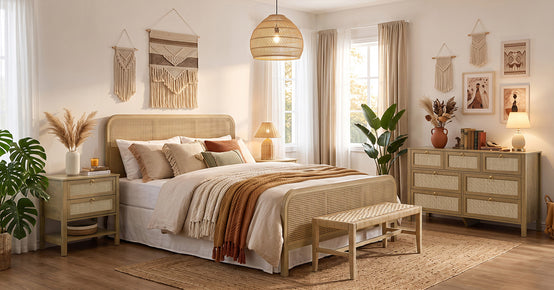
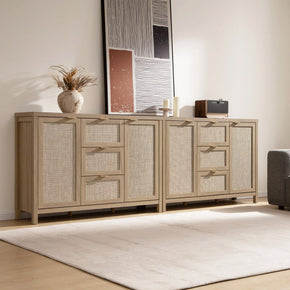
A full guest bed wastes that room for most of the year. A daybed doesn't. Style it with pillows during the week, and it's a couch for reading or taking calls. Strip the pillows when company arrives,s and it's a bed. Pair it with a small dresser like the Crescent Modular 9-Drawer Dresser, and guests actually have somewhere to put their stuff for a few days.
Kids' Rooms
Honestly, daybeds are kind of perfect for kids. They get a place to hang out with friends during the day. Sleepovers don't require digging an air mattress out of storage — most daybeds come with a trundle option. (The Sleep Foundation has a good explanation of how trundle beds work if you want the details.)
Also, as your kid gets older and stops wanting a “bedroom” and starts wanting a “room,” the daybed quietly transitions—no new furniture needed.
Narrow Rooms

Some bedrooms are just too narrow for a queen. A twin daybed is 38 inches wide at the mattress.Sleep Foundation's twin bed dimensions guide has the full specs, which fit in layouts where a 60-inch queen absolutely does not. If you've ever walked sideways past your own bed, you know what I mean.
4. Sizes, and Why the Frame Matters More Than the Mattress

Most daybeds use a twin mattress. A handful uses queen. Pick based on who's sleeping and how often.
|
Size |
Mattress |
Best For |
|
Twin |
38 × 75 in. |
Kids, solo guests, narrow rooms |
|
Twin XL |
38 × 80 in. |
Tall teens, college rooms |
|
Full |
54 × 75 in. |
Adult guests, more lounging depth |
|
Queen |
60 × 80 in. |
Couples, frequent overnight guests |
Here's what trips people up: the frame is always wider than the mattress. Always. You've got side arms—a back panel. Sometimes trim.
A “twin” daybed sounds small until you measure one — many run 80+ inches wide, including the frame. I've seen people buy daybeds online, have them show up, and realize they don't fit through the bedroom door.
|
📌 Measure everything. Then measure again. Don't trust the mattress size. Check the full external dimensions of the frame — width, depth, and height. Then add 4 to 6 inches for pillows along the back. That's your actual footprint. |
5. The Honest Pros and Cons

I like daybeds. But I'm not going to pretend they're perfect for every space.
What Daybeds Do Well
- They save floor space. One piece replaces two. Obvious but worth saying.
- No transformation required. You don't pull anything out. You don't unfold anything. You just... sit or lie down. That sounds minor until you've dealt with a sleeper sofa for six months.
- Sleep quality is closer to a real bed. Real mattress, real support.
- They anchor a room. A styled daybed looks like furniture. A twin bed shoved against a wall makes it look like you just moved in.
Where They Fall Short
- Seat depth is weird. Because the seat is a mattress, it's deeper than a sofa. Without throw pillows at the back, you'll slouch. There's no way around this.
- Most are twins. Fine for one. Tight for two adults.
- They can read as “bed” if you're lazy about styling. Skip the pillows and cover, and it just looks like you forgot to make the bed.
- Not great for daily entertaining. If you're having four friends over every Friday, get a deeper sofa. A daybed's seat isn't built for long conversations.
6. Making It Actually Look Good

This is the part most people get wrong.
A daybed without styling is a twin bed. A styled daybed is a piece of furniture. The gap between those two things is maybe $60 worth of pillows and a throw, plus ten minutes of effort.
Here's the formula that works in almost any room:
- A fitted cover or neutral bedding that matches the room. Not white. Not a loud quilt. Something that reads as upholstery.
- Three to five large throw pillows along the back. These aren't decorative — they're lumbar support. Without them, the seat is uncomfortably deep.
- A folded throw across one arm. Adds texture. Signals “someone uses this.”
- A small side table or lamp next to it. This is the single move that makes the biggest difference. It turns the daybed into “a seating area,” which is psychological but effective.
If you want actual visual inspiration, Homes & Gardens has a gallery of daybeds styled for small spaces that's worth scrolling through before you commit to a look.
|
💡 Quick styling rule Neutral base layer. Texture and pattern in the pillows. That's it. Linen, oatmeal, soft gray — all better than crisp white sheets or bold prints on the mattress cover. Save the personality for what goes on top. |
What to Pair With a Daybed

A daybed rarely works on its own. Especially in a guest or dual-purpose room, the furniture around it does half the work.
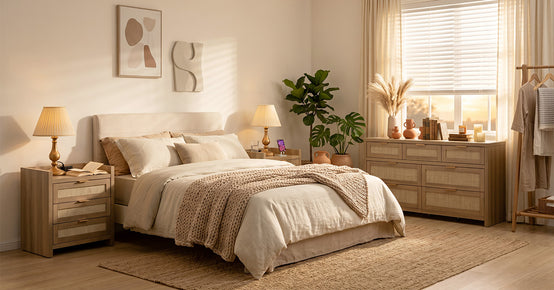
At a minimum, you need a nightstand. Guests need somewhere to put a phone, a water glass, and glasses overnight — and honestly, so do you if you're reading on it during the day. The Crescent Nightstand, 3 Drawers, works here because the drawers give guests somewhere to tuck small things for a few days without unpacking.
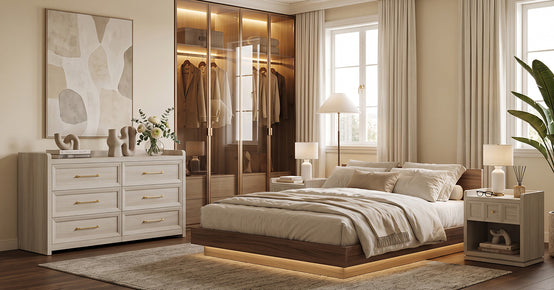
If the room has space, add a compact dresser or tall chest. This gets harder the smaller the room, but even a small one signals “this is a real bedroom” rather than “a couch we pretend is a bed.” For coordinated finishes across multiple pieces, browsing the Bedroom Sets collection saves you from the mismatched-wood-tones trap. (That trap is real. I've been in it.)
And for closet overflow — which every guest room seems to need — the Armoires and Wardrobes collection is worth checking. Especially useful if the room's being used for double-duty seasonal storage.
Companion Furniture, At a Glance
|
Piece |
Why You Want It |
Good Fit |
|
Nightstand |
Phone, water, glasses — guests and you both need one |
Crescent Nightstand, 3 Drawers |
|
Compact Dresser |
Guests staying more than 2 nights will thank you |
Crescent Modular 9 Drawers Dresser |
|
Wardrobe |
Closet overflow, especially in older homes |
Armoires & Wardrobes collection |
|
Matched Set |
Saves you from the mismatched-wood-tones trap |
Bedroom Sets collection |
7. The Checklist Before You Buy

Before you click buy, run through these:
- Measure the wall. Including pillow clearance (add 4–6 inches). Don't trust the mattress size alone.
- Check if the mattress is included. A lot aren't. Surprise.
- Consider a trundle. If you host more than one guest at a time, this one decision doubles your sleeping capacity without adding floor space.
- Check the assembly. Some daybeds are two-person jobs that take an afternoon. Read the reviews for this specifically.
- Match the style to the rest of the room. A rustic iron daybed next to a modern fluted dresser makes it look like you bought them at different garage sales. Because you basically did.
- Factor in the pillows and cover. They're not optional. Budget for them as you'd budget for the frame.
Sicotas has over 200 furniture products across modern and contemporary styles, and the Bedroom Furniture Sale collection is worth a look if you're furnishing a whole room rather than just swapping one piece. Buying coordinated tends to be cheaper than buying piece by piece anyway.
|
💡 The thing nobody tells you Buy a washable daybed cover from day one. Keeps the mattress clean, makes the whole thing look intentional, and saves your nice bedding for when guests actually arrive. It's the single best $40 you can spend on a daybed. |
FAQs
Can you sleep on a daybed every night?
Yep. People do it all the time in studios and small apartments. Sleep quality comes from the mattress, not the frame — so invest in a decent mattress, and you're fine. I've known people who've used daybeds as their main bed for years.
Is a daybed better than a sleeper sofa?
For sleep, almost always. Sleeper sofas have that thin mattress folded over a metal bar you'll feel in your back at 3 am. Daybeds use a real mattress. For formal living rooms where you want something that looks like a traditional couch, a sleeper sofa might still win out in terms of looks.
What size mattress fits a daybed?
Most are twin (38×75 inches). Some are full or queen. Check the specs before buying the mattress separately — a few brands use odd sizes, which is annoying but solvable if you catch it before ordering.
Does a daybed need a box spring?
Usually no. Most have slats or a solid platform built in. Check the product details, though — a handful of older-style daybeds still need one.
Can a daybed work in a living room?
Yes, and it's one of the smarter moves in small places. Style it right, add a side table, and it reads as a sofa. The neighbors coming over won't know it's also a guest bed — which is kind of the point.
What's the best daybed style for a small space?
Something simple. Clean lines, twin size, neutral finish. Skip anything ornate or heavy — those pieces make small rooms feel smaller. If you want character, get it from the throw pillows and bedding, not the frame itself.
The Bottom Line
A daybed earns its place when a room has to work harder than one function allows. Studios, guest rooms, home offices, kids' rooms — all of them benefit from a piece that does double duty without compromise.
In a bigger house with dedicated rooms for everything, you don't need one. But if you're reading this, you're probably not in a bigger house — and in a small one, a well-styled daybed is one of the best space-savers you can buy.
The trick is treating it like furniture from day one. Buy the pillows. Get the cover. Pick a nightstand that pairs with it. Do those three things, and it stops looking like a compromise and starts looking like you meant it.
Sources
- Britannica Editors. Daybed | Furniture. Encyclopedia Britannica.
- The Metropolitan Museum of Art. Daybed (lit de repos), ca. 1750–75, French. The Met Collection.
- Victoria and Albert Museum. Daybed | Tilliard I, Jean-Baptiste. V&A Explore The Collections.
- Sleep Foundation. Twin Size Bed Dimensions. SleepFoundation.org, 2025.
- Sleep Foundation. What Is a Trundle Bed?. SleepFoundation.org, 2024.
- Apartment Therapy. Small Bedroom Organizing Tips, According to Pros. ApartmentTherapy.com.
- Homes & Gardens. Daybed Ideas for Small Spaces — 10 Smart and Space-Saving Daybed Designs. HomesAndGardens.com.


Looking for something else?
What Is Rattan Furniture? A Buyer Guide to Types and Care
LEARN MORE
21 Nightstand Alternatives That Work in Real Bedrooms
LEARN MORE
26 Reading Nook Ideas for Adults That You Will Actually Sit In
LEARN MOREBiophilic Furniture: What It Is and How to Pick It
LEARN MORELooking for something else?
Color Coordinated Bookshelf: How to Arrange Books by Color Without Losing Track of Them
LEARN MORE
New Home Furniture Essentials: What to Buy First, Room by Room
LEARN MORE
26 Bedroom Coffee Bar Ideas That Actually Work at Home
LEARN MORE


Further reading

Why Adjustable Shelves Matter When Buying a Shoe Cabinet

Best Nightstand Height and Placement for an Adjustable Bed


