






21 Room Divider Ideas to Split a Space Without Building a Wall
Room divider ideas fall into three groups. Things you hang, things you stand up, and things you build in.
Budget and permanence follow from that choice. Pick the group first. Then pick the piece.
Below are 21 options for open-plan rooms, studios, bedrooms and home offices, sorted so you can match one to how much privacy you actually need. A safety section at the end also covers what most divider guides skip entirely.
How to Choose a Room Divider
Work through four questions before you shop.
- How much privacy? Visual zoning, partial screening, or a real door you can shut.
- How much light can you lose? A solid divider in a single-window room makes it gloomy fast.
- Does it need to move? Fixed, sliding, folding, or something you can carry away.
- Should it store things? Shelving solves two problems in one footprint.
Renters should add a fifth. Can it go up without drilling?
Answer those five and the list below shortens fast.
21 Room Divider Ideas
1. Stand a Folding Screen

The classic no-construction answer. Move it. Fold it. Store it flat. Good for a desk corner or a bed in a studio, and it leaves nothing behind when you go.
2. Hang Curtains

Curtains are usually the budget-friendly option for dividing a space, and how far that holds depends on the fabric, the run length, and the mounting.
Compare it against building a partition rather than against nothing. A wall means framing, drywall, finishing and often a permit. Against that, a track and fabric stay modest even at the upper end of fabric choices.
A ceiling track looks tidier than a rod and asks more of the ceiling. It has to fasten into joists or into anchors rated for the load, and joists do not always run where you want the divider.
Weight decides the hardware. Heavy blackout fabric across a wide opening loads a track far more than a sheer does. Plaster ceilings and unknown substrates are worth a professional. Renters should check the lease before drilling into a ceiling.
Fire safety sets limits a curtain has to respect. Keep it clear of the route to an exit, away from heaters and open flame, and clear of smoke alarms and any sprinkler head. Local code governs in shared or rented buildings.
Flame-resistant fabric tested to NFPA 701 is available and is required in some occupancies. A single-family home usually is not one of them, though the rated version is worth considering for a divider that hangs permanently.
Sheer fabric filters light. Heavy fabric blocks a view completely. Neither does much for sound, and the disappointment people report most is expecting acoustic separation from a curtain.
Tie them back, and the room opens again.
3. Fit Sliding Glass Doors

A proper boundary that does not shrink the room. Slim black frames keep it modern. Clear glass for openness. Reeded or frosted for privacy.
4. Use Glass Pocket Doors

A pocket door slides into the wall cavity rather than swinging into the room, removing the arc a hinged door needs.
It does not remove clearance requirements. The opening still needs a clear width when the door is open, and the pull side still needs somewhere to stand while operating it.
The wall has to be able to take it. A pocket frame needs a cavity roughly twice the door width, and that stretch of wall cannot carry structural load unless it is designed to. Anything load-bearing is an engineer's question before it is a door question.
What is already inside the wall usually decides the answer. Electrical, plumbing, ducting, and bracing all have to move, or the pocket goes elsewhere. Relocating them is often the largest part of the job.
Hardware access needs planning at the start. A door that jumps its track or a roller that fails can be behind finished drywall, and frames with serviceable access are worth choosing over ones that require opening the wall.
Fire-rated and egress locations have their own rules. Pocket doors are restricted in some, and requirements vary by jurisdiction. Confirm with your building department before framing.
A renovation is the practical moment for all of this, though a retrofit is possible where the wall allows it. Either way, it is construction rather than a furnishing decision.
5. Build a Wooden Slat Divider

Slats give partial separation while air and light still pass through. Tighter spacing means more privacy. Run them floor to ceiling and the effect turns architectural.
Cheap to build too, if you can cut straight.
6. Divide With an Open Bookcase

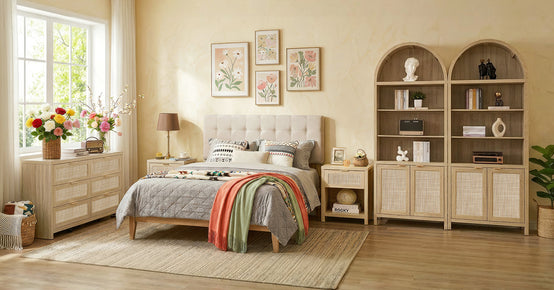
The most useful divider on this list, because it stores things while it separates. Open backs let light through from both sides. A five-shelf bookcase with a door section gives you display space and a place to hide clutter.
Style both sides. One will always face a room.
7. Build a Storage Wall

A bigger version of idea 6 for anyone who needs real storage. Mix open shelves with closed cabinets so the run does not read as one solid block.
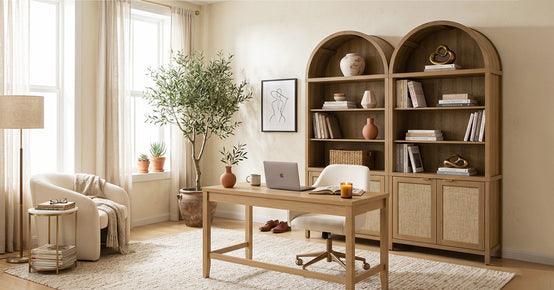
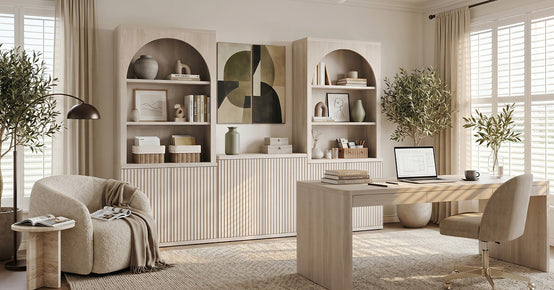
A tall arched bookcase with large storage anchors a run like this.
8. Screen Off a Home Office

Put the divider behind your chair, not beside it. That controls what shows on video calls.
Keep the window on the work side and add a task lamp inside the zone.
9. Use Frosted Glass Panels

Frosting hides shapes while passing daylight. That is why offices use it. Partial frosting keeps a sightline at standing height. Pair it with a sliding track for flexibility.
10. Try a Glass Block Partition

Back in fashion after decades away. Blocks diffuse light into a soft glow and blur anything behind them. A half-height run works better in a home than a full wall.
Heavy, though. Check the floor.
11. Add a Decorative Metal Screen

Laser-cut or geometric metalwork reads as sculpture first and divider second. Keep the open areas generous so light still travels. Pick a finish that matches the other metal already in the room.
12. Choose Bamboo or Cane

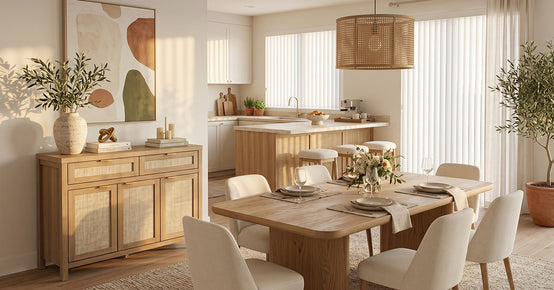
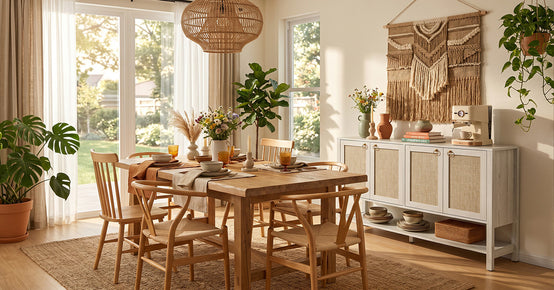
Natural screening softens a room in a way that painted timber cannot. Cane gives a lighter effect than bamboo. A white rattan bookshelf with woven panels does the same job while holding books.
13. Hang a Woven Textile Panel

Macramé, handloom, or tapestry panels filter light through the weave and double as artwork. Natural fibers bring texture that hard dividers cannot.
They collect dust. Shake them out.
14. Install Sliding Wood Panels

Solid panels on a track give stronger privacy than glass and stay more flexible than a wall. Stack two or three to cover a wide opening.
Match the timber to your joinery, and it reads as built-in.
15. Build a Partial Partition Wall

Stop the wall below ceiling height and the room still breathes. Glaze the section above it to keep the light. Build storage into the base, and it earns its footprint.
16. Turn a Headboard Into a Divider

Pull the bed off the wall and let a tall headboard mark the edge of the sleeping zone. Use the space behind for a desk or a narrow chest.
Common in lofts. Underused everywhere else.
17. Float the Sofa

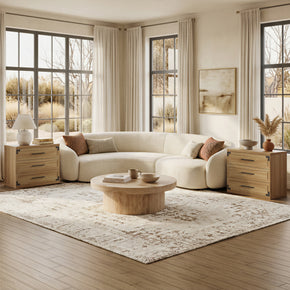
Furniture placement divides a room and costs nothing. Pull the sofa off the wall so its back becomes the edge, then slide a narrow table in behind it.
Console tables in narrow depths work here because they add a surface without eating the walkway.
18. Use a Low Cabinet Run

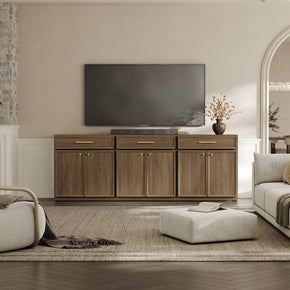
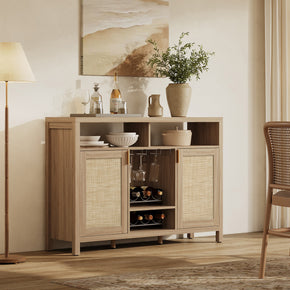
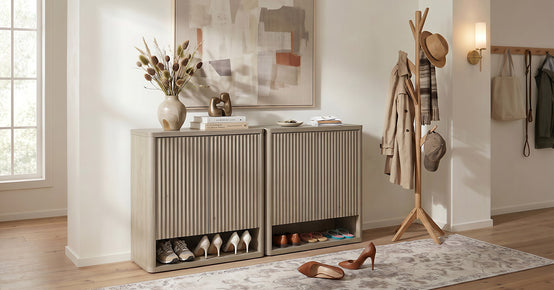
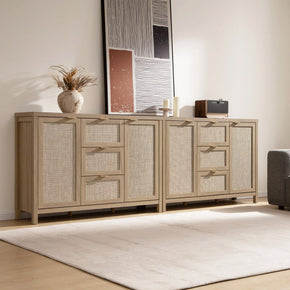
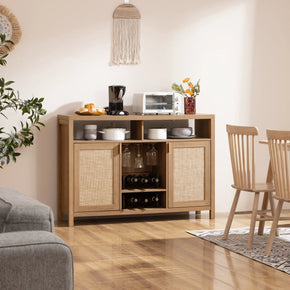
A long low unit divides at seated height and disappears when you stand, so the ceiling line stays unbroken. Sideboards and buffet cabinets are the usual pick, and both sides stay usable.
19. Suspend Shelves From the Ceiling

Hanging shelving reads as almost weightless and still holds objects. Keep the shelves narrow and the styling sparse.
Ceiling fixings must suit the load. Get this checked.
20. Grow a Plant Divider

Group tall plants on a slim stand or low shelf for a soft boundary at almost no cost. Choose plants for the light the spot actually gets. Not for the look you had in mind.
21. Repurpose Old Doors or Panels

Salvaged doors on a sliding track, reclaimed glazing, antique metal panels. Nothing else gives a room this much character. A console table with an open lower tier pairs well underneath a leaning salvaged panel if you want the look without the fixings.
Best Room Dividers for Studios and Small Rooms
Small rooms punish solid dividers. Anything that blocks the view end to end makes the space read smaller than it is.
See-through wins here—every time.
Curtains work because they disappear. Open shelving works because you see through it. Sliding panels work because you don't have to plan around a door swing.
Leave one long sightline open, usually toward the main window. That single move keeps a studio feeling like a home, not a corridor.
Cheapest Room Divider Ideas
Budget options in rough order of cost:
- A curtain on a tension rod or ceiling track
- Furniture you already own, turned to face a new direction
- A secondhand folding screen
- Tall plants grouped on a low shelf
- A timber frame with fabric or cane webbing stretched across it
Custom glass and sliding wall systems sit at the other end entirely. Worth knowing before you fall for a photo.
How to Divide a Room Without Blocking Natural Light
This is where most dividers go wrong. Choose materials that let light through rather than block it.
Clear and frosted glass perform best. Open slatted timber and open-back shelving come close. Sheer curtains filter rather than block.
Keep solid dividers below ceiling height wherever you can. If the room still ends up dim, warm lamplight covers a lot of it.
The Department of Energy explains howcolor temperature affects a room. Stay between 2700K and 3000K in living areas.
Safety Checks Most Divider Guides Skip
Design articles rarely mention any of this—all four matter more than the finish you choose.
Never Block an Escape Route
Put a divider across a bedroom window, and you have removed a way out. Anything blocking a door does the same thing.
That second exit is usually a window. NFPA recommends mapping both routes for every room, so check your plan before you position anything permanent.
Leave a Real Walkway
Dividers eat circulation space, and the number to use depends on which rules apply to your building.
The Access Board's accessible routes guide sets 36 inches as a continuous clear minimum, reducible to 32 inches at points such as doorways for no more than 24 inches. That applies to public accommodations and commercial facilities.
Multifamily housing has its own obligations under the Fair Housing Act for covered units. Verify what applies to your building rather than assuming a single-family exemption.
A single-family home is generally outside both. Egress code is not. Residential code requires a continuous unobstructed path to the exit door, and a divider placed across that path is a code question rather than a styling one. Local requirements govern.
Where you do borrow the 36-inch figure, borrow the conditions with it. It is a floor, not a comfort target. It does not let two people pass, which needs 60 inches or a passing space.
The turn is the part dividers get wrong. Going around an obstruction under 48 inches wide calls for 48 inches at the turn and 42 approaching it. A freestanding divider is that obstruction.
Check the actual clear width once it is in place. Protruding objects and anything mounted on the divider count against it.
Anchor Anything Tall
A bookcase standing mid-room has no wall to strap to. That leaves it more exposed than the same unit pushed against a wall.
CPSC recorded 234 tip-over deaths from clothing storage units alone between 2000 and 2022.
A freestanding unit in the middle of a room has no wall behind it, and that removes the restraint method most furniture is designed around.
Check what the manufacturer supports before anything else. Some units are rated for floor or ceiling fixing and provide the anchor points. Many aren't, and drilling into a case not designed for it can weaken the structure and void the warranty.
If the maker offers no mid-room method, the unit isn't a mid-room unit. Put it against a wall and anchor it as intended, or choose a piece built to stand free. Improvising the fixing is where this goes wrong.
Bring in a qualified installer for anything beyond the supplied kit. Floor fixing means knowing what is under the subfloor, including pipes, cables and radiant heating.
Ceiling fixing means finding structure that can take the load, not just drywall.
Load the heavy things low regardless of method. Weight near the base lowers the center of gravity and reduces how easily the unit tips.
Reconsider the placement entirely for a room a young child uses. A mid-room unit is climbable from two sides and cannot be anchored the usual way. CPSC recommends anchoring furniture in homes with young children, and a piece that cannot be anchored properly belongs somewhere else.
Screens Do Not Soundproof
A folding screen or curtain blocks a view. It barely touches noise. Real sound separation needs mass and a sealed edge, which means a built partition and a door.
Bookshelves full of books help a little. Do not expect much more than that.
Room Divider Mistakes to Avoid
Blocking the only window is the big one. A room with one light source cannot afford a solid partition across it.
Undersized dividers look accidental. A screen that reaches your shoulder in a tall room reads as furniture, not division.
Timber slat dividers move with the seasons, and indoor wood settles to about 6 to 8 percent moisture content so that a tight-fitting screen can bind in a damp month.
Then the practical ones. Narrow walkways. Blocked storage. A divider chosen before the furniture layout was settled.
Final Takeaway
The best room divider ideas do a second job. They store, display, seat, or light the room as well as splitting it.
Decide privacy first, light second, budget third. Check the escape route before anything goes up permanently.
Then pick the material you actually like. That bit is the fun part.
FAQs
What is the cheapest way to partition a room?
A curtain on a tension rod or a ceiling track. Fabric and fittings cost very little, and with tension you drill nothing at all. Pull it back when you want the room whole again.
What is a good way to divide a room?
It depends on privacy, light and budget. Curtains and screens suit flexible or temporary needs. Open shelving adds storage while dividing the space. Glass or slats work best when you want permanent separation without losing daylight.
How do you build a cheap room divider?
Build a light timber frame and stretch fabric, cane webbing or thin slats over it. Hinge two or three panels for a folding screen. Keep it light enough to shift and wide enough at the base to stand up on its own.
What is the best divider for a room?
No single option wins. Sliding glass panels are best for light-friendly permanent zoning. Curtains are best on a budget. Bookcases are best when storage matters. Folding screens suit anything temporary.
What can I use instead of a room divider?
Rearrange what you own. A floated sofa. A console table. A tall plant, an area rug marking a zone, or just a change in lighting. All of them signal a boundary without buying a divider.
How do you divide a room without building a wall?
Folding screens, ceiling-track curtains, sliding panels, open shelving, wooden slats, suspended shelves, or plain furniture placement. None of it needs construction. Most of it can be undone in an afternoon.
How do you split a room in half on a budget?
A ceiling-mounted curtain across the full width halves a room for the least money. If storage matters more than privacy, turn a tall open bookcase side-on instead. It divides the space and holds your things.
What is the cheapest room divider available?
A plain fabric panel on an existing rod or tension system. If you already own the rod, you are only paying for fabric. A secondhand folding screen is often the next cheapest option.
Sources
- U.S. Fire Administration, FEMA – Home Fire Escape Plans
- National Fire Protection Association – How to Make a Home Fire Escape Plan
- U.S. Access Board – Guide to the ADA Standards, Chapter 4: Accessible Routes
- Anchor It!, U.S. Consumer Product Safety Commission – CPSC Adopts Final Consumer Product Safety Standard to Prevent Tip-overs of Dressers and Other Clothing Storage Units
- U.S. Department of Energy – Purchasing Energy-Efficient Light Bulbs
- USDA Forest Products Laboratory – Wood Handbook, Chapter 4: Moisture Relations and Physical Properties of Wood


Looking for something else?
Types of Leather Furniture: A Simple Guide to Grades and Finishes
LEARN MORE
How to Create a Gallery Wall (2026 Step-by-Step Guide)
LEARN MORE
How to Choose & Style Coffee Table Books Like a Designer
LEARN MORE
How to Decorate Your Front Door for Christmas (2026)
LEARN MORELooking for something else?

How to Fold Napkins: 10 Easy Ways to Dress Up Any Table
LEARN MORE
How to Choose a Coffee Table: The Complete Buying Guide
LEARN MORE
Burl Wood Furniture: The Complete Buying Guide
LEARN MORE


Further reading

16 Bedroom Bench Ideas That Actually Fit Your Room
21 Room Divider Ideas to Split a Space Without Building a Wall


