




Nightstand Size for King Beds: Width, Height, and Matching Tips

So, a new king bed. Welcome to the club. Nobody warns you about the next part.
You drag the old nightstand over and something's just wrong. It shrank. Well, no, your bed got bigger. Sas ifeffewerethough. The thing that used to look right now looks like it was borrowed from another room.
Here's what we'll cover. The right width. The right height. Depth. Spacing. Whether your two nightstands should match. And the tiny stuff most people miss, which, honestly, is where bedrooms go from okay to actually finished.
Best Nightstand Size for a King Bed
No time? Here's everything in four lines.
- Width: 24 to 30 inches. Big rooms can go up to 36.
- Height: Same as your mattress top, give or take a few inches.
- Depth: 16 to 20 inches is standard.
- Spacing: 3 to 6 inches from the mattress edge.
Done. Everything else below just explains why those numbers work, and when to ignore them.
Why a King Bed Needs a Bigger Nightstand

Your king mattress is 76 inches wide. That's basically a whole wall. Whatever sits beside it had better earn its spot, or the room looks tilted. You'll feel it before you can s, ay why.
The scale thing
Stick a little side table beside a king and your eyes just go there. Not sure why. You just know something's off. That's scale. Designers have a fancy word for it. The rest of us say, yeah, this looks weir—samee deal.
Small nightstands don't hold enough.
Count what lives on your nightstand right now. Phone. Water. Lamp. Book. Glasses. A charger. Maybe a notebook. That's already a lot. A skinny little surface runs out of room by noon, and everything you can't fit ends up on the floor. Which is the one place you don't want it when the alarm goes off at 6 a.m.?
Bigger pieces just work better.
A wider nightstand takes a real lamp. Not a cute mini one, a real one, scaled to the bed. The drawers eat up your meds, chargers, night-read, all of it. Feels less like decor, more like the bedroom is actually working for you. Big difference after a week.
Best Nightstand Width for a King Bed

Width is where people get tripped up. So let's walk through each common size and what it actually looks like next to a king.
24-inch nightstands
Twenty-four inches is as small as you can go beside a king without it looking sad. Use it when your room is tight, or the bed is already hogging the wall. You get a lamp, a spot, and one drawer. That's it. But for a lean setup, it does the job.
28- to 30-inch nightstands

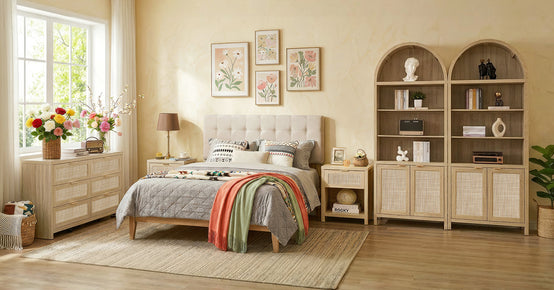
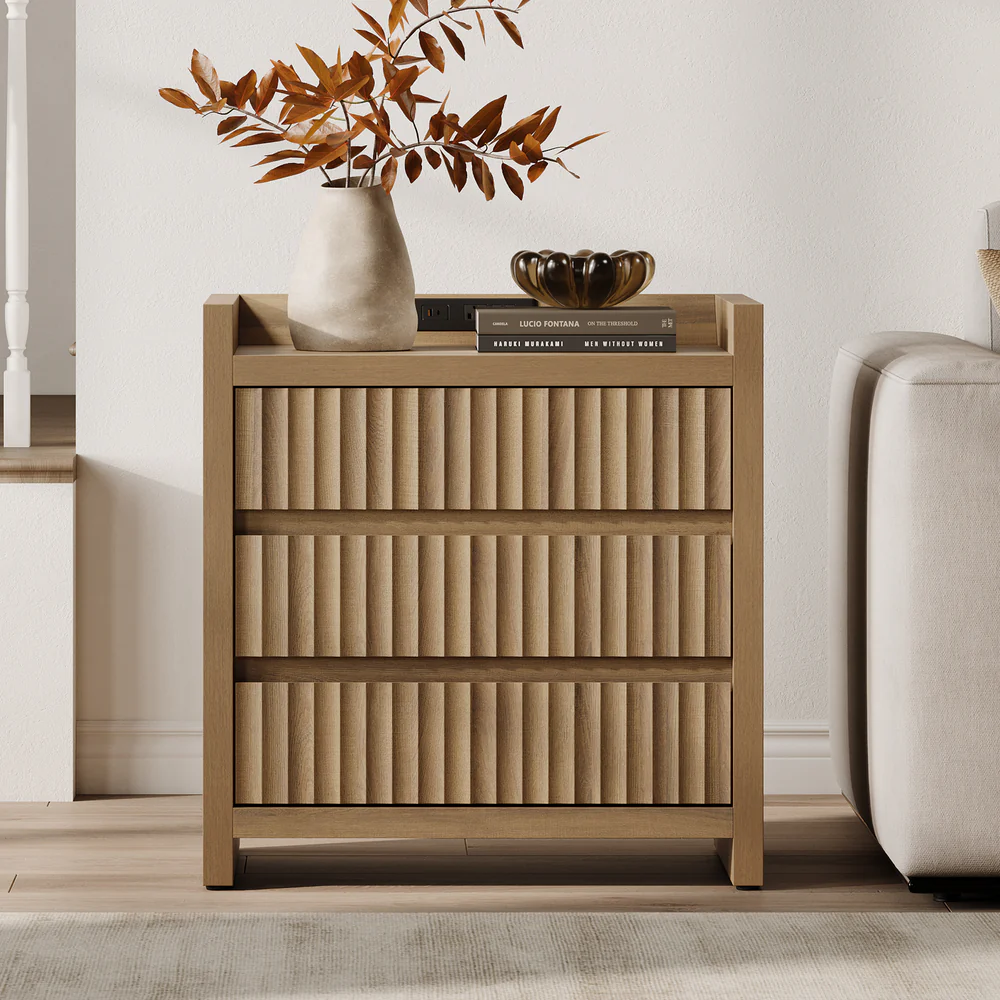
This is the zone most bedrooms end up in. If you have no clue what you want, start here and don't overthink it. The Crescent Nightstand, 3 Drawers, sits right in this zone, with three drawers and soft curves that keep it from feeling blocky in an average-sized bedroom.
32- to 36-inch nightstands
Got a big bedroom? Go bigger. These sizes provide real surface area, real drawer storage, and enough weight to keep pace with a tall or upholstered headboard. One warning, though, 36 inches eats floor space fast, so break out the tape measure before you click buy.
Anything under 20 inches
Just don't, for a king. It'll look wrong no matter what lamp or styling you throw at it. If nothing wider physically fits, a floating wall shelf actually reads better than a mini side table getting swallowed by the bed next to it.
Best Nightstand Height for a King Bed

Height is a reach thing, not a looks thing. And it's the one dimension that'll annoy you every single morning if you mess it up.
Match your mattress
Aim to get the nightstand top roughly level with the top of your mattress. A couple of inches higher or lower, fine. Here's why. When you reach sideways from bed, your arm lands at mattress height. So that's exactly where your water, phone, and book need to be.
Tall beats short
Forced to pick between slightly tall and slightly short? Go tall—every time. Reaching up beats fishing down, I promise. A nightstand sitting six inches below your mattress will wreck your mornings within a week. Learned that the hard way.
Measure your actual bed.
Tape measure time. From the floor to the very top of your mattress, topper and all. Whatever number pops up is your target. Most folks end up somewhere between 24 and 28 inches. Platform beds sit lower. Pillow-top monsters sit higher.
How Deep Should Your Nightstand Be?

Depth is the one nobody talks about. Quietly, it controls whether the room feels airy or cramped.
Standard depth
16 to 20 inches deep is where most pieces land. That's room for a lamp, a glass of water, your phone, and a book, without everything fighting for surface space. If there's a drawer at that depth, bonus. Real storage for chargers and notebooks, not a token slot.
Shallow for tight spaces
Close to a closet door or walkway? Stay shallow. Something around 12 to 15 inches gives the room breathing room. Yes, you lose a bit of surface. But you gain a path you aren't shuffling past every morning, which wins nine times out of ten.
Deep for bigger rooms
Room to burn? Go deep. 20 to 24 inches swallows chunky lamps and a stack of books with zero drama. Looks more substantial next to a king, too. Just know it juts into your walking path, so measure first and don't wing it.
How Much Space Do You Need for a King Bed and Two Nightstands?

Simple math here. Two minutes, and it'll save you the headache of a return.
The formula
76-inch king plus two 28-inch nightstands equals 132 inches. Eleven feet of wall, and you haven't even left room to breathe yet. Add another three inches of gap on each side, and you're at twelve. That's what your wall needs to hand over before anything runs into anything.
Leave a gap from the bed.
Set the nightstand 3 to 6 inches off the edge of the mattress. Close enough to grab anything you need. Far enough that your fitted sheet isn't snagging on a sharp corner every time you change the bed. It's a tiny gap, honestly, but the whole layout instantly looks more intentional.
Walking space matters
Give yourself 24 inches of clear floor on each side of the bed. That's a minimum, not a goal. Go below that and the bedroom turns into a hallway with a mattress shoved in the middle. Oh, and check door swings while you're at it. The closet. The bathroom. Both of them.
Matching vs. Mismatched Nightstands

Gotta match? Nope. But you can't just grab two random pieces either, not unless you want the whole thing to look like a yard sale landed in your bedroom.
When does matching work best?
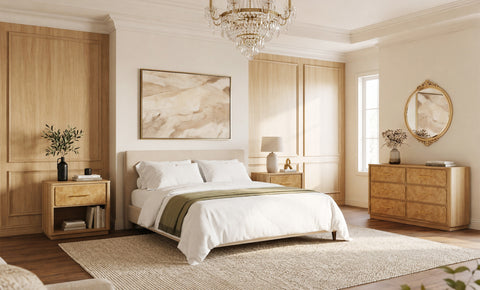
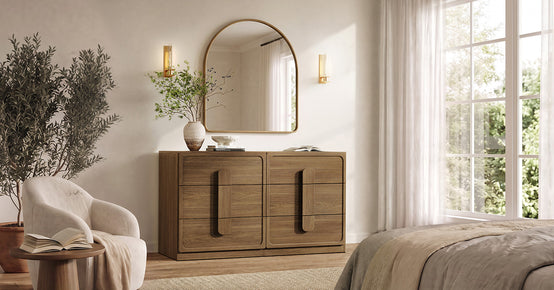
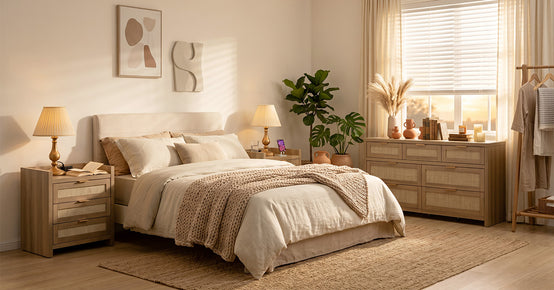
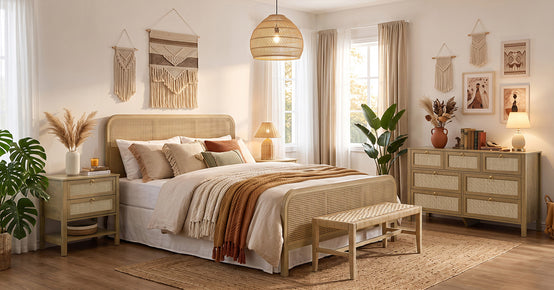
A matching pair makes a bedroom look instantly calm. Symmetry carries you across the finish line, especially in a primary suite. Easiest way to pull it off? Buy from one family. The Crescent Collection gives you two matching nightstands plus a dresser that already plays nice with them. No finish-matching gamble.
When mismatched nightstands work

The trick with mismatched is simple: the two pieces have to share one thing. Wood tone. Height. Visual weight. Any one of those three. One side of your bed needs more storage than the other? Drop something like the Cas Nightstands, 3 Drawers on the busy side, and a simpler open-shelf piece on the other. Looks intentional. Not like you gave up halfway.
Keep the heights close.
Going mismatched? Keep the heights within an inch or two. This one matters most when you're using identical table lamps, because two matching lamps at wildly different heights will drive you up the wall every night. If the heights just won't line up, skip lamps and put wall sconces at the same level instead.
Storage and Surface Space

Think about what actually ends up on your nightstand. Not the Pinterest version, I mean the honest one. The stuff you touch every day.
Drawers for the stuff you hide

Chargers. Meds. Glasses. Lip balm. A notebook. Stuff you want nearby, but not out on the counter. At least one drawer is basically mandatory. And some pieces now go a step further with built-in charging. The Savanna Nightstand with Charging Station is one, so you're not fumbling around behind the headboard for an outlet at midnight.
Open shelves for books
Open shelves are perfect for stacked books or a little basket. The catch? Everything is on display, always. Are you naturally tidy? Then you'll love it. Otherwise, drawers win. They hide the daily chaos in a way that open shelving just can't.
Surface size matters for lamps.
A dinky lamp on a dinky nightstand next to a huge king? Looks wrong, every time. Scale up the whole trio. Shoot for at least 18 by 14 inches on the tabletop. That's room for a real lamp plus the evening stuff without you juggling things every night.
How to Choose a Nightstand for Your King Bed

Doing this in the right order saves you from the usual rookie moves. Here's how I'd walk through it.
Step 1: Measure your bed
From the floor to the top of your mattress. Topper too. Type the number into your phone's notes app so you can pull it up mid-scroll while you shop. This is the single most important number for landing on the right nightstand.
Step 2: Measure the wall space
Measure both sides. Not just one. Mind the doors, windows, outlets, and anything that swings, like your closet. You really don't want to pay for a wide nightstand just to find out it's blocking the outlet you need every night.
Step 3: Pick a width
Follow the sizes from up top. 24 to 30 inches covers most king setups. Bigger bedrooms can handle 32 to 36. Width is the thing you'll clock visually every time you walk in, so take your time here. No rushing.
Step 4: Match the style, don't clone it
Complement the bed. Don't clone it. A wood bed next to a nightstand in the same finish ends up looking like a catalog. Shift the tone a little, or break the pattern with a painted or metal-touched piece beside a wood frame. Way more interesting.
Step 5: Choose storage that fits your habits

Big reader? Open shelf. Lots of small junk to tuck away? Go multi-drawer. Tech person with cables everywhere? Look for a built-in USB. The full Sicotas nightstands collection has pieces in all of those lanes, so scroll around a bit before you lock in.
Common Mistakes to Avoid
Stuff I've watched go sideways in plenty of bedrooms. None of them is a catastrophe. They're all the slow-burn kind of annoying, though, the kind you'll keep noticing every single day.
Too narrow
Number one, most common, by a mile. A 16-inch table pressed up against a 76-inch bed? Just looks silly. No amount of styling fixes it either. Measure once, size up, and don't let the nightstand you already own decide this for you.
Too low
When the nightstand sits way below your mattress, you're leaning down for your water every morning. And that gets so much worse when you're half asleep at 2 a.m. Pull the height back within a few inches of your mattress top and the problem just... disappears.
Ignoring clearance
A stunning nightstand that blocks your closet door is a paperweight. Pretty, but useless. Check all your clearances before you hit buy. Five minutes now, zero return-shipping drama later.
Wrong lamp scale
A tiny lamp on a tiny nightstand next to a huge king. It's such a weirdly common trio, and it looks off every time. Scale the lamp up alongside the nightstand. Suddenly, the whole wall reads coordinated instead of cobbled together.
Coordinating with the Rest of the Bedroom

Nightstands don't live in a bubble. They're part of a crew, your bed, your dresser, whatever else is in the room. Way easier to design them as a coordinated set from the start than to try to play catch-up on matching six months later.
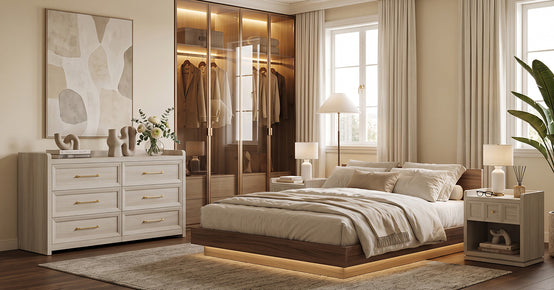
Simplest play, grab your nightstands and dresser from the same family. The Cas 6-Drawer Dresser plays nicely with many modern king frames, and pulling pieces from the same set means one less headache down the line. Keep your finishes in the same lane overall. Warm with warmth. Cool with cool. Simple.
FAQs
How big should a nightstand be for a king bed?
For most king beds, aim for 24 to 30 inches wide. Top should sit close to your mattress height, with depth of around 16 to 20 inches. That gives you a real surface for a lamp, water, and phone, without the whole piece looking undersized next to the bed.
How wide is a king-size bed with nightstands?
A standard 76-inch king plus two 28-inch nightstands hits roughly 132 inches. That's 11 feet, with zero spacing gaps. Add a couple of inches of breathing room on each side, and you're closer to 12 feet of total wall space.
How to size a nightstand?
Start with the mattress height, from the floor to the very top. That sets your target. Then grab the wall space on each side of the bed. Pick a width that actually matches your bed, which for a king usually lands at 24 to 30 inches.
How much room do you need for a king bed and nightstands?
Enough wall for the bed, both nightstands, plus the little gaps in between. A 76-inch king with two 28-inch nightstands requires a minimum of 12 feet of wall space. You also need 24 inches of clear floor on both sides so you can actually walk around it.
How large is a nightstand?
Most run about 21 to 28 inches wide, 23 to 28 inches tall, and 16 to 20 inches deep. King beds pair best with the bigger end of that range. Queens and twins can go narrower without the scale looking weird.
What is a good size for a bedside table?
For a king bed, at least 24 inches wide, with the top close to your mattress height. Aim for 16 inches or more of depth so a real lamp and your nightly stuff both fit. Drawer storage is a huge bonus because it tucks the small stuff away.
Are nightstands shorter or taller than beds?
They should sit level with your mattress top, or slightly taller. 2 to 4 inches above or below is the sweet spot. Dropping too low makes everything awkward to reach from bed. Stuck between options? Always pick the slightly taller one.
How to choose a nightstand?
Order matters. Height first. Then width, then depth, then storage. Style comes last. Height decides how easy it is to grab things from bed, which is the whole point of a nightstand. Good-looking options are available in every size, but only the right dimensions actually work in your room.
Final Rule
For a king bed, shoot for 24 to 30 inches wide. Height close to your mattress top. Placed 3 to 6 inches off the bed edge. Storage that fits how you actually live, not how you wish you did.
Measure first. Don't skimp on width. Your bedroom will look so much more finished when the pieces are actually sized right for the space.
References & Resources
- West Elm — What Size Nightstand to Buy for a King-Size Bed: westelm.com king bed nightstand guide
- Wayfair — How to Choose the Right Nightstand Size: wayfair.com nightstand size guide
- Birch Lane — Nightstand Dimensions Guide: birchlane.com nightstand dimensions
- Mix & Match Design — Ultimate Guide for Choosing Nightstands: mixandmatchdesign.com nightstand guide
- Sleep Foundation — King Size Bed Dimensions: sleepfoundation.org king bed dimensions
- Southern Living — Bedroom Decorating Guides: southernliving.com bedroom decor
- The Spruce — Bedroom Decor Tips: thespruce.com bedroom decor
- Hometips — BedrooMaster Bedroom Makeover—Luxe Looks on Any Budget | HomeTipsm Furniture Buying Guide: hometips.com bedroom furniture


Looking for something else?

20 Small Media Room Ideas for a Cozy, Space-Smart Setup
LEARN MORE
18 Jewelry Storage Ideas for a Tangle-Free Collection
LEARN MORE
10 Coffee Table Alternatives That Work Better in Small Living Rooms
LEARN MORE
15 Home Theater Furniture Ideas That Make a Room Work
LEARN MORELooking for something else?

Open vs Closed Floor Plan: Which Layout Suits Your Home?
LEARN MORE
Whitewashed Wood Furniture: Getting the Finish Right at Home
LEARN MORE
18 Accent Table Decor Ideas That Work in Real Rooms
LEARN MORE


Further reading

How to Choose a Dresser for Sweaters, Denim, and Bulky Clothes

Adjustable vs. Fixed Bookcase Shelves: Which Is Better for Real Storage?


