



10 Coffee Table Alternatives That Work Better in Small Living Rooms
Coffee table alternatives solve a problem most furniture guides skip past. A standard rectangular table eats about four feet of your best floor space. It offers no storage. It cannot be moved easily. It puts a hard corner right where a toddler falls.
This guide covers ten replacements that do more jobs in less space. You also get the measurements to check before you buy, the safety checks nobody mentions, and an honest note on when a small table still wins. Worth knowing how designers actually space living room furniture before you shop. The numbers change everything.
Do You Actually Need a Coffee Table?
No. It is a convention, not a requirement. Plenty of well-designed living rooms have nothing in the middle.
The Four Jobs It Really Does
Strip away the habit and the job list is short:
- Holds a drink, a remote, a book
- Gives you somewhere to rest your feet
- Visually anchors the seating group
- Sometimes hides clutter
Something smaller, softer, or easier to move can do all of those.
When Skipping One Makes the Room Better
Tight walkways. Studio apartments. Rooms that double as a dining space or a home office. Households with crawling babies. Open-plan layouts where a big rectangle blocks the sight line. Any of those and the table is working against you.
Sectionals are the sneaky one. On a large L-shape, the far end of a central table sits four feet from whoever is sitting there. Useless.
Balance the Room Another Way
Removing the table does not have to leave the room looking half finished. A rug, a pair of chairs, a well-placed ottoman, or two coordinated side tables will hold the seating group together just as well.
Measure First, Shop Second
Most articles on this topic go straight to pretty pictures. The numbers matter more, and they're why so many replacements get returned.
The 2/3 Rule, Adapted
The classic guideline puts a coffee table at roughly two-thirds the length of the sofa. That still applies to alternatives. It just gets spread across several pieces.
One ottoman can hit that width on its own. Two poufs together can. Three small tables grouped loosely can. No single piece has to reach two-thirdson its own.
Keep the Height Within Four Inches of the Seat
Whatever you put in the middle should sit close to the height of your sofa cushion, ideally an inch or two below it. Anything much taller feels like reaching up to a dining table from a low chair.
Trunks fail this test most often. Measure before you fall in love.
Leave 14 to 18 Inches of Legroom

That is the gap between the front edge of the sofa and whatever sits in front of it. Closer than 14 and your shins hit. Further than 18 and you lean forward to reach your mug. Neither is comfortable at the end of a long day.
Protect a 30 to 36 Inch Walkway
Main paths through a room want 36 inches. Secondary gaps between two pieces can drop to 30. If you turn sideways to pass, something is too big—simple test.
Measure the clear space between furniture edges, not from the center of each piece.
Tape the Footprint on the Floor
Painter tape. Five minutes. Mark the outline of whatever you are considering and live with it for two days. Walk the route to the kitchen. Open the door. You will know quickly.
10 Coffee Table Alternatives That Actually Work
Each covers why it works, where it fits best, and the catch nobody mentions in product photos.
1. Upholstered Ottoman With a Tray

The default swap, and it earns the spot. Soft edges, no corners, doubles as a footrest and an extra seat when people turn up.
Add a firm tray for a flat surface for drinks. Without one, a glass of wine on a padded top is a gamble.
Best for family rooms and casual layouts. Also the safest pick if a toddler is learning to walk in that room.
Catch: very plush upholstery will not hold a tray steady no matter how nice the tray is. Press the top with your palm before you buy. If your hand sinks more than an inch, look at a firmer model.
2. Storage Ottoman

The same piece with a hollow inside. Blankets. Board games. Controllers. That pile of magazines nobody reads. One item replaces a table, a footrest, a spare seat and a storage basket.
Best for apartments and rooms that never quite stay tidy. Catch: hinge and frame quality decide whether it survives being sat on. Check both.
One practical note. Lidded storage is slower to use than open storage. Things you reach for nightly should live somewhere easier to access. Save the inside for blankets and seasonal clutter.
3. A Pair of Poufs

Lighter and more flexible than one big ottoman. Pull them toward the sofa for a movie, split them for guests, and shove them aside when you need the floor.
Two usually look more deliberate than one. A single small pouf marooned in the middle of a room reads as an accident.
Best for small living rooms and households with kids who use the floor. Wool or performance fabric holds up better here than linen.
4. Side Tables Instead of One Central Table

Move the surfaces to where people actually sit—one beside the sofa, one between two chairs, one at the corner of a sectional. Nothing blocks the middle of the room. The shortcut here is to choose end tables and side tables by footprint rather than by looks.
Best for narrow rooms and awkward traffic paths. Catch: you lose the shared central surface. Board games and big serving platters get harder.
5. A Cluster of Small Tables

Two or three low tables grouped loosely in the center. Push them together on a quiet night, pull them apart when six people come over. Modular pieces built to be rearranged make this easier than mixing random finds.
Keep one thread running through the group. A shared material, a repeated finish, a matching height. Otherwise it looks like leftovers.
6. Nesting Tables

The neat version of a cluster. They stack into one footprint most of the time and spread out when you need surface area.
Light enough to move one-handed. That matters more than people expect. Best for rooms that change function during the day.
Catch: check that the smallest table is stable enough to use on its own.
7. Narrow Bench

A bench around 12 to 18 inches deep gives you length without depth. It holds a tray and a stack of books, seats two in a pinch, and slides back toward the sofa when you need the floor.
Low vintage benches are easy to find secondhand. Best for long sofas in narrow rooms.
Check the top before you commit. A slatted or woven seat looks great but won't hold a mug upright. Solid tops only if drinks are part of the plan.
8. Vintage Trunk or Storage Chest

Character plus hidden storage, and a genuinely solid top. A piece like this horizontal chest with open drawers does the same job with easier access, since you don't have to lift anything off the top to reach inside.
Best for eclectic, farmhouse and collected interiors. Catch: check the height against your sofa seat, and read the safety section below before buying anything with a hinged lid.
9. Stools or Storage Cubes

Three stools of the same height, loosely grouped. Use them as drink tables, extra seats, plant stands, or footrests. They move in seconds and stack in a closet.
Storage cubes add a hollow interior to the same idea—best for renters and people who entertain in bursts.
Keep them the same height. Mixed heights in a tight cluster read as a mistake, not a choice.
10. C-Table or Slim Tray Table

The lowest-footprint option on the list. A C-shaped table slides its base under the sofa so the top hovers over your lap or beside the armrest.
It uses almost no floor space. Best for studios and very small rooms where you mainly need somewhere to put a laptop and a mug.
Measure the clearance under your sofa first. Many modern frames sit too low for the base to slide underneath, and that kills the whole idea.
Which Coffee Table Alternative Fits Your Room?
Short version, by situation.
For the Smallest Rooms
C-table, one side table, a single pouf, or nesting tables. All four preserve circulation and can be shifted with one hand.
For Families With Young Children
Upholstered ottoman or storage ottoman. No corners, somewhere to hide the toys, and a soft landing when someone trips. Skip glass and anything with sharp metal edges for now.
For Maximum Storage
Storage ottoman, trunk, chest, or a run of storage cubes. Check how easily you can reach inside once you've styled the top.
For Entertaining
Nesting tables, clustered side tables, stools, or poufs. You can redistribute surface area and seating around the room in under a minute.
For Narrow Living Rooms
Narrow bench, side tables, or a C-table. Length without depth is the goal.
For Renters and Frequent Movers
Anything you can carry alone. Nesting tables, stools, and poufs travel well and survive stairwells. Trunks and heavy chests do not.
The Safety Checks Nobody Mentions
Every guide on this topic stops at styling. These four checks matter more, particularly if the piece has a lid or a hollow inside.
Falling Lids Are the Real Hazard

Hinged lids on trunks, chests and storage ottomans can drop onto a child leaning inside. Safety standards for toy chests require the lid to stay in place rather than fall freely, and the same logic applies to any lidded piece in a family room.
Look for slow-close or friction hinges. If a secondhand trunk has a free-falling lid, remove it or add a lid support before it goes in the room.
Check the Weight Capacity Before Anyone Sits
Ottomans and cubes get used as seats whether the listing says so or not. A rated capacity around 250 pounds with a hardwood or kiln-dried frame is a sensible floor.
Cheap frames fold at the corners within a year. The difference is almost always the frame, not the fabric.
Anchor Anything Tall
If your alternative is a chest or a cabinet rather than a low table, strap it to the wall. Guidance recommends anchoring furniture over 30 inches tall or over 30 pounds, and a piece with drawers is exactly the kind of thing that tips.
Test the Tray Before the Drinks
Put the tray on the ottoman empty, then press one corner hard. If it tilts, it will tilt with a full mug. Trays with a raised lip or a non-slip base hold better on fabric.
When a Small Coffee Table Still Wins
An honest counterpoint, because not every room is better without one. Hard surfaces wipe clean. They hold weight anywhere on the top. They never need a tray.
Go Narrow Instead of Going Without

Depth is usually the problem, not length. A space-saving rectangular table keeps the flat surface you actually wanted while returning most of the walkway you lost. Try this before writing off tables entirely.
Or Choose One With an Open Shelf

A lower shelf turns a plain table into storage without adding a lid or a hinge. Something like this two-tier rattan center table holds the remotes, the magazines, and the throw underneath while the top stays clear.
Surfaces Behind and Beside the Sofa
If the center of the room has to stay clear, the surfaces still have to go somewhere. Three places most people forget.
A Console Behind the Sofa

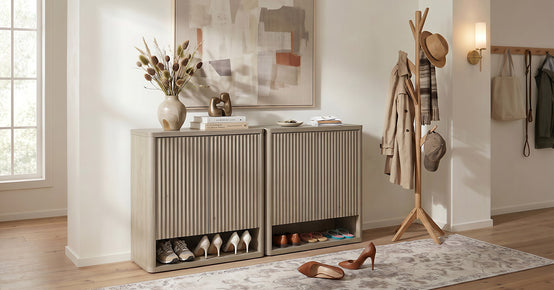
A narrow table along the back of a floating sofa gives you a full-length surface that takes up almost no walking space: lamps, keys, a drink, a plant. A slim,narrow entryway-style table fits this job well, since the depth is already built for tight spots.
A Wall-Mounted Ledge
A shallow shelf on the wall beside the sofa costs zero floor space. Good for renters who can patch two screw holes on the way out.
Sofa Arm Trays
A weighted tray that sits across the arm of the sofa. Barely furniture at all. Useful in rooms where nothing else will fit.
When Leaving the Center Empty Works Best
The tenth alternative is nothing at all, and in some rooms it is the right answer.
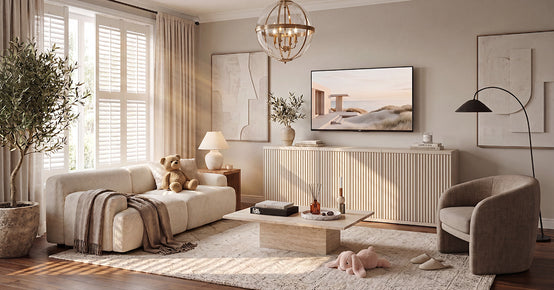
Let the Rug Do the Anchoring

A rug creates the visual boundary a coffee table normally provides. Size it so the front legs of every seat sit on it. That single move stops an empty center from looking unfinished.
Put Surfaces Where People Sit
Side tables, C-tables, a console behind the sofa. Nobody needs a surface in the middle of the floor. They need one within arm reach of their own seat.
Rooms That Are Better Empty
Play spaces. Rooms used for yoga or workouts. Layouts where the main path crosses straight through the seating area. Small rooms that already feel full.
You can always add something later. Living without a centerpiece for a month costs nothing and tells you more than any guide will.
Mistakes That Make an Alternative Look Improvised
The most common one is going too small. A tiny pouf or a single stool floating in front of a large sectional looks lost, not intentional. Scale up or add a second piece.
Second is forgetting drink stability. Soft tops need a firm tray, and the tray needs to match the piece rather than being grabbed from the kitchen.
Third is replacing one oversized object with another. Swapping a bulky table for an equally bulky trunk does not fix the walkway problem that started the whole search.
Height gets ignored constantly. A chest that sits well above the sofa cushion is awkward to use even when it looks great in photos.
Random clusters are the fourth trap. Three unrelated tables from three different places read as clutter unless something ties them together.
The last one is picking style over function. A beautiful stool is not a working surface if a mug will not sit flat on it.
Final Takeaway
A good coffee table substitute answers the room, not the rulebook. Run any option past four questions before it comes home.
Can people walk around it comfortably? Does it give you the surface or storage the room is missing? Does it do more than one job? Does its scale work beside the sofa?
An ottoman. A bench. A nesting set. A trunk. Even an empty center with a good rug. Any of them can look more intentional than a conventional coffee table wedged into a room that never had space for it.
FAQs
What to get instead of a coffee table?
An ottoman, storage ottoman, pouf, side table, nesting tables, narrow bench, vintage trunk, stools, storage cubes, or a C-table. Choose based on whether the room needs storage, seating, a hard surface, or open floor space.
What else can be used as a coffee table?
Almost any low, stable piece at the right height works. Common ones people already own:
- A storage trunk or blanket chest
- A low bench from a hallway or bedroom
- Two or three matching stools pushed together
- A garden stool or ceramic drum table
- A wide storage cube with a tray on top
What can I use instead of a table?
If you only need somewhere to set a drink, use an ottoman with a tray, a pouf, a stool, a storage cube, or a C-table that slides under the sofa. You don't need a central table at all.
What is the 2/3 rule for coffee tables?
The 2/3 rule suggests a coffee table roughly two-thirds the length of your sofa. For alternatives, apply it to the combined width of whatever sits in the middle rather than to each piece.
Is it okay to not have a coffee table?
Yes. A living room works fine without one as long as the surfaces you need are within reach and something else anchors the seating group, usually a rug. Skipping it often improves how the room flows.
What to do with no coffee table?
Ground the seating area with a rug, then put small surfaces beside the seats:
- A side table at each end of the sofa
- A C-table that tucks under the seat cushion
- A console along the back of a floating sofa
- A pouf or stool that moves where it is needed
Are coffee tables no longer in style?
They are still widely used and still sold everywhere. What has changed is that they are no longer treated as compulsory. Flexible, multifunctional pieces have taken a lot of ground in smaller and multi-use rooms.
What should I use when I do not have room for a coffee table?
Choose something with a smaller or movable footprint. A C-table, a slim side table, nesting tables, a pouf, a narrow bench, or a compact ottoman. Whatever keeps 30 inches of walkway clear and still puts a surface within reach.
Sources
- Apartment Therapy – Living Room Layouts: The Ideal Measurements for Everything in the Room
- U.S. Consumer Product Safety Commission – Toy Safety Business Guidance: Toy Chest Requirements
- Anchor It! – Preventing Furniture and TV Tip-Overs
- Consumer Reports – Best Furniture Anchor Kits to Prevent Furniture Tip-Overs
- RoomSketch3D – Furniture Clearance and Walkway Standards
- Soul & Lane – 24 Living Room Ideas Without Coffee Tables
- Decorated Life – Ottoman Coffee Table Trays and Styling




Looking for something else?
How to Decorate a Small Living Room: Ideas and Layout Tips (2026 Guide)
LEARN MORE
Spring Table Setting: 15 Fresh Ideas for a Bright, Welcoming Table
LEARN MORE
Unique Storage Solutions for Your Kitchen: Smart Ideas to Maximize Every Inch
LEARN MORE
How to Furnish a Small Bathroom (2026 Guide)
LEARN MORELooking for something else?
Bathroom Decor Ideas: 15 Stylish Ways to Refresh Your Space
LEARN MORE
16 Super Easy Coffee Table Makeover Ideas to Refresh Your Living Room
LEARN MORE
How to Spot Clean Decorative Throw Pillows Without Damaging the Fabric
LEARN MORE


Further reading

Open vs Closed Floor Plan: Which Layout Suits Your Home?

15 Home Theater Furniture Ideas That Make a Room Work


