




How to Style a Credenza Without Making It Look Cluttered
My credenza sat empty for three weeks after I brought it home. Walnut, mid-century, cane-panel doors. Beautiful piece. Looked terrible against that bare dining room wall with absolutely nothing on it.
I tried a candle. Just one. Looked abandoned. Then I went the other direction and put everything I owned on it — books, a clock, three vases, some rocks from a beach trip. Looked like a garage sale with nice furniture underneath.
Took me a while to land on what actually works, and it came down to a handful of rules I keep reusing. Not complicated. Not expensive. Just knowing where the tall thing goes, what to hang on the wall above, and how much empty space to leave. These are 19 approaches I’ve tested in real rooms. Steal whichever ones fit your space.
What Is a Credenza, and Why Does Styling It Trip People Up?
It’s a long, low cabinet. Sits below your hip. Has doors, drawers, or some mix. People get confused because stores label the same piece as a credenza, a sideboard, or a buffet, depending on the day. The technical differences are small — buffets stand taller on long legs, sideboards sit flush on the floor, credenzas hug the ground on stubby legs or no legs at all. Honestly though? Most shoppers don’t care, and neither do I. If it’s long, low, and has storage, we’re talking about the same thing.
Why Most People Get It Wrong
Think about what you’re working with. Fifty to seventy inches of flat surface, a blank wall above it, and no instructions. People drop a couple of random objects up there, step back, and it looks like someone left their stuff out. Or they overcorrect and cram every decorative thing they own onto one piece of furniture. Neither works. What works is structure — a tall thing, a medium thing, a low thing, and some empty space between them. Simple as that. But nobody tells you that when you buy the credenza.
Start With What Goes Above the Credenza
Spent a whole Saturday rearranging things on the surface before I realized the problem was the wall. A big empty wall above a credenza makes everything below it feel unfinished, no matter how good your arrangement is. Fix the wall first. Then deal with the top.
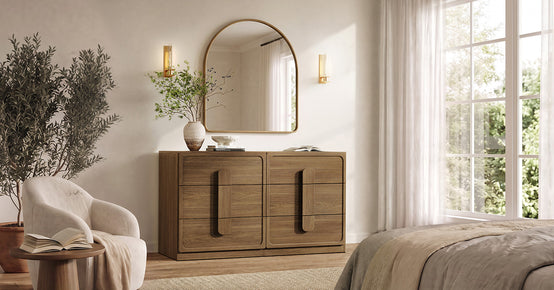
1. A Round Mirror Over a Wood Credenza

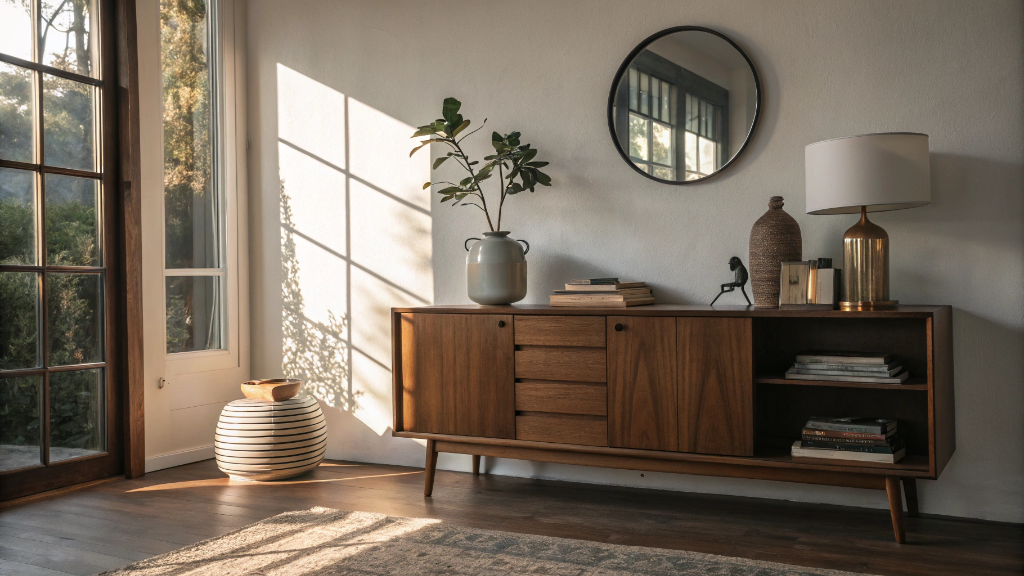
Wood credenzas are all straight lines. Rectangular top, flat doors, sharp corners everywhere. Hanging a round mirror breaks every one of those lines, and the contrast is immediate. The circle softens things up. Plus mirrors throw light around, which matters if your credenza ended up in a dim hallway or a corner that doesn’t catch much sun. I’ve recommended this pairing to friends probably a dozen times, and nobody’s come back unhappy with it.
2. One Large Piece of Art Instead of a Gallery Wall

Gallery walls are great above a sofa. Above a credenza, they create too much noise — your eye bounces between the frames and the stuff on the surface, and nothing gets the attention it deserves. One big painting or one big photograph calms everything down. Emily Henderson has been pushing this approach for years, and she’s right. When the art on the wall is carrying the room, the credenza surface can stay quiet. Tall vase on one side. Maybe a short tray on the other. Let the painting be the star.
3. Layered Frames for a Collected, Lived-In Feel

Lean one bigger frame against the wall. Prop a smaller one in front, nudged to the side. Tuck a postcard or a tiny print between them if you want. The whole thing should look like you’ve been collecting these pieces for years — not like you bought a “frame set” at HomeGoods last Tuesday. Overlap the frames a little. Mix landscape with portrait. Let it feel slightly messy. That’s the charm.
Build Height on the Surface
Flat surface plus flat objects equals boring. Your eye just slides across without stopping anywhere. Designers call the fix a “mountainscape” — objects that rise and fall across the credenza like a little skyline. Sounds fancy, but really it just means put one tall thing up there so your eye has somewhere to land.
4. A Table Lamp on One End

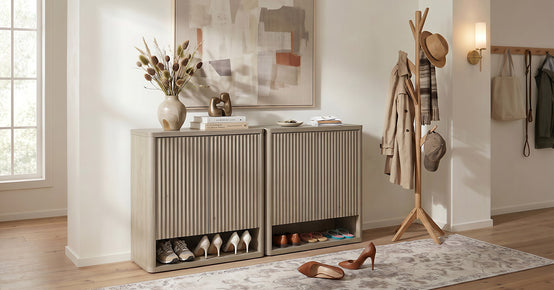
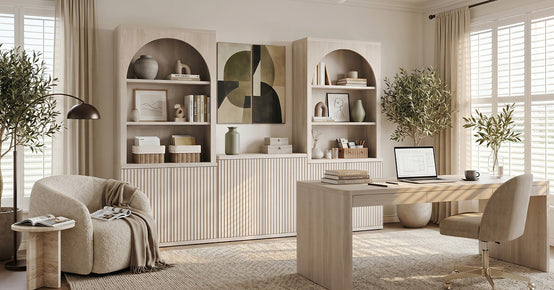
Easiest move there is. Lamp with a fabric shade, one side of the credenza, done. Fabric throws soft light — not harsh desk-lamp light, but the warm glow that makes a room feel lived-in after dark. Once the lamp’s placed, balance the other end with a plant or a few stacked books so it doesn’t feel lopsided. If your piece has fluted detailing — like the Stria Sideboardwith 2 Doors — go with a slim lamp that doesn’t compete with the texture of the doors.
5. Matching Lamps for a Formal Setup

Two identical lamps. One on each end. Mirror or artwork centered between them. Every Architectural Digest dining room photo uses this exact formula, and it’s because the thing is basically foolproof. Symmetrical setups like this look intentional without requiring a single creative decision. Tall, low, tall. Stick a footed bowl or some short flowers in the center, and you’re finished. Five minutes.
6. Tall Branches or Stems When There’s No Outlet Nearby

My dining room wall has no outlet within reach of the credenza. So a lamp was out of the question. I grabbed dried eucalyptus stems from the farmers' market, stuck them in a tall ceramic vase, and the height problem was solved for eight bucks. Pampas grass works too. Anything with length that fits in a narrow vase. You get that vertical anchor without dealing with cords or extension cables running along the baseboard.
Layer the Middle With Books, Trays, and Low Objects
The middle section of the credenza is the danger zone. Too much here and it’s cluttered. Too little and the tall things on the ends look like lonely bookends with nothing between them. My rule: group things in threes. Three books stacked. Three objects on a tray. If something is sitting alone in the middle of sixty inches of surface, it needs friends or it needs to go.
7. Stacked Coffee Table Books as a Pedestal

Stack two or three hardcovers flat. Put a little ceramic bowl or a candle on top. Now you’ve got a platform that adds color from the spines, creates a height bump in the middle of the arrangement, and gives guests something to pick up and flip through. Choose books you actually care about. Nobody’s impressed by a photography book you’ve never opened.
8. A Decorative Tray to Corral the Small Stuff

Trays saved my credenza from looking like a junk drawer. Five loose objects scattered across the surface? Chaos. Those same five objects sitting on a brass tray? Intentional. Candles, a tiny succulent, a small ceramic animal I found in Portugal — all on one tray, all suddenly looking like they belong together. If your credenza collects keys, sunglasses, and remotes, a tray makes the functional stuff look deliberate instead of forgotten.
9. Candlesticks for That In-Between Height

Taper candles in holders fill the vertical gap between the tall lamp on the end and the low books in the middle. They’re the medium layer. Use two or three at different heights — the unevenness is what keeps it from looking like a catalog photo. Pepper + Vetiver describes candles as a bridge between the bigger pieces, and yeah, that’s exactly right. They connect objects without crowding the surface.
Match the Decor to the Furniture Material
This is the part nobody talks about. Every guide says “buy a lamp and some books,” but skips the reason certain objects look right together, and others look off. It’s a material contrast. Smooth next to rough. Matte next to shiny. Cool-toned next to warm. Get the materials right, and even cheap stuff looks styled.
10. Ceramic and Stone on a Natural Wood Credenza

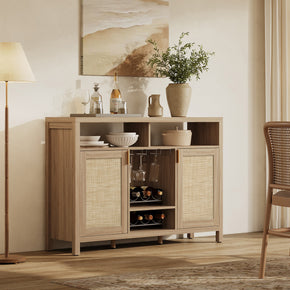
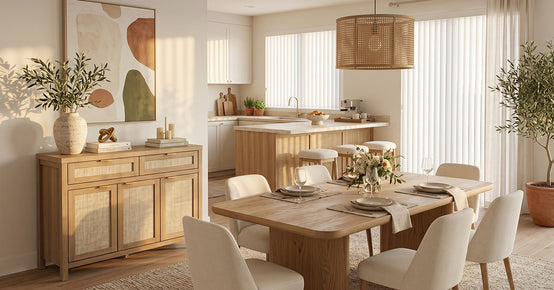
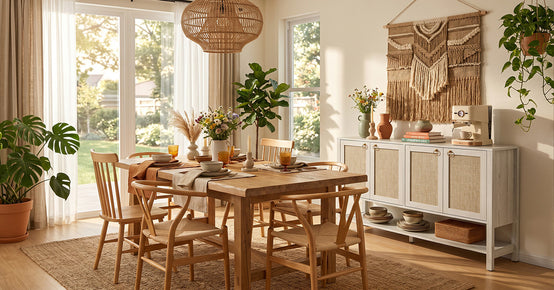
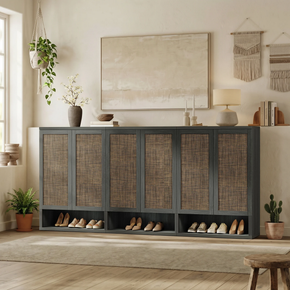
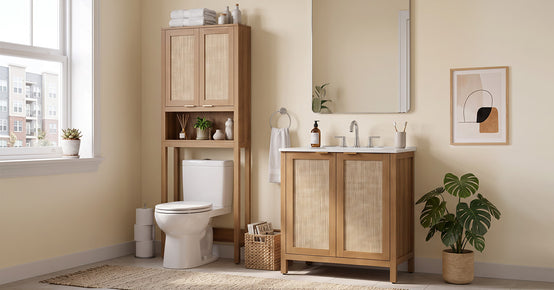
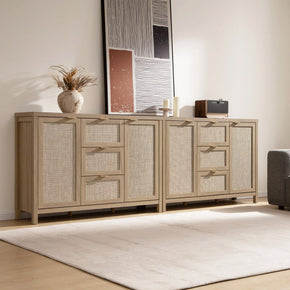
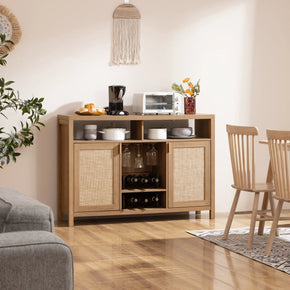
Wood-on-wood is the denim-on-denim of credenza styling. Your eye can’t tell where the credenza ends and the decor begins, because everything has the same warmth and grain. Swap in a matte white ceramic vase, a stone bowl, maybe a little marble object. Smooth against rough. The contrast is instant. If your piece has rattan or woven panels — like the Helio Decorative Sideboard Cabinet — let that woven texture be the star. Keep everything on top smooth and simple. One texture should lead.
11. Warm Accents on a Dark or Black Credenza

Black furniture eats light. Without something warm to counterbalance it, your wall starts to feel like a cave. Brass candlesticks help. A linen lamp shade instead of a dark one. Green plants — a pothos trailing off one end, maybe a small fiddle leaf. That green-against-black contrast does something to a room. Hard to explain, but you know it when you see it. The whole composition lifts.
12. Quiet Decor on a Carved or Fluted Front

Carved doors. Fluted panels. Geometric fronts. If the credenza is already shouting, the objects on top need to whisper. One lamp. One vase. Short stack of books. That’s the whole arrangement. I made this mistake with my first credenza — busy woven doors AND busy pottery AND a patterned runner. Everything competed, and nothing looked good. Homedit’s designer credenza roundup hammers this point home: when the furniture is the statement, the styling plays backup. Not the other way around.
Style a Credenza by Room
Where the credenza sits changes everything about what goes on it. A dining room setup and a bedroom arrangement have almost nothing in common.
13. Dining Room — Leave Space for Serving

Here’s what people forget about dining room credenzas. Tuesday night, it’s a styled display. Saturday night, when eight friends show up, it’s a buffet. So whatever you put on top needs to be easy to shove aside when the cheeseboard comes out. Lamps, candles, a vase of flowers — fine. But keep a solid stretch of surface clear. The Savanna Sideboard with 3 Drawers and 2 Doors is built for this kind of double life. The drawers and doors hide napkins and serving utensils between dinner parties, and the countertop has enough room to actually use when company arrives.
14. Living Room — Mix Storage and Display

Real talk: the inside of my living room credenza is a disaster. Board games, three remotes nobody can find, a tangled phone charger, extra throw blankets. That’s fine. The cabinet doors hide all of it. The top is where the styling happens — lamp on one end, tray for the everyday junk I don’t want loose, and then books, a plant, and some pottery filling in the middle. The credenza anchors that whole wall. So whatever’s on top and whatever’s hanging above it should feel like one arrangement, not two separate decisions.
15. Entryway — Keep It Tight and Simple

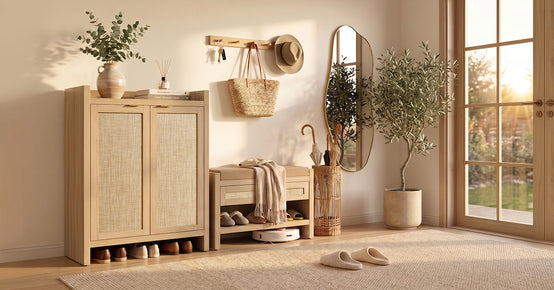
You pass an entryway credenza thirty times a day. It shouldn’t demand your attention every single time. Mirror on the wall. Lamp on one end. Small tray for keys. One object that makes you happy — a ceramic piece, a small sculpture, or flowers if you remember to buy them. That’s plenty. Overcrowding a hallway piece shrinks the whole entrance.
16. Bedroom — Calm and Minimal

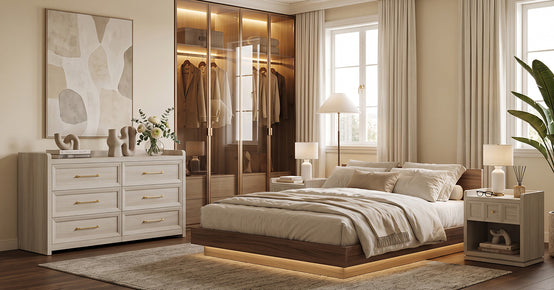
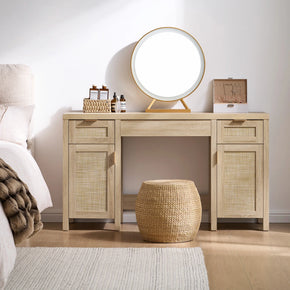
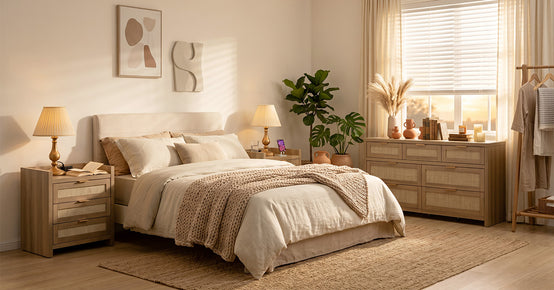
A credenza works in a bedroom if you treat it like a quieter version of a dresser. Less bulky, cleaner profile, more intentional. Match the energy of the room: a lamp for reading, dried flowers in a small vase, a jewelry dish, and two or three books. Nothing loud. Nothing that fights for your attention when you’re staring at the ceiling at midnight, trying to fall asleep.
How to Style a Credenza With a TV Above It
Nobody in design magazines wants to talk about this because a TV above a credenza isn’t Pinterest-pretty. But it’s how most people actually live. And it changes every single styling decision you make.
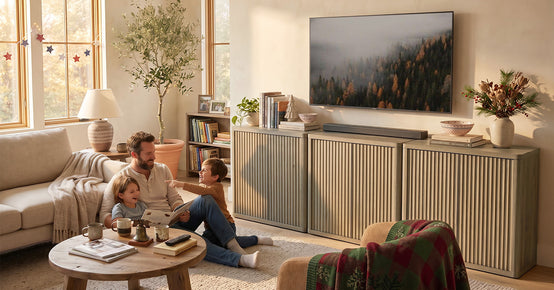
17. Style the Sides, Leave the Middle Clear

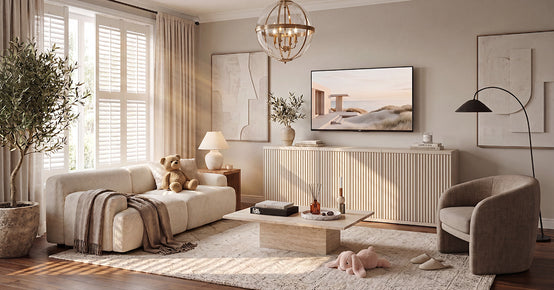
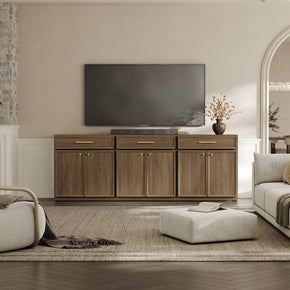
The TV sits dead center on the wall. So the middle of the credenza below it should be low and quiet — a short stack of books, a single candle, nothing over six inches tall. All the actual styling goes to the left and right ends. Lamp on one side. Tray with a vase and a candle on the other. Your eye moves across the full width instead of getting stuck under the screen.
18. Repeat Dark Tones So the TV Blends In

A television is a big black rectangle. In a room full of white oak and cream linen, that thing sticks out like a thumb you just hit with a hammer. Fix it by sprinkling in dark accents. Black picture frame on the credenza. Dark lamp base. Matte black tray. When your eye sees those repeated dark tones, the TV stops looking like an intruder and starts reading as part of the pattern. A glass-front piece like the Helio Glass Sideboard with Doors works particularly well under a TV — the glass panels create depth below the screen without adding visual weight.
19. Gallery Arrangement Around the TV

Hang a couple of framed prints on each side of the TV, with the prints stepping down in height as they move outward. This wraps the screen into a gallery-style arrangement so it stops being a lonely black box on an otherwise empty wall. The television becomes one element in a larger composition. Credenza surface below stays low — books, candles, one small plant. The wall is doing the work.
Common Credenza Styling Mistakes Worth Avoiding
Made most of these myself. Not proud. But at least you don’t have to repeat them.
Twenty small objects are scattered end to end. Looks like someone emptied their pockets onto a shelf. Group things on trays. Stack them on books. Clusters look deliberate. Scattered stuff doesn’t.
Everything at the same height. Five-inch candle, five-inch vase, five-inch frame. Your eye has nowhere to go. Mix it up. Tall thing, medium thing, low thing. Three heights minimum.
Blank wall above the credenza. This one haunted me for weeks before I figured it out. A credenza with nothing above it looks like furniture that’s waiting for something to happen. Hang a mirror. Put up some art. Anything.
Busy stuff on top of busy furniture. If your credenza already has carved doors or woven panels, or geometric patterns, the objects on the surface need to be plain. Two loud things at once cancel each other out. I learned this the hard way.
A Quick Formula You Can Copy Tonight
Standing in front of your credenza with no clue where to begin? Pick one of these and run with it:
Casual rooms: one lamp, one plant, stacked books, and something personal — a framed photo, a ceramic thing from a trip, whatever makes you smile. Doesn’t need to be symmetrical. Doesn’t need to be perfect.
Formal rooms: two matching lamps, a centered mirror or art, and one low bowl or flowers in the middle. Symmetrical. Polished. Done in five minutes. Browse Sicotas modern sideboards and credenzas if you need the furniture to match the formula.
FAQs
What do you put on top of a credenza?
Tall item on one end — usually a lamp or a big vase. Stacked books somewhere in the middle to break up the flat surface. A tray nearby to group candles and small objects so they don’t look scattered. Plant or greenery on the opposite end of the lamp. A framed photo thrown in makes it personal. The whole idea is three height levels across the surface: tall, medium, and low. Otherwise, it reads as a random collection of stuff.
Should you put a mirror or art above a credenza?
Depends what the room needs. Dark hallway or small dining room? Mirror. It bounces light around and makes things feel more open. Living room, where do you want a mood? Art. Personally, I lean toward round mirrors because they break up the horizontal line of the credenza in a way that rectangular frames don’t. But there’s no wrong answer here as long as something goes on that wall.
How tall should decor be on a credenza?
Keep the tallest object under two-thirds the height of whatever hangs above. Mirror sitting 36 inches above the surface? The tallest lamp or vase stays under 24 inches. The decor should connect to the wall piece rather than block it. I’ve seen people put a three-foot vase in front of their mirror and then wonder why the arrangement looks off. The vase was hiding half the mirror.
How do you style a credenza in a dining room?
Lamps for soft light. Candles for warmth. Flowers if you’re hosting. But — and this is the part everyone forgets — leave a third of the surface empty. You need room for wine glasses and a cheeseboard when company comes over. Inside the cabinet, stash the napkins and serving utensils you only pull out for dinner parties. That’s the whole deal with a dining room credenza — it serves double duty.
How do you style a credenza in a living room?
Lamp on one end. Tray for remotes and whatever else piles up. Books, a plant, and some pottery across the rest of the surface. Inside the doors, hide the ugly stuff — cables, blankets, games. The credenza anchors the wall it sits on, so the styling on top should connect with whatever’s hanging above it. Treat them as one piece, not two separate things.
How do you decorate a credenza with a TV above it?
The middle of the surface stays low because the TV already dominates that zone. Style the ends instead. Lamp on one side, grouped objects on the other. The real trick is repeating dark tones elsewhere so the screen doesn’t stick out — dark frames, a charcoal vase, a black tray. When the dark accents show up in a few spots, the TV looks like part of the plan.
How do you make a credenza look less cluttered?
Take everything off. All of it. Start with a bare surface. Then put back only the things that belong to a group — books stacked, candles on a tray, vases paired with greenery. Leave visible gaps between groupings. If you pick something up and can’t explain why it’s there in one sentence, it stays off.
Can a credenza be used as a bar or serving station?
Honestly, one of the best uses for one. Set a tray on the surface with a few bottles, a couple of glasses, and maybe a small arrangement of greenery. Tuck extra supplies and cocktail tools behind the doors. When guests arrive, sweep the everyday decor off, open the cabinet, and the whole credenza becomes a bar. It was designed for exactly this kind of flexibility — that’s why dining rooms have had them for centuries.
Sources
- Emily Henderson – How To Style A Credenza
- Homedit – 18 Credenza Styling Ideas From Designer Layering Rules
- Houzz – 9 Ways to Style That Credenza
- Pepper + Vetiver – 8 Must-Have Pieces for Decorating a Credenza
- CORT – What Is a Credenza?
- Living Spaces – 13 Credenza Decor Ideas That Are Picture Perfect


Looking for something else?

Furniture Materials Guide: Picking the Right Material Room by Room
LEARN MORE
How to Mix Wood Tones Without Making a Room Look Mismatched
LEARN MORE
18 College Apartment Furniture Ideas That Save Space and Money
LEARN MORE
Types of Entertainment Centers: 11 Designs and How to Pick One
LEARN MORELooking for something else?

Curio Cabinet Decor Ideas: How to Style a Display Cabinet Without the Clutter
LEARN MORE
Curved Furniture: How to Style, Measure, and Buy It in 2026
LEARN MORE
What Is Rattan Furniture? A Buyer Guide to Types and Care
LEARN MORE


Further reading

How to Choose a Nightstand for a CPAP Machine

How to Choose a Shoe Cabinet for Men's Sizes, High-Tops, and Bulky Shoes


