The Short Answer
The box won't tell you this. A good narrow bookcase is narrow in exactly one direction — the footprint. Under 20 inches wide? Fine. But the depth still has to run a real 10 to 12 inches, the shelves need to move, and an anti-tip strap goes into your wall. Most cheap ones flunk at least one of those four tests — depth is where they cheat hardest. Tape your gap, skip anything shallow, and even a skinny case will carry a proper library.
|
At a Glance
"Narrow" should describe the footprint — never the storage, never the sturdiness.
|

Small footprint, full-size function: a narrow bookcase done right in a hallway nook.
The narrow-bookcase aisle feels rigged, doesn't it? Cases too shallow for anything chunkier than a DVD. Cases so tall and featherweight they rattle when somebody walks past. Shelves fixed at heights no real collection matches. Run your nook through the filter below.
What "Narrow" Actually Means
Under 20 inches wide and you're in narrow territory — 20 to 50 is standard, past 50 is wide. Useful as a starting point, except all that number really says is how much floor and wall the thing eats up. Capacity? The industry stays dead silent on that. And that's where shoppers get burned. A 16-inch-wide case with five adjustable 11-inch-deep shelves holds way more actual books than a 36-inch case with three fixed, shallow ones. Judge the shelves, not the silhouette.
Then there's the other kind of "narrow" — the kind that shrinks every dimension at once. Eight inches deep, shelves seven inches apart, built for trinkets and plant pots. For real books, hold this line — width under 20 inches is totally fine, but depth and spacing stay full-size.
One reference point: the IKEA BILLY — the most common bookcase on the planet — comes in 15¾-inch and 31½-inch widths, both 11 deep. So a listing that says 16 wide and 11 deep is a BILLY-sized column. Go much narrower than 15 inches and plan on serious anchoring; much wider than 20 and you've left the narrow category altogether.
Measure the Gap Before Anything Else
Catalog first, regret later — flip it. Tape first. Walls are never straight, so measure the gap at three heights — floor, middle, top. The narrowest of the three is your real width. Then knock a finger's width off each side — otherwise the case won't come back out without taking paint with it.

Measure the gap at three heights — the narrowest reading is your real width.
Now the walkway. Measure from the face of the baseboard — not the wall — out to the far edge of the path, then subtract the case's outside depth. Main walkway? You want 30 inches of clear passage left over. Less than that in a daily-use hallway, and the bookcase becomes a permanent hip-check target. Don't forget the delivery route either. A skinny case still has to survive your stairwell corners and door frames.
Baseboards, though — skirting boards stick out half an inch to a full inch from the wall, so no case ever sits truly flush. It leans back a touch. Measure from the baseboard's face, or every number you write down is a lie.

The baseboard gap is real on narrow cases too — measure from its face, not the wall.
Corners: The 90-Degree Opportunity
This is where narrow stops being a compromise and becomes the whole point. Awkward corners — those 90-degree wall slots where nothing else fits — will happily take a 15-inch-wide case. Dead space becomes a full column of books. Best part? Two walls to anchor against instead of one. That alone makes even a tall skinny case far steadier than it has any right to be.

A dead 90-degree corner becomes a full column of storage with the right narrow case.
Width vs Contents: What Fits on a Narrow Shelf
Something the industry never puts in its ads — books couldn't care less about width. A paperback is about 4 inches deep, a hardcover 6 to 8 — both sit perfectly happy on a 14-inch shelf. Width only changes how many fit side by side. A 16-inch case takes roughly 12 to 14 standard novels per shelf — five shelves gives you a 60-to-70-book library. Not bad for a sliver of wall.
Width only changes the game in two spots — oversized items and stability. Art books and record crates need real width to lie flat — measure your widest item and make sure it clears the side panels. And a narrow case piles a lot of weight over a small footprint, which is why the stability section below isn't optional reading.

Books do not care about width: paperbacks and hardcovers sit perfectly on a narrow shelf.
Do Not Let Them Shrink the Depth
A narrow bookcase still needs 10 to 12 inches of depth for real books. Say it with me. But makers love trimming the depth along with the width. Those 7- or 8-inch shelves sold as "slim"? You end up with something that holds DVDs and paperbacks while your hardcovers hang two inches off the front edge. If your gap honestly only fits an 8-inch case, fine — buy it for paperbacks and decor, and find the hardcovers a different home. Here's my in-store test, and it's brutal. If your hardcovers are deeper than the shelf, walk away. Doesn't matter how perfect the width looks.
Spacing: Adjustable Shelves Are the Unlock
With a narrow case, spacing is everything. Fixed shelves at one generous height kill the whole point of going vertical. Paperbacks drowning in 14-inch gaps, tall art books with nowhere to go — sound familiar? Adjustable shelves let you set every opening to its contents — 9 inches for paperbacks, 12 for hardcovers, 15 for the tall ones. Ask around among slim-tower owners — you'll hear the same thing every time. Adjustability is what doubled their usable storage in the same footprint.
Comparing listings? Count the adjustment holes, not just the shelves. Pin holes every inch and you've got a custom library. Fixed spacing? You're stuck with whatever the factory guessed at. Then check how thick the shelves are. Narrow spans barely sag — one genuine perk of going narrow — but only if the shelf is an actual shelf and not a 12 mm afterthought.

Adjustable shelves tuned to each book height: this is what doubles a narrow case's capacity.
Stability: Tall, Narrow, and Honest
Let's be straight about this. A tall, narrow bookcase stacks a lot of weight over a tiny footprint, and the skinnier it gets, the easier it tips — forward when it's top-heavy, sideways if somebody clips it. Every tall narrow case gets anchored to the wall. No exceptions. Into studs if you can find them. The strap in the box is the bare minimum. For a wobbly secondhand unit in a kid's room, the verdict never changes: bracket it to the wall, add a back panel for rigidity, and never trust a display-weight etagere with real book weight.

Tall plus narrow must be anchored — the strap is the minimum, ideally into studs.
The backup plan? Loading order. Heavy hardcovers and reference sets go on the bottom two shelves. Light paperbacks and decor live up top. Freestanding narrow units used as room dividers survive on exactly this trick: bottom-heavy loading, sometimes with a plank screwed along the baseboard line for invisible extra steadiness.

Bottom-heavy loading: hardcovers low, paperbacks and decor high. Stability you can see.
The Room-Divider Trick
Narrow bookcases have a second career — dividing space. Two cases back-to-back split a studio into a bedroom and a living room — a partition wall with zero holes in the landlord's plaster, for a fraction of built-in cost. What actually works in real apartments — closed or doored bottom half for hidden storage, open top half so light still travels. And anchor every unit. A divider gets bumped from both sides.

Narrow cases moonlight as room dividers: a partition wall that also stores the library.
Ganging: Two Narrows Beat One Wide
Instead of one 30-inch case, grab two 15-inch narrows and gang them. Flank a doorway, split them across a chimney breast, pair them in an alcove. Same total shelf area, way more placement freedom — and when you move, two narrow cases glide down stairwells that would defeat one wide one. Bolt or strap the pair together, anchor both to the wall, and from the front they read as one custom piece.
Small-Bedroom Placement
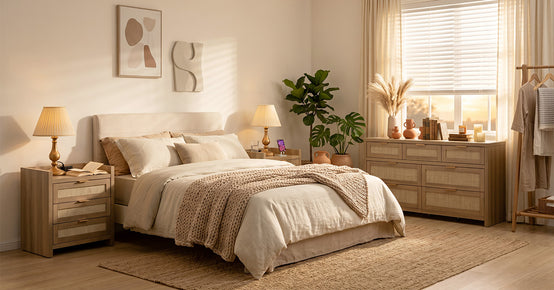
In a small bedroom, the narrow bookcase goes where nothing else fits — next to the bed as nightstand-plus-library, in the dead zone near the closet, or on the short wall the dresser doesn't reach. Keep it under half the ceiling height. Top shelves are for decor and the nighttime reads you grab with eyes half shut. One catch, though — the door swing. A case beside the bedroom door has to clear its arc, or you'll fight it every single morning.

Beside the bed, in the dead zone: where a narrow case earns its keep in a small bedroom.
The Narrowest Verified SICOTAS Models
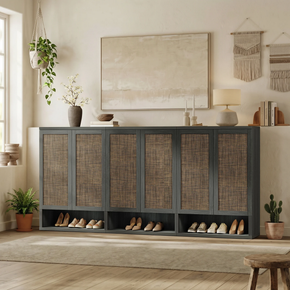
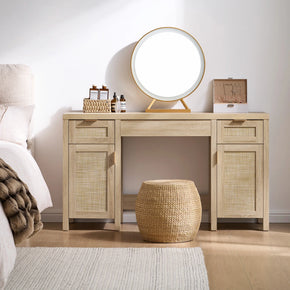
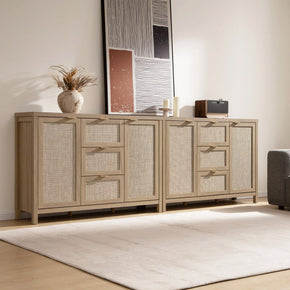
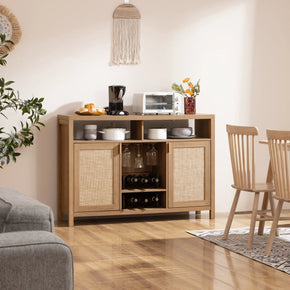
Some honest context first: the current SICOTAS bookcase range runs standard-width — the narrowest verified models are the Terra bookshelves at 28.74 inches, the slim end of standard rather than truly narrow. If your gap honestly needs under 20 inches, hold every candidate to the same four tests — real depth, adjustable shelves, anchor hardware, sane spacing.
|
Model
|
Width × Height × Depth
|
Weight
|
Why it fits the brief
|
|
|
28.74 × 68.5 × 14.37 in
|
78 lb
|
Narrowest verified SICOTAS bookcase; drawer + doors keep small-room clutter hidden
|
|
|
28.74 × 68.5 × 14.37 in
|
88 lb
|
Same slim footprint in black rattan; large-storage layout for mixed contents
|
|
|
30.7 × 70.9 × 14 in
|
99 lb
|
Next step up in width; five adjustable shelves for a real library
|
Measure your gap at three heights, demand full-depth adjustable shelves, anchor whatever you buy — then
browse the SICOTAS bookcases collection and filter by the dimensions that survived your worksheet.
FAQs
What counts as a narrow bookcase — how many inches wide is "narrow"?
Under 20 inches wide — that's the line. The usual bands run narrow (under 20 in), standard (20 to 50 in), wide (over 50 in). But width alone never tells you capacity. A 16-inch case with five deep, adjustable shelves stores far more than a much wider one with fixed shallow shelves.
How deep should a narrow bookcase be to still fit real books?
Ten to 12 inches of usable shelf. Let the books decide the depth, not the wall gap. Paperbacks are happy with 8 to 10 inches, hardcovers need 10 to 12. Never buy a narrow case with 7- or 8-inch shelves for a real collection. Your hardcovers will overhang the front.
Will a tall narrow bookcase tip over, and how do I keep it stable?
It tips easier than a wide one — not much footprint under all that height. Anchor every tall narrow case to the wall, into studs if you can, using the anti-tip kit from the box. Heaviest books on the bottom shelves, light stuff up top. And never let a kid climb a case that isn't anchored.
Can a narrow bookcase hold heavy books without the shelves sagging?
Usually, yes — short spans bend less under the same load, so narrow cases often win here. It comes down to shelf thickness and support, not width. Make sure the shelves are properly thick — not flimsy 12 mm boards — that the case has a back panel for rigidity, and that heavy books go low.
How do I measure my wall and walkway for a narrow bookcase (including baseboards)?
Tape the gap at three heights — floor, middle, top — and work from the narrowest reading, minus a finger's width on each side so the case slides back out later. Measure the walkway from the face of the baseboard, never the wall, and keep 30 inches of clear passage on main routes. And don't forget the delivery path. Stairs and door frames included.
What's the best narrow bookcase for a small bedroom, hallway, or awkward corner?
For hallways and tight alcoves, I'd go open or hybrid — 8 to 10 inches deep for paperbacks, under 20 inches wide, anchored to the wall. For awkward corners, a 15-inch-wide case turns dead space into a full storage column. Anchored against two walls, no less.
Is a narrow bookcase with doors better than open shelves in a small space?
In genuinely tight spaces, go open. Hinged doors need a swing arc that small rooms just don't have. Need to hide the mess? Look at sliding doors, or a hybrid with doors on the lower half only. Either way, the anti-tip anchor stays mandatory.
How tall can a narrow bookcase be before it looks out of proportion in a small room?
Stay under half your ceiling height — that's the visual-balance rule. Practical reach matters too — about 84 inches standing, 60 seated. A very tall narrow tower can loom in a small room. If you need the height, keep the top shelves for decor and keep the case anchored.