



21 Forest-Themed Living Room Ideas for an Earthy, Calm Space

The fake vine is usually the first thing: that and the novelty deer print. The woodland-themed wallpaper that arrives looking like a child's bedroom and never quite stops. The plastic mushrooms are arranged on a windowsill, the wooden letters spelling FOREST on a shelf. You know the version. That version is not this.
What a forest-themed living room looks like when it works is something else entirely — one wall painted dark enough that the room genuinely changes when you walk in, a coffee table that is actually wood rather than wood-colored, three plants that are alive or at least convincingly so, light that is warm enough to make the space feel inhabited rather than illuminated. None of those things is difficult. All of them together create a room that feels like a decision was made.
There is a name for why this works: biophilic design. Short version — humans evolved in natural environments, and rooms built from natural materials, earthy colors, and living things register as calm in a way that white walls and synthetic furniture simply do not. You already knew this if you have ever walked into a room full of wood and warm light and immediately felt your shoulders drop. That is not a coincidence. It is a predictable response to material and temperature.
These 21 ideas are specific. Not vague. Not 'choose earthy tones and add some plants.' Specific — which shade, which material, which piece does which job, which rule stops the room from looking like a mood board rather than somewhere people actually live. Three done well is better than twenty-one done halfway.
1. Paint One Wall in Deep Forest Green

The wall behind the sofa. Or the one across from the door, the one the television sits against, the one a bookcase stands in front of. One wall. Dark green. Benjamin Moore Backwoods, Sherwin-Williams Shade-Grown, Farrow & Ball Calke Green — any of these directions, or anything in that vicinity. Dark enough that the room changes when you walk in.
Not sage. Not dusty mint. Not 'eucalyptus-inspired.' Those are pleasant colors that make a room feel spa-adjacent at best. The forest reading requires actual depth, actual shadow. And the other walls stay light — but specifically warm light. Not grey-white, not cool stone. Warm cream, off-white with a yellow or pink undertone, something that could reflect candlelight. Cool grey next to deep green makes the room feel clinical. Warm cream next to deep green makes it feel designed. The temperature of the neutral is as important as the green itself.
2. Build the Base With Earthy Neutrals

Neutrals here are not background. They are structural. Beige, taupe, mushroom, warm oatmeal, clay, tan — these go everywhere the green is not. The unpainted walls, the rug, the curtains, the throws. Without them, the room tips from woodland to cave.
The trap is grey—white, stone-grey, warm grey. Grey is modern and clean, which is a completely different goal. If you find yourself reaching for grey, reach further until you hit beige or greige. Sherwin-Williams Accessible Beige, Benjamin Moore White Dove, Farrow & Ball Elephant's Breath — these sit in the correct temperature zone next to deep green. Grey does not. The visual tension is subtle and persistent, never fully resolving.
3. Add Rust, Clay, or Muted Gold as Accent Colors

All green and beige eventually reads flat. Two colors next to each other, nothing more. The third note is what makes it a palette. Rust, terracotta, bark brown, dusty amber, muted gold, ochre — these are the accent colors that read as natural because they actually are. Soil, bark, autumn leaves, lichen. All of those colors.
What does not work: saturated orange, hot pink, bright coral, anything neon. The test is simple enough. If you would find that color in a forest, it probably works. Suppose you would find it in a neon sign, probably not. And repeat each accent color at least twice in the room. One terracotta pillow reads as an accident. A terracotta pillow and a terracotta bowl on the coffee table read as a choice. Small distinction. Disproportionate visual difference.
4. Choose a Natural Wood Coffee Table

Solid wood. Not veneer. Not wood-effect laminate. Not something described as 'engineered wood' in a way that avoids confirming there is actual wood in it. The coffee table is the center of the room — the surface people look at most and touch most. If it does not read as a real material, the whole room reads as trying rather than being.
Oak. Walnut. Acacia. Mango. Reclaimed pine. A live-edge table — one where the natural irregular slab edge is preserved — is the strongest choice for an actual woodland feeling. The piece looks like it came from a specific sourcerather than a catalog. A simple rectangle or oval in natural, oiled, solid wood is more versatile and works well in a room that is otherwise relatively clean.
Finish matters more than most people realize. Oiled or waxed reads as wood. High-gloss lacquer reads as something trying to look like wood. In a room where the whole point is honest material, that difference shows.
5. Add a Console Table Against a Feature Wall

The corner where nothing is working — usually the green wall with nothing in front of it — gets solved by a console table. It gives the wall something to relate to, provides a surface for what you want to display, and makes the room feel finished at the back rather than just decorated at the front.
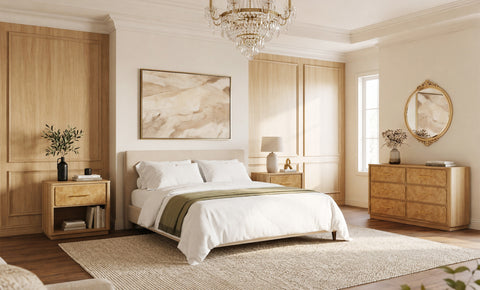
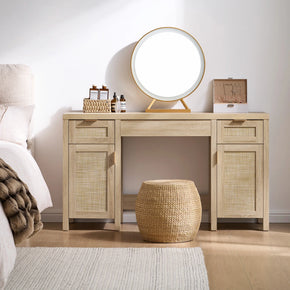
Three things on top. One lamp, one plant, one object with texture. Stop at three. The discipline is the point — a surface with seven things on it undoes the entire mood. The Savanna 3-drawer console table has three drawers for cables, spare batteries, whatever accumulates — so the surface stays clear for the three things you actually chose. Natural wood against deep green paint. That combination does not need help.
6. Use a Sideboard for Hidden Storage

Every living room accumulates things. Remotes. Cables. The book you are in the middle of. The candle lighter that never returns to one location. A forest-themed room is less tolerant of this than most other styles — the aesthetic is built on calm and material honesty, and a pile of visible clutter breaks that reading faster than almost anything else.
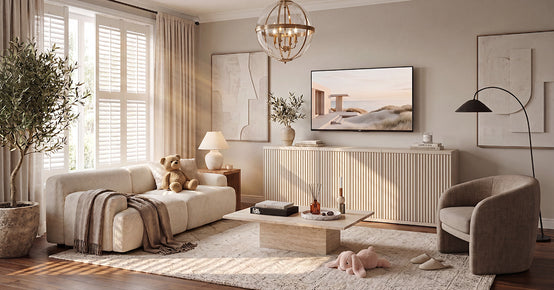
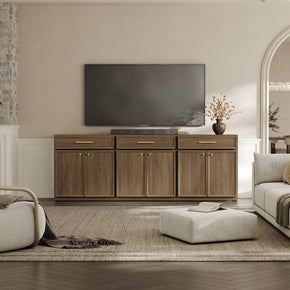
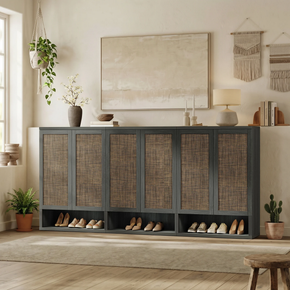
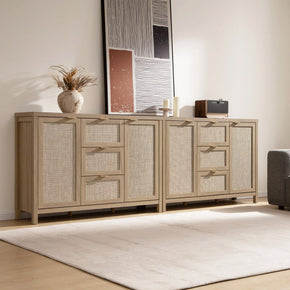
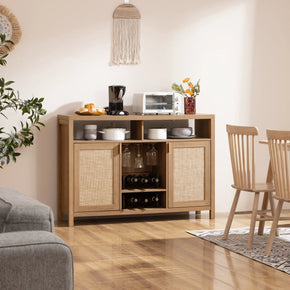
A sideboard puts it away—wide closed storage at low height, flat top for display. For finish and proportion options, the sideboards in the living room collection are worth browsing — the key is a warm wood tone that does not introduce a new visual element. The Cas 4-door sideboard cabinet has four closed doors, adjustable interior shelves, and a smooth, wide countertop. Everything messy goes inside. The top gets one plant, one lamp or candle, and one ceramic object. Done.
7. Style an Open Bookcase as a Forest Display

Open shelves are not difficult to do well. They are difficult to do well and then leave alone. The instinct once shelves are up is to fill them. Books, then objects, then more objects, then the thing that was on sale, then the succulent without a permanent home. The result is a shelf that makes the room feel busier than it would without any shelves.
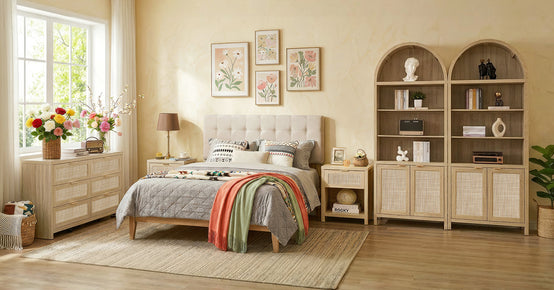
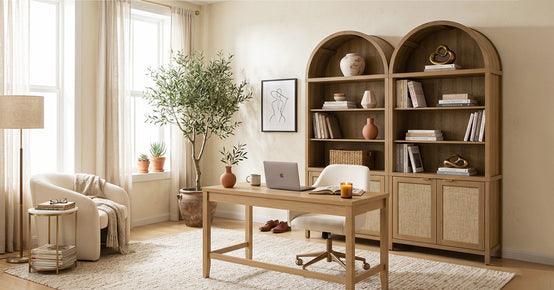
Four things per shelf. Five at absolute most. One trailing or upright plant. Two or three books as a horizontal stack. One ceramic object with weight to it—a space where nothing sits. The space is not a gap to fill — it is doing compositional work. The Savanna arched bookcase with doors has a closed base cabinet, so the floor-level mess disappears, and only the curated part shows. For more height, the Savanna 5-shelf tall bookcasefits a full wall without disappearing into it. The living room bookshelves collection has both, if you want to compare proportions first.
8. Bring In a Rattan or Woven Accent Chair

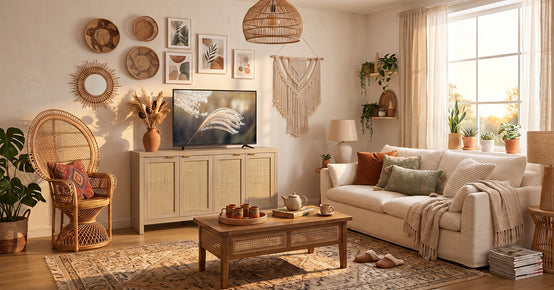
Rattan introduces material texture in a way upholstered furniture cannot — actual structural texture visible in the weave, not applied to the surface. In a room with a dark green wall and solid wood furniture, that is a different visual language. It adds lightness where the other materials add weight, which is usually exactly what the room needs.
The seat cushion goes in one of the colors already in the room. Cream, moss green, warm terracotta, caramel. Not a new color — repeating something already present. A woven basket nearby echoes the material at a different scale. That kind of repetition creates cohesion without anything matching.
9. Add One Large Statement Tree

One large plant does more than ten small ones. A fiddle leaf fig, rubber plant, bird of paradise, monstera, parlor palm, or olive tree placed in a corner that was actually cleared for it — not a corner where the plant is fighting with furniture — creates immediate vertical presence and makes the room feel inhabited by something alive.
If your track record with plants is a series of slow failures, a quality faux tree is completely defensible. Most people cannot tell the difference from across a room. What gives a faux tree away is the planter. A thin plastic nursery pot under a silk olive tree reads as a lie, even if the tree itself is convincing. A genuine terracotta, clay, or woven basket planter fixes the reading entirely.
10. Build a Layered Plant Corner

Real forests have layers — canopy at the top, understory in the middle, ground cover at the bottom. A room corner replicates that with three heights: a tall floor plant, a medium plant on a stool or a side table, and a small plant on the floor or on a low surface beside it. Three plants at the same height, grouped, look like a plant collection. Three plants at three different heights look like someone thought about the corner.
Vary the leaf shapes too. A broad tropical leaf, a fine feathery frond, and a trailing form together read more naturally than three plants with the same silhouette. The contrast is what makes the corner feel as if something grew there rather than was placed.
11. Use Trailing Plants on Shelves

Pothos, heartleaf philodendron, string of hearts, tradescantia. Any of them trailing from a top shelf down over the books below does something no other styling element achieves as easily: it makes the room looklived-in rather than staged, as if things have had time to settle into their positions.
Pothos is worth recommending specifically. Nearly impossible to kill. Grows in low light. Trails generously within a few months. Put a cutting in water, and it roots in two weeks — one plant becomes many at no cost. If you have limited patience for plant maintenance, start here.
12. Group Plants in Odd Numbers and Leave Space

Groups of three or five look natural. Groups of two or four look like a matched pair — formal, deliberate, in the wrong direction. According to Living Spaces' guidance on nature-themed rooms, the most important principle is simplicity. That applies directly here.
And the space between plants is not space. It is doing compositional work. Six plants pressed together on a shelf read as a plant collection. Three plants with deliberate gaps between them read as part of a designed room. The gaps matter as much as the plants.
13. Hang Botanical Artwork Above the Sofa

The wall above the sofa is watched more than any other surface in a living room. Most people leave it blank or hang something too small that looks lost. In a forest room, that wall is where the palette gets reinforced — a large forest landscape, a set of botanical prints, a pressed fern study, a detailed mushroom illustration.
Muted tones only. A botanical print in bright, synthetic-looking color reads as decorative in the wrong way — childish or kitschy rather than earthy. You want colors that look like they came from paint or ink. Dusty greens, warm browns, ochre, soft grey. Frame in walnut, oak, or plain black. And one large piece almost always reads better than three small ones unless you have a very specific gallery arrangement in mind.
14. Use a Darker Rug, Not a Delicate One

A pale cream rug or light tan rug in a forest room is a fast path to watching everything fall apart when real life enters. Living rooms get used. Feet, dogs, dropped food, outdoor shoes, the inexplicable crumbs. A delicate rug visibly absorbs all of it, and the room starts to look neglected within weeks.
Darker rugs — olive, warm brown, charcoal, rust, deep sage — with patterns mixing two or three earthy tones — handle daily life and look more intentional in a room with strong natural colors. Jute is inexpensive and looks immediately right. Wool is more comfortable and holds up longer. Either way: large enough that the front legs of the sofa and any accent chairs sit on it. A rug that only lives under the coffee table makes every piece of furniture look abandoned.
15. Add Forest-Toned Velvet or Linen Cushions

If a green wall feels like too large a commitment before you are sure, cushions are where you start. Moss, pine, forest, olive, dark sage — all of these read convincingly on neutral sofas. Velvet holds color well and adds tactile texture. A velvet cushion in moss green on cream linen looks richer in person than it sounds.
Do not buy a matching set. Two cushions in coordinating colors with different textures look like someone chose them. Two in identical fabric and size look like a display. The difference is small and immediately visible.
16. Use Earthy Linen Curtains to Soften the Room

Rooms without curtains look unfinished in a specific way — the windows look like holes rather than features. In a forest room aiming for warmth and enclosure, this is particularly wrong. Linen or cotton, floor length, in cream, warm taupe, sage, or off-white.
Hang the rod high — within six inches of the ceiling — and wide, past the window frame on each side. This makes the window look larger, the room feel taller, and the whole space more generous than its actual dimensions. Morning light filtering through unlined linen in a forest room is also particularly good: warm and diffused, exactly what a deep green wall needs to read rich rather than dark.
17. Drape Earthy Throws Over the Sofa

One throw blanket, actually draped over a sofa arm rather than folded in a neat square. Wool, chunky cotton, or a textured woven blanket — in chocolate, warm caramel, sage, cream, or forest green. Whatever is already in the room's palette.
One is enough. Two in different textures is fine. There is a pile.
18. Switch to Warm Amber Lighting and Layer Your Sources

Cold white bulbs in a forest room fight every other decision you made. The bulb temperature changes the reading of everything. Warm amber — 2700K, or 2400K if you want it warmer — makes the green wall look richer, the wood warmer, the whole room more habitable. This is not a subtle difference. It is one of the highest-impact changes on the list and one of the cheapest.
But bulb temperature alone is not enough. One overhead fixture at 2700K still creates flat, even illumination. Add floor lamps, a table lamp on the console, and something on the coffee table tray. Multiple warm sources at different heights create pools of light with shadow between them — that dappled quality is what the room needs and what a single ceiling light cannot provide, regardless of the bulb.
19. Add Stone, Clay, and Woven Basket Accents

Material is what earthly rooms are actually made of. Not color — material. Paint a room deep green and fill it with plastic objects, and it will not feel like a forest room. The objects need to be real: stone, clay, fired ceramic, woven natural fiber, carved wood.
They do not need to be expensive. A clay pot from a garden center, a woven basket from a homeware shop, a stone bowl from a market. One real stone object on the coffee table does more for the room's feel than three manufactured pieces that try to approximate the same quality.
And edit the surfaces. Coffee table: tray, candle, small plant, one object. Four things maximum. Console table: lamp, one decorative piece—shelves: plants, books, two or three ceramics per shelf. When you are not sure, take something away rather than add something. Almost always the right call.
20. Use a Tall Bookcase as a Statement Piece

Against a deep green wall, a tall bookcase in warm wood takes on an architectural quality. quality The grain and the dark green behind it work together without needing anything else around them. The bookcase stops being furniture placed against a wall and becomes part of the wall.
Height matters here more than in most other furniture decisions. A low bookcase against a dark wall disappears. A tall bookcase at 75 to 84 inches creates vertical presence, draws the eye upward, and makes the room feel layered. The Savanna arched bookcase with doors handles this specifically well — the arched crown reads organic rather than rigid, and the closed base keeps the lower portion tidy. For more shelving surface, the Savanna 5-shelf tall bookcase is the right proportion for a high ceiling or a long empty wall.
21. Edit Surfaces and Leave Breathing Room

This is the one that determines whether the other twenty work. A forest room with beautifully chosen furniture, the right paint, good plants, and surfaces covered in objects looks worse than a generic room with three things on a table. Space is not wasted space. It is not a work in progress. It is what makes everything around it readable.
Coffee table: tray, candle, one plant, one book. Four things. Console table: lamp, one ceramic piece. Done. Bookcase shelves: one plant, a small stack of books, one object with texture, and deliberately spaced beside it. That is a shelf. Once everything is arranged, remove one item from each surface and see how it looks. It almost always looks better. The rooms that get saved to design folders are almost always the ones where someone kept removing things until only the intentional ones remained.
Design Rules That Keep a Forest Room Balanced
The 3-5-7 Rule
Style objects in odd-numbered groups—three on the coffee table, five across a shelf, seven in a gallery wall. Odd numbers look natural and unplanned, which is exactly the quality on which a forest room is built. Even numbers look formal and symmetrical, which runs counter to the overall aesthetic. Apply this to plant groupings, shelf arrangements, and any surface where multiple objects sit together.
The 2/3 Rule for a Living Room
Art above a sofa at roughly two-thirds the sofa width — too small reads lost, too large reads overwhelming. The coffee table is about two-thirds the length of the sofa. The rug is large enough that the front legs of the sofa and chairs sit on it, not just the coffee table. These are proportional starting points, not rigid formulas, but they prevent the most common mistakes that make rooms look awkward without anyone being able to explain exactly why.
The 3-4-5 Rule in Decorating
Vary height, width, and shape across a display surface—three tall objects, four medium, five smaller — or any variation that creates visual rhythm. The numbers matter less than the principle: avoid uniformity. An arrangement where everything is the same height and material reads rigid and manufactured. One where heights and shapes vary reads organic, which is the entire point.
FAQs
How do you make your living room look like a forest?
One dark green wall. Wood furniture that is actually wood. Plants at three different heights in at least one corner. A dark jute or wool rug. Warm amber bulbs instead of cold white. Linen curtains hung high and wide. Surfaces with four things on them rather than twelve. None of those things individually is complicated. Together they do the work.
What is the 3-5-7 rule in decorating?
Group objects in odd numbers — three on a coffee table, five on a shelf, seven in a gallery wall. Odd groupings look natural. Even groupings look matched, which reads as formal and deliberate in the wrong direction for a forest room. Apply it anywhere multiple objects share a surface.
Can ChatGPT design my room?
Yes, given the right input. Room dimensions, ceiling height, existing furniture you are keeping, which walls have windows, what the light is like, and what mood you want—the more specific your input, the more specific the output. For a forest-themed living room, it can give you paint shade recommendations, a furniture layout, a product list with measurements, and a styling direction. What it cannot do is look at your actual room and react to what it sees.
What is the 2/3 rule for a living room?
Artwork above a sofa at two-thirds of the sofa's width. The coffee table is at two-thirds of the sofa's length. The rug is large enough that the front legs of all main seating sit on it. Starting points for proportion, not rigid rules — but they prevent the most common errors that make rooms look slightly off without anyone identifying why.
What is the 3-4-5 rule in decorating?
Vary height, width, and shape across a display surface rather than using matched identical objects—three large, four medium, five small — or any variation. The goal is to make arrangements look like they grew rather than got placed. Uniform arrangements read rigid. Varied ones read organic.
What are the 2026 living room trends?
Warmth, tactile texture, earthy color, and personal interiors. Nature-inspired layers — wood, stone, plants, linen, organic shapes — are consistently appearing across design publications for this year. Forest-core and forest-themed rooms sit squarely in this direction without requiring trend-specific purchases. These are material and proportion choices that will look right in five years for the same reason they look right now — because they are based on how rooms feel rather than what is fashionable.
How do you make a room look earthy?
Warm neutrals as base. Wood furniture in natural finishes. Woven textures in a jute rug or rattan chair. Plants. At least one stone or clay object. Warm amber light. The earthy quality comes from real materials and warm temperatures — not from product descriptions that use the words "natural" or "organic".
What is a baddie room?
A bold, social-media-forward interior style — dramatic lighting, large statement mirrors, plush velvet bedding, LED strip lighting, oversized decorative pieces, high-energy glam. The opposite end of the spectrum from forest-core. The two can overlap if you combine deep green walls, gold mirrors, velvet furniture, candles, and plants — but they create completely different feelings. Forest-themed reads quietly and is grounded. Baddie read aloud and performed.
Final Thoughts

Three done well. That is the starting point. A dark green wall, a wood coffee table, and a jute rug that is darker than your instincts suggest. The room changes at those three. The other eighteen ideas add detail and depth over time — they are not required simultaneously.
The rooms that end up looking like somewhere are rarely the result of one big purchase. They are the result of one deliberate choice, then another, then another. Patience is not a constraint. It is the actual method.
Sources
- Mamma Mia Covers — Elegant Forest-Themed Home Decor Ideas––Used for forest-core design principles, biophilic design context, deep green shades, wood textures, indoor plants, and forest living room ideas throughout the article.
- Living Spaces — Nature Themed Room Ideas––Used for nature-themed room palettes, forest room styling, darker rug guidance, and balance principles in nature-themed interiors.
- Wikipedia — Biophilic Design––Used for biophilic design definition and the human-nature connection context referenced in the introduction.
- The Spruce — Forest Room Decor––Used for forest room decor ideas, woodland aesthetic principles, and nature motif styling guidance.
- Better Homes & Gardens — Nature-Inspired Living Rooms––Used for nature-inspired living room palettes, earthy material choices, and furnishing ideas for forest-styled spaces.
- HGTV — How to Create a Nature-Inspired Room––Used for forest-core trend context, moody green palettes, botanical styling, and organic texture guidance.


Looking for something else?

Furniture Materials Guide: Picking the Right Material Room by Room
LEARN MORE
How to Mix Wood Tones Without Making a Room Look Mismatched
LEARN MORE
18 College Apartment Furniture Ideas That Save Space and Money
LEARN MORE
Types of Entertainment Centers: 11 Designs and How to Pick One
LEARN MORELooking for something else?

Curio Cabinet Decor Ideas: How to Style a Display Cabinet Without the Clutter
LEARN MORE
Curved Furniture: How to Style, Measure, and Buy It in 2026
LEARN MORE
What Is Rattan Furniture? A Buyer Guide to Types and Care
LEARN MORE


Further reading

How to Choose a Nightstand for a CPAP Machine

How to Choose a Shoe Cabinet for Men's Sizes, High-Tops, and Bulky Shoes


