
How to Choose a Dresser for Two People: Drawer Count, Width, and Daily Access
TeamSICOTAS
TeamSICOTAS
0 comment

How to Choose a Dresser for Two People: Drawer Count, Width, and Daily Access

Count the drawers last. Two people can run out of usable storage in a nine-drawer dresser and still have room left over in a six-drawer one, because drawer count tells you how many compartments exist and nothing at all about what fits inside them. Or whether both of you can get your own clothes at seven in the morning.
Three problems have to be solved at the same time. A dresser for two people needs to hold two wardrobes, give each person a predictable zone, and open fully without blocking the other person’s path across the room. Below is how to inventory what each person stores, how to read dresser drawer dimensions rather than exterior width, and how to measure the space a shared dresser occupies while it is actually in use.

Quick Answer: What Size Dresser Do Two People Need?

Allocation, not drawer count. A dresser for two people works when each person can claim a defined set of drawers, so six drawers are often enough if both partners also have closet space for hanging clothes. Higher drawer counts buy separation rather than volume. Each drawer usually gets shorter or narrower as the count goes up. Compare interior drawer dimensions, measure your usable wall width, then check the footprint again with the drawers pulled open.

What Makes a Dresser for Two People Work

Four things decide it. Run any shared dresser through all four before you buy. We call it the Two-Person Dresser Test.
  • Allocation. Can you hand specific drawers to Person A and Person B without argument? A symmetrical double dresser with two vertical columns settles this on sight. A single stacked column turns it into a negotiation.
  • Capacity. Interior drawer width, height, and depth decide what each person can actually store. The number in the product title does not.
  • Access. Drawers need to open all the way without hitting a bed frame, a wall, a closet door, or the nightstand next to them.
  • Traffic. One person stands at the dresser with a drawer open. Can the other still get past to the closet, the bathroom, the bedroom door?
Fail any one of these and you get daily friction. The fourth is where most couples get caught. Everything fits beautifully when the dresser is closed, and then someone opens a drawer and the walkway disappears.

Shared storage is an allocation problem

Two people rarely fold the same amount of clothing. One partner keeps almost everything on hangers. The other folds nearly all of it. Equal drawer counts do not produce equal usable capacity when the drawers inside a single unit are different sizes, which they often are.
Ownership by column holds up best over time. Left bank to one person, right bank to the other. Nobody has to work around anybody to reach socks.

Dresser drawer count is not the same as storage capacity

More drawers mainly buy separation. A six-drawer dresser with larger interior drawers handles bulky sweaters and folded denim better than a nine-drawer dresser built from smaller compartments. Work out which of the two you actually need before filtering a collection page by drawer count.

Step 1: List What Each Person Actually Stores

Before you open a single product page, write two separate clothing inventories. Two lists, not one combined list you split later. Combining first hides the imbalance you need to design around.
Categories that genuinely live in a dresser:
  • Underwear and socks
  • T-shirts, casual tops
  • Sleepwear
  • Gym kit and activewear
  • Jeans, trousers, shorts
  • Sweaters and heavier knits
  • Belts, scarves, small accessories

Keep hanging clothes out of the count

Anything on a hanger is out of scope. Shirts, dresses, suits, coats. So is off-season storage if you own bins or a wardrobe. The shared dresser only has to solve for whatever is left after that, which is usually less than people expect. When closet space is tight, pairing a smaller dresser with a wardrobe or armoire uses the same wall better than one oversized unit.
Person A / Person B storage audit
Clothing category
Person A
Person B
Needs a drawer?
Underwear and socks


T-shirts and tops


Sleepwear


Activewear


Jeans and trousers


Sweaters and knits


Accessories


Add up the yes boxes for each person. That number tells you how many drawer zones your shared dresser needs. Not a rule of thumb.

Step 2: Decide How Many Drawers Two People Need

No universal drawer count exists for couples, but the reasoning is straightforward. Match your household to the profile below.
Your situation
Layout that usually fits
Allocation plan
Both partners have good closet space
6 drawers, two columns of three
Three drawers each, split left and right
You want a shared or overflow compartment
7 drawers
Three each plus one neutral drawer
Little closet space, most clothing folded
9 drawers or a modular double dresser
Four or more zones each, finer categories
Narrow bedroom, limited wall width
Tall chest plus a second small unit
One piece per person rather than one shared piece

When a 6 drawer dresser works for couples

Two columns of three. Each person gets a self-contained bank, which is the cleanest possible split, and it works well when both people have closet storage backing it up and are folding three or four categories apiece. Six-drawer layouts also tend to deliver the largest individual drawers available at a given cabinet width. That matters for sweaters.

When a seventh drawer helps

Seven drawers break the left-right symmetry, usually with one wider drawer spanning the top or bottom row. Treat that odd compartment as neutral ground: shared linens, seasonal accessories, overflow for whoever needs it that month. Seven does not divide evenly between two people, so plan for it rather than discovering it after delivery.

When 9 drawers or a modular double dresser make sense

Higher drawer counts give finer category separation, which earns its keep when the dresser carries most of both wardrobes instead of supplementing a closet. You pay for it in wall width and, frequently, in smaller individual drawers. Modular setups built from separate cabinets can give each person a physically distinct piece. They also need a lot more uninterrupted wall, so compare stated widths across the nine-drawer dressers against your own measurement before you commit to the format.

Step 3: Divide the Drawers Before You Buy the Dresser

Settling the split in advance changes which dresser you should be shopping for. Three models are worth considering.
Allocation model
Best for
Watch out for
One drawer bank per person
Couples who get ready at the same time
Layouts with a full-width drawer that neither person owns
Personal banks plus a shared drawer
Seven-drawer and asymmetric layouts
The shared drawer quietly becoming one person’s overflow
Split by clothing category
Partners with similar wardrobes and offset schedules
Both people needing the same drawer at the same time
Start from ownership by vertical column. It gives each person independent access and kills the daily negotiation that category-based splitting creates.

Step 4: Measure Dresser Width for Two Users, Not Just the Wall

Measure between the real obstructions rather than corner to corner:
  • Door casings and window trim
  • Watch the closet opening and its swing path
  • Radiators, vents, baseboard depth
  • Any outlet you plan to charge from on top of the dresser
  • Nightstands and anything else that is not moving

Map where each person will stand

Most dresser buying guides skip this step. Stand at the left end of the proposed position, then walk to the right end and stand there. Ask whether one person at their own bank still leaves room for the other to get past. For a reference point, the U.S. Access Board specifies a minimum clear floor space of 30 by 48 inches for one person to occupy a spot at a fixture under the ADA standards. Bedrooms are not regulated space. The footprint is still a fair check on what one adult takes up.

Step 5: Measure the Dresser With Its Drawers Open

A dresser takes up more room in use than it does closed. Work out the active footprint before you order.
Active depth = cabinet depth + drawer extension + standing space

Measurement
Why it matters
What to check
Usable wall width
Sets the maximum dresser width for two banks
Distance between fixed obstructions, not wall corners
Cabinet depth
Determines the closed footprint
Exterior depth on the spec table, plus baseboard offset
Drawer extension
Determines the active footprint
Published extension, or treat full drawer depth as worst case
Interior drawer size
Determines what actually fits
Interior width, height, and depth, not exterior dimensions
Walkway clearance
Keeps the room usable while a drawer is open
Remaining path to the bed, closet, and door

Test simultaneous access

Open two drawers at once, one from each bank. Three collisions to check:
  • Bed clearance. Do the drawers clear the bed where it currently sits?
  • Door swing. An open drawer should not block a bedroom or closet door.
  • Shared use. Both people working at their own bank, without shuffling around each other.

Compare Interior Drawer Dimensions, Not Exterior Dresser Size

Exterior width tells you whether a dresser fits the wall. Dresser drawer dimensions tell you whether your clothes fit the dresser. Two different numbers, and the gap between them is where shared storage plans quietly fail.
Two SICOTAS models show it cleanly, because from the outside they are almost the same piece of furniture.
Specification
Savanna 6 Drawer Dresser
Savanna Dresser, 7 Drawers
Overall dimensions
56.85"W × 31.34"H × 17.72"D
56.88"W × 31.34"H × 17.72"D
Number of drawers
6
7
Interior drawer width
26.81"
24.61"
Main drawer interior height
8.59"
6.88"
Product weight
112 lb
119 lb
Drawer glides
Metal roller glides
Metal roller glides
Drawer safety stop
Yes
Yes
Read that table closely. It is the whole argument of this guide sitting in one place:
  • 0.03 inches separates the two exteriors. For room fit they are the same dresser.
  • Inside, the main drawers differ by 2.2 inches in width and 1.71 inches in height.
  • Multiply that out and each main drawer on the six-drawer model opens to roughly 26 percent more cross-section.
  • The seven-drawer model hands you one extra compartment to allocate.
Neither one wins. They answer different questions. Folded sweaters and jeans want the taller, wider drawer. Finer separation and a shared compartment want the extra drawer.

Wide Dresser or Tall Chest for a Shared Bedroom?

Format
Best for
Trade-off
Wide horizontal dresser
Two people who want separate side-by-side banks
Needs a long stretch of uninterrupted wall
Tall chest of drawers
Narrow rooms where wall width is scarce
Both people share one vertical access zone, so ownership is harder to divide
Two smaller units
Awkward room shapes and very different storage needs
Costs more and takes two wall positions
For one shared unit, a wide horizontal layout divides into two ownership zones more easily, assuming the room gives you the wall for it. In a genuinely narrow bedroom, two smaller pieces usually beat one tall chest.

The Two-Person Dresser Decision Table

Your situation
Prioritize
Watch out for
Both have good closet storage
Six well-sized drawers
Buying more width than you need
Each wants a clearly separate side
Symmetrical two-column layout
A full-width drawer nobody owns
One person folds far more
Mixed drawer sizes, unequal allocation
Assuming equal drawer counts mean equal capacity
Little or no closet space
More total interior volume
Drawer counts that shrink individual drawers
Narrow bedroom
Moderate depth, checked open-drawer clearance
Storage that pinches the walkway
Both get ready at the same time
Accessible left and right zones
Single-column tall chests

SICOTAS Dressers for Shared Bedroom Storage

Once the drawer split and the available wall width are settled, the SICOTAS dresser collection can be filtered by drawer count and width. Two models cover the two most common shared-storage approaches.

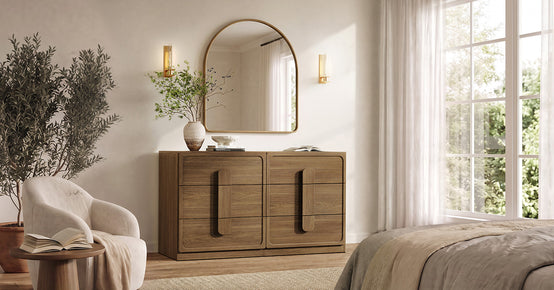
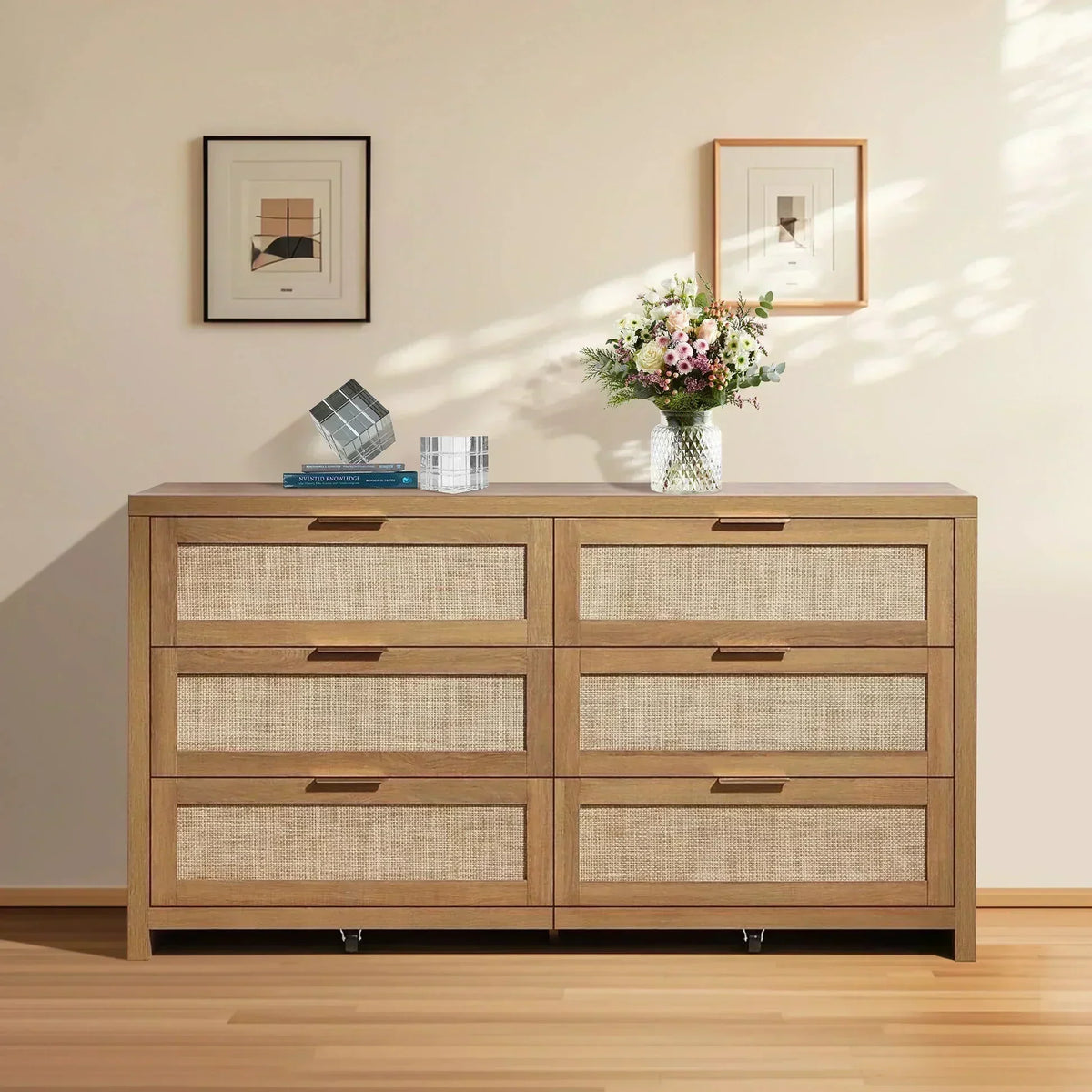
Savanna 6 Drawer Dresser: straightforward two-sided allocation

Six drawers, 56.85 inches wide, with a listed interior drawer width of 26.81 inches and a main drawer interior height of 8.59 inches. This model is the straightforward pick for a three-and-three split where both people have closet support and want the largest individual drawers on offer at this cabinet width. It does need a long clear run, so measure around door casings and adjacent furniture first. Other six-drawer configurations come in different widths.

Savanna Dresser, 7 Drawers: personal banks plus a shared drawer

This model takes essentially the same footprint at 56.88 inches wide, adds a seventh compartment, and lists a 24.61-inch interior drawer width. Worth a look when you want personal banks plus one shared or overflow drawer, and your folded items are not bulky enough to need the taller drawer interior.

If you need more separation

Both Savanna models list metal roller glides and drawer safety stops. Both require assembly and ship with a wrench, though a power drill is recommended and not included. If your inventory came out at more than four drawer zones per person, look at higher drawer counts or modular configurations, and confirm the assembled width against your wall before ordering anything.

Stability and Anti-Tip Safety for a Shared Dresser

Shared dressers get opened more often, loaded heavier, and left open more frequently than single-user dressers. Stability is worth a minute.
Free-standing clothing storage units sold in the U.S. that stand at least 27 inches tall, weigh at least 30 pounds, and hold at least 3.2 cubic feet of enclosed storage fall under a federal safety standard. In April 2023 the U.S. Consumer Product Safety Commission adopted ASTM F2057-23 as a mandatory standard under the STURDY Act, covering units manufactured after September 1, 2023. Testing includes stability on carpet, with loaded drawers, and with multiple drawers open at once.
That last condition is the one couples should notice. Two people getting ready together leave more than one drawer open constantly.
  • Install the anti-tip restraint that comes with the unit, following the assembly instructions exactly
  • Anchor into a stud, or use hardware rated for your wall type
  • Heavier folded items belong in the lower drawers
  • Level it, especially on carpet or an uneven floor
  • Close drawers when you finish instead of leaving several extended
SICOTAS publishes assembly instructions for its furniture. Check the manual for your specific model to see which anchoring hardware is included.

Two-Person Dresser Buying Checklist

  • We listed each person’s folded categories separately
  • We know what stays in the closet instead
  • Each person has a defined drawer zone
  • Interior drawer dimensions compared, not just exterior width
  • We measured usable wall width between real obstructions
  • Active depth calculated with the drawers open
  • Open drawers do not block the bed, closet, or doorway
  • We tested both people using their zones at the same time
  • Assembly instructions and anchoring requirements reviewed

Find a Dresser That Works for Both of You

Decide the split first, then shop. Once you know how many drawer zones each person needs and how much clear wall you have to work with, compare the SICOTAS dresser collection by width, drawer count, and published interior drawer dimensions to find a layout that gives both of you storage you can actually reach.

Frequently Asked Questions

Is a 6 drawer dresser enough for two people?

Often, yes. Three drawers each, with hanging clothes living in a closet. Six-drawer layouts also tend to give you the largest individual drawers for any given cabinet width, which starts to matter once sweaters and folded denim are involved. Check the interior dimensions before assuming, though. Drawer count says nothing about what fits.

How many drawers does a couple need?

There is no fixed number, but there is a method:
  • Count the folded categories each person needs to store
  • Find a layout that gives each of them that many zones
  • Couples with generous closets usually land at three drawers each
  • Couples storing nearly everything folded need more

Is a 9 drawer dresser better than a 6 drawer dresser for couples?

Not automatically. The two answer different needs.
  • Choose nine when you are sorting many categories, have limited closet space, and own the wall width for it.
  • Choose six when you are storing bulky folded items and want the most room inside each drawer.

How should two people divide a dresser?

Vertically, by complete bank. Left column to one person, right column to the other. Vertical division gives each person independent access and avoids the situation where both partners need the same drawer at the same moment. Splitting horizontally by row creates bottlenecks instead, which is why it tends not to survive the first busy week.

How wide should a dresser for two people be?

Wide enough for two separate drawer banks, and no wider than your usable wall allows. Work it out this way: measure between the fixed obstructions rather than corner to corner, subtract room for anything that has to sit beside the dresser, and treat what is left as your ceiling. A wider double dresser improves side-by-side organization. It also demands more uninterrupted wall than most bedrooms have.

How much space should you leave in front of a dresser?

No universal figure exists, because drawer extension varies by model. Calculate instead:
cabinet depth + drawer extension + standing space
Use the numbers from your actual product page. The ADA clear floor space of 30 by 48 inches is a reasonable reference for what one adult occupies while standing at furniture.

What is the difference between exterior depth and interior drawer depth?

Exterior depth measures the full cabinet front to back, including the drawer front, the frame, and the back panel. Interior drawer depth measures usable space inside the drawer box, which is always the smaller number. Both usually appear on the product page. Exterior depth answers room fit. Interior depth answers what fits inside.

Should couples buy one wide dresser or two smaller ones?

One wide dresser is simpler and usually cheaper, provided you have the wall for it. Two smaller pieces earn their place when the room is narrow, when the two partners have sharply different storage needs, or when there is no single uninterrupted wall long enough for a double dresser.

Can two people use a dresser at the same time?

Only if the layout allows it. A two-column double dresser lets each person open a drawer in their own bank simultaneously. A single-column tall chest does not, because one person occupies the whole unit. Couples who get ready together should treat this as a hard requirement rather than a nice extra.

Does a wider dresser always mean more storage?

No. Compare the Savanna six-drawer and seven-drawer models: their exteriors differ by 0.03 inches, while their interior drawer widths differ by 2.2 inches. Configuration decides usable volume, not the cabinet measurement. Read the published interior figures.

Do I need to anchor a shared dresser to the wall?

Yes, following the manufacturer instructions. Federal safety requirements for clothing storage units include stability testing with loaded drawers and with multiple drawers open, which is exactly what happens when two people share a unit. Install the supplied restraint into a stud, or with hardware appropriate for your wall type.

What should I measure before ordering a dresser for two people?

Seven numbers:
  • Usable wall width between real obstructions
  • Cabinet depth
  • Drawer extension
  • Interior drawer width, height, and depth
  • Walkway you need to keep clear
  • Clearance to bed, closet, and door
  • The folded stack itself, held against the published interior drawer height

Looking for something else?

20 Small Media Room Ideas for a Cozy, Space-Smart Setup

20 Small Media Room Ideas for a Cozy, Space-Smart Setup

LEARN MORE
18 Jewelry Storage Ideas for a Tangle-Free Collection

18 Jewelry Storage Ideas for a Tangle-Free Collection

LEARN MORE
10 Coffee Table Alternatives That Work Better in Small Living Rooms

10 Coffee Table Alternatives That Work Better in Small Living Rooms

LEARN MORE
15 Home Theater Furniture Ideas That Make a Room Work

15 Home Theater Furniture Ideas That Make a Room Work

LEARN MORE

Read more from Blogs

Looking for something else?

Open vs Closed Floor Plan: Which Layout Suits Your Home?

Open vs Closed Floor Plan: Which Layout Suits Your Home?

LEARN MORE
Whitewashed Wood Furniture: Getting the Finish Right at Home

Whitewashed Wood Furniture: Getting the Finish Right at Home

LEARN MORE
18 Accent Table Decor Ideas That Work in Real Rooms

18 Accent Table Decor Ideas That Work in Real Rooms

LEARN MORE

Read more from Blogs

You may also like

Savanna Console Table
$149.99
-4%
Savanna Shoe Cabinet, 2 Doors
Regular price $239.99 Save 4% Sale price $229.99
Cas Black Shoe Cabinet Entryway
$259.99
-12%
Cas Shoe Cabinet with Storage
Regular price $294.99 Save 12% Sale price $259.99
-12%
Savanna Entryway Bench
Regular price $169.99 Save 12% Sale price $149.99
-3%
Savanna Tall Shoe Cabinet,30 Pairs Shoes
Regular price $319.99 Save 3% Sale price $309.99

Further reading