

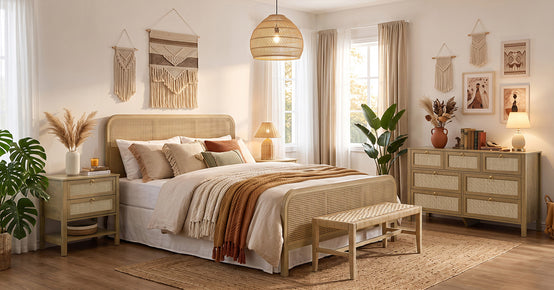
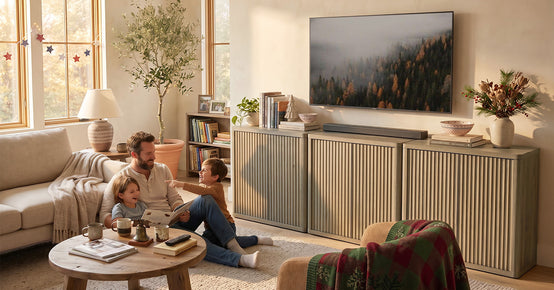



Dresser Alternatives: Smart Ways to Store Clothes Without a Bulky Dresser
Let me tell you about the worst furniture purchase I ever watched someone make. A friend of mine bought a dresser — not a bad one, mid-range solid wood, six drawers — for her studio apartment. It took three people and a Saturday afternoon to get it up two flights of stairs. Once it was in the room, she had to shimmy sideways to get to the window. The closet door hit it if you opened it more than forty-five degrees.
Six months later, she posted it on Facebook Marketplace for $30. Nobody bought it for three weeks. She eventually gave it away.
The problem wasn't the dresser. The problem was the assumption that a bedroom needs a dresser. It doesn't. There are dresser alternatives that work better for small rooms, tight budgets, rented apartments, minimalist wardrobes, and anyone who just doesn't want to wrestle heavy furniture up a staircase ever again.
Here are 28 of them. Some is furniture. Some are organizational systems. A few cost almost nothing. The right one depends entirely on what you own and what your room actually looks like — not on what the furniture section of a department store assumes everyone needs.
Before You Buy Anything: Look at Your Clothes First
This is the step that saves people from buying the wrong thing. Not once, but repeatedly.
Pull everything out of wherever it lives right now. Put it in four piles: things that fold flat, things that hang, bulky seasonal stuff, and daily-grab items. That sorting exercise tells you more about what storage you actually need than any buying guide.
If your pile of hanging clothes is three times bigger than your pile of folded clothes, a dresser is never going to solve your problem. You need rods, racks, or a wardrobe. If it's the reverse, you need shelves, bins, or drawers. Most people have a mix, which is exactly why combining two smaller solutions usually beats buying one large piece of furniture.
Also: be honest about how you actually put laundry away, not how you plan to. If drawers tend to become black holes where socks disappear forever, open shelves or visible bins might serve you better, even if they require more discipline to maintain.
1. Under-Bed Storage Bins

There's a whole second bedroom under most people's beds. Dusty? Yes. Wasted? Also yes. Low-profile bins slide underneath standard frames and hold folded jeans, T-shirts, spare linens, and whatever else you're tired of piling on a shelf. Buy the ones with wheels — not for aesthetics, but because sliding them out without wheels means getting on the floor every morning, and you won't do that for long.
Label the side of the bin, not the top. When it's under the bed, you're looking at the side. Labels on top are invisible from a standing position and useless in practice.
2. Storage Beds with Drawers

A platform bed with built-in drawers sounds like a compromise in furniture. It's actually just smart math. One piece replaces two — the frame you were going to buy anyway and the dresser you were trying to fit somewhere. The drawers seal out dust, slide on proper tracks, and hold as much as a mid-range dresser without claiming any floor space beyond the bed's footprint.
They cost more than a basic frame, yes. But if you price a decent frame plus a decent dresser, the gap usually closes fast. And when moving day comes, you're moving one piece instead of two.
3. Trunks and Chests

Nobody actually talks about trunks. Which is strange, because a good cedar chest at the foot of a bed is doing three jobs at once — storage, seating, and room anchor — and it smells like it's protecting your clothes from moths at the same time. That's a hard combination to beat.
The size is both the point and the problem. You open a big undivided trunk, put a sweater in, and two years later you're surprised to find three sweaters you forgot you owned. It becomes a black hole with a lid. The fix is boring but it actually works: small baskets inside so things stay categorized, vacuum bags for bulky winter pieces, and a strict rule about pulling everything out when the seasons change. Do that consistently and a trunk becomes one of the smartest things in the room. Skip it and you've just bought a very heavy mystery box.
Cedar is worth the extra cost if you can swing it. It keeps moths out without chemicals, and the smell is genuinely pleasant rather than the mothball situation most people are trying to avoid.
4. Storage Benches

Here's what nobody mentions in the product listing: bench cavity depth varies wildly. Some of these things look like they have real storage inside and then you open the lid and there's four inches of space. Maybe enough for a couple of thin blankets. Not much else. Others go eight or nine inches deep and genuinely hold a season's worth of bulky clothing.
The lesson is to check the internal dimensions before buying, not the external ones. The outside can look identical across very different products.
When the depth is actually there, a storage bench earns its place faster than almost anything else you could put at the foot of a bed. You sit on it to put shoes on every single morning. You lift the lid maybe twice a week. The spare duvet, the extra pillow set, the sweaters you only need when it actually gets cold — all of it disappears inside and stops taking up space anywhere else in the room. It just sits there looking like bedroom furniture and quietly doing its job. That's a good deal.
5. Storage Ottomans

Same concept as the bench, more flexible placement. Move it to the foot of the bed, beside the chair, in front of the sofa, wherever it's needed. Put a tray on top, and it becomes a side table. The inside holds anything that needs to disappear — throw blankets, seasonal extras, things you're not ready to deal with yet.
Two or three smaller storage ottomans lined up can replace a short dresser for someone with a compact wardrobe. It's not a perfect swap, but it does the job with a fraction of the footprint, and the arrangement is easy to change.
6. Armoires

An armoire is basically a freestanding closet with doors. The doors are the point. Whatever level of chaos lives behind them is invisible when they're closed — and for a lot of people, that's worth a lot. Open the doors, rs and there's usually a hanging rod, some shelves, and often a drawer or two—one piece handling two jobs.
They use height rather than width, which is the correct trade-off for a small bedroom. Floor space is usually the constraint. Vertical space is usually available. An armoire works with that reality instead of against it.
7. Freestanding Wardrobes

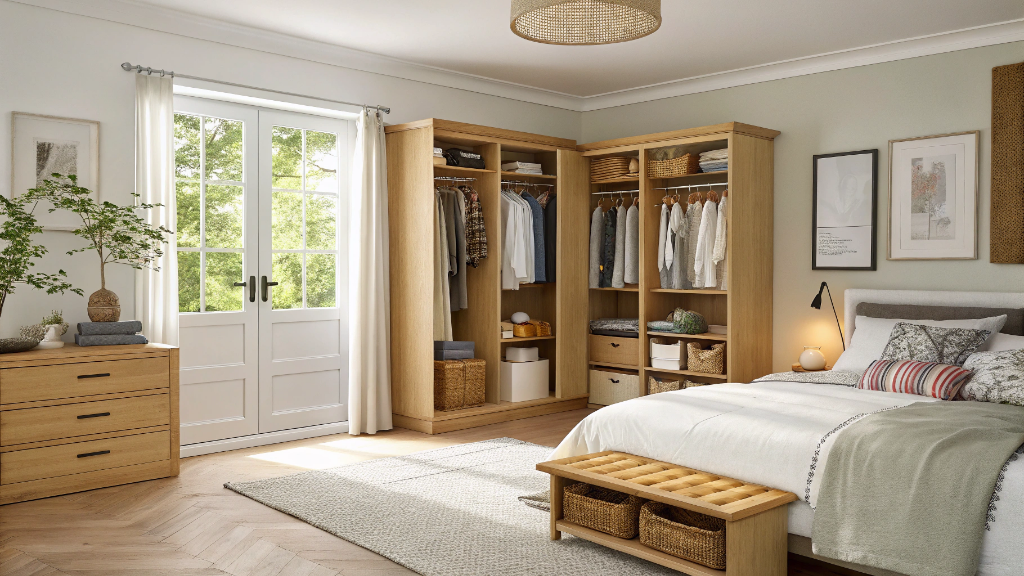
If the room has no built-in closet at all, a wardrobe isn't a dresser alternative — it's the only serious option. Wider than an armoire, usually taller, with proper hanging space plus shelves and sometimes drawers, a wardrobe functions as the closet the room was never given.
The Savanna Wardrobe 71-inch is a clean-line contemporary piece that accommodates hanging and folded storage in a single unit. Seventy-one inches of height captures wall space most furniture never uses, and the design suits modern rooms without demanding attention.
8. Clothes Cabinets

Smaller than a wardrobe, usually narrower than an armoire. A clothes cabinet typically has a short hanging rod and either shelves or a couple of drawers — enough for a modest wardrobe, a guest room, a teenager's room, or a second bedroom where you don't need the full closet treatment.
Good for rooms where a full wardrobe would be too much. Bad for rooms where it would need to serve a large or varied wardrobe — it's a supporting player, not a lead.
9. Garment Racks

Here's the honest case for garment racks that nobody usually makes: some people genuinely need to see their clothes to wear them. If out of sight really does mean out of mind for you — if clothes in a drawer stay there for months because you forget they exist — then a rack is objectively better for your actual life than a dresser.
Everything visible. Nothing buried. You plan outfits by looking at the rack rather than remembering what's in which drawer. For renters, the bonus is that it weighs almost nothing and can be moved in fifteen minutes. If dust is a concern, a fabric cover handles it without destroying the visibility benefit.
10. Open Closet Systems

An alcove. A recessed wall section. A gap between two built-ins. Any of these can be converted into a functional open closet with a rod and some brackets. The difference between an open closet system and a garment rack is that a system can be configured with different rod heights for different clothing lengths, a shelf above for folded items, and hooks below for bags.
It takes slightly more setup than a rack, and it's less portable. The payoff is storage that feels permanent and intentional rather than temporary and improvised.
11. Bookcases and Shelving Units

High-end clothing stores stack folded clothes on open shelves. It looks clean and considered. The same approach works in a bedroom. Neat low stacks, consistent folding, matching bins or baskets for smaller items — the result is open storage that looks like a system rather than clutter.
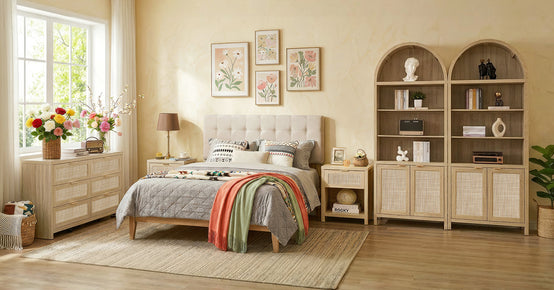
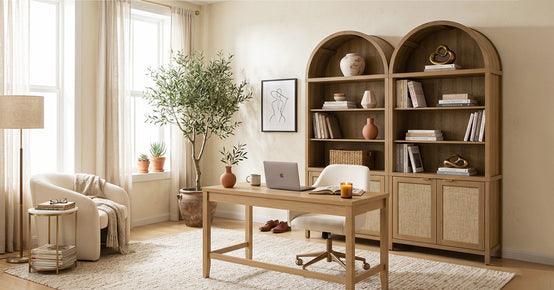
The Savanna Arched Bookcase adds closed lower compartments to open upper shelving. Open access for everyday items up top, hidden storage down below for things you'd rather not display. Two storage zones, one floor footprint, cleaner result than either alone.
12. Floating Shelves and Wall Storage

No floor footprint at all. That's the argument for floating shelves,s and it's a strong one. Install them above the desk, beside the window, over the door — anywhere wall space is going unused. Folded clothes in neat stacks, labeled baskets, and stacked sand mall storage boxes. All of it goes up, none of it touches the floor.
For more vertical volume without taking up floor space, the Willow 75-inch Tall Bookshelf uses height to create the sense of a taller room while delivering multiple shelf levels for both open display and organized storage — in a footprint narrower than most dressers.
13. Wall Hooks and Pegboards

Hooks are probably the most ignored storage option in most bedrooms. Not the decorative ones people buy at homeware stores and then don't trust with anything heavier than a silk scarf — proper load-rated hooks, a row of them, installed somewhere they'll actually get used.
A good set of wall hooks handles bags, jackets, robes, scarves, hats, and everything in the between-washes category — the clothes you wore yesterday that aren't dirty enough for the hamper but too used to go back in the wardrobe. That stuff usually ends up on a chair. It doesn't have to. It just needs somewhere to go.
Pegboards are the more flexible version of the same idea. The hooks move. You can add a small shelf, a few bins, a mirror. Rearrange it as your wardrobe changes without any tools beyond the peg itself. Takes about twenty minutes to set up and it costs almost nothing.
One thing that catches people out: check the weight rating per hook before loading one up. A canvas bag full of gym gear on a hook designed for light scarves will pull out of the wall. It's not the hook's fault — it was doing what it was rated for. Read the spec, buy the right hook for what you're actually hanging, and the whole system holds up for years.
14. Fabric Bins on Shelves

Cheap. Light. Portable. Genuinely effective. Stack matching fabric bins on any shelf, fold clothes into them, label the front, and you have the functional equivalent of dresser drawers for a fraction of the cost and with zero furniture weight.
The word 'matching' is doing a lot of work there. A collection of identical bins in a single color looks like a system. A collection of mismatched bins in six sizes and colors looks like a garage sale. The clothes inside are the same either way — the visual reads completely differently.
15. Plastic Drawer Towers

Not going to pretend these are stylish. They're not. But they hold socks, underwear, T-shirts, and gym clothes in stackable drawers that slide in and out without sticking — which is more than some actual dressers manage. They fit in closets, in corners, under desks, in the gap between two pieces of furniture.
For a first apartment, a temporary setup, or any situation where the goal is function over form, this is the honest budget answer. If the look is a problem, fabric draped around the sides and tucked underneath makes it look considerably less provisional.
16. Rolling Carts

Originally a kitchen and office solution. Works fine in a bedroom. Compact enough to roll into a closet corner, a wheeled cart can hold a specific clothing category — gym gear, baby clothes, work shirts, accessories — without taking up a permanent position in the room.
The wheels matter more than people expect. Roll it to the laundry pile. Roll it out of the way when someone visits. Roll it into the close,t and it effectively disappears. That mobility changes the way you use it.
17. Hanging Closet Shelves

These hang from the existing closet rod with no drilling, installation, or landlord conversation required. They drop three to five fabric shelf levels below the rod — exactly the right spot for sweaters that lose their shape on hangers, folded shirts, jeans, and small item baskets.
If you have a closet with unused space below your hanging clothes and you haven't tried this yet, it's the first thing to add before any new furniture purchase. You've already got the rod. The space is already there.
18. Double Hanging Rods

A second rod below the first doubles the closet's hanging capacity for anything that ends at hip height or above: shirts, skirts, children's clothes, short blazers. It costs a few dollars and takes twenty minutes. The upper rod keeps long items. The lower rod takes everything shorter. Suddenly, the closet handles twice as much with no new furniture in the bedroom at all.
This is one of those solutions people discover and immediately wish they'd done five apartments earlier.
19. Closet Organizer Systems

The average built-in closet has one rod and one high shelf. That uses roughly forty percent of the available volume. A modular organizer system — second rod, adjustable shelves, cubbies, drawer inserts, shoe towers — reclaims the rest. In a reasonably sized closet, this often eliminates the need for a dresser in the bedroom.
Stackable plastic drawers on the closet floor create a compact dresser zone that closes behind the closet door and takes up zero bedroom space. For people with an underused closet, this is usually the answer they were looking for before they started shopping for furniture.
20. Over-the-Door Organizers

The back of a bedroom door. Everybody has one. Almost nobody uses it. An over-the-door pocket organizer holds socks, underwear, belts, scarves, accessories, and small folded items — all visible, all accessible, all completely off the floor and off every piece of furniture.
No drilling, no wall damage, hangs over the door in thirty seconds—the clearest possible option for renters who need storage without consequences.
21. Sideboards and Media Cabinets

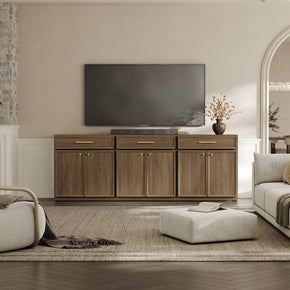
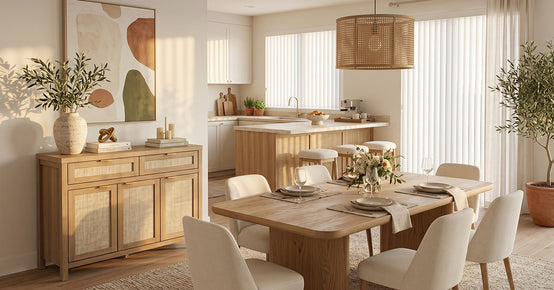
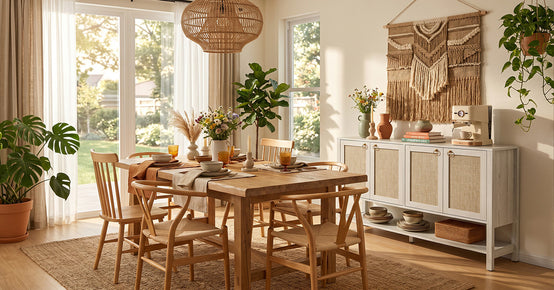
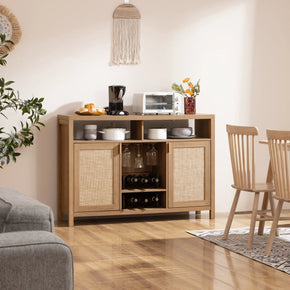
A sideboard has drawers, shelves, and door compartments. That's the same storage a dresser has, in a piece of furniture that looks as if it were chosen on purpose for the room rather than inherited from a previous life. For a bedroom that doubles as a workspace, a guest room with a desk, or an open-plan space, a sideboard stores folded clothes and accessories while looking like it belongs.
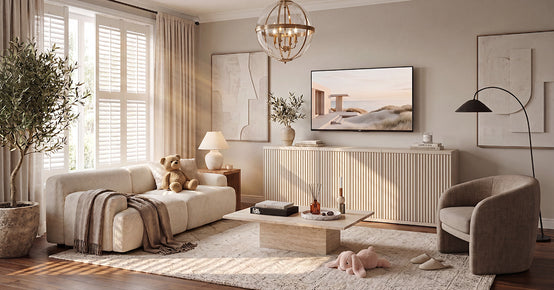
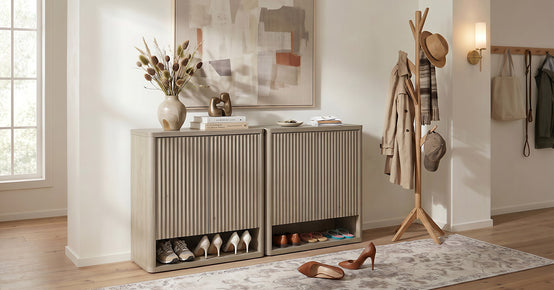
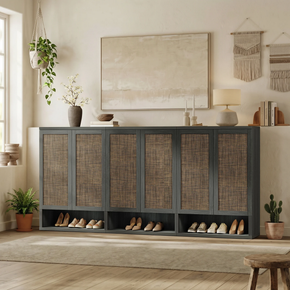
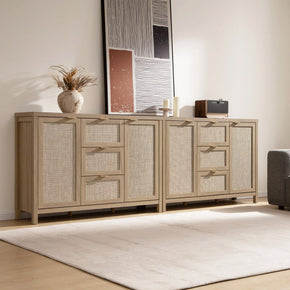
The Stria Sideboard with 2 Doorsfeatures two doors and a clean top surface for a lamp or mirror. Storage is hidden, the surface is functional, and the finish is contemporary enough to sit in a modern bedroom without looking like it wandered in from a different room.
22. Nightstands with Multiple Drawers

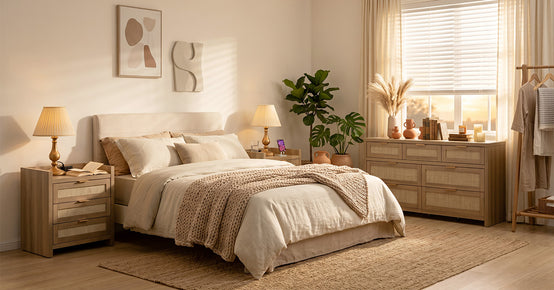
The nightstand gets used as a lamp holder. That's it, in most bedrooms. A nightstand with two or three real drawers can hold sleepwear, socks, phone chargers, reading glasses, and the kind of daily items that usually end up in a dresser drawer. You were walking to the bedside table anyway — it might as well hold more.
In shared rooms, two well-chosen nightstands replace a small dresser, keeping bedroom-specific items separate without adding any furniture to the main floor space.
23. Corner Shelves

Corners are the most consistently ignored space in most bedrooms. A corner shelf unit — freestanding or wall-mounted — turns that dead zone into usable vertical storage without projecting far into the room. Folded clothes in baskets, seasonal items, and decorative storage boxes.
When every other wall already has something against it, and the room feels out of options, the corner is almost always the answer that hasn't been tried yet.
24. Overhead Storage Units

If the ceiling is high enough, the space above the door, above a wardrobe, or running along the top of the walls can hold seasonal clothing, spare bedding, luggage, and anything that doesn't get touched between seasons. Overhead cabinets or high perimeter shelves use the height that most furniture completely ignores.
The rule worth following: nothing goes up there daily. Reaching overhead every morning for socks is annoying enough that it stops happening within a week. Seasonal rotation only. Everything you need regularly should be at eye level or below.
25. Clothes Lockers

Metal lockers get dismissed as institutional. In the right room they're exactly the right choice. They take less floor width than a dresser, the height often accommodates hanging items, and modern versions come in matte colors that read as industrial-modern rather than school hallway.
Best for teenagers' rooms, shared spaces where assigned storage matters, or anyone who wants their bedroom storage to have some personality. Not for everyone. When they work, they work well.
26. Suitcases and Vintage Storage

Suitcases sitting empty in a closet are storage containers that aren't storing anything. Use them. Slide them under the bed, where they're filled with off-season clothes. Stack a set of vintage cases in graduated sizes as a bedside table — the inside holds clothes, the outside reads as room decor.
This works for seasonal rotation, travel-ready items, and occasional extras. Not a replacement for real storage if the wardrobe is large. But it's free capacity in something you already own and weren't using.
27. S-Hooks and Over-the-Rod Hooks

S-hooks move more out of dresser drawers than people expect. Hang jeans by a belt loop from the closet rod. Loop a bag by its strap around another. Add scarves, belts, and accessories on a third. The rod starts holding things it never held before without any new hardware.
One specific note that saves fingers: buy S-hooks with rounded, smooth ends. The kind with sharp ends will catch your hand every time you reach the back of the closet. After about the fourth time, that gets old.
28. Window Seat Storage

A window seat with a hinged lid is storage that doesn't look like storage. That's the whole point of it. Built into a bay window or constructed as a bench below a standard window, it hides clothing, linens, and bulky items behind a surface that reads as comfortable seating and a natural light spot all at once.
It's the most labor-intensive option on this list — you're either building it, buying a custom piece, or finding a modular option that works. The result is storage with zero visible weight. The room doesn't look like it has a storage problem,since nothing signals one.
How to Pick the Right One for Your Situation

Three questions narrow down most of this list fast.
First, how much floor space can the storage actually take up? In a small bedroom, the answer is often 'not much.' That pushes toward vertical storage — wardrobes, tall bookcases, wall-mounted shelves, overhead units — and toward solutions that use space you already have, like the underside of the bed or the inside of the closet.
Second: Are you renting, or do you own? Renters need portable, damage-free options. Garment racks, fabric bins, rolling carts, over-the-door organizers, and plastic drawer towers all move without repair bills. Built-in systems, wall-mounted shelving, and floor-anchored wardrobes require either permission or careful removal.
Third: Do you want things hidden or visible? This one is less obvious than it sounds. Closed wardrobes, storage benches, and sideboards keep everything out of sight. Open racks, shelves, and visible bins require consistent habits to look intentional rather than messy. Be honest about your habits. The storage solution that matches how you actually behave will outlast the one that matches how you think you ought to behave.
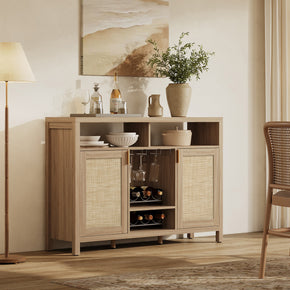
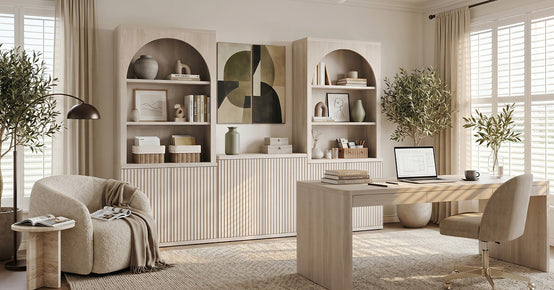
For a piece that handles both visible and hidden storage in the same footprint — open shelving on top, closed doors below — the Helio Decorative Sideboard Cabinet works in bedrooms, hallways, or any multi-purpose space that needs furniture to do more than one thing. The open section is for display and daily grab items. The closed section is for everything else.
FAQs
How can I store clothes without a dresser?
Under-bed bins, closet shelves, garment racks, storage beds, wall hooks, fabric bins on shelves, and freestanding wardrobes all work, depending on the room and what you own. The sorting exercise matters here — folded clothes need bins, shelves, or drawers; hanging clothes need rods or racks; bulky seasonal items need under-bed or trunk storage. Start with your actual wardrobe, and the answer usually becomes obvious.
What can I use as a temporary dresser?
Plastic drawer towers are the most practical answer — cheap, light, easy to move. Fabric bin towers, rolling carts, cube organizers, hanging closet shelves, and suitcases all work for shorter-term setups. For renters or anyone between permanent living situations: avoid anything heavy, anchored, or requiring wall installation. The over-the-door organizer is the most portable option on the list.
What to do if you don't have room for a dresser?
Use what's already there more efficiently. Under the bed with rolling bins. Inside the closet with an organizer system. On the walls with floating shelves and hooks. A storage bed replaces both the frame and the dresser without adding any floor footprint beyond what the bed already uses. A narrow wardrobe or tall bookcase often holds as much as a dresser while using less wall space.
What can you use instead of a chest of drawers?
Armoires, wardrobes, storage benches, under-bed bins, modular shelves, garment racks, sideboards, and closet drawer inserts all substitute for a chest of drawers. A sideboard is the closest visual replacement — similar surface height, similar storage capacity, and a cleaner, contemporary look in bedrooms where the furniture serves more than one purpose.
What is a Dutch dresser?
A Dutch dresser is a traditional tall cabinet with open shelves or glass-front cupboards on top for display, and closed storage below for household items. Originally used for china and linens. In a modern bedroom, the same format — display shelving up top, closed storage below — works well for folded clothes and accessories, particularly if you want furniture with visual presence rather than something that disappears into the room.
Where to put clothes if there is no wardrobe?
Garment racks for hanging pieces. Open closet setups — a rod in an unused nook, hooks and shelves on a wall section — for both hanging and folded items. Under-bed bins, storage ottomans, shelving units with baskets, and over-the-door organizers for everything else. Almost every bedroom has at least one of these spaces available — under the bed, behind a door, or a section of wall not currently in use.
How to hang clothes when there is no closet?
A freestanding garment rack is the quickest solution and requires no installation. Wall-mounted rods fixed into studs hold more weight and feel more permanent. Tension rods in an alcove create hanging space without drilling. An armoire or wardrobe gives you a closed version of the same solution. A curtain on a ceiling-mounted rod turns any corner into a makeshift closet. None of these requires a built-in closet.
What is the 70/30 rule for wardrobe?
A wardrobe planning principle: roughly 70% of what you own should be core everyday pieces you actually wear, and 30% should be statement, occasional, or trend items. Applied to storage, the 70% needs to be the most accessible — on the main rod, on the front shelf, in the top drawer. The 30% can live in trunks, under-bed storage, overhead cabinets, or the back of the closet. It connects to storage because the way you organize reflects the proportion of what you actually use.
Sources
- The Spruce,25 Best Dresser Alternatives for a Stylish Bedroom
- Feige's Interiors,12 Brilliant Bedroom Dressers & Storage Alternatives That Really Work
- Living Spaces,12 Dresser Alternatives for Clever Clothing Storage
- T.Y. Fine Furniture,9 Dresser Alternatives for Small Spaces
- Reddit ApartmentDesign,Alternatives to a Dresser — Community Discussion
- Amazon,Clothes Storage Dresser Alternative Products


Looking for something else?

Furniture Materials Guide: Picking the Right Material Room by Room
LEARN MORE
How to Mix Wood Tones Without Making a Room Look Mismatched
LEARN MORE
18 College Apartment Furniture Ideas That Save Space and Money
LEARN MORE
Types of Entertainment Centers: 11 Designs and How to Pick One
LEARN MORELooking for something else?

Curio Cabinet Decor Ideas: How to Style a Display Cabinet Without the Clutter
LEARN MORE
Curved Furniture: How to Style, Measure, and Buy It in 2026
LEARN MORE
What Is Rattan Furniture? A Buyer Guide to Types and Care
LEARN MORE


Further reading

How to Choose a Nightstand for a CPAP Machine

How to Choose a Shoe Cabinet for Men's Sizes, High-Tops, and Bulky Shoes


