



29 Couch Types: Every Sofa Style and What It's Actually For
Here's how most sofa shopping goes: you walk in, stare at twenty sofas that look basically the same, check the tape measure on your phone, pick one in your price range, and bring it home. Six months later, it's fine. Technically fine. But it's either too stiff for movie nights or too casual for the dinner parties you host, or just not quite what you were picturing when you started. The size worked out. The style was never actually a decision.
That's what happens when you shop for a sofa the way most guides tell you to — room dimensions first, budget second, style last. By the time style comes up, half the options are already gone. What's left fits the room, but it doesn't fit you.
There's a better way to do this. Know the couch types before the tape measure comes out. Know what each one's actually built for, which rooms it suits, and — just as useful — when it's the wrong call. These 29 types cover all of that. Jump straight to the one you're already considering, or read through — the buying notes at the end are worth getting to.
1. Standard Sofa

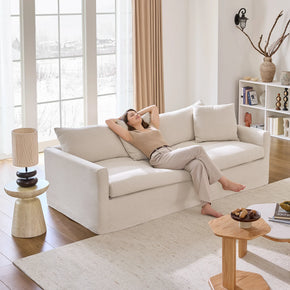
Three seats, straight back, two arms. Anywhere from 78 to 90 inches in most collections. It's not exciting. That's kind of the point. It fits against most walls, pairs with most chairs, and doesn't box you into a layout you'll resent after a year. If nothing else on this list has spoken to you, start here.
2. Loveseat

Two seats. Not a small sofa — different piece, different job. A loveseat is 52 to 72 inches wide and genuinely good at specific things: apartments where a full sofa would crowd everything, bedrooms at the foot of a bed or tucked into a reading corner, or beside a full sofa in a bigger room when you need more seating but can't fit another couch.
Put one in the right spot, and it looks intentional. Treat it as a fallback, and it always looks like you couldn't afford the full sofa. The distinction between those two outcomes is mostly about placement and intent, not price.
3. 3-Seater Sofa

82 to 92 inches wide. Three seats. The most common living room sofa in American homes — not because it's interesting, but because it's the right scale for most rooms. It fits against a wall, floats in an open-plan space, pairs with accent chairs or a loveseat without the room feeling like it's trying too hard.
4. 5-Seater Sofa

Here's the thing people miss: it's not about the seats — it's about the width. A 5-seater runs 100 to 120 inches, sometimes more. That's a lot of wall. You need at least 130 clear inches on a single wall plus walking clearance on both ends. In a room that doesn't have that, a 5-seater doesn't look generous. It looks like it won't stop.
Measure the wall. Not the room. The wall.
5. Sectional Sofa

Bought wrong more often than almost anything else on this list. People pick a sectional because it looks good in the showroom or because they want more seating — not because their room can actually take one.
A sectional needs walking clearance on all its open sides, room in front for a coffee table, and enough leftover floor space that the room doesn't feel like a furniture depot. In a genuinely large living room? It's the right call. In a medium or small room? A standard sofa with two chairs usually looks better and works more flexibly than any sectional would.
6. L-Shaped Sectional

One arm along one wall, the second longer arm along the adjacent wall. The L-shape fits corners better than any other sofa layout, and it defines a seating zone without needing a wall behind all of it — which matters a lot in open-plan rooms where you're trying to create a distinct area without blocking sightlines.
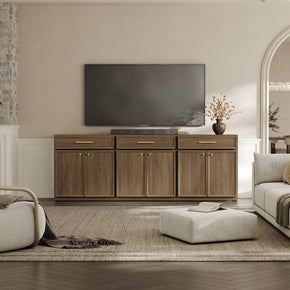
A coffee table in the inner corner of the L finishes the look. On the opposite wall, a console table with storage keeps the TV side organized — the Savanna Console Table has three drawers that swallow cables and media accessories, keeping that wall from looking like a tangle.
7. U-Shaped Sectional

Three sides. The most seats of any configuration on this list. The catch: it needs a genuinely large room — roughly 15 × 18 feet at minimum — and still has walking space around the outside. In anything smaller, it doesn't look inviting. It looks like a traffic problem.
People buy U-shapes for holiday gatherings and then live with an awkward room the other 350 days of the year. Does the space actually fit it? It's great for movie nights, big families, and rooms where the sofa is the main focus.
8. Modular Sofa

So modular sofas come in pieces. Literally. You get individual seat sections, corner pieces, armless middles — and you connect them however you want. That's the whole point. Is your living room wide? Go with a long straight layout. Got an awkward corner to fill? Build an L.
People who rent love these things, and honestly, it makes sense. You move, the sofa changes shape to fit the new place. Nobody's hauling a giant one-piece sectional down a narrow stairwell at 7 am on moving day.
Where it goes wrong — and I've seen this happen plenty — is when somebody orders four sections without measuring anything first. They show up, get tossed against a wall in a line, and the whole room looks like a waiting area at a doctor's office. Modular doesn't mean "figure it out later." You still need to plan what shape works in your space. Corner pieces anchor a layout. Armless sections fill the middle. Get the geometry right, and the sofa looks like it was custom-built for that room. Skip that step, and it never quite comes together.
9. Chaise Sofa

Picture a regular sofa, except one side stretches out long enough to put your legs up. That's a chaise sofa. No separate ottoman sliding across the floor every time you shift your weight. The extended part is attached — it goes nowhere.
Footprint-wise, it's smaller than a full sectional. You still get that lounging spot, just without eating up half your living room. Works really well in spaces where an L-shaped sectional would be overkill.
Here's what burns people, though. Every chaise sofa is built facing one direction — left or right. Not adjustable. Not reversible. You ordered a right-facing chaise and your room needed a left? That extended section is now jutting into your hallway or pressed flat against a wall with nowhere to go. I cannot stress this enough. Go stand in your living room right now. Look at where the sofa will sit. Which side needs the long part? Left or right? Order that one. 15 seconds of thinking saves you from a return-shipping nightmare.
10. Sleeper Sofa

The measurement nobody checks: the footprint when the bed's fully open. The sofa itself might fit fine. With the mattress extended, most sleeper sofas need 6 to 8 feet of floor space, which clears out more room than people expect. Do that math on paper before buying.
Modern sleeper sofas are genuinely better than the old heavy steel pullout frames. Foam fold-out versions are lighter, easier to open, and more comfortable. Still not a real bed for extended stays, but fine for occasional overnight guests.
11. Reclining Sofa

They spent decades being associated with a very specific kind of living room — you know the one. Modern versions have caught up aesthetically and mechanically. Electric recliners run quietly, operate on remote control, and look like normal sofas most of the time.
The one constraint that hasn't changed is that standard models need 12 to 18 inches behind them to recline fully. Wall-hugging versions move the mechanism forward rather than pushing the back outward, which solves that. Good for TV rooms, anyone who needs proper leg support. Wrong room: anywhere formal or design-forward.
12. Futon

Let's be real — a futon is a compromise. Thinner than a mattress. Firmer than a couch. It's not trying to win any awards in either category.
But when your apartment is 500 square feet, and you physically cannot fit a bed AND a sofa? A futon earns its spot overnight. Lightweight, cheap to replace, and easy to haul up three flights of stairs on moving day.
And the frames have gotten way better. The old pine-slat-and-foam-pad look is mostly gone. Some newer models actually pass for real furniture in a dimly lit living room.
Still — if budget isn't the thing holding you back, a proper sleeper sofa does both jobs better. Futons make the most sense when the real constraint is space or money, and there's zero shame in that.
13. Daybed and Divan

A daybed is a twin mattress with a back panel that makes it look like a couch during the day. No folding mechanism. No pull-out frame, you have to fight with at midnight. Sit on it, sleep on it, done.
A divan is basically the same idea but with Middle Eastern roots. Low platform, pushed against a wall, surrounded by cushions instead of a fixed back panel. Less structured. More lounge-y.
Both work beautifully in studios and spare rooms. A home library with a daybed against one wall? That's the kind of room people photograph.
Quick way to tell them apart from a chaise lounge: a daybed has a back. A chaise doesn't. That back panel is what stops a daybed from looking like a pool lounger that wandered indoors.
14. Settee

Not a loveseat. Two seats but a completely different piece — upright posture, exposed legs, more visual formality than any standard two-seater. It came from 17th-century France, originally designed for women in wide skirts. That sounds like a weird reason to exist in 2025. But the proportions that constraint produced look genuinely good in modern rooms.
Good at the foot of a bed. Good in an entryway where a sofa's too large and a bench is too plain. Good wherever scale matters more than seating capacity.
15. Deep-Seated Sofa

Standard seat depth runs 28 to 32 inches. Deep-seated starts at 34. That 6-inch gap is the actual difference between sitting on a sofa and settling into one — between comfortable for an hour and comfortable for an evening.
Deep seats suit tall people and households where the sofa's genuinely a lounging surface. Shallow seats suit upright sitting, shorter people, and formal use. Most furniture listings don't make this distinction clearly. Ask about seat depth specifically before buying any sofa. It matters more than most specs.
16. Chesterfield Sofa

Deep button tufting head to toe. Rolled arms at the same height as the back—usually leather. The design's been this way since the 18th century — legend has it the fourth Earl of Chesterfield commissioned a sofa specifically to sit upright for hours without wrinkling his clothes. Whether that story's true or not, the resulting design survived 300 years unchanged. That's either a sign it was perfect or that nobody wanted to be the one to mess with it.
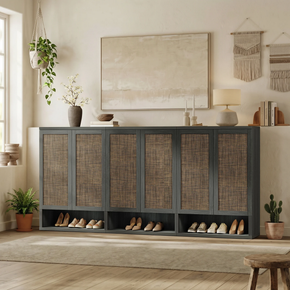
It visually takes over a room, which is either the feature or the problem, depending on what you're after. Dark floors, rich walls, and layered textiles all suit it. A glass-front sideboard alongside it adds storage without competing — the Helio Glass Sideboard has the same level of deliberate design and holds most flat screens without looking like media furniture.
17. Lawson Sofa

Thomas W. Lawson, Massachusetts financier at the turn of the 20th century, had one brief: make it as comfortable as possible. Slightly rolled arms that sit lower than the back, loose seat cushions, a relaxed shape without looking like it gave up.
A Chesterfield commands a room. A Lawson just makes you glad to be in it. That's a real difference, not a branding distinction. It's the sofa most people would design if they started from comfort rather than appearance — and it's the one that suits the most households because of it.
18. English Roll Arm Sofa

British country houses, early 1900s. That's the DNA, and it still shows. Compact rolled arms — tighter than the American roll arm, still padded — short turned legs on casters, plump seat cushions. It looks slightly worn-in even when it's new, which is either the whole point or a dealbreaker depending on your taste.
Pairs with warm tones, natural materials, and rooms with fireplaces. Works in linen, cotton, classic stripes, and faded florals. It's one of the most versatile sofas on this list in terms of fabric choices — let me not say "versatile," as it's overused. It just pairs well with almost anything.
19. Track Arm Sofa

Flat arms. Squared off. No roll, no extra padding. Clean lines from the top of the arm straight to the floor. It's visually slim, which is genuinely useful in smaller rooms where rolled-arm sofas eat visual space without adding any useful floor space.
It goes with most modern and transitional rooms because it doesn't compete with other elements. The flat arms are also wide enough to hold a drink or a remote — whether that counts as a design feature is up to you, but it's there.
20. Tuxedo Sofa

Arms at the same height as the back. Clean boxy geometry. Art Deco. Named after Tuxedo Park, New York, which tells you a lot about who it was made for.
It's sharp, confident, and not pretending to be comfortable. Works in rooms with a strong design point of view — modern glam, architectural minimalism, spaces where furniture's supposed to be noticed. Jewel-tone velvet amplifies it. Don't put it in a casual family room. It'll look like it arrived at the wrong address.
21. Camelback Sofa

Thomas Chippendale is credited with the original in the 18th century. Frank Lloyd Wright designed his own versions in the 1940s and 50s. Neither of those people was building furniture for rooms where someone needs to watch TV with their feet up after a long week.
The arched back rises above the arms — one hump or two. Formal, refined, best in a sitting room or reading nook rather than a room that sees daily rough use. It's the right choice for rooms where elegance is the brief. Not the right choice when comfort is.
22. Cabriole Sofa

The frame curves continuously from the back through the arms in one flowing line, often with exposed wood that makes the whole piece feel more like sculpture than furniture. Cabrioler is a French verb meaning to jump like a goat — a compliment about the style's gracefulness. Peaked in the 18th century at the court of Louis XV. It's a two-seater.
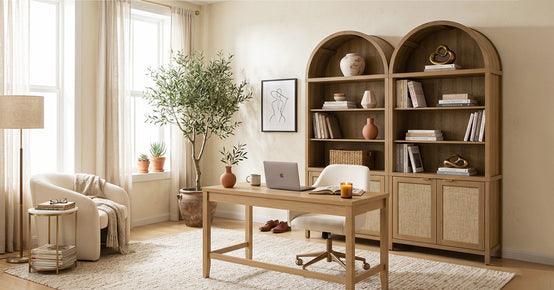
It belongs in eclectic rooms full of layered textiles and collected objects. Linen and patterned fabric suit it. A tall bookshelf nearby adds vertical presence without competing with it — the WillowTall Bookshelf at 75 inches gives the wall height and splits the space between open display and lower closed storage, which suits these kinds of rooms.
23. Mid-Century Modern Sofa

Low-slung, tapered wooden legs, clean lines. Designed before screens took over living rooms — lower backs, open frames, a posture that draws people toward conversation rather than orienting them all at a wall. That quality hasn't disappeared just because its reason has.
Works well in smaller rooms because the low profile doesn't dominate visually. Boucle and ribbed weave suit it. Deep navy or forest green if you want a more current take rather than the period-accurate mustard and burnt orange.
24. Curved / Crescent Sofa

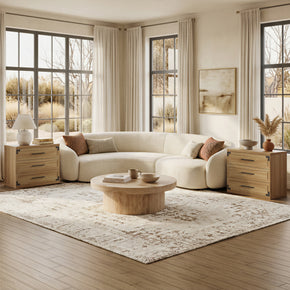
The rounded shape pulls people toward the center of the seating arrangement rather than lining them up in a row. Living rooms in the 1970s and 80s were often designed around curved sofas because those rooms were built for talking, not watching. The shape and the room's purpose aligned.
The crescent works in medium-sized rooms. Full semicircle and pit configurations need serious floor space. Velvet on a curved frame is a strong combination. A deep, solid color lets the shape carry the room.
25. Leather Sofa

Top-grain leather wears in rather than wearing out. It softens with age, gets character, and it's easier to wipe clean than most fabric options. The real downsides: more expensive upfront, warm in summer, cold in winter, and shows pet scratches. Faux leather and bonded leather cost less but peel and crack in a few years,whereas genuine leather doesn't. Know which you're buying.
26. Fabric Sofa

More colors, more textures, more ways to regret the choice if the fabric doesn't match how the room's actually used.
Performance fabrics — tightly woven polyester blends, microfiber, Crypton — handle spills, pets, heavy use. Velvet looks great and shows every fingerprint, every pet hair, every time someone sits on it. Linen feels right and stains more easily than you'd expect.
27. Slipcovered Sofa

The cover comes off. Goes in the washing machine. Goes back on. That's the point, and it's worth more than it sounds in any household with children, pets, or the kind of regular use that ruins fabric over time.
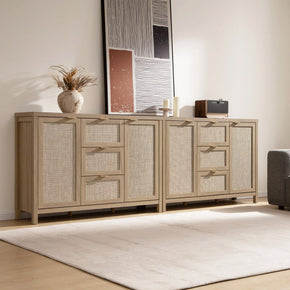
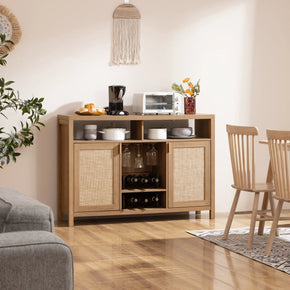
For the storage side of the living room — media equipment, games, extra blankets — a wide buffet cabinet with closed front handles it without adding visual noise. The Stria Buffet Cabinet has large drawers and a wide surface, and the closed fronts keep the floor area looking intentional rather than stored-in.
28. Seat Depth — This One Measurement Changes Everything

28 to 32 inches is standard. 34 inches or more is deep-seated. Most furniture listings don't highlight this. Most showrooms don't bring it up. But it's the measurement that determines how the sofa feels to live with every day — not for five minutes in a store, but for years in a room you actually use.
Deeper seats suit lounging, taller people, households where the sofa doubles as a reading or napping spot. Shallower seats suit upright sitting, shorter people, and rooms where the sofa gets formal or occasional use. Ask about this specifically before ordering. It won't come up unless you ask.
29. Sectional vs. Standard Sofa — What Actually Decides It

This is the question most people ask when they start researching couch types. The answer isn't preference — it's space. Can the room absorb a sectional without blocking traffic routes or crowding the furniture that's already there?
A sectional needs clear walking space on all open sides, room for the coffee table, and enough leftover floor that the room feels like a room rather than a seating arrangement. Large living rooms and open-plan family rooms: a sectional is usually right. Standard or smaller rooms: a sofa and two chairs give more flexibility and almost always look more considered.
One detail that gets missed: when a standard sofa floats off the wall, the view from the entrance is the sofa's back. A narrow console table pushed against that back — about 12 inches deep — gives that view a lamp and some objects. The Savanna Console Table fits behind most sofas without extending noticeably into the room. Small change. The difference between walking into a room and walking into a sofa.
FAQs
What are the different types of couches?
Standard sofas, loveseats, sectionals (L-shaped, U-shaped, modular, chaise), sleeper sofas, recliners, futons, daybeds, and settees are the functional types. Chesterfield, Lawson, English roll arm, track arm, tuxedo, camelback, cabriole, mid-century modern, and curved sofa are the main style types. Most sofas combine style and layout. Those are two separate decisions. For living room storage alongside any of these, the Sicotas living room furniture range includes sideboards, bookshelves, and consoles that pair well with any sofa type.
What is a 3-seater sofa?
Three seats. 82 to 92 inches wide. The default living room sofa for most people. Works against a wall or floats in a space. Pairs with accent chairs, a loveseat, or a chaise without the room feeling like too much is going on.
What are 5 examples of furniture?
Sofa, chair, table, bed, storage cabinet. In a living room: the sofa anchors the seating zone, coffee and side tables handle surfaces, and a sideboard or bookshelf handles storage. The storage piece gets underplanned constantly — it does as much for a room's daily appearance as the sofa does.
What is a 5-seater sofa?
Either a long single-piece sofa or a compact sectional setup. Runs about 100 to 120 inches wide. Suited for larger living rooms where a 3-seater reads as undersized. Most 5-seater setups are L-shaped sectionals, with the chaise end providing the extra seats.
What are the four types of furniture?
Seating, surfaces, storage, and sleeping furniture. Living rooms use the first three. A well-furnished room needs all three working together — a sofa for seating, tables for surfaces, and a sideboard or shelving for storage. The room that only has the sofa never quite looks finished.
What is a 3-seat couch called?
A 3-seater sofa. Also called a three-seat sofa, standard sofa, or full-size sofa. Interchangeable terms across the industry.
What type of sofa is best?
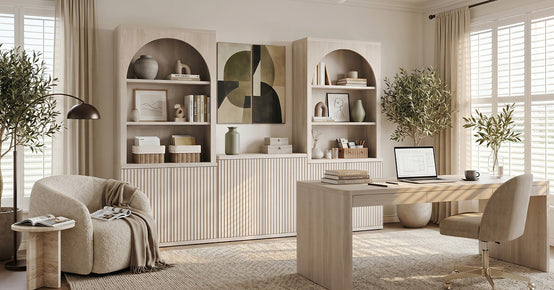
No single answer. Large family room: L-sectional or modular. Small apartment: loveseat, track arm, or apartment-size standard. Formal room: Chesterfield or tuxedo. Daily comfort priority: Lawson or English roll arm. Guest use: sleeper sofa. Lounging household: a deep-seated version of any style. For the storage piece alongside whichever you pick — a Stria Sideboard with Doors handles media equipment and household items with closed fronts that keep the room looking clean.
What are the major furniture categories?
Seating, tables, storage, beds, dining furniture, office furniture, and outdoor furniture. For living rooms: seating, surfaces, and storage. The storage category is the one most buyers underplan. A room without a sideboard or bookshelf tends to look like it isn't finished — the sofa alone can't do all the work.
Sources
- The Spruce,26 Types of Couches and How to Choose One
- Adorn Croft,10 Sofa Styles Explained
- Crate & Barrel,Types of Sofas Buying Guide
- Bassett Furniture,Sectional vs Sofa: What's the Difference?
- One Kings Lane,Sofa Styles 101
- Adorn Croft,Sofa Sizes and Dimensions Guide


Looking for something else?

Furniture Materials Guide: Picking the Right Material Room by Room
LEARN MORE
How to Mix Wood Tones Without Making a Room Look Mismatched
LEARN MORE
18 College Apartment Furniture Ideas That Save Space and Money
LEARN MORE
Types of Entertainment Centers: 11 Designs and How to Pick One
LEARN MORELooking for something else?

Curio Cabinet Decor Ideas: How to Style a Display Cabinet Without the Clutter
LEARN MORE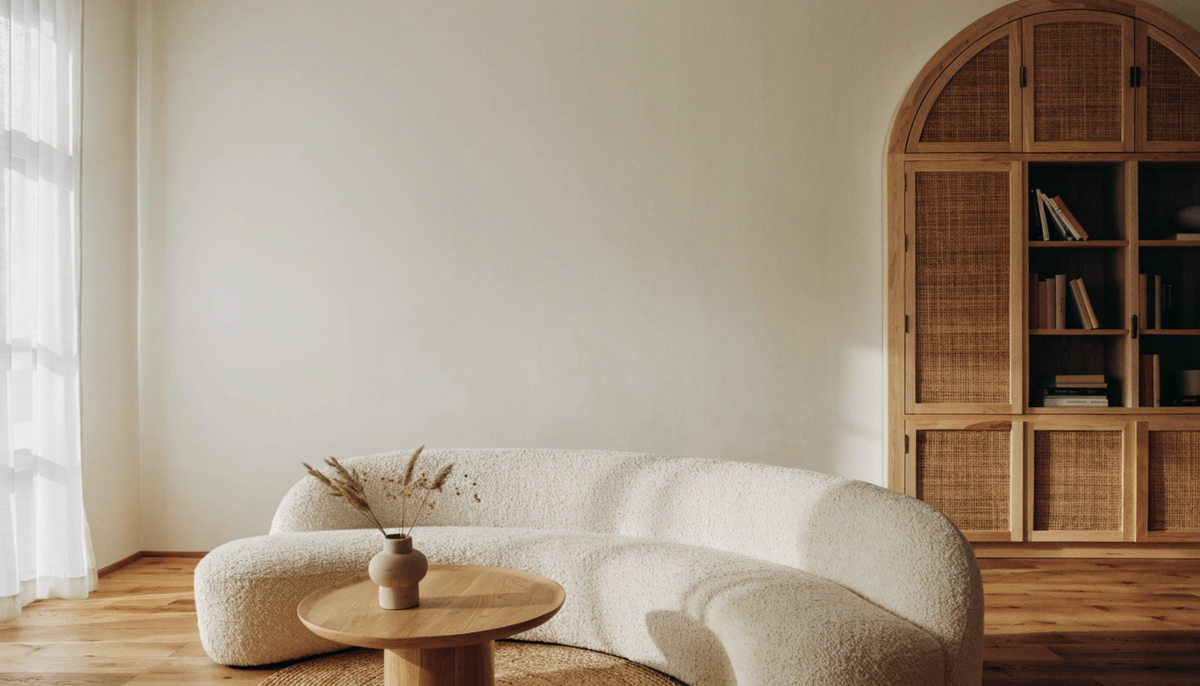
Curved Furniture: How to Style, Measure, and Buy It in 2026
LEARN MORE
What Is Rattan Furniture? A Buyer Guide to Types and Care
LEARN MORE


Further reading

How to Choose a Nightstand for a CPAP Machine

How to Choose a Shoe Cabinet for Men's Sizes, High-Tops, and Bulky Shoes


