




11 Boy and Girl Sibling Room Ideas for a Shared Space That Works

Sharing a bedroom with a sibling of the opposite gender sounds like a recipe for constant arguments. And sometimes it is. But the fighting is rarely about the sharing itself — it's almost always about the setup—too little storage. No privacy. One child's stuff is bleeding into the other child's space with no clear boundary.
Fix those things, and the room mostly works. Don't fix them, and even the most agreeable siblings will find something to disagree about.
These 11 ideas cover the practical end of the problem: layouts that actually save floor space, storage setups that give each child ownership, privacy solutions that don't require construction, and color ideas that don't lean too hard on pink versus blue. Start with the one that addresses the biggest current frustration in the room and go from there.
One Thing to Settle Before You Move Any Furniture
Who goes to sleep first?
It sounds like a small question. It's not. If one child needs lights out at 7:30 and the other reads until 9, that difference drives almost every decision about where the beds sit, how the lighting is set up, and whether a physical divider is needed. Answer that first. Then look at storage — who has more stuff, where it currently lives, and whether the closet can realistically be split.
Most shared bedroom problems trace back to those two things. Sleep schedules and storage. The decor is rarely the actual issue.
1. Bunk Beds — Not the Compromise, the Right Answer

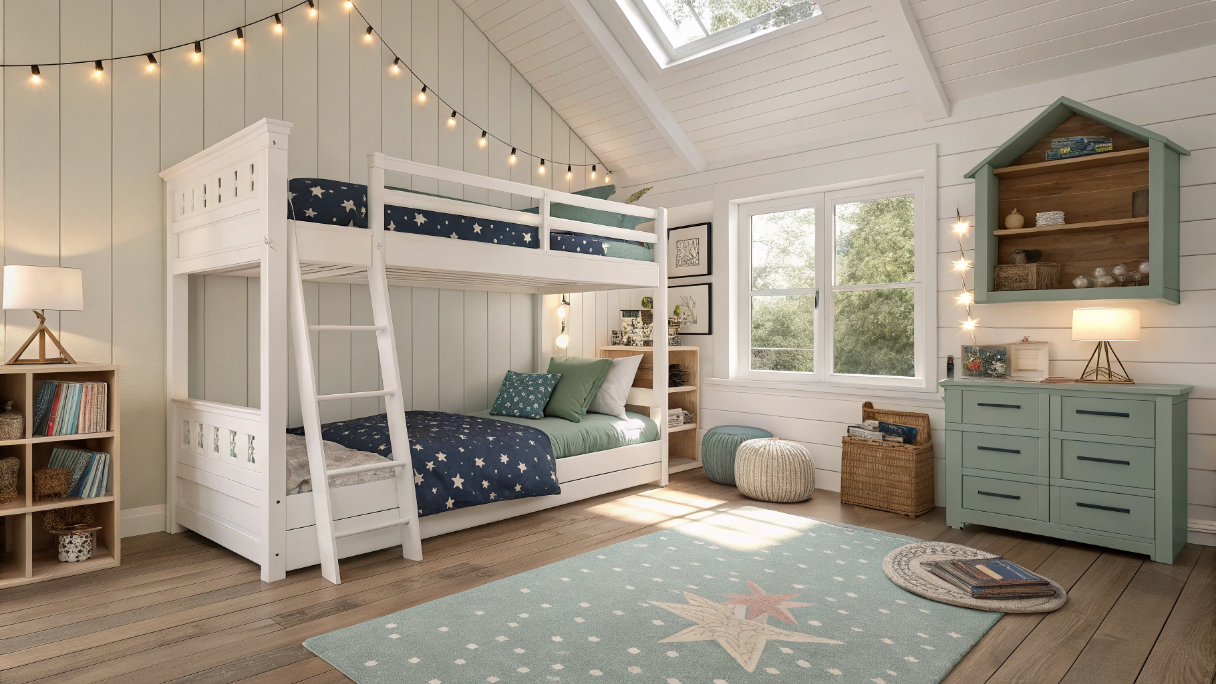
Bunk beds get treated like a fallback when nothing else fits. They shouldn't be. In a shared bedroom for two kids, Decorilla's designers consistently recommend them as the primary solution for small shared spaces because of how much floor space they recover — space that becomes available for desks, play zones, storage, or just room to move around. Two separate beds side by side in a small room eat up that space. A bunk stack doesn't.
One safety note worth clarifying: the top bunk is only for children ages 6 and older. TheU.S. Consumer Product Safety Commission (CPSC) requires manufacturers to include warning labels stating that the upper bunk is not suitable for children under six. Kids younger than 6 often lack the coordination and spatial awareness to safely climb and sleep at that height. Younger children on upper bunks face a real fall risk — roughly half of all bunk bed injuries involve children under 6. This rule isn't flexible, regardless of how badly the younger sibling wants to be on top.
A compact nightstand beside the bunk keeps each child's bedside things organized without cluttering the floor. The Crescent 3-Drawer Nightstand handles this well — three drawers for actual bedside storage, slim profile that doesn't crowd a tight bunk layout, clean lines that read quietly in a shared room without demanding attention.
2. L-Shaped Beds When Bunk Beds Aren't Happening

Some kids won't use bunk beds. The younger one is scared of heights. The older one doesn't want anyone above them. Whatever the reason — and there's always a reason — pushing a bunk bed into a room where it's not wanted just creates a different problem.
L-shaped beds (one on each adjacent wall, meeting at the corner) are the next best option for floor efficiency. Each child has their own wall and their own visual territory. Neither is looking directly across at the other. The corner between them becomes a natural shared zone — with a rug, a toy chest, and a small bookshelf. It works.
The layout also reads more spacious than parallel side-by-side beds, which is worth something in a room that already feels tight.
3. Keep the Frame Timeless. Let the Sheets Get Weird

Buy a dinosaur-themed bed for a six-year-old, and you're on borrowed time. Maybe two years. Three if you're lucky. By second grade, the theme already feels babyish. By the fourth, nobody wants to admit it exists.
Neutral furniture — white, natural wood, light oak, warm gray — doesn't have that problem. It doesn't belong to an age or a phase. It just sits there, looking fine, year after year, while your kids' taste does whatever kids' taste does.
And when you've got two kids sharing the room? Neutral living spaces are even more important than people realize. A dinosaur-themed bed frame doesn't just belong to a six-year-old — it signals to the other kid that this room was designed around their sibling. Even little kids pick up on that. Neutral furniture belongs to the room, not to whoever happened to pick it first.
Now — bedding is a completely different conversation. That's where you let them go wild.
One wants navy with stars. The other wants stripes or that tiger print that'll embarrass them by next Christmas. Great. Let them have it. Both sleep in the same oak or white frame, both rooms look intentional, and nobody feels like they got shortchanged on personality.
The math here is pretty simple: bedding costs $30 to $60 and gets replaced every couple of years anyway. A bed frame sticks around for a decade. Spend the furniture budget on something that ages well. Let the personality live in the stuff you can actually afford to swap out.
4. A Bookshelf Between the Beds

A bookshelf down the middle of a shared bedroom does three things at once: creates visual separation, adds storage, and doesn't block light. None of those things is true of a curtain divider or a folding screen, which is why a bookshelf consistently outperforms both.
Height is the main variable. Low bookshelf (about 3 feet): a soft visual boundary; the room still feels open. Mid-height (4 to 5 feet): stronger zone separation, better for older children. Full height: functions almost like a wall, best when real privacy is a daily need rather than an occasional one.
A bookcase with open shelves above and closed storage below is the most practical configuration here — each child gets display space on their side at the top, and the mess stays behind closed doors at the bottom. The Savanna Arched Bookcase with 2 Doorsis well-suited to this role. Tall enough to mark a zone clearly, closed cabinet doors at the base for actual containment, open shelves above for whatever each child considers display-worthy this month.
5. One Color Accent Per Child — That's Enough

Dividing the room into blue and pink halves looks fine in photos. In practice, it creates a room that reads as two unrelated spaces rather than a shared one — and it ages out within a few years at most.
Better approach: keep the walls and furniture completely neutral, then give each child one accent color that appears in their bedding, a single cushion, a lamp shade, or a small rug. Sage green for one. Warm rust for the other. Dusty blue and muted yellow. Soft terracotta and olive.
The two accents should relate without matching — similar temperature, different hues. That way, the room looks deliberate from a distance and personal up close. The kids feel like they have their own space. The room still looks like one coherent room.
6. Curtains or a Canopy Around Each Bed
 Low cost. High impact. A canopy over a bed or curtains hung from a ceiling track give each child the feeling of having their own enclosed space without any structural changes to the room.
For younger children, it's mostly about the cozy reading-nook feeling. For children approaching the preteen years, it's about actual privacy — getting dressed, having a moment alone, a barrier between their space and their siblings. Both uses are valid.
Ceiling track with curtain rings is the most flexible version. Curtains stay open most of the day and close when needed. The room stays open and airy unless someone specifically wants it otherwise. That reversibility is most of why it works so well.
7. A Shared Desk That Actually Feels Equal

One long desk, two chairs, two equal widths of surface. That's the setup. It's more space-efficient than two separate desks and removes the fairness arguments that arise when one child has a larger or more prominent workspace.
What actually makes it function: each child gets their own clearly assigned storage — either separate drawers or a labeled basket. Separate task lamps so different bedtimes don't create problems. Floating shelves above each half of the desk to keep the surface clear.
Without separate storage, the shared desk becomes a source of conflict by the second week.
A wardrobe near the study area handles clothes independently of the closet — useful when the closet is already doing a lot of work. The Savanna 71-Inch Wardrobe is sized for a kids' bedroom wall — tall enough to hold a child's wardrobe. These clean lines sit quietly without becoming a dominant feature in an already busy room.
8. Completely Separate Storage for Each Child

Shared storage sounds logical. It rarely works.
When clothes, toys, and school things are communal — one closet, no system, a dresser neither child has claimed — nothing stays organized for more than a few days. Both children feel like they can't find their own things because technically, the space belongs to neither of them.
The fix is simple and annoying to implement: completely separate, clearly labeled storage for each child. Their own dresser. Their own closet rod (even if it's half of the shared closet). Their own laundry basket. When a child knows exactly where their things live, and no one else's things are there, the daily negotiation mostly disappears.
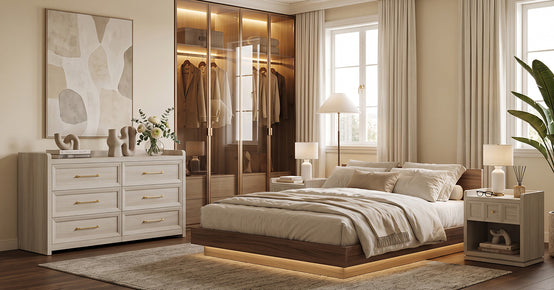
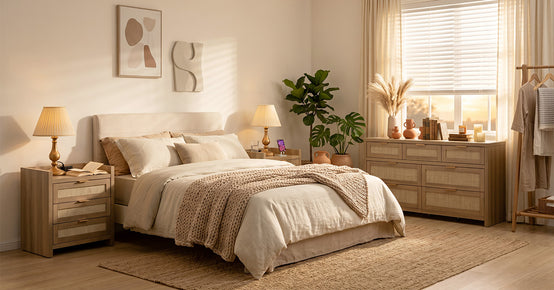
A wide dresser with six full drawers provides a child with complete wardrobe storage in a single piece. The Savanna 6-Drawer Chest of Drawers holds enough to make the dresser genuinely useful rather than a spillover from a closet that ran out of room — six deep drawers, a real wood finish, and a proportioned design for a shared bedroom where the furniture needs to work hard.
9. Loft Beds for Small Rooms That Need Vertical Space

A loft bed raises the mattress, leaving everything below open. Desk underneath. Reading nook with cushions and a string light. Extra shelving. Even just open floor space that isn't possible with a standard bed.
One loft per child with different configurations underneath is the version that gives each sibling something specific to them. One child's loft has a desk setup. The other has a tent-style reading nook with cushions on the floor. Neither setup is the same, and both children feel like their space was actually thought about — not just given a bed and told to figure out the rest.
A bedside nightstand with a built-in charging station keeps devices organized at the mattress level without requiring a power strip running across the floor. The Savanna Nightstand with 3 Drawers and Charging Station works well beside a loft bed — three drawers for bedside storage, integrated charging for devices, and a compact footprint that doesn't take up space under the loft.
10. A Zone Both Kids Can Claim Together

Separation gets most of the focus in shared bedroom design. The shared zone gets almost none. That's backward, because siblings who have a shared space in the room tend to spend less time arguing over whose half is whose.
A large rug between the beds is the simplest version. It marks the shared space. A toy chest or low shelf of shared items sits nearby — board games, building sets, craft supplies, whatever they actually both use. The zone has a purpose. Neither child owns it. Both feel entitled to be in it.
That framing matters more than most parents realize. The conflict in shared bedrooms is often about territorial ownership. A clearly communal zone reduces it.
11. Build in Privacy Before Anyone Demands It

Most families wait until there's a problem before thinking about privacy. By then, the room needs a bigger redesign than it would have if privacy had been considered from the start.
If one child is 7 or 8, now is the time to make decisions that accommodate privacy later. Not because anything is urgently needed today, but because the layout choices made now either make adding a curtain track easy or require moving all the furniture again.
A room where the beds sit with space for a canopy. Where a bookshelf could reasonably become a divider in a year, where each child has their own wardrobe rather than sharing one closet with no system, that room adapts without drama.
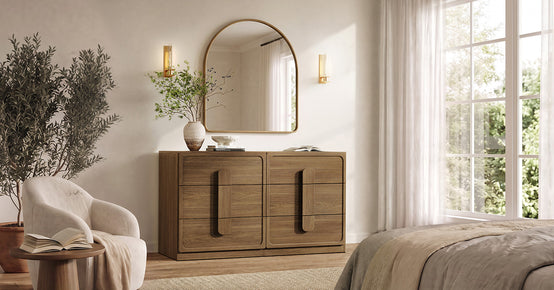
Giving each child an independent dresser storage from the start makes the privacy transition easier later. The Cas 6-Drawer Bedroom Dresser is compact enough for a shared room, deep enough to genuinely hold one child's wardrobe — six full drawers, a footprint that doesn't eat the room, clean form that works alongside almost any bed style.
What Tends to Go Wrong
- Themed furniture that a child outgrows — neutral furniture lasts, dinosaur or princess sets don't
- Communal storage with no system — every shared closet without clear ownership turns into chaos within a week
- Top bunk for a child under 6 — the age rule exists for a reason, and it's not flexible. The room is designed for the children's current ages rather than who they'll be in three years — the privacy needs at 9 and 11 are completely different from those of 5 and 7
- No shared play zone — when the room is entirely divided, siblings have nowhere neutral to be, which creates more conflict, not less
- One lighting source for the whole room — different bedtimes need separate lights.
In Summary
A shared bedroom for a brother and sister works when the setup is fair, both children have clear ownership of their storage and their space, and there's enough flexibility built in to accommodate changing needs.
Most of these ideas cost nothing to rearrange and relatively little to implement. Start with the problem that's causing the most friction right now — usually storage or sleep schedules — and fix that first. The rest tends to follow.
FAQs
Can a boy and a girl sibling share a room?
Yes. Most families do it at some point, and the majority manage fine, particularly when the children are young. The challenges that come up — privacy, different sleep schedules, storage conflicts — are design problems, not relationship ones. Good room setup handles most of them before they become arguments.
How do you combine a boy's and a girl's room?
Neutral furniture throughout, then separate bedding and color accents for each child. Focus styling on their individual interests — space, animals, sports, art, books — rather than gender-coded colors. A shelf divider, separate storage, and a shared central zone do most of the work. The room should feel like two children share it, not like two different rooms were pushed together.
What are the bedroom trends for 2026?
Storage beds and multifunctional furniture are prominent — floor space is limited, and parents are looking for pieces that do more than one job. Softer color palettes, natural textures like wood and rattan, and layouts that can adapt as children grow are all part of the current direction. Highly themed kids' rooms are less common than they were a few years ago, with more parents choosing flexible neutral palettes that don't need to be redesigned every few years.
How do you divide a room for siblings?
A bookshelf is usually the strongest option — it divides the space, holds storage, and doesn't block light. Curtains on a ceiling track are good for older children who want real closeable privacy. Two different rugs under each bed create a visual zone without any physical object. The right solution depends on how much separation is actually needed day to day.
At what age should a boy and a girl stop sharing a room?
No universal answer — it varies by family, culture, available space, and both children's comfort levels. Many families start planning for more privacy around the preteen years. Some siblings share well into their teens without issues. The more useful question is whether the current setup is still working for both children — if either child is clearly unhappy with the arrangement, that's the signal to change it, regardless of age.
How do you give kids privacy in a shared room?
Canopies or curtains around each bed are the cheapest and most flexible option. A bookshelf between the beds creates a visual separation at all times. Individual wardrobes give each child private space for clothes. Clear household rules about knocking, personal belongings, and getting dressed matter as much as any physical change to the room — and cost nothing.
What is the 60-30-10 rule for bedroom design?
A color proportion guideline: 60% of the room in the main color (walls, large furniture), 30% in a secondary color (bedding, curtains, rugs), 10% in accent colors (cushions, lamps, accessories). In a shared sibling room, it works to apply this across the whole room rather than per child — the 60% stays consistent, the 30% is shared or coordinated, and each child's accent colors occupy that 10% on their own side. The result is a room that looks designed rather than split.
Sources
- Decorilla — 10 Shared Bedroom Ideas for Hassle-Free Sibling Spaces — Loft beds, privacy zones, built-in storage, workstations, and sibling room layouts with real design examples.
- Living Spaces — 8 Boy and Girl Shared Room Ideas for Young Siblings — Bunk beds, neutral furniture, L-shaped layouts, gender-neutral accents, and storage for shared kids' rooms.
- Happiest Baby — 10 Smart Shared Kids Room Ideas — Wardrobes, bunk beds, dividers, built-in beds, big-and-little-sibling setups, and boy-girl shared decor examples.
- U.S. Consumer Product Safety Commission — Bunk Bed Safety Standards — Bunk bed guardrail requirements, top bunk age guidance, and safe use standards for consumer products.
- American Academy of Pediatrics — Safe Sleep Recommendations — Room-sharing and safe sleep guidelines for infants, including recommendations on surfaces, bedding, and positioning.
- Good Housekeeping — Shared Kids Room Ideas — Practical shared kids bedroom ideas covering bunk beds, neutral palettes, storage solutions, and room dividers.


Looking for something else?

Furniture Materials Guide: Picking the Right Material Room by Room
LEARN MORE
How to Mix Wood Tones Without Making a Room Look Mismatched
LEARN MORE
18 College Apartment Furniture Ideas That Save Space and Money
LEARN MORE
Types of Entertainment Centers: 11 Designs and How to Pick One
LEARN MORELooking for something else?

Curio Cabinet Decor Ideas: How to Style a Display Cabinet Without the Clutter
LEARN MORE
Curved Furniture: How to Style, Measure, and Buy It in 2026
LEARN MORE
What Is Rattan Furniture? A Buyer Guide to Types and Care
LEARN MORE


Further reading

How to Choose a Nightstand for a CPAP Machine

How to Choose a Shoe Cabinet for Men's Sizes, High-Tops, and Bulky Shoes


