




Best Dining Tables for Every Space: Shapes, Styles, and Materials
A dining table does more than hold dinner — it sets how your whole home gathers. Get the shape right, and a small room suddenly seats six in comfort. Get the material wrong, and you'll see every scratch by year two. This guide breaks down dining tables by size, style, and material — for real spaces and real life. It’s scratched up now. There’s a wine ring from Thanksgiving 2022 that won’t come out. I wouldn’t trade it for anything. The point is, the best dining tables aren’t the prettiest ones in a showroom—they’re the ones that handle your actual life and still look good doing it. This guide covers shapes, sizes, materials, styles, and the mistakes that cost people money. If you’re shopping for a dining room table right now, this is the stuff I wish someone had told me before I started.
What Makes the Best Dining Tables Worth Buying
Durable Materials That Handle Real Life

My brother, Wood hardness matters more than most buyers think. Pine looks warm and runs cheap, but it dents under almost any pressure. A dropped fork, a kid pressing hard on homework, a hot pan without a trivet — they all leave marks you can't sand out. Oak, walnut, ash, and maple are noticeably harder. They take years of daily wear without recording every small accident. If your table will see real life, pay for the harder wood. You won't be patching scratches at year two. Oak handles that. Walnut handles that. Maple is like a tank. Pine and softer woods look gorgeous, but they dent and scratch easily. Engineered wood and veneer? Fine for the short term, but you can’t sand them when they wear through. Once the thin top layer goes, you’re staring at particle board.
Stable Construction You Can Actually Trust

I have this thing I do every time I look at a dining table in a store. I put both hands on the edge and push. Then I lean on one corner. Then I grab the opposite sides and try to rack it back and forth. My wife thinks I look insane. But I’ve never brought home a wobbly table, so the method works. Stability is all about how the legs attach and whether the joints are actually reinforced or just glued together, hoping for the best. Wirecutter’s team does basically the same thing—pushing, pulling, leaning—and a shocking number of mid-priced tables fail that test. Don’t get distracted by the finish. A beautiful table that shifts when someone leans an elbow on it will drive you crazy within a week.
Comfortable Seating and Enough Legroom
My dad is six-three. Every Thanksgiving for years, he’d sit at our old table with his knees jammed against the apron, shifting around trying to get comfortable. We didn’t think about legroom when we bought that table, and it was a problem for a decade. Standard dining tables sit 28 to 30 inches tall, which works with most chairs. But some have thick wooden aprons or crossbeams underneath that steal two or three inches of knee space. That doesn’t sound like much until a tall person sits down and realizes they literally can’t cross their legs. Before you buy anything, sit in it with a chair similar to what you’ll use at home. Actually sit. For five minutes. If it’s uncomfortable at five minutes, it’ll be unbearable at an hour.
Best Dining Tables by Shape
Rectangular Dining Tables

Rectangles work in most homes because most homes have rectangular dining rooms. That's the main reason they outsell every other shape. A 72-inch rectangle seats six comfortably with room down the middle for serving bowls. A 96-inch version seats eight, sometimes ten if you squeeze. That's usually the practical ceiling. Anything longer starts feeling like a conference table.
The bench-on-one-side setup people talk about isn't really a magic trick. It mainly helps when one side of the table sits close to a wall, and you don't have room to pull chairs out. A bench slides in flush; chairs don't. If your room is open on both sides, chairs all around is honestly more comfortable for adults.
One real downside: conversation gets worse the longer the table gets. At 96 inches, people at opposite ends can barely hear each other across the surface. Most long dinners end up splitting into two side-conversations, whether you want them to or not.
Round Dining Tables

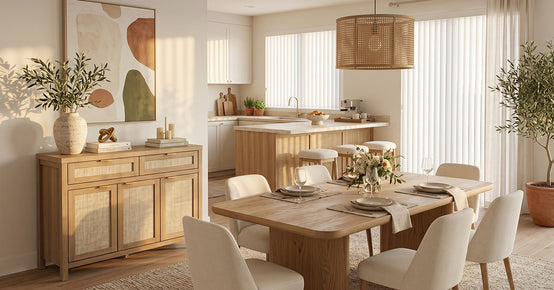
I didn’t get the round table thing until we ate at my neighbor’s place last year. She’s got a 54-inch round oak table in her kitchen, and the six of us sat around it for three hours talking. Nobody was stuck at the “far end.” Nobody was craning their neck to hear someone on the other side. That’s the round table advantage—everyone faces everyone. They’re also weirdly good in tight rooms because the curved edges let you shimmy past without catching your hip on a corner. A 48-inch round fits four. A 60-inch round fits six without things getting weird. A round wood dining table that seats six brings warmth to a dining area without swallowing the whole room. If your dinners are more conversation than ceremony, a round is genuinely the better shape.
Oval Dining Tables

I almost never recommend ovals because people don’t think of them. But my cousin bought one last spring for her open-plan condo, and I immediately got it. She’d been bruising her hip on the corner of her old rectangular table every time she walked past it to the kitchen. The oval fixed that overnight. No sharp corners. Same seating capacity as her rectangle, maybe even better, because guests can squeeze in at the curved ends. There’s also something about the shape that looks intentional in a way that rectangles don’t always manage. It’s softer. More inviting. If you’re stuck choosing between round and rectangular and neither feels exactly right, try sitting at an oval. Most people who do end up buying one.
Square Dining Tables
When my wife and I lived in our first apartment—tiny kitchen, barely 10 by 10—we had a square table wedged into the corner. It seated four. Barely. But for the two of us eating weeknight dinners? Perfect. Square tables do that intimate thing where everyone feels close, and the conversation stays easy. The problem shows up when you try to add a fifth chair. Suddenly, someone is sitting at a corner with no real edge space, and the whole arrangement feels forced. If your household is two to four people and you don’t host big groups, a square table is great. If you ever want to seat six, look elsewhere.
Best Dining Tables by Material
Solid Wood Dining Tables

I’m biased toward wood. Fully admit it. There’s something about sitting down to dinner at a real wood table—you can feel the weight, the grain has character, and it smells faintly like a woodshop when it’s new. Oak is the safe pick. Tough, ages well, works with almost any chair style. Walnut is for people who want their table to look expensive—with its dark, rich grain that photographs beautifully. Maple is the hardest common option and basically laughs at scratches. Cherry starts out pale and turns this gorgeous amber over the years, which I love, but my neighbor thinks is annoying because it means the table changes color. Mango wood is newer on the scene—West Elm uses it for their Anton line—and holds up better than you’d expect at its price point. The real advantage of any solid wood? A decade from now, you sand it down, slap on a new finish, and it looks like the day you bought it. Try doing that with veneer.
Glass Dining Tables

Glass tables are sneaky. They make a room look bigger because your eye passes right through to the floor—it’s like the table barely exists. My friend Sarah has one in her small Brooklyn apartment, and it genuinely makes the dining area feel open. But here’s what she also told me after three months: she wipes it down twice a day. Fingerprints. Water spots. Crumbs that are invisible on wood but glaring on clear glass. If you’re a neat person who cleans instinctively after meals, glass works beautifully. If you’re the type who leaves the dishes until morning—and I say this with love because I am that type—glass will make you crazy. Also, only buy tempered. Regular glass can shatter into dangerous shards. Tempered crumbles into pebbles. Big difference.
Marble and Stone Dining Tables

I wanted a marble table so badly a couple of years ago. Went to three showrooms, sat at about a dozen of them, and nearly pulled the trigger on a Carrara piece that was objectively beautiful. Then the sales guy casually mentioned that lemon juice can etch the surface permanently, and I thought about my wife’s nightly habit of squeezing lemon into her water glass. Nope. Marble is porous. It stains. Red wine, citrus, coffee, tomato sauce—basically everything you’d actually serve at dinner can leave marks if you’re not wiping it up within seconds. You can seal it, and you should, but sealing doesn’t make marble bulletproof. It makes it slightly more forgiving. Marble dining tables look absolutely spectacular in homes where the adults are careful and the kids are nonexistent. For everyone else, think hard.
Metal and Concrete Dining Tables
A buddy of mine has a concrete dining table in his loft apartment in Philly. That thing weighs an absurd amount—like 400 pounds. Four people struggled to get it up two flights of stairs. But it’s been there for seven years now, and it looks exactly the same as the day they hauled it in. Concrete doesn’t scratch. Doesn’t stain easily. Doesn’t care about your toddler banging a spoon on it. The downside is it’s cold and industrial—not exactly cozy for a candlelit dinner. Metal bases with wood tops are a more practical compromise. You get the visual weight of iron or steel legs with the warmth of a wood surface. Works in industrial lofts, modern kitchens, and even farmhouse-adjacent dining rooms when paired with the right chairs.
Laminate and Veneer Dining Tables
Look, not everyone can drop two grand on a walnut table. And that’s completely fine. Our first dining table out of college was a laminate from IKEA. The cost may be $150. Looked decent. Survived three years of grad school, two moves, and a memorable game night where someone spilled an entire bottle of red wine across the surface. We wiped it up, and the table was totally fine—try that with unsealed wood. Modern laminate and veneer have gotten shockingly convincing. The grain patterns look real. Some even have texture. The honest downside? Once the surface wears through, you’re done. Can’t send it. Can’t refinish it. It’s a five-to-seven-year table, not a forever table. If you’re renting or furnishing your first real place, that’s a perfectly reasonable plan.
Best Dining Tables for Small Spaces

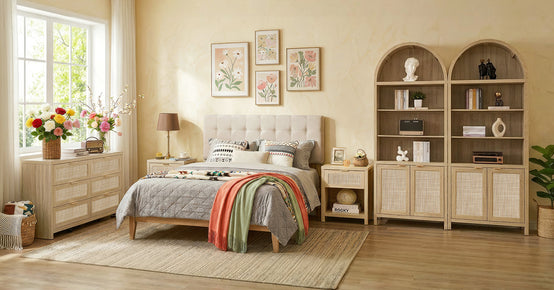
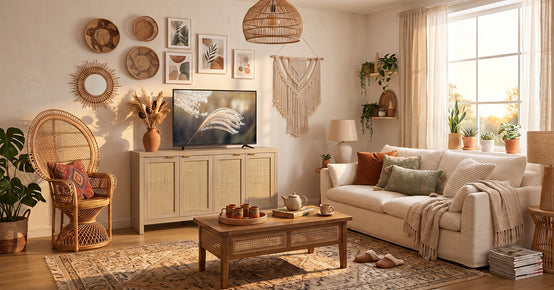
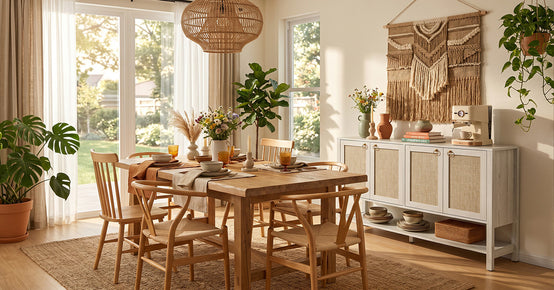
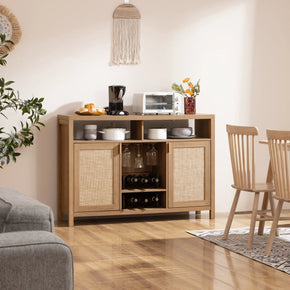
Color matters in small spaces, too. Dark wood in a tiny dining nook makes the walls close in. Light finishes—white oak, natural pine, even glass—trick your brain into thinking there’s more room than there actually is. A rattan dining set with upholstered chairs is a particularly good call for tight rooms because the woven texture adds personality without the visual bulk of a full solid-wood set.
Best Dining Tables for Hosting Dinner Parties

I learned this the hard way at Thanksgiving three years ago. We invited eight people. The table listing said it seats eight. What the listing didn’t mention is that “seats eight” means eight place settings crammed shoulder to shoulder with absolutely zero room for a turkey platter, a casserole dish, or even a candle. We ended up putting the stuffing on a folding chair next to the table. Not my finest hosting moment. The takeaway? Width matters more than length. A good hosting table needs to be at least 36 inches deep—40 or 42 is even better. That extra space is the difference between a table that holds a meal and one that actually holds a dinner party.
Shape plays into it, too. I noticed something at our last gathering—we had six people at our rectangular table, and the two at the far ends basically had their own separate conversation from the middle four. Like two different dinner parties happening simultaneously. A 60-inch round table would have fixed that, because everyone would be facing everyone. The other mistake I watch people make constantly is not leaving enough room behind the chairs. You need a good 36 inches between the table edge and whatever’s behind it. Otherwise, guests stand up and slam the chair into the wall or your sideboard. It makes the whole evening feel physically cramped, even when the food is great.
Best Dining Table Styles for Different Homes
Modern Dining Tables

The base often becomes the focal point — a single pedestal, an X-frame in metal, sometimes a sculptural shape that looks more like furniture art than a table leg. Tops vary: tempered glass, stone, matte wood, or thin steel. You don't load these tables up. Two or three items max, or the look falls apart. They photograph beautifully, and they're murder on anyone who actually cooks for a crowd.
Farmhouse Dining Tables

Farmhouse tables are built thick on purpose. Wide planks, heavy trestle bases, finishes that already look a few years old before you bring the table home. The whole point of the style is that wear adds to it instead of taking away from it. A scratch is fine. A water ring blends in within a month. A kid's marker stain wipes off the surface, leaving barely a shadow on the grain.
That forgiveness is mostly why farmhouse stays popular even when other styles cycle in and out. The tradeoff is weight — these tables are genuinely hard to move, and the thicker the top, the worse it gets. If you rearrange your dining room often, this style is not for you. If you don't, it might be the last dining table you ever buy.
Mid-Century Modern Dining Tables
My friend Mike is on his third apartment in four years, and he’s had the same mid-century walnut table the entire time. Tapered legs. Rounded edges. Warm finish. The thing moves with him because it fits everywhere. That’s the trick with mid-century—it doesn’t dominate a room. It just sits there looking quietly good. He’s paired it with modern white chairs, then industrial stools, then some velvet dining chairs his girlfriend brought. Every combination worked somehow. If your taste changes every couple of years—and most of ours do—mid-century is probably the safest money you’ll spend on a table because it gets along with basically everything.
Rustic and Live-Edge Dining Tables

A guy on Reddit posted about finding a live-edge walnut slab at a local woodworker’s shop and turning it into his dining table. Steel hairpin base. Natural bark edge. The grain tells you exactly which tree this came from. That’s the appeal of rustic—nothing else in your house will look like it because no two slabs are the same. The bark, the knots, the color shifts in the grain—all one-of-a-kind. These tables tend to weigh a ton and cost more than standard furniture. But people who own them rarely sell them. They become part of the house.
How to Choose the Right Dining Table Size
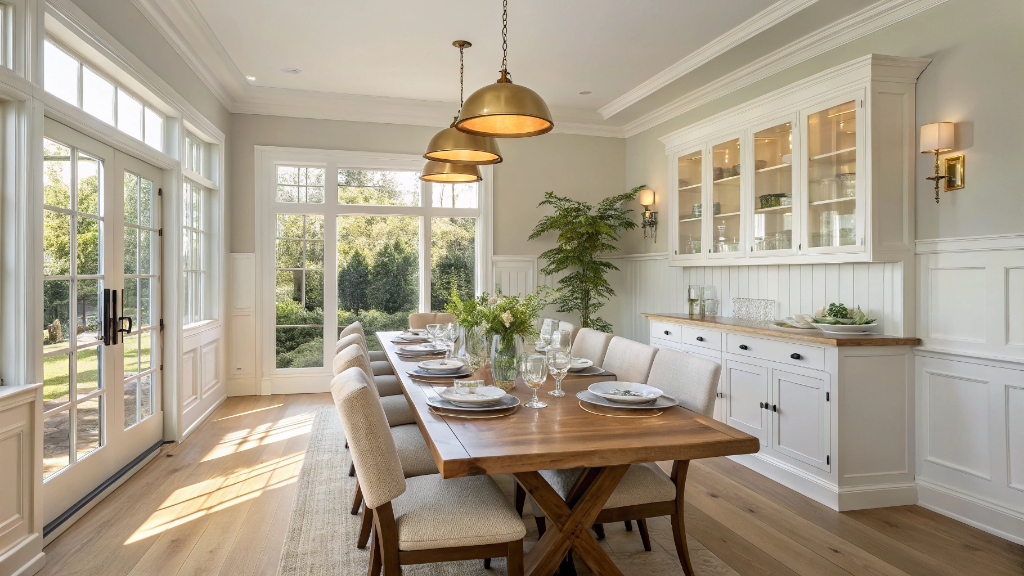
A furniture store guy in New Jersey gave me this trick, and I’ve used it for every table purchase since. Grab a tape measure. Get the length and width of your dining area. Subtract six feet from both numbers. Whatever’s left is the absolute maximum table size you should buy—those six feet are what let people scoot chairs back, walk behind each other, and generally not feel trapped. Then figure about 24 inches of table edge per person. Three people down each long side? That’s a 72-inch table. Four per side means 96. A 48-inch round fits four people. A 60-inch round gets you to six. And please, whatever you do, ignore the seating number on the product page. Manufacturers stretch those numbers every single time.
Oh, and one more thing that catches way more people than you’d think. Measure your doorways. Hallways. Staircase turns. Elevator dimensions if you’re in an apartment building. I know a couple who ordered a stunning 96-inch farmhouse table online, got excited for the delivery, and then watched the delivery guys try for forty-five minutes to angle it through their front door. It didn’t fit. Had to send it back. Tape measure before a credit card. Always.
How to Style the Best Dining Tables

My mother-in-law is the queen of table styling, and she taught me one rule that changed everything: start low and build out. A flat runner down the center. Plates. Glasses. Flatware. Napkins folded simply. That’s your base—the seven essentials people always ask about. Then add one low centerpiece. Not a tall one. Low. She uses a wooden bowl with three pillar candles and some greenery. People can see over it, which means nobody’s talking through a flower arrangement. Match the vibe of your modern dining room furniture around the table, and the room pulls together without looking like a catalog.
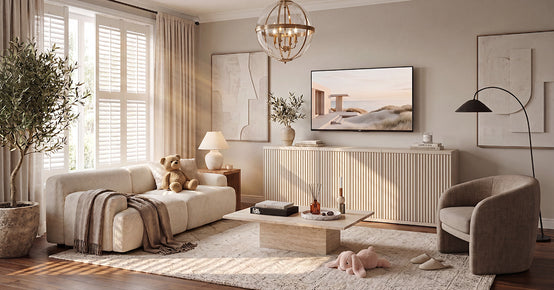
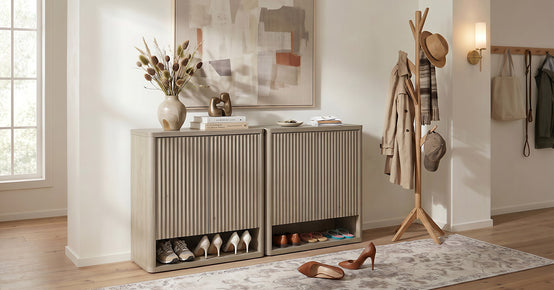
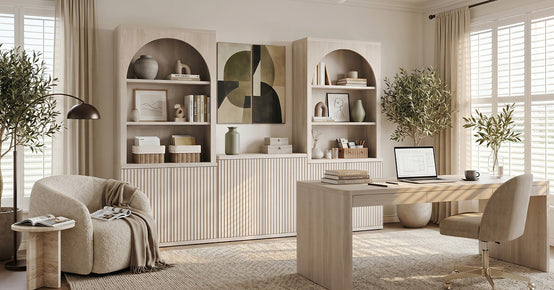
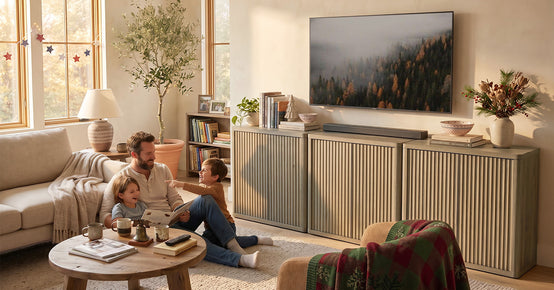
We had this ugly boob light—you know, the basic flush-mount dome that comes standard in every rental—hanging over our dining table for three years. Finally, I replaced it with a simple black pendant light, centered right over the table, with a warm 2700K bulb. I’m not exaggerating when I say it changed the whole room. The food looked better. Our faces looked better. The table suddenly felt like a real dining spot instead of just furniture under a ceiling light. Warm bulbs between 2700K and 3000K are the move—anything cooler and dinner starts looking like a hospital cafeteria. The fluted dining room sideboard does the job beautifully—storage plus an extra surface for serving when guests are over.
Common Dining Table Buying Mistakes
I’ve seen this so many times. Someone falls in love with a table online—gorgeous photos, perfect styling, five-star reviews—and then it shows up and wobbles on their uneven dining room floor. Or the apron is so thick that nobody can comfortably cross their legs underneath it. Or it’s just too big. An oversized table in a modest dining room doesn’t look impressive. It looks like the room is choking. You pull out a chair, and it slams into the wall. You stand up and you’re wedged between the table and the sideboard. I’d rather have a table that’s slightly too small than one that’s too big. You can always pull up an extra chair. You can’t make a room bigger.
The maintenance thing trips people up, too. Your salesperson isn’t volunteering that your beautiful marble top needs resealing twice a year or that the oiled walnut gets blotchy if you skip the quarterly treatment. Glass shows every fingerprint. Veneer can’t be sanded. I wish more people asked these awkward maintenance questions before buying because the answers follow you home for years. And the chair problem—oh man. People buy the table first, then go looking for chairs, and discover the table legs block certain chair widths or the apron hangs too low for padded seats. Wrong order. Always test chairs with the table before you commit to either one.
FAQs
What are the 7 essentials of table setting?
Dinner plates. Salad plates. Bowls. Flatware—a fork, a knife, a spoon at a minimum. Drinking glasses. Napkins. And placemats or chargers to anchor each setting. That’s your base seven. For a holiday dinner or something more formal, layer in wine glasses, bread plates, serving utensils, and place cards if you’re feeling fancy. But honestly? The basic seven handle the vast majority of meals. Don’t overcomplicate it.
What type of dining table is most durable?
Solid hardwood. That’s the short answer. Our oak table has survived six years of daily use, two kids learning to eat solid food, a hundred dinner parties, and my husband’s habit of using it as a workbench when he thinks I’m not looking. Oak, walnut, and maple all hold up like that. Decades of real use without falling apart. Concrete and metal are technically tougher, but they feel cold and look industrial—not everyone wants that at dinner. Marble is gorgeous, but one lemon slice on the surface too long, you’ve got an etch mark forever. For the average family that wants a table that’s warm to sit at and hard to destroy, sealed hardwood wins.
What are the types of dining tables?
Way more types than most people realize, and it gets confusing fast. The base can be a standard four-leg setup, a single pedestal column in the center, a double pedestal with two supports, a trestle beam connecting the legs, a pub-height bar table, or one with built-in storage underneath. Shape-wise, you’ve got rectangle, round, oval, and square. Then there’s whether the table changes size—fixed means it stays put, extendable means you pop in a leaf for extra seats, drop-leaf means the sides fold down, and gateleg folds almost completely flat. My parents have a gateleg in their small condo. When it’s folded, it barely takes up any space. When they have guests, it opens to seat six.
What is the best surface for a dining table?
Totally depends on your household. Got kids who spill everything? Laminate wipes clean without leaving a trace. Want something that feels warm and looks better with age? Solid wood, no question. Love the modern look and don’t mind cleaning? Glass opens up a small room beautifully. Want to impress guests and are willing to baby the surface? Marble is stunning. If I had to pick one answer for most people, I’d say solid hardwood with a matte or satin sealant. It’s warm, repairable, and actually improves as it ages.
Which wood is the highest quality?
If we’re talking purely about quality? Walnut ranks at the top amongwood species for furniture makers. That rich chocolate grain is unmistakable, and it holds up for generations. White oak is the most versatile—hard, takes stain beautifully, and you can find it everywhere. Hard maple is the toughest of the bunch, which is why cutting boards are made from it. Cherry is interesting because it starts out almost blonde and slowly deepens into this warm amber over five to ten years. Some people love watching that transformation. Others want their table to stay the color it was when they bought it.
What are the two main types of tables?
Two big buckets: fixed and extendable. A fixed table is one size forever—no moving parts, no mechanisms, generally more solid because there’s nothing to break. An extendable table has some kind of leaf system—butterfly leaves that fold out, panels that pull from underneath, or a stored leaf you insert in the middle. We have an extendable, and I’m so glad we went that route. Most weeknights, it’s just the two of us. But when my parents visit, or we host friends for dinner, the table expands to seat eight, and we don’t have to eat on our laps.
What is the origin of the dining table?
This is one of those random facts I picked up reading a design book last winter and haven’t stopped telling people about. Dining tables as a category are ancient. Romans ate communally at shared surfaces. Medieval families used trestle tables—big planks on removable legs—that got broken down and shoved against the wall after every meal because space was tight. The fancy standalone dining table didn’t become a thing until maybe the 1600s, when wealthy European families started dedicating entire rooms to eating. Before that, you ate wherever. The table went wherever. The basic concept—a flat surface where people sit, share food, and talk—hasn’t really evolved. Just the materials and the price tags.
Final Thoughts on Choosing the Best Dining Tables

Six years, three tables, and a lot of opinions from family and friends who’ve asked me to tag along while they shop. Here’s what all of that taught me. Pick a material that suits the life you actually live—not the Instagram-perfect version of it. Get a shape that leaves breathing room in the dining area. Be honest about how many people really eat at your table on a normal night, not just holidays. Choose a look you won’t regret in three years when trends shift. And push on the thing in the store to make sure it doesn’t wobble. Wood and extendable tables tend to make most people happy in the long term. Round if your place is small. Rectangular or oval if hosting matters.
Measure your room. Sit at the table in the store for more than thirty seconds. Push on it. Check the legroom. Think about who’s going to eat there every day—not just on Thanksgiving—and buy something you’d be happy waking up to for the next decade. That’s it. That’s the whole formula.
Sources
- Wirecutter / NYT – Dining and Kitchen Tables We Like, expert product testing and editorial reviews
- West Elm – Dining Tables Built for Everyday Life, retailer guide on shapes, sizes, and finishes
- IKEA – Dining Tables buying guide, table height, spacing, and small-space solutions
- Crate & Barrel – Find Dining Tables for Your Kitchen or Dining Room, materials, and styling tips
- Cabinfield – The Complete Guide to Dining Tables: Types and Styles, base, and material reference
- Color & Chic – 10 Best Dining Tables for Modern Homes, design inspiration, and personal recommendations
- Reddit r/furniture – Good brand to consider for a dining table, real shopper discussion on quality and budget


Looking for something else?

Furniture Materials Guide: Picking the Right Material Room by Room
LEARN MORE
How to Mix Wood Tones Without Making a Room Look Mismatched
LEARN MORE
18 College Apartment Furniture Ideas That Save Space and Money
LEARN MORE
Types of Entertainment Centers: 11 Designs and How to Pick One
LEARN MORELooking for something else?

Curio Cabinet Decor Ideas: How to Style a Display Cabinet Without the Clutter
LEARN MORE
Curved Furniture: How to Style, Measure, and Buy It in 2026
LEARN MORE
What Is Rattan Furniture? A Buyer Guide to Types and Care
LEARN MORE


Further reading

How to Choose a Nightstand for a CPAP Machine

How to Choose a Shoe Cabinet for Men's Sizes, High-Tops, and Bulky Shoes


