




15 Types of Bedroom Furniture: A Complete Guide for Every Room
Most people don't actually sit down and think through bedroom furniture. You need a place to sleep, so you get a bed. Maybe a dresser. Done. And then, months later, the nightstand is still a cardboard box, the shoes are in a pile near the door, and there's a chair in the corner that hasn't been sat on since you moved in — it just holds things now. That's basically everyone's bedroom at some point.
This covers 15 types of bedroom furniture. Not all of them belong in every room — honestly, most bedrooms only need to work well. But knowing what exists and what it does helps you figure out what your specific room is missing, which is more useful than a generic list that treats every bedroom like it's the same size and has the same problems.
1. Bed Frame

Everything in the room responds to this one choice. Pick a wrong bed frame for the room and every other piece of furniture you buy will feel slightl,y off. Too big and you're navigating around it every morni,, ng. Too small and the room looks like it's waiting for the real furniture to show up. The frame sets the scale and everything else either fits around it or doesn't.
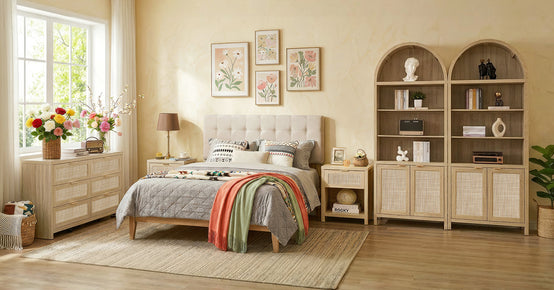
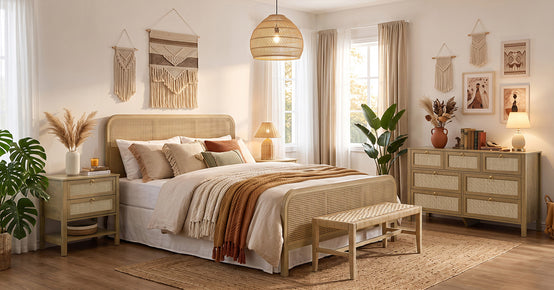
Platform beds are the most common modern choice — low, clean lines, no box spring needed, easy to find in almost any finish. Storage beds have drawers underneath, or a lift-up base, which sounds like a gimmick until you move into a place with nowhere to put extra bedding. Having abed is the traditional look — headboard, usually a footboard, solid and recognizable. Canopy or four-poster beds are for rooms large enough that the posts don't become things you walk into. And daybeds, bunk beds, trundle beds — those are situational, mostly kids' rooms or spaces that need to sleep more than one person without a second bedroom.
2. Mattress

The boring purchase that isn't actually boring. Look, nobody's excited about buying a mattress. But it's worth spending ten minutes on. Memory foam shapes to your body, sleeps warm, good if you like a softer feel. Pocketed coil has more bounce, and it sleeps cooler, better if you move around at night and don't want to feel like you're sinking. Latex is firm and long-lasting. Hybrid mixes foam and coil layers, which is why it's popular — it doesn't do any one thing, but it covers most situations reasonably well. The part people skip: this is literally the surface you spend a third of your life on, and it's also weirdly one of the first budget cuts people make when setting up a bedroom. That math doesn't work.
3. Headboard aIt'sotboard

One's pretty useful. The other one — read the room. Headboards actually do something. Sitting up in bed to read or look at your phone without anything behind you is genuinely uncomfortable after about ten minutes — your lower back starts complaining, and you end up propped sideways on a pillow like a problem. A headboard fixes that. Upholstered ones add warmth to a room and dampen sound a little, which in a hard-floored apartment is a real benefit. Wood and metal headboards are simpler to clean and work in more minimal spaces.
Footboards are more of a debate. They look finished and stop blankets from sliding off the end of the bed. But in a small bedroom — anything under about 150 square feet — they make the room feel tighter,r and they're mildly annoying to deal with when making the bed every morning. If the room is generous, fine. If not, probably skip it.
4. Nightstand

Last piece people buy, first one they miss when it's not there. Here's how most people's nightstand situation actually goes: there isn't one for the first few weeks, so your phone charges on the floor, your water glass lives on the windowsill or balanced somewhere sketchy, your book is on the mattress or under it, and every morning you're hunting for your glasses in a slightly different spot. It works. Technically. But it's the kind of thing you stop tolerating pretty fast once you've had an actual nightstand.
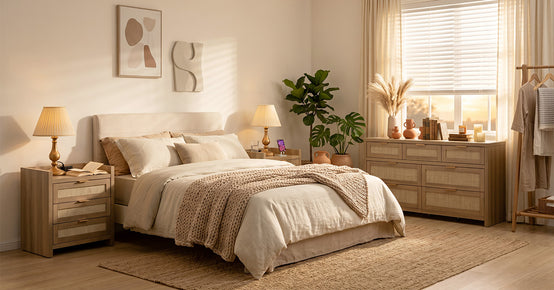
The height thing matters more than people expect — it should sit within an inch or two of your mattress top so the reach is natural, not stretched. Two nightstands, one on each side, are worth it even if they don't match perfectly, because the symmetry is what makes a bedroom look like someone actually thought about it. And drawers are genuinely better than open shelves for a nightstand — the surface fills up fast enough without making the storage underneath visible too. A bedside nightstand with drawers keeps everything you grab before sleep and first thing in the morning in one closed spot next to the bed — which sounds small until you've been reaching for your glasses on the floor for a month.
5. Dresser

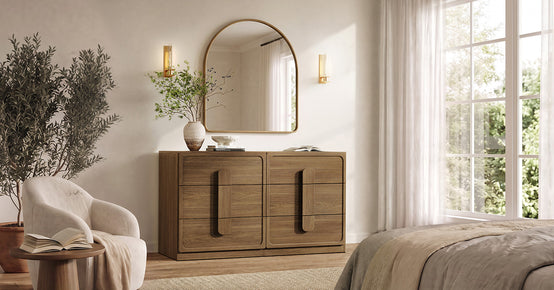
Folded clothes, plus a surface that will definitely accumulate things. A dresser is drawers for folded clothing — t-shirts, jeans, socks, the stuff that doesn't hang. Wide and lower-profile is the standard shape, which means it runs along a wall rather than climbing it. The top gets used as a display surface, whether you plan for that or not: lamp, some jewelry, the things you grab every morning, a candle you bought three months ago and still haven't lit. That's fine, it's a useful surface. Just factor it into where you position the piece.

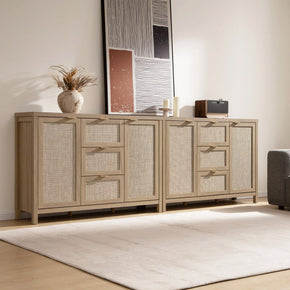
The width vs. height question is worth actually thinking about before buying. A wide dresser needs a wide wall, which not every bedroom has. A tall dresser fits the same amount of clothing into a narrower footprint and uses vertical space instead. Coleman Furniture's bedroom guide has a good point about the dresser-plus-mirror combination — it creates a natural focal point on whatever wall you put it on, without needing a separate piece of furniture. A tall storage dresser is the practical answer for rooms where the only usable wall isn't wide — go up instead of across.
6. Chest of Drawers

Same idea as a dresser, just taller and narrower. Honestly, the difference between a dresser and a chest of drawers is mostly just shape. The chest goes vertical — taller, narrower, more drawers stacked rather than spread. Same job, different wall requirement. If your bedroom has a narrow wall with good height, a chest fits where a dresser would stick out awkwardly. Some people have both, which makes sense in a larger bedroom with more clothes than one piece can handle. In a small bedroom, pick whichever one fits the wall you actually have.
7. Wardrobe and Armoire

Built-in closet too small? Yeah, it's almost always too small. The closet situation in most apartments is a joke. One rod, one shelf, maybe a small shelf up top, and whoever designed it assumed you own about twelve items of clothing.
In reality half your wardrobe ends up draped over a chair, in a suitcase that's been 'unpacked later' since you moved in, or in a pile that's been described as temporary since day one. A freestanding wardrobe doesn't fit the closet but it gives everything that didn't fit somewhere real,actually, somewhere to go.
It holds hanging clothes, and sometimes has a drawer or two for smaller stuff. Doesn't require any wall work. Comes with you when you move. An armoire is the more decorative take on the same thing — bigger, more of a statement, same basic function.
A wardrobe closet organizer at 71 inches gives you full-length hanging space and shelf storage in one piece. The test for whether you need one: look at that chair in the corner of your bedroom and count how many things are on it that should be hanging somewhere.
8. Bench and Storage Ottoman

The foot of the bed is more useful than it looks. Nobody talks about the foot-of-the-bed zone,e but it's one of the most-used spots in the whole room. You sit there to put your shoes on. The outfit you laid out the night before lands there.
The blanket you kicked off at 2 am ends up there. With a bench, it's just the floor, and the stuff that belongs there ends up on the floor. With a bench it has a home, the bed looks finished, and you actually have to sit while getting dressedting dressed, that isn't the mattress edge.
Storage ottomans are worth mentioning separately because they're more flexible. Extra blankets, off-season stuff, whatever needs to live in the bedroom without being visible — it all goes in the ottoman, which also works as a footrest or a surface if you put a tray on it. In a small bedroom where a full bench feels like too much, an ottoman at the foot of the bed covers most of the same jobs in a smaller footprint. Both are underused. Both are the kind of thing people add and then wonder why they didn't do it sooner.
9. Accent Chair

Depends entirely on room size — skip it if it's tight. A chair in the bedroom — not a desk chair, just a proper chair in a corner — creates a spot in the room that isn't the bed. Somewhere to sit with coffee in the morning or read without lying down. You don't know how much you'd use it until it's there. The problem is floor space. In a bedroom under 150 square feet or so, an accent chair is basically a very expensive clothes holder. It just becomes the place things get put on the way to somewhere else. If the room can handle it, great — it changes how the space feels. If not, it waits.
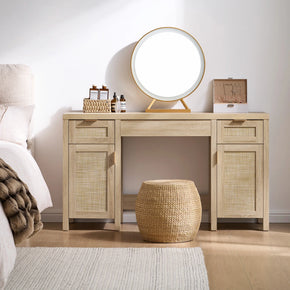
10. Vanity and Dressing Table

More practical than it sounds, especially in shared spaces. A vanity sounds fancier than it is. It's a mirror, some drawers, and a surface at the right height for getting ready. That's it. The actual benefit is that all the makeup, skincare stuff, jewelry — whatever is currently scattered across the bathroom counter, the dresser top, the windowsill — gets a single home in one place. Routine gets faster. Nothing disappears. In a sh, especially, having your getting-ready setup in the bedroom means you're not competing for 7:30 am time at 7:30 am, which sounds minor until you've had that specific problem on a Tuesday.
Compact versions work perfectly — a small table, a mirror, a stool that slides under. You don't need the full Hollywood setup unless you want it. The one thing that's worth getting right is placement: natural light from the side, not from a window behind you. Looking in a mirror means you're looking at a silhouette. Every decision you make about what you look like in that mirror will be slightly wrong.
11. Mirror

Takes up no floor space and earns its place immediately. A full-length mirror leaned against a wall, hung on a door, propped up, or in a corner — costs zero floor space and pays that back right away. Checks outfits, reflects light arouand nd the room, makes smaller spaces feel less closed-in. The placement notes that actually matter:
somewhere near a window so it picks up natural light rather than just reflecting a wall at you; not directly facing the bed if you don't enjoy unexpected reflections at 3 am when you wake up; and big enough for the wall it's on, because a small mirror on a large wall somehow makes the wall look emptier than no mirror at all.
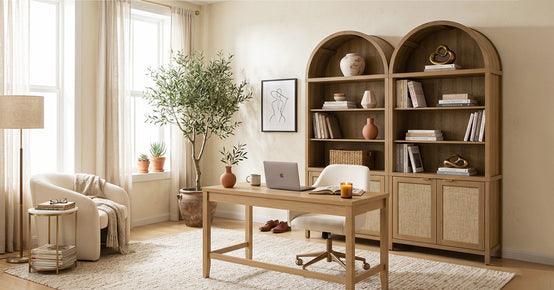
12. Bookcase and Shelves

A corner worth looking at, plus storage that doesn't look like storage. Books need somewhere to go and the nightstand isn't it after the third stack. A bookcase gives books, small plants, framed photos, and whatever objects collect in a bedroom, intentionallydesigned to live — rather than stacking on the floor or getting shoved into a closet. And it fills a dead corner with something that actually looks good, which matters more than people admit.
Wall shelves do the same with less floor commitment — above a desk, on either side of the headboard, over a dresser for things that don't fit on the dresser top. An open shelving unit at 75 inches is a lot of vertical storage in one corner footprint without eating into the floor. The one rule worth following: don't fill. Leave gaps. The breathing room between objects is what makes it look like you meant it rather than just needed somewhere to put things.
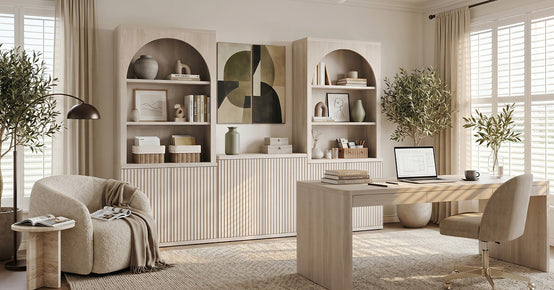
13. Desk

One valid use case. Everything cluttered is a cluttered surface. A bedroom desk makes sense when you work from home,e and the bedroom is the only room with enough space to focus. That's basically it. In that situation, it's not optional; it's just infrastructure. Any other scenario — you have a separate office, you don't work from home, or there's a spare room — and a bedroom desk mostly becomes a place where things go when they don't have anywhere else to go.
A narrow wall-mounted desk or a 40-inch writing desk takes up the least possible space if you do need one. The main thing: put some visual distance between the desk and the bed, even just a different corner — sleeping in the same sightline as your work setup makes the room feel like an office you also sleep in, which isn't great.
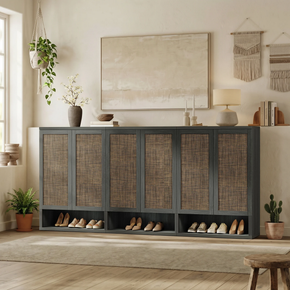
14. Shoe Cabinet

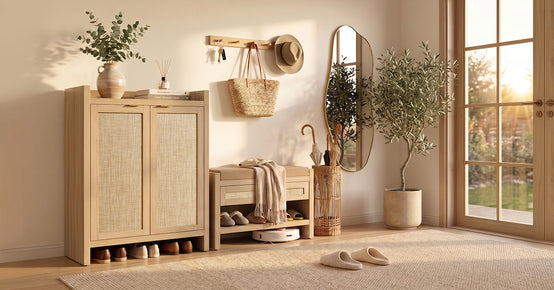
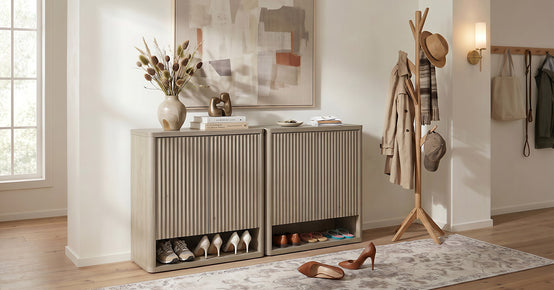
The floor is not a shoe storage system, even though it acts like one. Somehow, shoes end up everywhere. The bottom of the wardrobe fills up. The zone by the door fills up. The side of the bed — I don't know how, but it happens. And once shoes are on the floor the room looks disorganized in a specific way that's hard to fix with anything else, because no amount of nice furnitcan compensated compensates for visual chaos on the floor.
A shoe cabinet puts doors between you and the problem. Cas Black Shoe Cabinet is an upright unit — matte black finish, closed doors, compact enough to tuck near the bedroom door or against a wall. Clean modern look that doesn't draw attention to itself, which is exactly what shoe storage should do. Ideally you'd position it near the entrance so shoes never reach the bedroom floor at all — intercept them at the door. But inside the bedroom works fine too. Either way, the floor situation improves immediately.
15. Bedroom Set

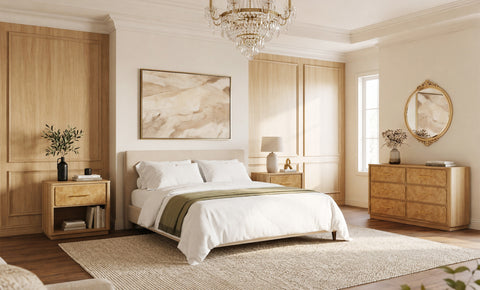
Coordinated pieces, one decision — here's when that's worth it. A bedroom set is a group of furniture designed to go together — same finish, same hardware, same design language across all of it. Typically,a bed frame, dresser, and nightstand, sometimes with a mirror, chair thrown in, depending on the set. The appeal is real: you make one decision instead of six, everything arrives already matching, and there's no hunting across different brands trying to find a wood tone that's close enough. It simplifies a frustrating part of furnishing a bedroom.
Tcovers cover a smaller room fine. Four or five suits a larger primary bedroom. The catch: sets are designed to look complete, not to fit your specific room. A set with a wide dresser might be wrong for a wall that needs a tall chest. A footboard in a small room costs you visual floor space you can't afford.
So — sets simplify the buying process, but they don't replace measuring first and checking that what's included actually matches what your room needs. Browse bedroom furniture at Sicotas for coordinated pieces sized for real bedrooms.
How to Actually Choose Bedroom Furniture
Measure the room before you buy anything. Seriously, do this.
The number of people who buy a bed frame and then discover it's six inches too wide for the wall is genuinely surprising. Everything starts with room dimensions and bed size — those two numbers determine how much space is left for everything else. A king bed in a 10x10 room leaves 18 inches on each side, which is not enough to open dresser drawers without standing at an angle. A queen in that same room gives you real space to work with. Measure. Mark it on paper. Then buy.
Small bedrooms have one real strategy: go vertical and .multi-purpose
Tall chest instead of a wide dresser. Storage bed so you don't need a separate bench. Wall shelves instead of a freestanding bookcase. Nightstands with drawers, not open shelves. House Digest's small bedroom coverage puts it simply: furniture that does two things at once is the actual strategy in a small room, not a compromise. Skip the accent chair until there's space for it. Skip the vanity unless the getting-ready routine genuinely needs it in the bedroom. Add those things back later — but start with what the room can handle.
Buy for how you actually live, not how you think you should
The bench earns its space if you sit on it — not if it becomes the designated jacket pile. The accent chair works if you read in it, not if you own it. The vanity belongs in the bedroom if your act takes place there—an honest room. Honest assessment of daily habits produces a better result than buying everything on the list because it seems like a bedroom should have those things.
|
Short version: bed frame, mattress, nightstand or two, dresser or chest, clothing storage. That's the working core. Everything else solves a specific problem — add it when your room actually has that problem. |
Frequently Asked Questions
What are the different types of bedroom furniture?
Bed frame, mattress, headboard, footboard, nightstand, dresser, chest of drawers, wardrobe, armoire, vanity, bench, ottoman, accent chair, desk, mirror, bookcase, shelves, shoe storage. Most bedrooms need five or six of those — the rest depends on room size, how many clothes you own, and whether you're someone who actually sits in bedroom chairs or just sort of owns them.
What are different types of furniture?
By what it does: sleeping furniture, seating, storage, surface furniture, and display furniture. In a bedroom, you mostly deal with the first three — beds, dressers and wardrobes, chairs or benches — plus nightstands, desks and shelves depending on the ro4-piecet is a 4 piece bedroom?
Usually a bed frame, dresser, mirror, and nightstand — but 'four piece' just means four items and different brands include different things. Some have a bed, dresser, chest, and nightstand. Always check what's actually included before ordering.
What are the types of bedrooms?
Primary bedroom, guest bedroom, kids' room, teen room, nursery, shared bedroom, small bedroom, studio sleeping area, and the now-very-common bedroom-slash-home-office that exists because the apartment doesn't have a spare room.
What are the four types of furniture?
Seating, sleeping, storage, and surface furniture. Bedroom version of that: chairs and benches, beds, dressers and wardrobes, nightstands and desks. Most bedroom furniture decisions are really just one of those four things.
What are the types of bedroom styles?
Modern, traditional, farmhouse, rustic, coastal, Scandinavian, mid-century modern, minimalist, bohemian, glam, transitional, industrial. Style affects finishes and materials — the actual types of furniture pieces stay pretty much the same across all of them.
What is the current trend in bedroom furniture?
Warm wood tones, storage beds, drawer nightstands, statement headboards, mixed rooms where not everything fully harmonizes. The full coordinated bedroom set is giving way to rooms that look more collected, purchased all at once.
What are the 7 types of beds in nursing?
Manual hospital beds, semi-electric beds, full-electric beds, low beds for fall prevention, bariatric beds, pediatric beds, and ICU beds. These are healthcare equipment, nothing to do with home bedroom furniture.
That's the List
Fifteen types. Most bedrooms are well-served by five or six. Bed and mattress first. Nightstands sooner than you think you'll need them. Dresser or chest, wardrobe if the closet can't handle the clothes. Everything else — bench, mirror, bookcase, vanity, shoe cabinet, desk — comes in when the room actually has the problem that piece solves.
The three things people most often wish they'd sorted sooner: shoe storage before the floor becomes the default system, nightstands with actual drawers instead of surfaces that immediately pile up, and a proper wardrobe when the built-in closet stopped being enough a long time ago. The dresser and storage collection at Sicotas has bedroom storage pieces that are built for real rooms — worth a look if you're still figuring out what the room is missing.
Resources
• Coleman Furniture — Types of Bedroom Furniture — Per-type design tips covering dressers, nightstands, wardrobes, benches, mirrors, vanities, and bedroom sets.
• Bestier — Top 13 Bedroom Furniture Types — Bed frames, mattresses, headboards, nightstands, wardrobes, vanities, desks, and storage.
• House Digest — Bedroom Storage — Storage strategies for small bedrooms, multi-functional furniture, and vertical storage.
• HGTV — Bedroom Design Styles — Modern, minimalist, farmhouse, coastal, Scandinavian, traditional, and mid-century modern bedroom styles overview.
• Bassett Furniture — Bedroom Tips — Small bedroom storage, bed layering, matching vs. mixing bedroom furniture.
• Living Spaces — Buying a Bedroom Set — Choosing bedroom sets, furniture, and determining a bedroom layout.


Looking for something else?

Furniture Materials Guide: Picking the Right Material Room by Room
LEARN MORE
How to Mix Wood Tones Without Making a Room Look Mismatched
LEARN MORE
18 College Apartment Furniture Ideas That Save Space and Money
LEARN MORE
Types of Entertainment Centers: 11 Designs and How to Pick One
LEARN MORELooking for something else?

Curio Cabinet Decor Ideas: How to Style a Display Cabinet Without the Clutter
LEARN MORE
Curved Furniture: How to Style, Measure, and Buy It in 2026
LEARN MORE
What Is Rattan Furniture? A Buyer Guide to Types and Care
LEARN MORE


Further reading

How to Choose a Nightstand for a CPAP Machine

How to Choose a Shoe Cabinet for Men's Sizes, High-Tops, and Bulky Shoes


