




















TV Stand Size Guide: How to Choose the Right Fit for Your TV

Here's the thing about TV stand sizing: the number printed on the box is useless for this. A "55-inch TV" isn't 55 inches wide. It's about 48. The 55-inch measurement goes corner to corner diagonally. That number matters for comparing screens. It means nothing when you're picking a stand.
So that's where most stand purchases go wrong. Someone buys a "55-inch TV stand" for their "55-inch TV" and ends up with something too narrow, a precarious setup, and probably a slightly stiff neck after movie night because the screen is sitting too high.
This guide fixes all of that. Width rule, height formula, depth checklist, size chart — everything you need before spending money. And if you're still looking for the right piece itself, explore Sicotas's modern furniture collection — they do sideboards, console tables, and media storage in modern finishes that work well in a living room without trying too hard.
Three Problems Wrong Sizing Causes
Skip the sizing, get one of these:
The top-heavy look. TV overhanging the stand edges, the whole setup looking like it's about to tip. It's not just an aesthetic thing — a wide screen on a narrow base genuinely is less stable than it should be. Anyone who's lived with curious toddlers or large dogs understands why that matters.
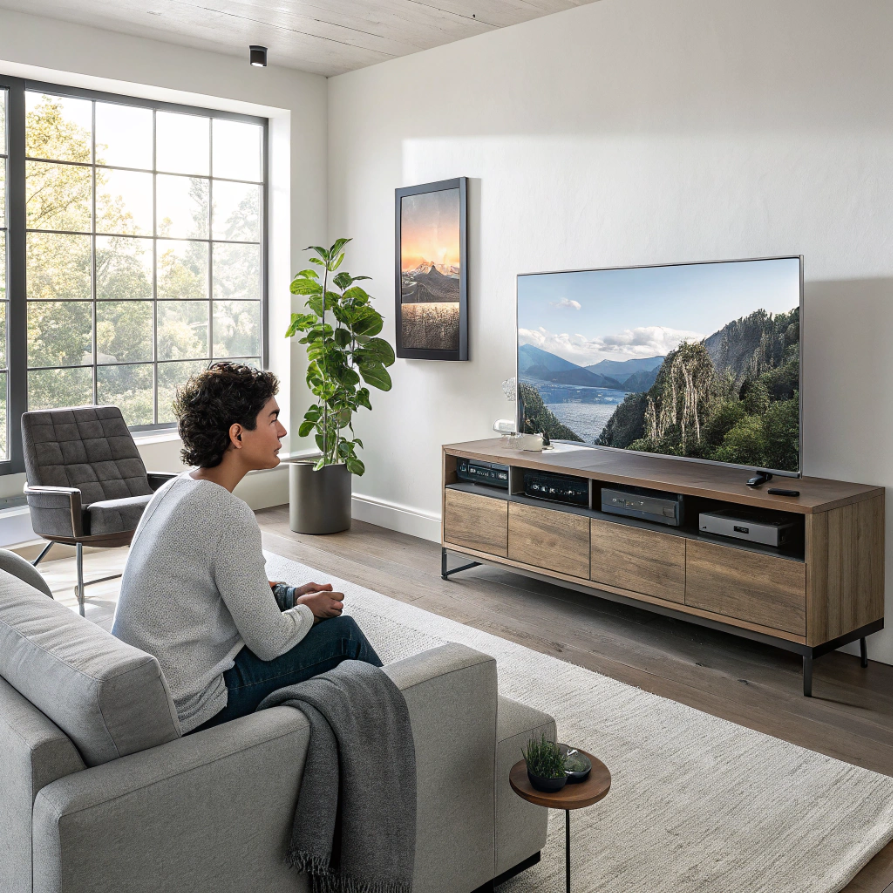
Neck strain. A screen that's too high means you're tilting your head up for everything. Fine for ten minutes. Not fine for a two-hour film. The center of the screen should sit at roughly your eye level when seated — not above it.
Bad room proportions. A stand that's too wide for a small room dominates it. A tiny stand on a wide wall looks like an afterthought. Neither is good. The right stand fits the room and the TV.
First: What's the TV Actually Wide?

Already covered above, but worth repeating clearly. TV sizes are diagonal measurements — corner to corner across the screen. That's how the industry measures them. Actual horizontal width is always smaller.
Rough numbers for the common sizes:
- 50-inch TV: about 44 inches wide
- 55-inch TV: about 48 inches wide
- 65-inch TV: about 57 inches wide
- 75-inch TV: about 65–66 inches wide
- 85-inch TV: about 74 inches wide
These are estimates. Bezel thickness and design vary between brands, so the actual width for your specific model might be an inch or two different. Measure the TV yourself or look up the product specs. Left edge to right edge. That's the number that matters.
The Width Rule — and It's a Simple One

The stand should be wider than the TV. By at least 6–10 inches total, so roughly 3–5 inches sticking out on each side. That's it.
48-inch wide TV? Look for a stand between 54 and 58 inches. You can go wider — in most rooms, that actually looks better. What you can't do is buy a stand that's the same width as the TV and expect it to look right. It won't. It'll look like the TV is balanced on a platform.
For 55-inch TVs and smaller, a console table actually works well in this role — it lands in the right width range, keeps things clean, and usually adds real storage. The Savanna Console Table with 3 drawers does exactly this. The Sicotas console table collection has other options if you need a different size or finish.
When wider is better
Going wider than the minimum makes sense when you want surface space for a soundbar, when the wall itself is wide, and a narrower stand would look lost, or when you're thinking about upgrading to a bigger screen in a year or two. Buy for the TV you'll have, not just the one you have now.
Only time wider is a problem: genuinely cramped apartments where every foot of floor space is felt. In that case, wall-mount the TV and use a slim console underneath for storage.
The Size Chart
Here's your quick reference. Find your TV size, check the width, and pick a stand that provides the right clearance. The height column assumes a seated eye level of around 40–43 inches — standard for most sofas.
|
TV Size (Diagonal) |
Approx. TV Width |
Recommended Stand Width |
Stand Height (approx.) |
|
43-inch |
~38 inches wide |
44–50 inches wide |
20–22 inches |
|
50-inch |
~44 inches wide |
50–55 inches wide |
22–24 inches |
|
55-inch |
~48 inches wide |
54–60 inches wide |
24–26 inches |
|
60-inch |
~52 inches wide |
58–65 inches wide |
24–26 inches |
|
65-inch |
~57 inches wide |
63–70 inches wide |
22–25 inches |
|
70-inch |
~61 inches wide |
66–75 inches wide |
20–24 inches |
|
75-inch |
~65–66 inches wide |
72–80 inches wide |
20–22 inches |
|
85-inch |
~74 inches wide |
80–90 inches wide |
18–20 inches |

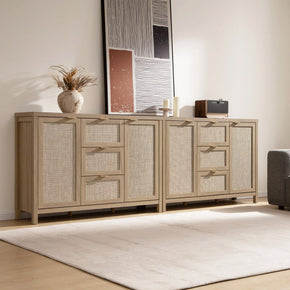
A wide, low dresser with drawers works surprisingly well as a TV console — especially for 55–65-inch setups where you want real storage, not just a surface. The Savanna 6-Drawer Dresser at 56.9 inches wide sits in exactly the right range for a 55-inch TV. Six actual drawers for cables, remotes, game controllers, and everything else that ends up orbiting a TV without ever finding a permanent spot.
Bezel sizes and leg designs vary. Always double-check your specific TV's product dimensions before buying.
Getting the Height Right

Rule of thumb: center of the screen at your seated eye level. Not above it. Not noticeably below it.For most people on a regular sofa, seated eye level is 40–43 inches off the floor. Work from that.
The formula
Seated eye level minus half the TV's height equals the stand height you want.
Say eye level is 42 inches, and the TV is 33 inches tall (roughly right for a 65-inch). Half of 33 is 16.5. Subtract: 42 minus 16.5 is 25.5 inches. Stand around 25–26 inches tall. Done.
One thing that catches people: bigger TVs need lower stands. Not higher. A 75-inch TV is about 38 inches tall. Half of that is 19 inches. Same eye-level math puts the ideal stand height below 24 inches. A tall stand under a big TV pushes the screen above eye level, which is exactly what you're trying to avoid.
Depth: Check This Before Anything Else

Honestly? Most people forget about depth until the TV arrives and they realize the legs don't fit the stand properly. Don't be that person.
Some TVs have wide-set legs.
Screen width and base width aren't always the same thing. Plenty of modern TVs have legs positioned toward the outer edges of the frame rather than close together in the center. A stand can pass the width test and still fail the depth test because the leg span is wider than the shelf allows.
Pull up your TV's product specs and check the stand base dimensions — not just the screen width. Two minutes of checking saves a really annoying return process.
And check for cable routing.
A stand with no cutouts, no open back, nothing — that means cables have to go over the front edge or pile up on the floor. Looks fine in a showroom. Looks terrible every day at home.
Stands with built-in cable ports or open backs make the setup look clean without extra effort. Worth looking for specifically.
Fitting It to the Room

Measure the wall before you order anything.
Wall width, outlet position, and walking routes through the room. A stand placed directly over the only accessible outlet, or one that blocks how people naturally move through the space, creates annoyances you'll deal with every day. TaskRabbit's living room guide has decent notes on room flow and furniture placement if you want to think through the layout more carefully.
The painter's tape trick
Tape the stand footprint on the floor before buying. Add a smaller rectangle inside for the TV width. Step back and look. Blocked by anything? Proportional to the wall? Is the room still navigable? Takes five minutes and saves a return trip.
Scale it to the wall, not just the TV
A small stand on a wide wall reads as unfinished. A massive entertainment center in a small apartment makes the room feel like a storage unit. The right piece looks proportional to the wall behind it — when that reads as balanced, the whole room does too.
Viewing Distance
Where the sofa sits matters as much as where the stand sitsviewing distance calculator gives a useful formula for this: viewing distance divided by 1.6 gives you a comfortable screen size estimate. Run it backward to find how far your sofa should be from your screen.
Sort the sofa position before locking in the stand placement. The sofa is easy to move. A fully wired TV setup is not.
|
TV Size |
Comfortable Viewing Distance |
|
50-inch TV |
About 6–8 feet |
|
55-inch TV |
About 7–9 feet |
|
65-inch TV |
About 8–10 feet |
|
75-inch TV |
About 9–11 feet |
|
85-inch TV |
About 10–12 feet |
4K holds up better at closer range than 1080p — if you're upgrading the TV as part of this project, you can generally sit a bit closer with a 4K set without the picture looking soft.
What Actually Makes a Good TV Stand

Open shelves for anything that generates heat
Consoles, streaming boxes, AV receivers — these need airflow. Closed cabinets trap heat and eventually cause problems. Open shelves also mean you can actually reach buttons and ports without rooting around behind doors.
Closed doors for everything else

Cables, remotes, chargers, spare controllers, the random things that multiply near every TV. Behind closed doors, out of sight. The Cas Bookcase with 2 Doors splits the work well — open shelves up top for anything that needs to be visible or frequently accessed, two closed doors below for the stuff you don't want to look at. Works in a media area just as well as a reading corner.
Cable routing
Cutouts in the back, open back panels, and internal routing channels. Not exciting to research, but very noticeable once everything is set up and you've got cables snaking over the front edge.
Weight capacity
Large TVs are heavier than they look. An 85-inch can weigh 80–100 pounds before you add anything to the stand. Check the weight rating and leave a buffer above your real load. For homes with kids or pets, also look into anchoring the TV and stand to the wall — the CPSC's Anchor It guidance covers the specifics. Anti-tip straps cost almost nothing.
Display storage next to the screen

If you want some things visible and some hidden, a glass-door unit beside the TV area handles that split well. The Helio Glass Sideboard with Doors has a low profile that pairs cleanly with most TV setups — objects stay visible through the glass, protected, and the internal lighting option makes it a room feature rather than just storage.
Mistakes to Skip
Using the diagonal to size the stand
Said this already. Saying it again. The 55-inch TV is 48 inches wide, not 55. Use the actual width.
Matching the stand width to the TV width
Looks bad. Less stable. Minimum 6 inches wider than the TV, full stop.
Buying a tall stand for a large TV
A large TV plus a tall stand equals a screen above eye level. The formula exists so you don't have to guess. Use it.
Not accounting for the soundbar.
Soundbars are typically 36–45 inches wide and need 2–3 inches of vertical clearance below the TV to avoid blocking the IR sensor—factor both the surface width and the vertical gap into your calculations before ordering.
Skipping the TV base dimensions
TV screen width does not equal TV base width. Check what your TV's actual leg footprint is before assuming the stand will work. Takes two minutes. Saves a return trip.
Checklist Before You Buy
These are the numbers. Write them down.
|
Measure This |
Your Measurement |
|
Actual TV width (measure left edge to right edge, not diagonal) |
___________ |
|
TV height (needed for the eye-level formula) |
___________ |
|
Seated eye level from the floor |
___________ |
|
Wall width at the intended location |
___________ |
|
Outlet position and cable route |
___________ |
|
Soundbar width (if you use one) |
___________ |
|
Gaming console or streaming device dimensions |
___________ |
|
Combined weight of TV and all equipment |
___________ |
Four questions to answer: Is it wide enough (6–10 inches more than the TV width)? Is it the right height (formula, not guesswork)? Is it deep enough for the TV base and soundbar? Does it have the right kind of storage for your setup?
FAQs
What size should my TV stand be?
Measure the TV width from edge to edge. Add 6–10 inches to that number. That's your stand width minimum. For height: seated eye level minus half the TV's height. That's your stand height target.
What size does a 50-inch TV stand for?
A 50-inch TV is about 44 inches wide. The stand should be 50–55 inches wide. That gives you the side clearance without going over the size limit.
How big is a 55-inch TV stand?
TV is about 48 inches wide. The stand should be 54–60 inches. Three to six inches on either side of the screen.
Will a 55-inch TV fit on a 120cm stand?
120cm is roughly 47.2 inches. The TV is about 48 inches wide. That's basically the same number — no side clearance, looks cramped, less stable. Go for 135–150cm.
Can a 65-inch TV fit on a 55-inch stand?
A 65-inch TV is about 57 inches wide. The 55-inch stand is too small — the TV hangs over the edges on both sides. The right range is 63–70 inches wide.
How big is a 120cm TV stand?
About 47.2 inches. Fine for a 43-inch TV. Fine for a 50-inch TV. Too narrow for a 55-inch TV if you want proper side clearance — which you do.
Can a 55-inch TV fit on a 50-inch stand?
TV is about 48 inches wide, and the stand is 50 inches wide. Two inches of margin. Looks precarious, probably is. Get the 54–60-inch range.
How many cm stand for a 55-inch TV?
137–152cm, which is about 54–60 inches. 150cm is a solid target in most rooms — fits the screen, clears the sides, leaves room for a soundbar if you need one.
That's the Guide

Two numbers run this whole decision—your TV's actual width. You're seated eye level. Get those right and everything else falls into place.
The math is simple: add 6–10 inches to the TV width for stand width. Subtract half the TV's height from your eye level to determine the stand height. Tape the footprint on the floor before you order. Check the base dimensions for depth. That's the complete process.
Dimensions first. Style, finish, and storage layout come after — and when the sizing is right, those choices feel easy.
Sources
- RTINGS — TV Viewing Distance and Size Relationship Guide — https://www.rtings.com/tv/reviews/by-size/size-to-distance-relationship
- Taskrabbit — Living Room Layout and Organization Tips — https://www.taskrabbit.com/blog/living-room-ideas/
- Living Spaces — TV Stand Size Guide — https://www.livingspaces.com/inspiration/ideas-advice/guides/tv-stand-size-guide
- Fitueyes — How to Choose the Right TV Stand Size — https://fitueyes.com/blogs/top-tips/how-to-choose-the-right-tv-stand-size
- Cabinfield — TV Stand Size Guide: How Wide Should Your TV Stand Be? — https://www.cabinfield.com/blog/tv-stand-size-guide-how-wide-should-your-tv-stand-be/
- Countryside Amish Furniture — Size and Height Guide for Your TV Stand — https://www.countrysideamishfurniture.com/blog/entry/size-and-height-guide-for-your-tv-stand
- Granite Gold — How to Care for Wood Furniture — https://granitegold.com/blogs/blog/how-to-care-for-wood-furniture-dos-donts-cleaning-guide


Looking for something else?

Furniture Materials Guide: Picking the Right Material Room by Room
LEARN MORE
How to Mix Wood Tones Without Making a Room Look Mismatched
LEARN MORE
18 College Apartment Furniture Ideas That Save Space and Money
LEARN MORE
Types of Entertainment Centers: 11 Designs and How to Pick One
LEARN MORELooking for something else?

Curio Cabinet Decor Ideas: How to Style a Display Cabinet Without the Clutter
LEARN MORE
Curved Furniture: How to Style, Measure, and Buy It in 2026
LEARN MORE
What Is Rattan Furniture? A Buyer Guide to Types and Care
LEARN MORE


Further reading

How to Choose a Nightstand for a CPAP Machine

How to Choose a Shoe Cabinet for Men's Sizes, High-Tops, and Bulky Shoes


