



Large Bedroom Ideas: How to Fill a Big Room Well
Take a 16 by 18 ft bedroom with a queen bed, two 18 inch side tables and a dresser shoved into the corner by the closet. Nothing in it is wrong, exactly. Together they look like a room someone is about to move out of, with a wide patch of empty floor in the middle.
We plan these rooms in a fixed order. Bed first. After the bed come the nightstands, after those the long dresser, then the bench. A chair only goes in once all of that fits with floor to spare.
Quick answer: Buy in this order. Nightstands about 25 inches wide, a dresser close to 8 ft long for the wall opposite the bed, a bench, and last of all one chair with a lamp. A large rug and three layers of light tie it together.
Start With the Bed and the Walkways

Designer Suzanne Kasler decides where the bed goes before anything else and plans the floor from there, Architectural Digest reports. Use the longest wall without a window.
A king mattress is 76 by 80 inches, per the Sleep Foundation. The frame adds a few more.
Next come the paths, and in most bedrooms there are three that matter: door to bed, bed to closet and bed to bathroom. Nothing should sit on any of them. We leave 24 inches on each side of the bed, and 30 to 36 for the main routes. The National Institute on Aging makes a similar point about falls at home: keep furniture out of the places where you walk.
The Order to Add Furniture in a Big Bedroom
Big bedrooms tend to get furnished in one weekend and then patched for years. We would rather go one step at a time, and give each step about a week before buying the next piece.
|
Step |
Add |
Why it comes here |
|
1 |
Two wide nightstands |
They turn the bed wall into one solid block |
|
2 |
A long dresser, or a second one |
It balances the bed from across the room |
|
3 |
Bench at the foot of the bed |
It pulls the bed toward the middle of the floor |
|
4 |
Reading corner |
It uses whatever floor is left over |
|
5 |
Rug, color and lamps |
They connect the zones you just made |
Step 1: Match the Nightstands to the Bed

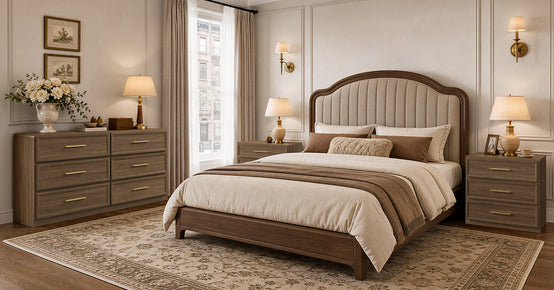
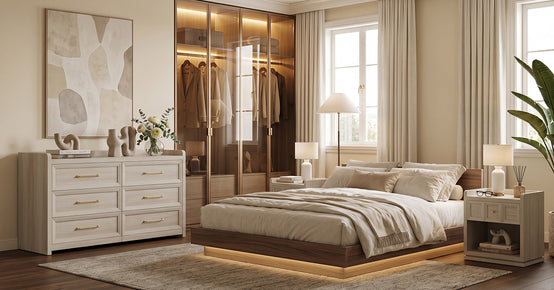
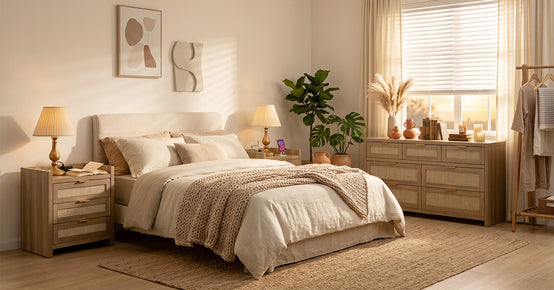
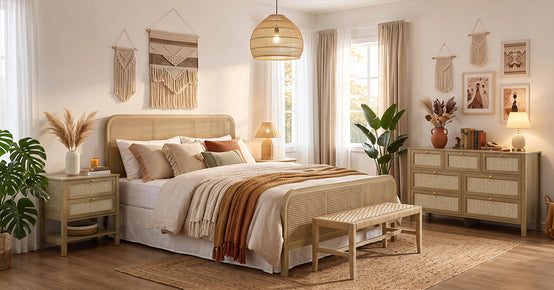
We would start with the side tables. Plenty of pieces sold as nightstands are around 18 to 20 inches wide, fine for a full bed and lost beside a 76 inch king. The ones in the Savanna dresser and nightstands set are 24.8 inches wide and 26.57 inches tall, three drawers each.
We always do the wall math before ordering: a 76 inch king plus two of these is about 126 inches, or 10 ft 6 in, before the frame.
The listing gives the main drawer as 6.06 inches high and 12.6 inches deep inside, enough for a charger, reading glasses and a paperback laid flat. You get the set in Reclaimed Light Oak, Reclaimed Caramel Oak or Black Oak, and SICOTAS puts assembly at about 45 minutes if you have a power drill.
Step 2: Fill the Long Wall With a 9 Drawer Dresser

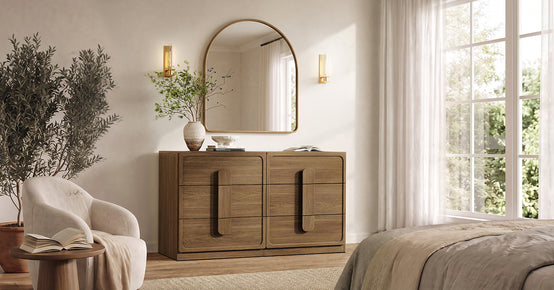
Most big rooms have one long wall that nothing seems to fit. A long, low dresser belongs there, and our 9 drawer dressers are sized for that stretch.
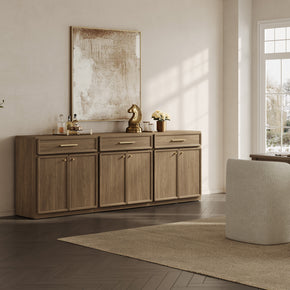
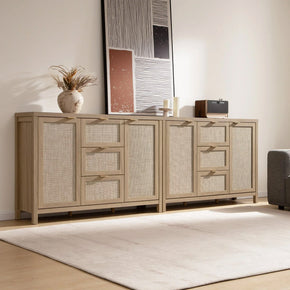
On that wall we would use the Crescent modular 9 drawer dresser. SICOTAS lists it at 93.9 inches wide, just under 8 ft, but only 26.6 inches high and 16.4 inches deep, so it reads as a long low line rather than a block. The nine drawers sit in three separate cabinets, which we like for walls with a heating vent or a door in the way, since the cabinets can be spaced out.
|
Spec |
Crescent modular 9 drawer |
Savanna 6 drawer (in the set) |
|
Width |
93.9 in |
56.85 in |
|
Height |
26.6 in |
31.34 in |
|
Main drawer, inside |
7.5 in high, 30.1 in wide |
8.59 in high, 26.81 in wide |
|
Weight |
180 lb |
122.4 lb |
|
Best spot |
Long wall facing the bed |
Shorter wall, or as a second dresser |
Already own a dresser? Put the new one on a different wall in a matching finish. Crescent comes in Dark Grey Oak, Walnut Brown and Greige Oak.
Watch out: Anchor both pieces. CPSC asks families to fix dressers and bookcases to the wall, and its Anchor It campaign, which turned ten in 2025, is credited with a nearly 50 percent drop in tip over injuries and deaths. Also leave around 36 inches in front of any dresser.
Step 3: Add a Bench at the Foot of the Bed

We usually find a gap of 6 ft or more between the foot of the bed and the dresser in a room 16 ft or longer, and from the doorway that bare strip is the first thing you notice. A bench closes it.
Size it to the bed. We aim for two thirds to three quarters of the bed width, so roughly 50 to 57 inches on a king, with the seat below the top of the mattress. If the spare duvet has nowhere to live, a lift top storage bench takes care of it. Then check you still have about 36 inches between the bench and the dresser.
Step 4: Turn a Spare Corner Into a Reading Spot

Kasler likes to break a big bedroom up with small seating areas and treat each one as its own vignette. In the room Architectural Digest shows, that meant one chair and a table by the window, for coffee and the view. We give it the corner nobody crosses to reach the closet.
An armchair, a floor lamp and a side table are all we would put there. For loveseat or chaise layouts, see our master bedroom with separate sitting area ideas.
Tie the Zones Together With a Rug, Color and Light
A small rug makes a large floor look larger, in the wrong way. The Spruce recommends a 9 by 12 ft rug under a king, reaching 18 to 24 inches past each side of the bed.
Then there is color. Homes & Gardens describes the 60/30/10 split, which we cover in the FAQ below, and it is the quickest check we know for a room this size.
Light each zone on its own. That means a ceiling fixture for the room, a lamp on each nightstand and a floor lamp next to the chair, plus at least one switch you can reach from bed, as the NIA also suggests.
Final Thoughts
Fill a big bedroom in order and stop when the walkways start to shrink.
Some bare floor is fine. Before ordering from SICOTAS, tape each footprint on the floor and walk around it for a day.
We took every measurement here from the SICOTAS product pages on November 2, 2026.
FAQs
What Is the 60/30/10 Rule for Bedrooms?
A color split, and a loose one. Roughly 60 percent of what you see is one main color, 30 percent a second color and the last 10 percent an accent. Homes & Gardens puts the 60 on the walls in most rooms, with the 30 going to curtains, accent chairs or a feature wall and the 10 to cushions, lamps and artwork.
Big bedrooms bend it a little. Picture the Crescent dresser in Walnut Brown along an 8 ft wall, or a 9 by 12 ft rug. Either one covers enough of the room that it counts toward the 60 or the 30. It cannot be the accent.
We pick those big finishes on the same afternoon as the paint. The accent is the easy part. Cushions and a lamp shade can change every season.
How Do You Break Up Space in a Large Room?
With zones, not walls. One job per area, with the edges drawn by rugs and furniture instead of screens or half walls.
In practice that is usually three zones. Sleep is the bed with its two nightstands, sitting on the big rug. Across from it, the long dresser takes care of storage. We would put the reading spot on its own rug, with a chair, a lamp and a small table, and let the bench between the bed and the dresser act as a low divider you can see over.
We would use the same wood tone in all three so it still feels like one room. Two zones is plenty if you would not use the third every week.
What Are the 7 Golden Rules for Bedroom Design?
We have not found an official list anywhere, and the ones online all differ. These are the seven we work from:
• Bed first, on the longest solid wall.
• 24 inches of floor beside the bed, both sides.
• Measurements before shopping, every time.
• Three light sources, not one.
• Closed storage for daily clutter.
• One palette, repeated across the room.
• Some floor left empty on purpose.
Scale is the rule big rooms break most. We see it with dressers constantly. On a 15 ft wall, a 56 inch dresser that looked long in the photos covers less than a third of the wall.
What Makes a Home Look Wealthy?
Scale and restraint, more than price. Go back to the 16 by 18 ft room at the top of this article. Nothing in it needed to be expensive. It needed 25 inch nightstands instead of 18 inch tables, a dresser along the wall and a 9 by 12 rug under the bed.
Fewer accessories help. So does a curtain rod hung a few inches below the ceiling, since the windows then look taller than they are. We keep one wood tone going across the dresser, the nightstands and a frame or two. A row of small, unrelated pieces does the opposite, whatever they cost.
Short on budget? Bed, dresser and rug come first, and the accessories can wait a few months.
What Color Makes a House Look Expensive?
Probably not the one on the paint chip. North light cools a greige down and late west light pushes it toward gray, so we only judge paint once it is on the wall.
Large bedrooms can take something darker than most people expect. We like dark green or navy on the bed wall only, because a 16 ft room has enough floor and ceiling around it to keep that color from closing in. What usually looks cheap is five unrelated colors fighting each other.
Buy sample pots first. A 2 by 2 ft patch on two walls, left up for a few days, settles it before a gallon gets opened.
What Is the Perfect Color for a Bedroom?
Our answer changes with the room, so we start with what is already in it. If the rug and bedding are bought, the wall gets matched to them. If nothing is bought yet, we would hold off on paint, because a color picked before the fabrics is usually the first thing redone.
For a big bedroom with Savanna furniture, our starting points are warm white or pale sage next to Reclaimed Light Oak, cream or clay next to Reclaimed Caramel Oak, and warm greige next to Black Oak. A 16 ft room can also take one shade darker than you would use in a 10 by 10.
Then we leave a big swatch beside the bed for a week, which is where you will look at it every night.
What Makes a Home Look Outdated?
Usually scale and clutter more than age. The rooms that look most dated to us have a full five piece suite bought in one go, a 5 by 8 rug floating in 300 square feet and a dresser top covered in small frames.
Age by itself is not the problem. Some of the best rooms we have seen pair a vintage dresser with two plain modern nightstands. Lighting gives a room away faster. One dim ceiling fixture and nothing else makes everything under it look worn.
We would change the cheap things first, meaning bedside lamps, curtains and bedding, and keep any dresser that still works and still fits the wall.


Looking for something else?

One-Drawer vs. Two-Drawer Nightstands: Which Is More Useful?
LEARN MORE
Adjustable vs. Fixed Bookcase Shelves: Which Is Better for Real Storage?
LEARN MORE
How to Choose a Dresser for Sweaters, Denim, and Bulky Clothes
LEARN MORE
Mixed-Depth vs. Uniform Dresser Drawers: Which Layout Fits Your Wardrobe?
LEARN MORELooking for something else?

How to Choose a Low Dresser for Under a Bedroom Window
LEARN MORE
How to Choose a Dresser for a Rental: Assembly, Moving, and Wall Anchoring
LEARN MORE
How to Choose a TV Stand for an Ultra-Short-Throw Projector
LEARN MORE


Further reading

Small Bedroom Furniture: What to Keep and Skip
Large Bedroom Ideas: How to Fill a Big Room Well


