




Mixed-Depth vs. Uniform Dresser Drawers: Which Layout Fits Your Wardrobe?
Nobody shops for drawer heights. They shop for the dresser.
I get it. Two dressers. Same width, same finish, same price. Drawer fronts basically identical. Done, right? Pick the prettier one?
Wrong. The front is a billboard. What matters is interior height, the usable space inside each drawer box after walls, slides, and gaps take their cut. And that number varies wildly between dressers that look like twins.
Two philosophies. Uniform: every drawer the same height, tidy as a spreadsheet. Mixed-depth: shallow up top for small stuff, deeper below for bulky stuff, each band of your wardrobe gets its own band of the dresser.
Which wins? Depends on what's folded in your closet. Let's find your answer.
The Bed Test (Do This Before You Browse)

Do this before you open a single product page. Dump your folded wardrobe on the bed. Yeah, all of it. Now sort everything by how tall it stacks when folded. There's a closet outfitter who published an interior-height prescription, and honestly? It's the most useful chart in this whole guide. Works for dressers too.
Sort everything by how tall it stacks. A closet outfitter published an interior-height prescription that works for dressers too, honestly the most useful chart in this guide:
|
Interior height |
What lives there |
|
3 to 4 inches |
Jewelry, watches, rolled belts, sunglasses, ties flat. |
|
5 to 6 inches |
Underwear, socks, swimwear, scarves. The workhorse. |
|
7 to 8 inches |
Folded tees, activewear, light knits. File-fold territory. |
|
9 to 11 inches |
Denim, heavy sweaters. Four to five folded jeans = ~9 inches. |
|
12 to 14 inches |
Bulky knits, handbags flat, bed linens. Danger zone. |
Count STACKS, not items. Mostly one height? Uniform might be fine. All over the map? Mixed-depth is calling.
The same source prescribes a six-drawer bank at 4, 4, 6, 6, 8, and 11 inches. That beats six identical 8-inch drawers for any real wardrobe. Because real wardrobes aren't uniform. Why should the drawers be?
Shallow Drawers: The Single-Layer Rule

Five to six inches of interior height is the sweet spot for small stuff. Socks, underwear, sleepwear, scarves, the things you grab half-asleep. My rule? One layer. If you can see every item without lifting another one, you'll stop losing things. The second a shallow drawer gets a second layer, congratulations, you've got a junk drawer with better lighting. And file folding only works here. Stand those folded tees on edge in a 7-to-8-inch drawer and suddenly you've got a readable row. Grab the third shirt without touching the first two. Go deeper and they slump like dominoes.
File folding? Only works here. Stand folded tees on edge in a 7-to-8-inch drawer and the stack becomes a readable row. Grab the third shirt without touching the first two. Go deeper and the files slump like dominoes.
Reach matters too. One guide puts the easy zone at 24 to 48 inches off the floor. So: watches and keys up top, daily smalls in the shallow drawers, sweaters and denim in the 8-to-10-inch band below. Your body already knows this layout.
Oh, and shallow drawers only stay organized DIVIDED. Undivided? Mixed layer within a week, guaranteed. Match the divider to the drawer height. Standard dividers are too short for deep drawers and just disappear into the pile.
Deep Drawers: Where Clothes Go to Be Forgotten

Deep drawers feel SO generous in the showroom. All that space! Then you actually live with one for a month. The thing you want is always buried under three things you don't want, and pretty soon the drawer is just... geology. Layers. The bottom strata? Clothes you haven't worn in a year. Archaeological finds. Woodworkers have a saying about this, and every dresser owner discovers it's true: deep drawers swallow small things. The usable capacity is way smaller than the volume suggests because only the top few inches are actually reachable without digging.
Woodworkers say what every owner discovers: deep drawers swallow small things, and their usable capacity is way smaller than the volume suggests. Only the top few inches are reachable without excavation.
One owner said it best: her bottom drHere's what makes deep drawers worse than they look. First, the visibility cliff. 16 to 18 inches of interior depth is the sweet spot. Hit 22 to 24 and you've got a tunnel, not a drawer. Second, weight. A 36-inch drawer full of denim runs 40 to 55 pounds. That wants slides rated to 75 pounds, 100 if the drawer's wide. Most people don't think about slide ratings until the drawer starts sagging.l of geology.
The Drawer-Count Lie
Two structural facts make it worse. One: the visibility cliff, 16 to 18 inches of interiorHere's the thing about drawer counts. Take two dressers with the same outside box. One has 9 drawers, the other has 6. The 9-drawer holds more, right? Nope. Every drawer costs you volume in box walls, slides, and gaps between drawers. So a 9-drawer and a 6-drawer in the same case? They can hold surprisingly similar totals. What those extra drawers actually buy you is SORTING. Your small items each get their own shallow home instead of piling together in one big drawer. That's genuinely useful. Just don't confuse it with more cubic inches.sers with the same outside box but different drawer counts. The 9-drawer holds more, right? Wrong. Every drawer costs volume in box walls, slides, and gaps. So a 9-drawer and a 6-drawer in the same case can hold surprisingly similar totals.
What the extra drawers buy is SORTING. Small items each get their own shallow home instead of piling together. That's the whole benefit. Good benefit, just don't confuse it with volume.
Related trap: counting fronts instead of interiors. "Deep drawers" on a listing might mean 9-inch interiors or 13-inch interiors. Different products. Same word. Measure the interior height, not the front.
Two Real Dressers, Opposite Answers

Enough theory. The SICOTAS dressers collection carries both philosophies. Real numbers below.
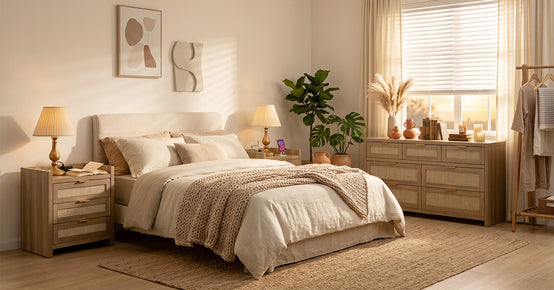
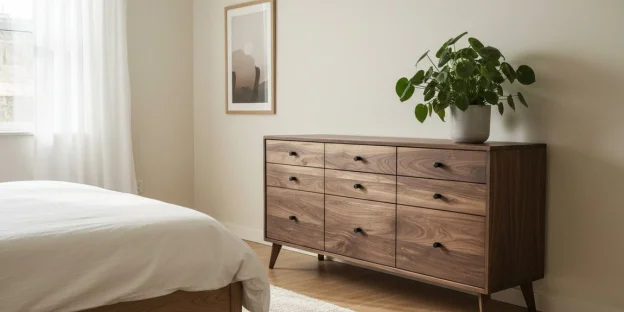
The mixed-depth pick is the Stria Sectional 9-Drawer Dresser, Large Storage. It's 33.7"H x 77.7"W x 15.6"D, which sounds huge until you realize the drawers are doing different jobs. Nine of them, sectional layout, smaller up top and larger below. The main interior runs 7.1"H x 13.7"D (23.6"W). That 7-inch band is perfect for file-folded tees, your activewear, light knits, stuff you grab daily. Lower sections handle denim and sweaters without the archaeology problem. 177 pounds on roller glides. If your wardrobe is lopsided, lots of small stuff AND bulky stuff, this is your dresser.
The uniform pick is the Cas 53.5-Inch Wide Chest of 6 Drawers30.3"H x 53.5"W x 17.7"D, and every drawer is the same: 6.5"H x 13.4"D interiors (23.6"W). Six equal drawers, 146 pounds total. It's the "you do the sorting" dresser, the furniture won't do it for you, so you bring dividers. Works great if your wardrobe is mostly medium-weight stuff and you don't mind organizing. No surprises, no weird deep drawers, just six capable mediums.
|
Dresser |
Outside dims |
Drawers |
Main drawer interior |
Best for |
|
Stria Sectional 9-Drawer |
33.7"H x 77.7"W x 15.6"D |
9, sectional mixed layout |
7.1"H x 13.7"D (23.6"W) |
Varied wardrobes: accessories up top, denim and knits below |
|
Cas 53.5" Chest of 6 Drawers |
30.3"H x 53.5"W x 17.7"D |
6, uniform |
6.5"H x 13.4"D (23.6"W) |
Simpler wardrobes; owners happy to use dividers |
Three Maps. Pick Yours.
None of these put daily smalls in a deep drawer or bulky items in a shallow one. That's the whole game.
● Map 1 is for the minimalist. You know the type, mostly tees and jeans, few accessories. Here's how I'd lay it out: top gets two shallow drawers at 4-5 inches. Underwear and socks in one, accessories in the other. Middle: two 7-to-8-inch drawers with tees file-folded on edge so you can see them all. Bottom: one or two 9-to-Map 2 is the family dresser. Two people's daily clothes in one piece of furniture, which is always chaos without a system. If you're past 36 inches wide, split every drawer with a divider. I'm serious about this. Without dividers, his-and-hers becomes one heap within a month. I've seen Map 3 is for the maximalist. Serious knitwear collection, the kind that needs its own dresser. Top: shallow for the small stuff, same as always. Middle: medium for daily wear. Bottom: this is where you go deep, 12 inches and up, but ONLY for off-season and bulky items. The stuff you touch monthly, not daily. Deep drawers make fine archives. They make terrible inboxes. If you're reaching into the bottom drawer every morning, something's wrong with the system. bedding.
● Map 3: the maximalist. Serious knitwear collection. Top: shallow for the small stuff. Middle: medium for daily wear. Bottom: the deepest drawers, 12 inches and up, off-season and bulky items ONLY. The stuff you touch monthly. Deep drawers make fine archives. They make terrible inboxes.
The Matrix
|
Your wardrobe |
Winner |
Why |
|
Mostly small items: socks, underwear, accessories, tees |
Uniform bank, shallow-to-medium |
You need visibility and sorting, not volume. |
|
Heavy on denim, hoodies, chunky knits |
Mixed-depth, genuinely deep bottom drawers |
Bulky stacks need 9 to 12 inches of interior height. |
|
A bit of everything, one or two people |
Mixed-depth sectional (like the 9-drawer Stria) |
Each band of your wardrobe gets its band of drawers. |
|
Simple wardrobe, mostly medium-weight folds |
Uniform medium drawers (like the 6-drawer Cas) |
Fewer zones; dividers handle the small stuff. |
|
Shared dresser, two full wardrobes |
Mixed-depth AND wide, dividers past 36 inches |
You need height variety and the lateral split. |
Two rules to take home. One: interior height is the spec. Distrust any listing that only gives you the front. Two: top drawers should always be the shallowest, because daily-touch items are almost always the smallest.
Ready to compare? Open the dressers collection and check each product page for drawer interior heights, not just outside dimensions. And when you've picked your layout, SICOTAS publishes every interior dimension on the PDPs.
FAQs
What is a mixed-depth dresser drawer layout?
A layout that varies drawer heights on purpose, shallow up top for small items, deeper below for bulky clothing. The dresser admits your wardrobe isn't uniform, so the drawers aren't either.
Are shallow or deep drawers better for everyday clothes?
Shallow to medium, no contest. Socks, underwear, t-shirts stay visible in a 5-to-8-inch interior, one layer, everything findable. Deep drawers are for bulky, low-frequency stuff. Daily clothes should never need excavation.
How deep should dresser drawers be for jeans and sweaters?
Nine to eleven inches of interior height. Four to five folded jeans stack to about 9 inches, so that's your floor. Go much deeper and you're back to geology.
Do more drawers mean more storage space?
Not necessarily. It surprises people. Every drawer costs volume in walls, slides, and gaps, so a 9-drawer and a 6-drawer in the same case can hold similar totals. More drawers buy sorting, not cubic inches. Different thing. Both useful.
Why do things get lost in deep dresser drawers?
Because only the top few inches are reachable without lifting the stack. Past about 11 inches of interior height, the bottom becomes archive storage, stuff you forgot you owned. It's not you. It's physics.
What is the best drawer height for socks and underwear?
Five to 6 inches, divided. The single-layer band. Everything visible at a glance, nothing stacked, nothing lost. Boring? Maybe. Effective? Completely.
Can drawer dividers fix a too-deep drawer?
Partly. Tall dividers matched to the drawer height stop the migration, socks stay in their lane. But a 13-inch drawer with dividers is still a 13-inch stack. Dividers organize the problem; they don't shrink it.
Should the top drawers of a dresser be shallow?
Yes. Top drawers sit in the easiest reach zone, and daily-touch items are almost always the smallest. Shallow up top, deeper below.


Looking for something else?

One-Drawer vs. Two-Drawer Nightstands: Which Is More Useful?
LEARN MORE
Adjustable vs. Fixed Bookcase Shelves: Which Is Better for Real Storage?
LEARN MORE
How to Choose a Dresser for Sweaters, Denim, and Bulky Clothes
LEARN MORE
Mixed-Depth vs. Uniform Dresser Drawers: Which Layout Fits Your Wardrobe?
LEARN MORELooking for something else?

How to Choose a Low Dresser for Under a Bedroom Window
LEARN MORE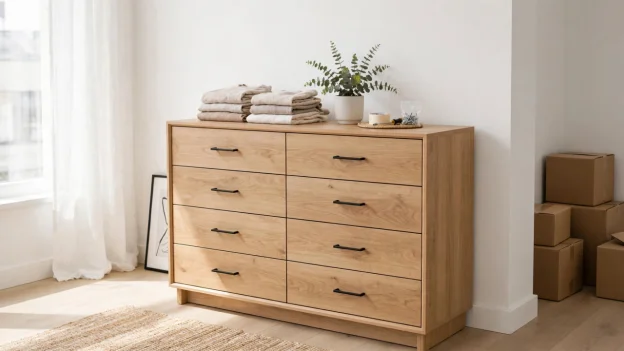
How to Choose a Dresser for a Rental: Assembly, Moving, and Wall Anchoring
LEARN MORE
How to Choose a TV Stand for an Ultra-Short-Throw Projector
LEARN MORE


Further reading

Small Bedroom Furniture: What to Keep and Skip

Large Bedroom Ideas: How to Fill a Big Room Well


