Here's what nobody tells you when you're shopping for one: the doors that make your entryway look tidy are the same doors that turn it into a smell box. This is my honest take on ventilated versus fully closed — what airflow does, where it falls short, and how to pick without overthinking it.
First, the reality check. No cabinet kills odor — not vented, sealed, or expensive. Ventilation slows buildup because moisture escapes. But shove in soaking-wet sneakers and never clean it? Nothing saves you.
Where Shoe Odor Actually Comes From
It starts with your feet. One foot puts out 100 to 200 ml of sweat a day, and your shoes absorb a good share. Warm, damp insoles are a bacteria playground. The moisture comes from you — not the cabinet, not the season. The cabinet just decides what happens next.
Shut that moisture in a sealed box and it has nowhere to go. Testing shows a closed cabinet's humidity can jump 15 to 25 points above the room within half an hour of tossing in freshly worn shoes — sometimes hitting 70 to 80 percent. Open shelving, for comparison, stays within 5 to 8 points of room air. That gap right there is the whole case for ventilation. Moving air pulls the moisture out before it settles in and starts smelling.
What "Ventilated" Means on a Real Cabinet
There's no official definition. "Ventilated" on a product page just means openings that let air drift in and out on its own. Three versions you'll actually find in stores.
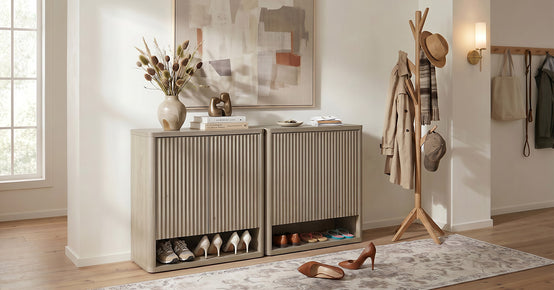
Slatted and louvered doors
Horizontal slats or angled louvers. Simple concept — each gap is tiny, but you've got dozens of them, so air keeps moving across the shelves. Looks-wise it's traditional. Plantation shutters, that vibe. Works great in some entryways, looks dated in others. These move the most air of any front style. They also let in the most dust. Tradeoffs everywhere.
Woven rattan fronts
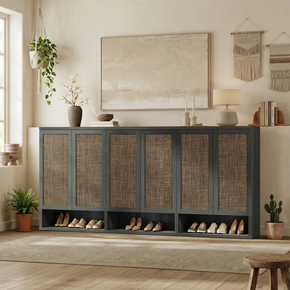
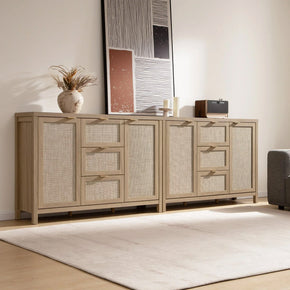
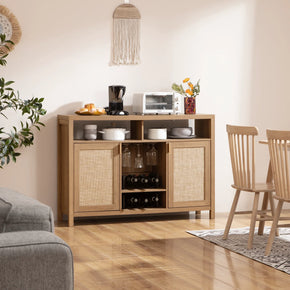
This is the one most people end up happiest with. A woven rattan or cane panel is full of tiny openings, so air keeps drifting through — but from across the room the cabinet still looks closed.
SICOTAS puts its Savanna shoe cabinets in the Boho/Woven category for exactly this reason. The weave looks like solid furniture but breathes like an open front. The 24-pair Savanna has two woven rattan doors and six adjustable shelves in a 41"H × 32.4"W × 14.8"D frame.

Close-up of a woven rattan door panel. The small gaps in the weave let air move through while hiding what's inside.
Perforated backs and raised bases
Some cabinets breathe from behind instead — a perforated back panel, an open back, or a base lifted a couple inches off the floor so air moves underneath. You won't see it working, which is kind of the point. It just stops the box from sealing shut. Old furniture-care trick that actually holds up: leave about 5 cm between the cabinet and the wall so the back can breathe.
Ventilated vs. Fully Closed: An Honest Comparison
I wish one of these clearly won. It doesn't. Here's the real tradeoff, row by row.
Odor buildup: ventilated fronts let moisture escape nonstop, so things stay fresher between cleanings. Sealed cabinets trap it — humidity can run 15–25 points above the room.
Dust protection: here's the catch. Every gap that lets air out lets dust in. Ventilated cabinets need their shelves wiped more often. Solid doors keep the inside noticeably cleaner for longer.
Concealment: woven and louvered fronts blur what's behind them — you can't really make out individual pairs. Solid doors hide everything completely. Tidier look from the hallway, no contest.
Cleaning effort: ventilated means dusting every few weeks. Sealed means less dust, but you've got to air the thing out and wipe it down on a schedule because trapped moisture does its own damage.
Best for: ventilated suits busy households, anyone athletic, humid climates — basically anywhere shoes go in damp. Sealed suits dress shoes, guest entryways, dusty homes, or when you want the storage to look like display furniture.
The Dust Tradeoff Nobody Mentions
Every vent works both ways. I don't see this spelled out enough. The same gaps that let moisture escape let fine household dust drift in, and after a few weeks it's sitting on your shelves and shoe tops. Honestly? That's the real price of ventilation. Not the look. Not the cost. The dusting.
If you live near a busy road, or you're not someone who dusts regularly, a woven-front cabinet is going to need a quick shelf wipe every few weeks. A solid-door cabinet? Stays clean inside way longer. So ask yourself which chore you'd rather live with — wiping dust off shelves, or airing out a sealed box. Families with kids and daily-worn sneakers usually pick the dust. People storing dress shoes they wear twice a month pick the seal. Neither answer is wrong.

Sunlight and household dust drift through any entryway. Ventilated fronts trade a little dust for a lot of airflow.
The Drying Routine That Matters More Than the Door
Okay, uncomfortable truth time. Your drying routine matters more than which door style you pick. I know that's not what the product pages say. But a ventilated cabinet cannot rescue shoes that went in soaking wet. Airflow trims moisture. It doesn't erase it.
If you remember one thing from this guide, make it this:
Air your shoes before they go in. Get home, loosen the laces, pull the tongues forward, leave the pair on a mat by the door for 30 to 60 minutes. Most of the day's moisture leaves in that first hour. This one habit does more than any cabinet feature.
Never store wet shoes. Rain-soaked, gym-drenched — whatever. Stuff them with newspaper and leave them out overnight. A cabinet is not a dryer, vented or not.
Rotate. Wearing the same pair two days running gives moisture zero recovery time. Even a basic every-other-day rotation makes a visible difference.
Don't cram. Packed shelves block whatever airflow your cabinet has. If shoes are touching on all sides, the vents might as well not exist.

The habit that beats any door style: let worn shoes air on a mat for 30 to 60 minutes before they go in the cabinet.
Removable Shelves: The Feature That Makes Cleaning Possible
Fixed shelves are where freshness goes to die. You can't reach the corners. Crumbs pile up at the back. Cleaning means crouching with a cloth around rows of shoes. Removable shelves fix all of that — lift them out, wipe the cabinet empty, slide them back.
There's a second reason adjustable heights matter. Tall boots and flat shoes waste space on fixed shelves, wasted space means fewer pairs fit, and that tempts you to cram — which kills airflow and brings back the smell. The Savanna 24-pair comes with six adjustable shelves — set them to match what you own. And when shelves lift out easily, you'll clean twice as often, because it stops feeling like a project.

A removable shelf lifted out of an open cabinet. Shelves that come out make the monthly wipe-down a five-minute job.
How to Clean a Shoe Cabinet (and Keep It That Way)
A cabinet you never clean will smell regardless of the doors. The routine takes about fifteen minutes a month. That's it.
Go one section at a time. Pull the shoes out, shake each shelf over a bin, vacuum the corners where grit collects. Corners are always worse than you expect.
Wipe every shelf with a lightly damp cloth, then follow with a dry one. Don't skip the drying — moisture left sitting on wood or MDF swells the surface over time. Never put shoes back on a wet shelf.
Then air the cabinet itself. Doors open, one hour, let the interior dry fully before anything goes back in. Check the back panel and base while you're at it — dust collects where you never look, and that's where the stalest air sits.
Charcoal sachets and cedar blocks
Between cleanings, activated charcoal sachets and cedar blocks genuinely help. They adsorb odor compounds instead of just covering them up with fragrance — different mechanism, actually works. Two things worth knowing: swap the charcoal sachets every two to three months (dead charcoal does nothing), and give cedar blocks a light sanding about once a month to wake the surface up. Think of them as helpers for your routine, not replacements for it.

A quick interior wipe-down. Monthly cleaning does more for freshness than any ventilation feature.

Charcoal sachets and cedar blocks beside everyday shoes. They adsorb odor between cleanings — they don't replace cleaning.
|
The honest truth about "fresh"? No shoe cabinet — ventilated or sealed — eliminates odor. Ventilation cuts moisture buildup. Cleaning handles what ventilation misses. Charcoal and cedar fill the gaps. Anyone promising you a cabinet that keeps shoes smelling new is selling a story, not storage.
|
Which Cabinet for Your Climate?
This part actually matters more than people think. Same cabinet, totally different behavior in a coastal apartment versus a dry mountain town.
Humid coastal climates
When the air itself is damp, shoes dry slowly and sealed boxes stay humid for hours. A woven or slatted front earns its keep here — it never lets the interior drift far above room humidity. Still air the shoes first, though. Ventilation handles the last of the moisture, not the whole job.
Dry climates
Dry air changes the math. Shoes air out fast, sealed cabinets rarely get musty. Here I'd actually go solid-door: it keeps dust off shoes that sit unworn for weeks, and odor buildup is slow anyway. Ventilation solves a problem you don't have.
Rainy seasons and wet commutes
Shoes coming home wet regularly? Neither door style saves you — the drying routine does. Set up a proper landing zone: waterproof mat, newspaper for stuffing, and a hard rule that wet pairs stay out overnight. Once they're actually dry, either cabinet type works fine.
Small apartments
Tight entryways with bad airflow make sealed cabinets worse — no draft rescues them when you open the doors. In a small place, lean ventilated, keep the cabinet a few centimeters off the wall, and clean monthly. (And if you're still torn between a cabinet and an open rack — different tradeoff entirely. Open racks win on airflow and lose on looks. This guide assumes you want doors.)

A rattan-front cabinet in a humid-climate entryway. Where the air is damp, continuous airflow matters most.
SICOTAS Shoe Cabinets Compared
Here's how the
SICOTAS lineup actually breaks down on the ventilated-versus-closed question. All five live in the
shoe cabinet collection — the question is which front and footprint match your routine.
Savanna Shoe Cabinet, 24 Pairs — 41"H × 32.4"W × 14.8"D, 76 lb, six adjustable shelves, woven rattan doors that breathe. My pick if odor is your main enemy and you've got damp daily sneakers.
Savanna Shoe Cabinet, 30 Pairs — 40.94"H × 47.24"W × 14.76"D, three doors, same Boho/Woven line. The one to get if you need maximum pairs per square foot.
Terra 3-Door Shoe Cabinet — 38.98"H × 45.59"W × 14.17"D, 77 lb, solid three-door front. Better sealed against dust. Built for dress shoes, guest entryways, dusty homes.
Terra Black Shoe Cabinet, 2 Doors — 38.97"H × 31.49"W × 14.17"D, 54 lb, solid two-door front. The compact option when space is tight and pairs sit unworn for days.
Savanna Shoe Cabinet (24 pairs) — two woven rattan doors let air drift through while hiding shoes; six adjustable shelves fit boots and flats. The pick if odor buildup worries you more than dust.
Inside a solid-door cabinet: shoes fully hidden and dust-free — the closed-cabinet payoff.
Bottom line: match the cabinet to your routine. Browse the
shoe cabinet collection and compare fronts, footprints, and capacities.

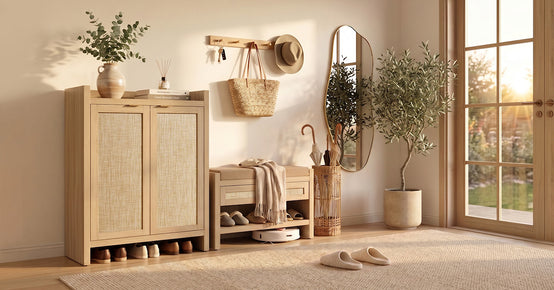
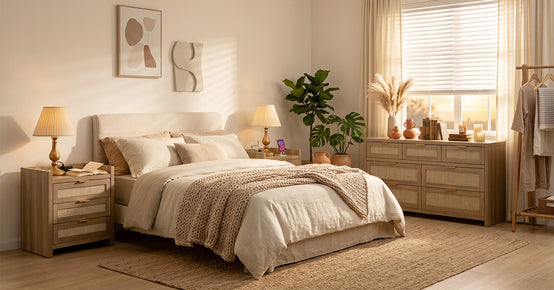
A styled entryway with a woven-front cabinet. Ventilation that looks like furniture.
FAQs
Do ventilated shoe cabinets actually reduce shoe odor?
They cut down buildup. They don't remove odor, though. Because moisture escapes, ventilated fronts keep interior air closer to room humidity, which slows that stale sealed-box smell. Real effect, but limited. Damp shoes and skipped cleanings will overwhelm any amount of airflow.
What's the difference between a ventilated and a fully closed shoe cabinet?
Openings. That's the whole difference. Ventilated means slats, louvers, woven rattan panels, or a perforated back — anything that lets air move through on its own. Fully closed means solid doors sealing the interior. Better at hiding shoes and blocking dust. Worse at letting moisture out.
Can shoes get musty inside a closed shoe cabinet?
Yes — especially pairs you put away damp. Sealed in, the moisture from worn shoes has nowhere to go, and humidity can run 15 to 25 points above the room. The fix is a drying routine (air shoes 30–60 minutes before storing) plus monthly cleaning. A different cabinet alone won't do it.
How do I stop my shoe cabinet from smelling?
Air shoes before storing them. Never put away wet pairs. Wipe the interior monthly. Keep charcoal sachets (swap every 2–3 months) or cedar blocks (sand monthly) on the shelves. Ventilation helps; routine does the heavy lifting.
Are slatted or louvered doors better than solid doors?
For airflow, yes — nothing moves more air than slats and louvers. For dust protection and concealment, solid doors win. Woven rattan lands in the middle: gentle continuous airflow with a mostly-closed look.
Should I store wet or damp shoes in a closed cabinet?
No. Not in any cabinet. Wet shoes need to air-dry fully first — loosen them, stuff with newspaper, leave them out overnight. Storing them damp in a sealed box is the fastest way I know to grow a musty cabinet.
Do ventilated shoe cabinets let in dust?
Yes. Any opening that lets air out lets fine dust in — physics doesn't negotiate. Plan on wiping shelves every few weeks. Small price if odor is your bigger problem; real consideration in dusty homes.
What's the best way to ventilate a cabinet that has no vents?
Crack the doors for an hour after putting shoes away. Pull the cabinet 5 cm off the wall so air reaches the back. Don't overfill the shelves — crammed shoes block what little airflow exists. Some people drill vent holes and cover them with mesh, which works, but honestly the drying routine matters more than any retrofit.