




Wood Shoe Cabinets: Solid Wood vs Engineered Wood for Entryways
Your Entryway Is the Meanest Room in the House
Go stand by your front door and look at the shoe cabinet. That thing has seen things.
February slush pooling underneath it. August sand, everywhere, no matter how often you sweep. December road salt eating at the finish one crystal at a time. No other furniture in your home takes that beating.
Forget the abstract debate. The real question is meaner: which material walks away from your front door alive?
This guide runs both materials through the tests that matter by a front door — water, weight, daily wear, money — then two real cabinets.
What You're Actually Choosing Between
First, the vocabulary — furniture listings abuse it.
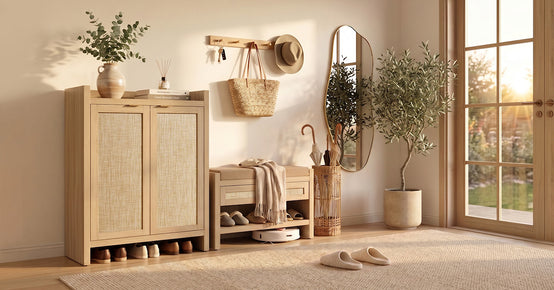
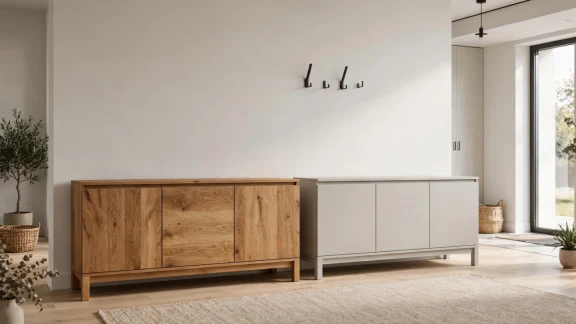
Solid wood means boards: oak, pine, rubberwood, acacia — real lumber, joined, grain running straight through. Engineered wood means manufactured boards — MDF, particleboard, plywood — dressed in veneer or laminate until they look convincing in photos.

And the sneaky one: "wooden shoe cabinet" promises solid wood and delivers... maybe. Always check the materials line.
Solid wood, in plain English
Here's the honest version. Solid wood is lumber, edge to edge. It's dense, heavy, with that deep knock when you rap it with your knuckles. Scratch it and you've scratched wood.

Real wood. Which is secretly the whole selling point, because real wood can be repaired. The catch: lumber and real joinery cost money. But a well-made solid cabinet? It'll outlast your mortgage.
Engineered wood, in plain English
Wood fibers, chips, or thin veneers glued under pressure into boards. MDF paints beautifully; particleboard is the cheap core inside flat-pack furniture. Plywood — layers with the grain running opposite directions — is the tough one, no contest.

The shared superpower: these boards don't move. No single grain direction means humidity swings barely register. And your entryway swings harder than any room except the bathroom.
Test 1: Water — Wet Boots, Rain, and Winter Salt
You get home in a downpour and shove soaked boots straight into the cabinet. Here's what happens inside.
Engineered wood's kryptonite is standing water — not damp air, actual liquid. MDF and particleboard are pressed fibers; soak them and they swell. The edges puff up. The veneer lifts away from the core like old wallpaper. Plywood copes better, but none of them are waterproof.

Solid wood doesn't get a free pass either. It drinks water, swells, looks miserable for a week — then dries out and mostly goes back to normal. A soaked MDF shelf, meanwhile, can lose its structure completely. Different leagues of failure.
The finish is half the battle — a well-sealed matte engineered cabinet buries a badly finished solid one.
The move: a boot tray, ten minutes of air-drying before shoes go inside, and a ventilated cabinet if your household comes home wet often.
Test 2: Weight — Twenty Pairs Are Heavier Than They Look
One pair of sneakers weighs nothing. Twenty pairs plus winter boots? Different story.
Shoes are dense — rubber, leather, hardware — and this is where the two materials part ways.
Solid wood shelves hold straight over long spans. But the part nobody mentions: the screws. Every hinge, bracket, and shelf pin is biting into something. In solid wood, that bite holds for decades. In MDF and particleboard, screws work loose over the years — slowly, then suddenly. Especially doors yanked open daily.

Shorter spans. A center support on wide units. Heavy boots low. Anchor tall cabinets to the wall — thirty pairs up high gets top-heavy fast. Anti-tip brackets aren't paranoia.
Test 3: Daily Wear — Scratches, Chips, and Second Chances
Keys dropped on top. A stroller clipping the corner. The question was never if — it's what the damage looks like a year later.
Solid wood's home turf: scratch solid oak and you've scratched wood. Sand it, dab on stain or oil — mostly gone. A real gouge? Fill, sand, refinish. You get three, four, five rounds of this over a lifetime, which is exactly why solid pieces become heirlooms.
Engineered wood forgives less. Chip through the veneer and the core shows — pale MDF staring out through the finish. Edge banding goes first, usually; once it peels, moisture has a highway straight into the core.
Wear test goes to solid wood — with one asterisk: a cheap solid cabinet with a thin finish looks worse at year two than a well-built engineered one. Build quality beats material snobbery.
Test 4: Money — What You Pay Now vs What It Costs Per Year
But per-year math changes things: solid wood, looked after, 20-plus years; good engineered, kept dry, 10 to 15; budget particleboard, maybe 5 to 8.
|
Material |
Typical price |
Realistic lifespan |
Cost per year |
Best for |
|
Solid wood |
$$$ |
20+ years |
Low over time |
Forever-home entryways; refinishing planned |
|
Engineered (plywood/MDF) |
$$ |
10–15 years |
Low–moderate |
Most households; humid climates |
|
Budget particleboard |
$ |
5–8 years |
Moderate (replaced sooner) |
Rentals, tight budgets, kids' mud years |
Planting roots for a decade? Solid wood's lifetime cost is genuinely hard to beat. Renting? Engineered wood's lower buy-in is the sane choice.
The Uncomfortable Truth: Engineered Wood Often Wins by the Front Door

Okay. Deep breath, wood purists.
By a front door, engineered wood wins more often than anyone admits.
It's the stability. Entryways are humidity rollercoasters — freezing air with every door swing, damp coats steaming two feet away. Solid wood breathes with all of it: drawers that stuck in August glide in January, then stick again. Engineered boards barely notice.
Then there's the replaceability nobody talks about. Entryways flood. People move suddenly. A burst pipe doesn't care about your furniture budget — and replacing an engineered cabinet that cost a third as much hurts a third as much.
That's not "better" — it's pragmatic. Which is why both SICOTAS picks below are engineered wood done right: stable cores, wipeable matte finishes, hardware that survives daily yanking.
Two Cabinets, Compared Honestly

Two real engineered-wood SICOTAS cabinets, specs straight from the listings.
|
Savanna 41" Tall Shoe Cabinet |
Cas Black Shoe Cabinet with Doors |
|
|
Dimensions |
40.94"H × 47.24"W × 14.76"D |
44.9"H × 34.7"W × 14.6"D |
|
Weight |
85 lb |
87 lb |
|
Material |
Engineered wood, matte finish |
Engineered wood, matte finish |
|
Capacity |
30 pairs |
24 pairs |
|
Layout |
Wide format, vertical presence |
Narrower format, adjustable shelves |
|
Best for |
Big households; top doubles as a drop zone |
Narrower walls; mixed shoe sizes |
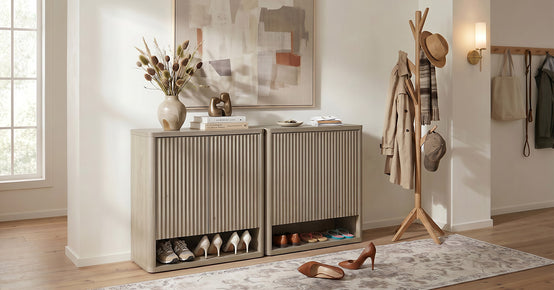
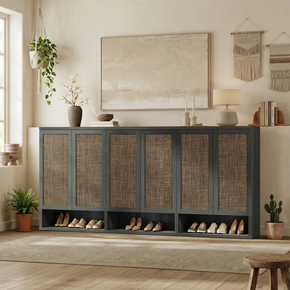
The Savanna 41" Tall Shoe Cabinet is 47.24 inches of width that swallows 30 pairs, its broad top doubling as a drop zone. The Cas Black Shoe Cabinet with Doors runs 34.7 inches wide for narrower walls, and the adjustable shelves solve the boot problem — tall boots get a tall slot.
No solid-wood cosplay here. That's the point. If neither footprint fits, browse the shoe storage collection.
How to Make Either One Last

Five habits.
● Wet shoes go on a boot tray first — ten minutes of air-drying does more for a cabinet than any finish ever will.
● Wipe, don't soak. A damp cloth handles mud and salt. Standing water is the enemy of every wood product ever made, no exceptions.
● Give everything breathing room. Crammed compartments stay damp — shoes and shelves both.
● Anchor tall units to the wall. Ten minutes with a bracket turns a top-heavy cabinet into a non-issue.
● Respect the weight. Boots live low. Flats live high.
Do those five and even a budget engineered cabinet outlives its expected years. Still deciding between closed cabinets and open racks? Shoe Cabinet vs Shoe Rack lays out the tradeoffs.
The Bottom Line
So: solid or engineered? Buying for decades, and you'll actually maintain it — solid wood, no contest. For everyone else — renters, busy families, humid climates, muddy-dog households — a well-built engineered cabinet is the rational buy.

Measure your wall. Keep the depth under 15 inches. Buy capacity for the shoes you actually wear. And start at the SICOTAS homepage.
FAQs
Is engineered wood bad for a shoe cabinet?
Nope. Good engineered wood is the backbone of most well-reviewed shoe cabinets: dimensionally stable, sensibly priced, easy to wipe down. What actually matters is how it's built — sealed edges, a real wipeable finish, hardware that doesn't feel like it'll give up by spring. The thing to avoid is cheap unsealed particleboard. That's the villain, not engineered wood as a category.
Will a wooden shoe cabinet survive wet boots?
Either survives if you keep standing water off it. Dripping boots never go straight in — boot tray, air-dry, then inside. Soak engineered wood and it swells; solid wood handles a soaking with more grace but can still warp. A sealed matte finish is the best insurance either way.
Which lasts longer — solid wood or engineered wood?
Solid wood, maintained — twenty years and up, with a few refinishings along the way. Quality engineered buys you ten to fifteen solid years. Do the honest math — price divided by realistic lifespan — before you decide.
Can you refinish an engineered wood shoe cabinet?
Not really, and that's the honest tradeoff. Sand through the veneer and you hit core material that won't take stain the way wood does. Small chips are fixable — touch-up markers help. Deep damage stays visible. If refinishing is part of your plan, buy solid wood from the start.
Does solid wood warp near the front door?
It can. Front doors are brutal — cold blasts, warm indoor air, humidity swinging all day — and solid wood expands and contracts with it. Good dried lumber and proper joinery keep it minor, but the drawer that sticks every August is a classic solid-wood story. Engineered boards stay put through the same swings.
How much weight can a wood shoe cabinet hold?
Depends on the model, so check the listing's rating — that's what it's for. As a working rule: heavy boots on the bottom shelf, lighter shoes up top, and don't push past the rated capacity. The Savanna above weighs 85 lb empty and is rated for 30 pairs.
Is MDF the same as engineered wood?
MDF is one member of the engineered wood family — the family also includes particleboard and plywood, and they don't all behave the same. Plywood is the strongest and most moisture-tolerant; MDF takes the smoothest finish; particleboard is the budget pick. When a listing just says "engineered wood," finish quality and edge sealing tell you more than the category name.
What's the best way to protect a shoe cabinet from wet shoes?
A boot tray. Full stop. After that: wipe up puddles instead of letting them sit, leave gaps between shoes so air moves, and if your household comes home soaked on the regular, choose a ventilated door style.Useful Sources


Looking for something else?

How to Choose a Bookcase for Plants Without Damaging the Shelves
LEARN MORE
How to Choose a Bookcase for Board Games: Shelf Depth, Height, and Access
LEARN MORE
7 Best Narrow Nightstands for Small Bedrooms With Real Storage
LEARN MORE
Chest of Drawers vs Dresser: Key Differences and Which One to Choose
LEARN MORELooking for something else?
Narrow Shoe Cabinet Buying Guide: Depth, Sizes and Styles That Fit a Small Entryway
LEARN MORE
11 Best Mid-Century Modern TV Stands for Style and Real Storage
LEARN MORE
Mid Century Sideboard Guide: How to Choose the Right Size, Wood and Style
LEARN MORE


Further reading

Zen Bedroom Ideas for a Calmer Room

Sage Green Bedroom Ideas and Furniture That Suits It


