

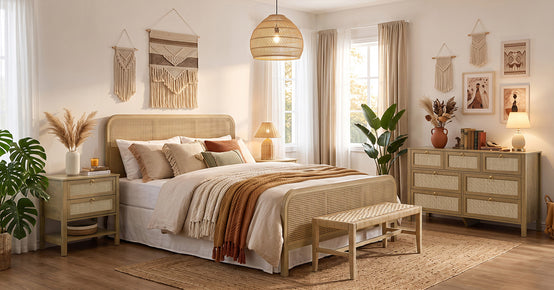
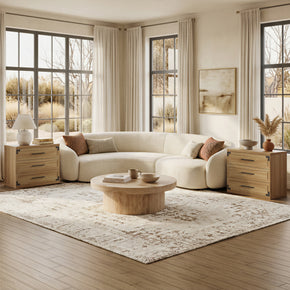



When is mid-century? A Complete Guide to Mid-Century Modern Design

Ask five people what ‘mid-century modern’ means and you’ll get five different answers. ‘The 1950s.’ ‘Those chairs with the funny legs.’ Someone brings up Mad Men. Someone else describes the house they grew up in, which was built in 1974 and had brown shag carpet — adjacent, but not quite.
Part of the confusion is that two completely different ideas got welded into one phrase, and nobody ever bothered to pry them apart. ‘Mid-century’ is a time period. ‘Modern’ is a design philosophy. They overlap — but they don’t mean the same thing, and the furniture industry has found that ambiguity useful—time to be clearer about it.
When is mid-century? The Timeline Is Less Obvious Than It Looks

The simple answer is the 1940s, 1950s, and 1960s
Most people stop there, and that’s fair enough—the middle of the 20th century. A lamp made in 1957 is mid-century. A house built in 1954 is mid-century. A sofa from 1963 is mid-century. Simple.
The design history answer runs earlier, though. Atomic Ranch defines the MCM eraas spanning from the end of World War II through the mid-1970s. Some historians push the start back to the 1930s, when the Bauhaus school and the International Style were already laying down the ideas MCM would later pick up. Britannica draws the line from 1933 to 1965. The range is genuinely contested — depending on who you ask, you’re looking at 30, 40, or somewhere in between.
The more important distinction — mid-century vs. mid-century modern
Here’s where people actually lose money — at estate sales, in antique shops, sometimes just at furniture stores. The mid-century is when something was made. Mid-century modern is a design aesthetic: clean lines, functional forms, natural materials, no ornament to speak of. Those aren’t in the same category.
A heavily decorated Victorian revival chair made in 1958 is mid-century furniture. It is not mid-century modern. Meanwhile, a walnut credenza made last year can carry that MCM label in style, despite having nothing to do with the mid-20th century. That’s why a vintage dealer and IKEA can both legitimately advertise ‘mid-century modern’ furniture — and neither one is wrong, exactly. It’s a situation that probably deserves more scrutiny than it gets.
Why This Whole Thing Started — the Post-War Context Actually Matters

People wanted to stop living in the past.
Millions of families moved into new suburban homes after the war and faced a question that had never arisen at that scale before: how do you actually furnish these places? Victorian heaviness felt wrong. Heavy ornament felt like it belonged to the world that had just produced two devastating wars in 30 years. The appetite was for something genuinely new. Optimistic. Not looking backward. Wikipedia’s MCM entry points out that many European modernist designers — Gropius, Mies van der Rohe, Eliel Saarinen — had already moved to the United States in the 1930s and 40s, seeding exactly those ideas into American design culture before the war even ended.
World War II accidentally created the materials MCM needed
The part of the story that usually gets skipped: the war drove materials science forward at a pace that peacetime never would have. When it ended, designers suddenly had access to plywood that could be bent and molded, fiberglass that held complex shapes, aluminum, foam, plastic laminates — all of it newly cheap and newly available.
This is literally why Eames chairs look the way they do. You cannot carve solid wood into those compound curves. The only way to get that shape is to cast it. The technology made the aesthetic possible, not the other way around. That’s also why MCM furniture has a structural logic running through it that most trend-based furniture doesn’t — the forms were justified by what the materials could actually do.
Smaller houses needed lighter, smarter furniture.
Post-war housing went up fast and dense, and those houses were smaller and more open than anything from the generation before. Closed-off rooms gave way to open plans. Furniture had to be compact, visually light, and often dual-purpose. MCM addressed every one of those constraints directly. That, incidentally, is also why it translates so cleanly to apartments in 2026. The constraints haven’t changed.
What Actually Makes Something Mid-Century Modern?

Ornament is the enemy — and that's more radical than it sounds
Furniture before MCM was covered in things. Carved legs, ornate hardware, and decorative surface details everywhere you looked. MCM took all of that away deliberately. To someone coming from Victorian or even 1930s furniture, it would have felt nearly aggressive in its simplicity.
In place of ornament, you get proportion, material quality, and the geometry of the form itself. An MCM piece earns its looks through how the angles sit, how the wood grain reads, how the proportions land — not through anything applied to the surface afterward. It’s a fundamentally different standard for what makes something worth looking at, and a big part of why MCM furniture still looks good decades later.
Organic and geometric shapes in the same piece
There’s something almost contradictory about MCM shapes when you really look at them. A kidney-shaped coffee table is entirely organic — pulled from the natural world. A rectangular sideboard on tapered legs is architectural, almost engineered. An Eames chair is a molded organic shell sitting on angular steel legs—two entirely different-shaped languages in the same object. By rights, it shouldn’t hold together. It does, almost every time. That tension between the curved and the geometric is one reason these pieces don’t go dead on you.
Natural materials shown as themselves
Walnut, teak, oak, leather, wool, stone — none of these are trying to be anything other than what they are. Walnut looks like a walnut. Leather looks like leather. No paint to make wood look like marble. No cheap substrate hiding under a thin veneer with the price tag of solid wood. Designers at the time actually used the phrase ‘honest use of materials’ — and that honesty is part of why these pieces hold up physically as well as they do. There’s nothing underneath to fail.
Color as punctuation
Mustard yellow. Burnt orange. Avocado green. Deep teal. These are the colors everyone pictures when they think of MCM, and they’re not wrong. But in rooms that actually work, those colors show up in one place, maybe two — against a backdrop of warm white, cream, natural wood. A mustard throw on a walnut sofa reads exactly right. An entire room in mustard is a different project entirely. Most MCM color mistakes come from not understanding that the bold colors are punctuation, not prose.
Mid-Century Modern Furniture — What You're Looking At When You Shop

Tapered legs: fastest identifier in the room
The fastest way to identify an MCM piece in a room: look at the legs. Slender, angled slightly outward, narrowing toward the floor. That single detail runs across sofas, dining chairs, side tables, nightstands, credenzas, and desks throughout the entire MCM catalog. It visually lifts the furniture off the ground, lets the floor show through, and keeps the room from feeling weighed down. That’s the ‘breathes’ quality people describe. It usually comes down to legs.
The sideboard is the most MCM piece of furniture.

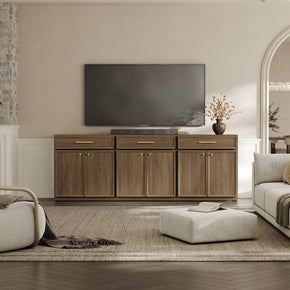
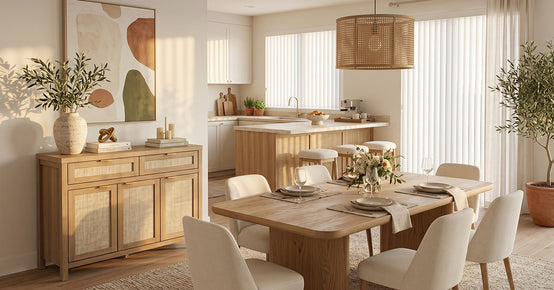
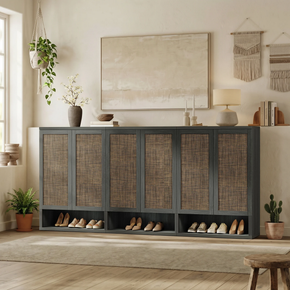
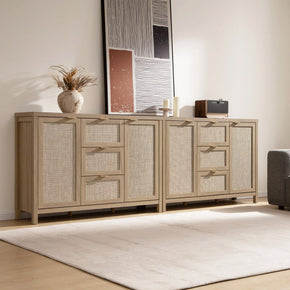
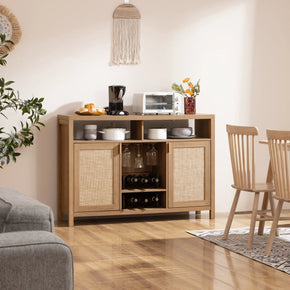
Of all the furniture that defines MCM interiors, the low sideboard is probably the most representative. Long, horizontal, tapered legs, closed storage below, a clear surface on top for a lamp or a plant or nothing at all. The Helio Decorative Sideboard Cabinetworks in this exact tradition — clean hardware, structured form, storage kept behind doors. The surface above it stays intentionally open. Hidden storage below, display surface above: that’s the MCM arrangement, and it’s as practical now as it was in 1960.
The woods: walnut, teak, oak
Walnut, teak, oak. These dominate MCM furniture for practical reasons: warm tones, strong grain patterns, and the fact that they look better after ten years than they did when new rather than worse. Teak was the Danish modern standard through the 1950s and 60s. Walnut, slightly richer and darker, was the American default. Both still appear in contemporary MCM-influenced furniture because both still do the same job. They bring the warmth that ornament used to bring, at no visual cost.
The canonical pieces — worth knowing even if you never buy them
Eames Lounge Chair. Saarinen Tulip Chair and Table. Noguchi Coffee Table. Nelson Ball Clock. Bertoia Diamond Chair. You’ve seen all of these, probably without knowing the names. They set the proportional language for MCM — the relationship between weight and lightness, between organic curves and geometric lines. Originals are expensive and the reproduction market is full of problems. But understanding what those pieces were solving visually gives you a way to evaluate contemporary pieces on the same terms, rather than just hoping the tapered legs are enough.
What MCM Architecture Looked Like — and Why It Still Matters for Interiors

Low, horizontal, and grounded.
MCM buildings go wide, not tall. Low rooflines, broad overhangs, windows running in ribbons across the facade rather than punched in one by one. Where Victorian houses strain upward, MCM houses hug the ground. That same horizontal logic runs through every interior: the long, low sideboard, the spread-out sofa, the coffee table that opens across the floor rather than stacking anything on top.
Open floor plans — this was genuinely radical at the time.
Everything was enclosed before MCM — dining room, living room, kitchen, all sealed off from each other with walls and doors. MCM architecture blew that arrangement open. Post-and-beam construction replaced load-bearing walls with structural columns and beams, which meant the walls themselves could be glass. Rooms felt bigger. Light got further into the house. People could actually see from one end of the home to the other. At the time, that was a fairly radical thing.
The glass wall and the indoor-outdoor philosophy
Floor-to-ceiling windows. Sliding glass panels. Atriums planted with indoor trees. The whole project was to make inside and outside feel like the same continuous space. Palm Springs still has the densest collection of intact MCM architecture in the country — and when you’re standing inside one of those houses, with the desert framed in glass on three sides and the door track sliding back to nothing, you understand immediately what they were going for.
How this translates to furniture

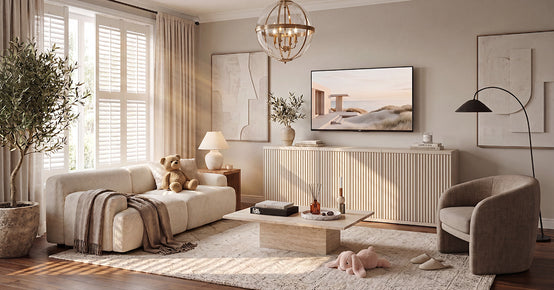
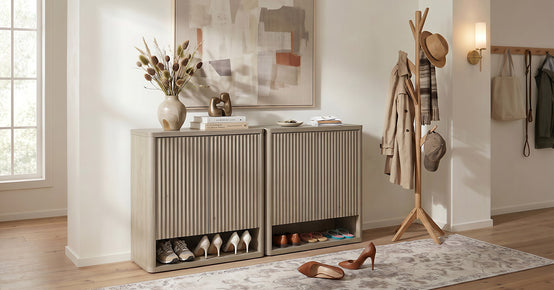
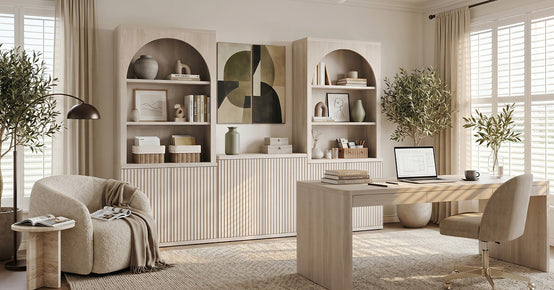
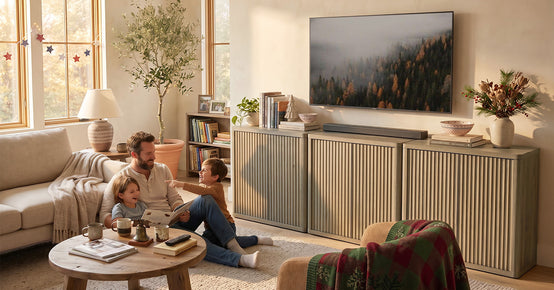
A low horizontal sideboard pulled away from the wall — not crowding anything, not dominating the room — does the same thing MCM architecture does: keeping things open, letting space breathe, and avoiding accumulation. The Stria Sideboard with 2 Doors follows that same impulse — the fluted front panels add visual texture without bulk, the doors tuck everything away behind clean surfaces, and the low profile keeps the wall above open for art or just open.
The Designers — Some Names Worth Knowing

Charles and Ray Eames
Husband and wife. Pacific Palisades studio. Years of working through molded plywood and fiberglass in the 1940s, trying to find a chair that was simultaneously light, structurally strong, inexpensive enough to manufacture at scale, and actually comfortable to sit in — all four, not three out of four. The Lounge Chair came in 1956 and has remained in production. Their house from 1949 is now a landmark. Anyone who’s ever walked through a design store has recognized an Eames chair even without knowing the name. That level of recognition doesn’t happen by accident.
Eero Saarinen
Finnish-American, working with the same sculptural instincts whether he was designing a chair or an airport terminal. The Tulip Chair in 1955 came from his irritation with what he called ‘the slum of legs’ — the visual chaos of multiple furniture supports scattered across a floor. He wanted a single pedestal base. He got it. The Gateway Arch, TWA Flight Center at JFK, Dulles International Airport — all of them have the same quality: they look like the only form the object could have taken. That sense of inevitability in a design is hard to manufacture.
George Nelson, Florence Knoll, and the Scandinavian connection

Nelson was Herman Miller’s creative director for two decades, designing clocks, storage systems, sofas, and writing seriously about what design was for as a cultural enterprise, not just an aesthetic one. Florence Knoll translated the same principles into corporate and institutional settings. The Scandinavian side of the family — Jacobsen, Wegner, Aalto — brought a craftsperson’s sensibility and the warmth of natural materials to the same clean-lined framework, which is why Danish modern and American MCM feel like cousins rather than the same thing. If you’re looking for furniture that applies these ideas right now, Sicotas modern furniture works in exactly that tradition — clean form, real warmth in the materials, storage actually built to function.
5 Key Elements of Mid-Century Modern Decor

1. Furniture with tapered legs and clean edges — no ornament
Start here. Any piece of furniture in the room with clean, undecorated lines and slim tapered legs — sofa, dining table, accent chair, sideboard — establishes the visual language that everything else will follow. Without at least one piece like this, the style doesn’t register. With one, it tends to pull the whole room in the right direction.
2. At least one warm wood surface
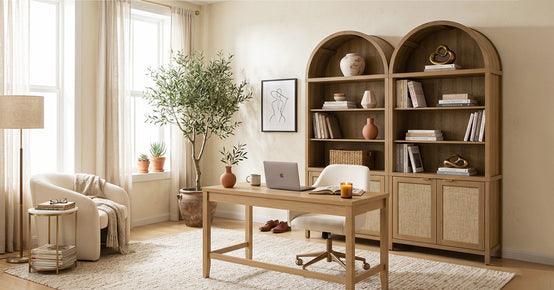
Some kind of warm wood surface in the room is non-negotiable if you actually want MCM rather than just ‘modern.’ A walnut dining table. A teak credenza. An oak bookcase. Without wood, you have the geometry but not the warmth, and the style ends up reading cold rather than calm. The wood is doing the emotional work that ornament used to do, just without all the visual interference.
3. Storage that displays and hides at the same time

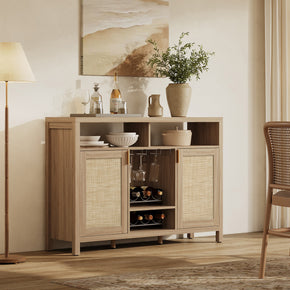
MCM rooms aren’t minimalist in the bare sense — they’re selective. A sideboard keeps everyday objects behind closed doors while holding a lamp and a plant on its surface. Something like the Helio Glass Sideboard with Doors takes it further: objects sit inside, visible through the glass, contained and organized without being entirely hidden. The combination of things shown and things stored — without clutter and without emptiness — is what makes an MCM room feel considered rather than staged.
4. One bold accent color — in one or two places, not everywhere
Mustard, rust, forest green, deep teal, cognac. Choose one. Put it in one spot — a pillow, a vase, a chair — and leave everything else as neutrals. The accent color makes its statement and then exits. Where people go wrong is using the same accent in four or five places, which turns a deliberate styling move into a theme. Themes date. A single color note doesn’t.
5. Something living and natural
A plant, or natural light getting into the room, or a wool rug underfoot, or a leather surface somewhere — something from the outside world needs to be physically present. MCM was always partly about dissolving the wall between inside and out. A room with the right shapes but no natural materials, no greenery, no daylight has the vocabulary but not the feeling. The quality of life is the last thing that lands, but often the first thing missing.
How to Actually Use MCM in a Real Home Right Now

One anchor piece does more than a full room set.
The fastest way to get MCM wrong is to buy five matching pieces and fill the room at once. It ends up looking like a period-room installation — very expensive, but still more showroom than home. One strong anchor piece does more: a walnut credenza, a lounge chair with some presence, a clean dining table. That piece sets the direction, and everything else you add over time responds to it naturally.
MCM mixes with more styles than people expect

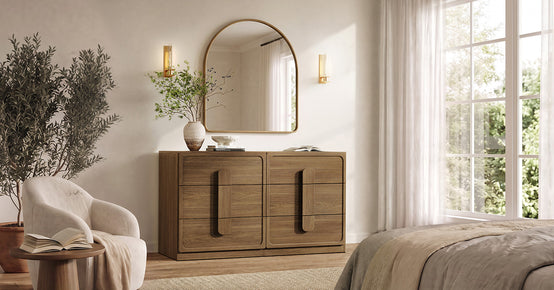
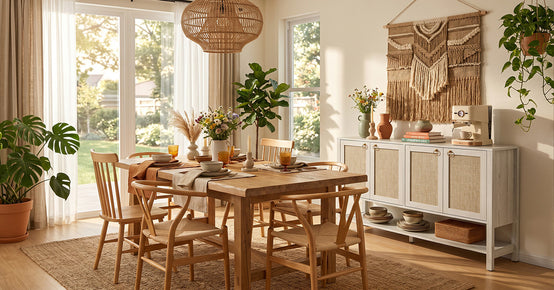
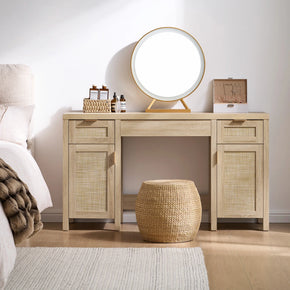
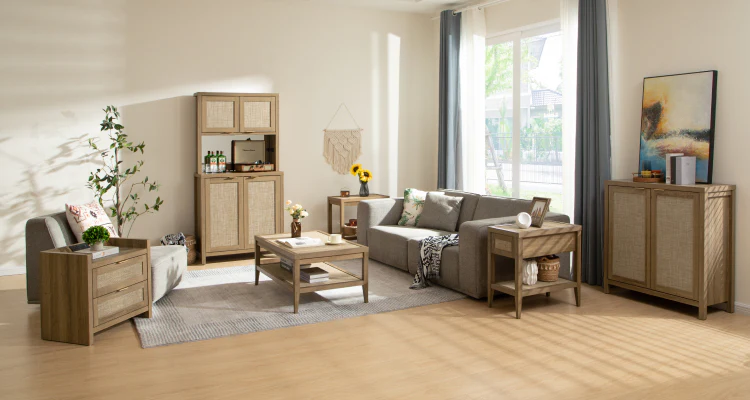
MCM furniture mixes more easily than most people expect because its proportions are restrained and its finishes don’t demand a particular partner. It holds its own alongside contemporary pieces, industrial elements, Japandi furniture, and bohemian textiles — none of those things clash with it. The Savanna Sideboard 3 Drawers and 2 Doors is a good example in practice: MCM proportions, strong horizontal profile, enough storage to be genuinely useful — and it works in a range of rooms without being tied to a specific era or needing a matching set to make sense.
Update the obvious period signals.
Hairpin legs on everything. Orange and avocado as the color scheme. Retro globe pendants in every room. These date the approach immediately. The underlying logic — clean lines, warm wood, function before decoration — hasn’t aged at all. The specific period signals have. So swap them: forest green for avocado, slate blue for burnt orange, abstract prints that don’t look like they came out of a 1960s catalog. Keep the philosophy, update the costume.
Use the 3-5-7 rule on MCM surfaces.
Because MCM surfaces are intentionally simple, every object sitting on them gets scrutinized. Three things on a console, varying in height. Five items on a shelf with visible gaps between them. The rule is odd numbers and deliberate space — the gaps are as much a part of the arrangement as the objects themselves. In MCM rooms, more than most, what you’ve decided not to put somewhere is at least as important as what you have put there.
|
Short MCM formula: one warm wood piece + one bold accent color used in one place + one clean-lined storage piece + one plant + plenty of open space. That's the core. Everything else is optional. |
FAQs
Why is Mid-Century Modern design still popular?
Mostly because the problems it was designed to solve haven’t gone away. Clean lines that don’t clutter a small room. Furniture that doesn’t compete visually with everything else in the space. Wood that looks better in twenty years than it does today. There’s also a genuine post-war optimism in the style — a sense that design could be useful and forward-looking rather than just decorative — and that feeling hasn’t entirely dated. Trend-led design tends to look old within a decade. MCM has been in mainstream use for thirty years and still doesn’t look tired.
What is the 3-5-7 rule in decorating?
Group things in odd numbers, and they tend to look intentional. Even numbers create pairs, and the eye reads a pair as complete and moves on. Three things, or five, or seven, leave a slight visual imbalance that keeps the eye moving through the arrangement. In an MCM room, this matters more than average because the surfaces are simple and undecorated — there’s nothing else to look at besides what you’ve placed on them. Three well-chosen objects on a sideboard will always beat a cluttered six.
What defines mid-century modern style?
No applied decoration. Materials used honestly — wood looks like wood, leather like leather. Geometric and organic shapes coexist in the same piece without conflict. Warm accent colors — mustard, rust, teal — used sparingly against neutral backgrounds. And a persistent effort to keep the room connected to the outside world through light, plants, and natural textures. The through-line is that every decision should have a reason beyond aesthetics — usually function, sometimes structural, occasionally material.
Is MCM still popular in 2026?
Yes, still popular — and has been since the 1990s revival, which means we’re talking close to 30 consecutive years in mainstream design. That’s not a trend cycle, it’s an established vocabulary. What has changed is the approach: full-period-accurate MCM rooms now read more like exercises in nostalgia than as living spaces. The current version that works is mixed — one or two strong MCM pieces alongside contemporary furniture, newer lighting, updated colors. That approach reads as current without the museum-exhibit feeling.
Is mid-century modern LGBTQ?
No — it’s a design movement tied to post-war materials technology, suburban housing growth, and a particular rejection of Victorian ornament. It emerged from a specific set of cultural and economic conditions in the 1940s and 50s, shaped by designers from across Europe and North America. The style has no inherent connection to any particular identity group. It can be applied across the full range of aesthetics: minimal, expressive, formal, relaxed, neutral, or bold. Design doesn’t belong to anyone in that sense.
What are the 5 key elements of MCM decor?
Furniture with tapered legs and no ornament — at least one piece that clearly announces the vocabulary. Some warm wood somewhere in the room — walnut, teak, oak. A storage piece that actually holds things behind closed doors rather than leaving everything visible. One bold accent color is used in one or two places and nowhere else. And something natural: a plant, a wool rug, a leather surface, actual daylight. That last one gets left out more than any other.
Is MCM still in style?
Still in style. Still on every design platform, still in furniture stores, still photographing well in real homes. The version of MCM that dates is the costumed version — period-accurate rooms with every detail matched to the 1960s. The version that doesn’t date is the one where MCM pieces mix with everything else in the room without insisting on a particular decade. That’s the approach that looks right in 2026.
Who is the most popular mid-century modern designer?
Charles and Ray Eames, and it’s not a close race. Their chairs never left production. Their house is a national landmark. Most people who couldn’t name a furniture designer can still recognize an Eames Lounge Chair on sight. Eero Saarinen follows — the Tulip Chair and his airport buildings gave him an unusually specific visual identity. George Nelson, Florence Knoll, Arne Jacobsen, and Isamu Noguchi each have serious followings if you go further in.
The Short Answer — and Why It Matters More Than You'd Think
The mid-century is a time period — roughly the 1940s through the 1960s, give or take a decade depending on the historian. Mid-century modern is the design language that emerged from that period: built on post-war optimism, new manufacturing materials, the demands of suburban housing, and a hard rejection of decoration as an end in itself—related things, but not the same thing.
The reason the style has remained in continuous use for nearly 30 years isn’t nostalgia — it’s that the problems it was designed to solve are still the same. Small rooms. Open plans. Furniture that serves more than one purpose without taking over the space. Applying MCM now means working with those principles directly: clean lines, warm wood, real storage, one color note, something alive — not copying a room from a 1958 magazine.
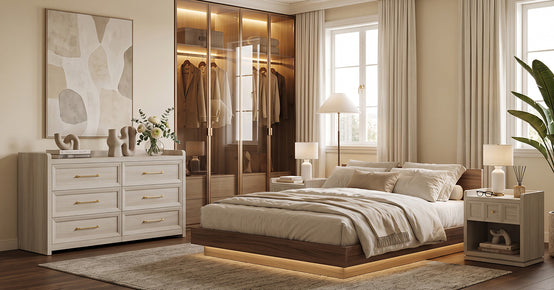
If you need furniture that actually applies this thinking, the Helio furniture collection at Sicotas is worth spending time with — clean lines, real storage, finishes that sit comfortably in modern homes without dating the room to any specific decade.
Resources
- Wikipedia — Mid-Century Modern — Timeline, architectural history, Bauhaus and International Style influences, key designers worldwide.
- Atomic Ranch — What Does Mid-Century Modern Mean? — Post-WWII origins, MCM era definition, architectural characteristics, and key designers.
- The Spruce — What Is Midcentury Modern Style? — Design features, history, key characteristics, materials, and practical home styling tips.
- The Best Airbnbs in Palm Springs for Mid-Century Modern Devotees — Designer interviews on MCM's enduring relevance — functionality, mass production, indoor-outdoor connection.


Looking for something else?

Furniture Materials Guide: Picking the Right Material Room by Room
LEARN MORE
How to Mix Wood Tones Without Making a Room Look Mismatched
LEARN MORE
18 College Apartment Furniture Ideas That Save Space and Money
LEARN MORE
Types of Entertainment Centers: 11 Designs and How to Pick One
LEARN MORELooking for something else?

Curio Cabinet Decor Ideas: How to Style a Display Cabinet Without the Clutter
LEARN MORE
Curved Furniture: How to Style, Measure, and Buy It in 2026
LEARN MORE
What Is Rattan Furniture? A Buyer Guide to Types and Care
LEARN MORE


Further reading

How to Choose a Nightstand for a CPAP Machine

How to Choose a Shoe Cabinet for Men's Sizes, High-Tops, and Bulky Shoes


