




21 Moody Bedroom Ideas for a Dark, Cozy Retreat

Think about the last time you stayed somewhere and thought: This room is exactly right. The lighting was probably low. The walls probably weren't white. There was something textured on the bed and curtains that actually reached the floor.
That's a moody bedroom. Not a dark room in the depressing sense — in the atmospheric sense. A room that feels deliberate. One that doesn't make you want to leave.
Most people assume getting there requires either expensive design help or some instinct they don't have. Neither is true. It's mostly a handful of specific decisions: a color with some depth, the right bulbs, a bed layered with texture, and enough contrast so the room still has life. The 21 ideas here cover it all.
So What Makes a Bedroom 'Moody'?
Not sad. Not gloomy. Those versions exist, but they're bad design, not moody design.
In interior design, "moody"refers to a room built around atmosphere rather than light. Architectural Digest describes the key as keeping saturation levels consistent throughout the room — walls, floors, furnishings all existing in the same tonal world. That consistency is what makes a dark bedroom feel designed rather than just painted. Take it away, and you get a room that's dark in the same way a power outage is. Keep it, and the room has presence.
Moody colors include deep forest green, chocolate brown, navy, dusty plum, smoky charcoal, rust, burgundy, and dark olive. None of these requires a commitment to something oppressive. All of them, with the right lighting and the right textiles, feel warm.
1. Forest Green — Start Here If You're Unsure

Of all the colors on this list, forest green is the most forgiving. It has warmth that navy and charcoal don't naturally carry. It works behind wood furniture, behind upholstered furniture, behind almost anything. It photographs well, but more importantly, it looks right at 10 pm, when no one is taking photographs.
Under warm amber light, it takes on a rich, earthy tone. Against cream bedding, it reads almost expensive. Nobody ever paints a room forest green and regrets it the way they might regret going full black.
The brief: all four walls for full enclosure, or just the wall behind the bed if you want to ease in. Cream or oatmeal linen. Brass or wood hardware. A warm bulb. Done.
2. Charcoal With Light Bedding — the Contrast Does the Work

Charcoal is black minus the harshness. It has a warmth that pure black doesn't, and it doesn't flatten the room the same way. More livable. More forgiving of imperfect lighting.
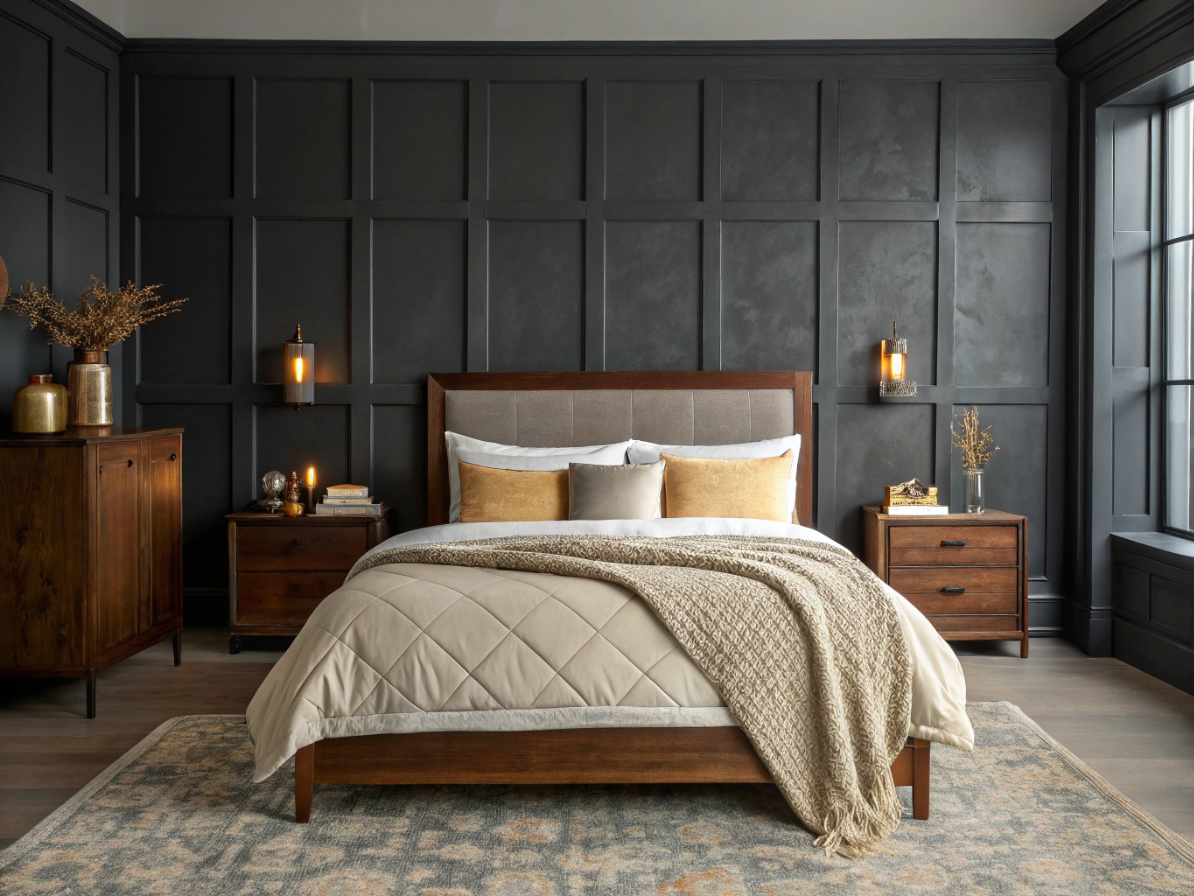
The light bedding is non-negotiable. Cream sheets, oatmeal duvet, warm white linen — something that sits obviously lighter than the walls. That push-pull between dark walls and light bed is doing most of the visual work in the room. Remove it, and the charcoal goes from atmospheric to just dim.
A warm wood nightstand keeps the palette from reading cold. The Savanna Nightstand with 3 Drawers and Charging Station works here — three drawers deep enough to actually clear the surface, proportions that sit comfortably against a dark wall without disappearing.
3. Navy — the Color That Looks Like a Decision Was Made

Painting a bedroom navy signals commitment. Same room in greige or agreeable gray signals someone who looked at thirty samples and picked the middle one. The Navy doesn't do that.
One thing that kills the Navy: cool bulbs. Cool-toned light under navy walls produces a room that feels like a corporate meeting room with ambitions. Warm bulbs at 2700K — roughly the temperature of traditional incandescent light — pull navy into warmth. That's the version worth living in. Cream linen, something wooden, a brass lamp. The rest sorts itself out.
4. Chocolate Brown — Warmer Than Any Other Dark

Brown bedrooms have been making a comeback for a few years now, and the reason is simple: warmth. A deep chocolate or tobacco brown bedroom on a cold gray morning feels warm before any lamps are switched on. Charcoal and navy can't say that.
Pair with caramel leather — a bench, a chair, a small stool — cream linen, aged brass. The room ends up feeling like the most comfortable library imaginable, which is a better aspiration for a bedroom than most.
5. Plum and Burgundy — Used Everywhere Except Bedrooms

Boutique hotels constantly use dusty plum and burgundy in bedrooms. Residential design rarely does. The gap is hard to explain because both colors work beautifully in this context.
Plum has a vintage warmth. Burgundy has richness without the starkness of black. Both feel grown-up in a way that greens and blues don't quite replicate. Rule: keep the bedding neutral. Deep walls plus deep bedding make the bed disappear. Deep walls plus cream or warm-white bedding is the version that photographs well and lives well.
6. Color Drench — Walls, Trim, Ceiling, All of It

Standard approach: dark walls, white trim. It works. But the white trim creates a visual boundary, making the room feel as if it stops at the edge of the painted surface. Color drenching — running the same color across walls, skirting boards, trim, and ceiling — removes that boundary and makes the room feel complete. Good Housekeeping suggests balancing the dark envelope with lighter bedding and accessories so the room has somewhere to breathe visually.
The extra cost of painting trim and ceiling on top of the walls is maybe 20% more paint. The visual impact is significantly more than 20% better. Worth doing if you're already committed to repainting.
7. The Ceiling — Most People Leave This White and Shouldn't

Dark walls, white ceiling. It's the default. The white ceiling can look unfinished in a dark room,as the painting was interrupted.
Same color on the ceiling as the walls, or one shade lighter, and the room wraps rather than containing. That's the cocoon effect — a bedroom that holds you rather than housing you. For a space where the stated goal is rest and privacy, that direction is obviously correct.
8. Two-Tone Walls for Compact Bedrooms

Small bedroom. You want dark walls. The worry is it'll feel claustrophobic.
Two-tone walls solve this. Dark lower section — roughly the bottom two-thirds — lighter neutral above. The dark grounds the space without bearing down on the ceiling. Keep the split crisp, the bedding light, and the floor as clear as possible. The room reads as moody without reading as small.
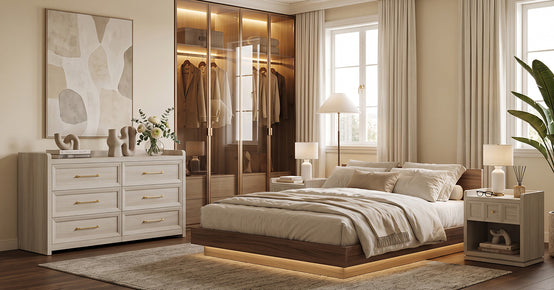
Keeping storage closed and compact matters in a smaller dark bedroom. The Cas 6-Drawer Dresser for Bedroom holds a full wardrobe's worth of clothes without eating up the room — compact footprint, six functional drawers, nothing overbuilt.
9. The Bulbs — Change These Before Anything Else

This is the most important item on this list. Not the color. Not the furniture.
Cool daylight bulbs at 5000K or 6500K in a dark bedroom look wrong in a way that's hard to fix with any other change. The darkness reads as harsh rather than soft. The room feels like an unfinished project.
Warm white at 2700K — roughly the temperature of old-style incandescent bulbs — makes the same room feel intimate. The walls haven't changed. The paint hasn't changed. The whole atmosphere has. Cost: about $15 for the whole bedroom. It's the highest return change on this list by a considerable margin.
10. Sconces Over Table Lamps — With Dimmers on Everything

Table lamps work. Sconces are better in a moody bedroom. They position the light at the right height for reading and winding down. They free up the nightstand. They don't add the visual clutter of a shade sitting at eye level on an already busy surface.
Dimmers change the room more than any other single electrical decision. The gap between a bedroom at full brightness and the same room at 20% is not a small aesthetic shift — it's a completely different environment. Put dimmers on everything that accepts them.
A nightstand that keeps the surface clear makes the sconce the focal point rather than competing with it. The Crescent 3-Drawer Nightstand has enough drawer depth to genuinely clear what accumulates at the bedside — slim profile, clean lines, doesn't demand attention.
11. A Statement Light Fixture — Bigger Than Your First Instinct

Dark ceilings swallow small pendants. A flush-mount or a single recessed downlight in a drenched-colored room provides light but adds nothing to the design. A proper statement pendant — large rattan, bronze dome, sculptural metal form — becomes part of the room rather than just infrastructure.
Scale up. Whatever size feels about right, try the next size up. A pendant that would look balanced in a white room typically reads as too tentative in a dark one.
12. Candles — Genuinely Different from Electric Light

Candles produce light at roughly 1800K. That's warmer than any LED or halogen currently available. The slight flicker adds movement that static sources can't replicate. In a dark bedroom with the main lamps off, three candles on the dresser produce a quality of light that's qualitatively different — not because it's nostalgic, but because it actually is different.
Battery candles for every night. Real ones for evenings that warrant them. Neither requires design thought after the initial purchase.
13. Limewash Paint — When Flat Emulsion Isn't Enough

Flat emulsion on a dark wall looks flat. That sounds obvious, but it's a real problem in practice — the color can be exactly right,t and the wall still looks inert. Uniform. No movement.
Limewash has a chalky, naturally variable finish that gives a dark color and a layered look. The same forest green or chocolate brown in limewash looks alive at different times of day in a way standard paint simply doesn't. Costs more. The difference is visible enough to be worth it, at least on the main wall.
14. Dark Patterned Wallpaper — One Wall, Behind the Bed

Botanical print, moody floral, abstract repeat, textured paper — one wall of dark wallpaper behind the headboard creates the atmospheric quality of dark paint with considerably more visual interest.
One wall is right. Four walls of dark, patterned wallpaper compete with everything in the room, including themselves. One strong feature wall gives the pattern room to read and gives the rest of the design something to respond to.
15. Paneling — Grid Molding, Board-and-Batten, Anything Textured

A textured dark wall looks designed. A flat dark wall looks painted. That's not a condemnation of flat walls — it's just a real perceptual difference that's worth knowing about.
Grid molding, board-and-batten, tongue-and-groove — any of these applied to a dark wall creates shadow variation that changes across the day. Under morning light, under evening lamp, under a single overhead source: three different rooms. For roughly the cost of timber and a few hours of work.
16. Layer the Bed — Dark Walls Demand More

A flat duvet on dark walls makes the room look unfinished. The bed needs weight, texture, and contrast.
The layering: fitted sheet, top sheet, duvet in a lighter neutral, throw draped at the foot — casually, not folded — pillows in at least two sizes, at least two different textures. The colors can be simple and close: cream, oatmeal, warm white, soft camel. The variation across materials is what makes the bed look like somewhere you want to get into, rather than just land on.
17. Floor-Length Velvet Curtains — Rod at Ceiling Height

Ceiling-height rod. Not a window-height rod. Every interior designer says this. Most people install the rod at window height anyway because it's easier. The ceiling-mounted version makes the room feel taller, the windows feel larger, and the enclosure feels complete. In a moody bedroom, those effects compound.
Velvet is the right fabric for this application. It absorbs sound (noticeably), has a light-catching quality that linen and cotton can't match, and adds weight that makes the room feel considered. Deep teal, forest green, dusty plum, charcoal, rust — color choice is open. All of them work in a dark bedroom.
18. Furniture That Belongs in the Palette

Light-toned Scandinavian wood in a dark bedroom has a stranded quality — like it arrived from a different house and nobody reassigned it. Walnut, espresso, ebonized oak, and dark-stained furniture in any form read as part of the scheme rather than an exception to it.
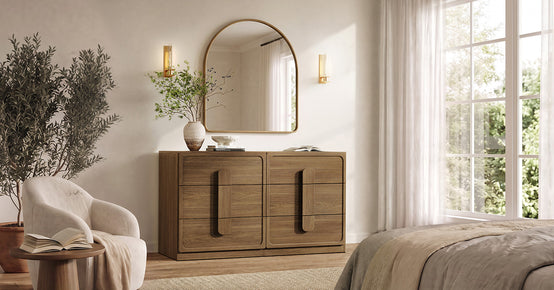
A tall dresser in warm wood or dark finish anchors one wall and provides genuine storage. The Savanna 7-Drawer Tall Wood Dresser is appropriately proportioned — substantial enough to read as a real bedroom piece, not so big that it dominates.
19. Moody Forest Bedroom — Green, Wood, Plants, Amber Light

Deep green walls. A dresser or nightstand with visible wood grain. A snake plant (handles low light, doesn't need fussing over). Cream linen on the bed. Botanical prints in simple black frames. Maybe dried stems in a narrow vase—amber lamp light rather than overhead.
Together: a room that feels like a considered retreat rather than a decorated space. Like somewhere quiet and specific. The components are modest. The effect is not.
A wide wood dresser in a natural finish sits right in this palette. The Savanna 6-Drawer Wood Chest of Drawers brings the real wood quality the forest bedroom needs — six full drawers, proportioned for different room sizes.
20. Dark Academia — Brown, Books, Late-Night Lamp

The dark academia bedroom is a specific brief. It should look like a scholar's room in a novel — warm brown or deep burgundy walls, a bookshelf visible from the bed, a lamp that belongs in a library (brass base, dark shade, angled toward reading position), plaid or houndstooth on a throw, framed vintage maps.
Modern minimalist furniture clashes with this aesthetic badly. Pieces with some weight to them — turned legs, visible joinery, anything with a bit of history — work far better. If the room already has one piece like that, build from it.
21. Consistent Metal Finishes — Brass, Bronze, or Matte Black

Mixed metal finishes register below conscious thought most of the time. Chrome lamp base, gold-toned drawer pulls, brushed-nickel mirror, black curtain rod in the same room: individually unnoticed, collectively producing a low-level feeling that something's not quite right.
Pick two finishes and run them through everything: lamp base, curtain rod, mirror frame, drawer hardware. Brass plus matte black is a natural pairing in a dark bedroom. Bronze plus dark wood runs warmer. Whichever combination, the agreement across all the metals in the room is what makes the space feel resolved.
A wardrobe with a clean, upright form closes out the bedroom storage without adding another design problem. The Savanna 71-Inch Wardrobe is proportioned for standard bedroom walls — tall enough to be genuinely useful, quiet enough not to compete.
Where Moody Bedrooms Go Wrong
- Dark walls plus dark bedding plus dark curtains — no contrast anywhere — the room loses atmosphere and just reads as dim
- Cool bulbs — this is the single most common problem; warm white at 2700K is not optional
- No rug — bare dark floor under dark walls is the specific combination that earns the cave comparison.
- Too much small decor — restraint works better here than abundance
- Misjudging the light available — a north-facing room with one small window needs a different approach from a well-lit dual-aspect one
- Clutter on surfaces — a moody bedroom must also feel calm; the atmosphere breaks down when surfaces are messy
Bottom Line
Moody bedrooms work when all the decisions point in the same direction. Color with depth. Lighting that's warm and aimed rather than overhead and indiscriminate. A bed with enough layering to be inviting. Contrast where the room needs it.
Change the bulbs first. Paint second. Everything else follows.
FAQs
How do I make my bedroom moody?
Start with the bulbs. Warm white at 2700K. Then choose a dark color and paint the walls. Layer the bed in lighter neutral linen and textures. Hang floor-length curtains. Add at least one lamp and preferably sconces with dimmers. That sequence, in that order, gets the result more reliably than any other approach.
What are the best moody colors for a bedroom?
Forest green, navy, charcoal, chocolate brown, dusty plum, burgundy, smoky teal, dark olive, and rust. Colors with depth and shadow. They absorb light rather than reflect it, which creates an enclosed, held-in feeling that makes a moody bedroom work rather than just look dark.
What does a moody bedroom actually look like?
Dark walls. Warm, directed light from lamps or sconces — not overhead. Bedding in lighter neutral tones with a layered texture. Heavy curtains from ceiling to floor. Furniture with visual weight. Surfaces that are clear rather than covered. It looks finished in a specific, intentional way. Nothing is there by accident.
What does moody mean in interior design?
Atmospheric. Built around enclosure and intimacy rather than openness and light. The best moody rooms are genuinely comfortable — warm, quiet, like somewhere you'd choose to spend time. The term specifically describes spaces that use darker colors, warm lighting, and layered textures to create emotional richness rather than airy openness.
What colors work for a teenager who wants a moody bedroom?
Deep teal, muted navy, dusty purple, or forest green. None of these is so specific that they can't evolve as taste changes. Keep bedding lighter than the walls. Include a proper desk with good task lighting. Add personal elements — shelves for books, space for things that matter to them. Moody doesn't mean sparse, and it doesn't mean the room only works one way.
What are the bedroom color trends for 2026?
Warm browns and deep chocolate tones. Smoky blues and deep teals as alternatives to sage green, which dominated the previous few years. Earthy pinks and clay tones still appear. And darker nature-forward colors — forest green, deep aubergine, olive — in bedrooms specifically because they feel grounded in a way that matters for sleep.
Which colors are moody?
Colors with depth and saturation rather than brightness or clarity. Forest green, charcoal, navy, plum, burgundy, chocolate brown, rust, dark olive, smoky blue. What they share: they pull light in rather than reflecting it outward. That quality — absorbing rather than bouncing — creates the intimate, enclosed feeling that moody bedrooms are built around.
Do dark walls make a small bedroom feel smaller?
Not if the other decisions are right. The problem isn't dark walls — it's dark walls with dark floors, dark bedding, and no contrast anywhere. That combination reads small. Dark walls with light bedding, a rug underfoot, proper lighting, and clear floors can make a small bedroom feel purposeful rather than cramped. Two-tone walls — dark on the bottom two-thirds, lighter above — are a lower-stakes route to the same effect.
Sources
- Architectural Digest — Dark Bedroom Ideas Featuring Moody Colors — Saturation balance, color drenching, texture, lighting, and furnishing guidance for dark bedrooms from working designers.
- Good Housekeeping — Dark Bedroom Ideas to Inspire Your Moody Escape — Dark green, black, purple, brown, accent walls, ceiling paint, contrast tips, and the sleep benefits of dark rooms.
- TheCoolist — 27 Moody Bedroom Ideas for 2026 — 2026 bedroom inspiration across charcoal panels, deep green, navy, olive, plum, and brass accent styling.
- Bauwerk Color — Cozy Moody Bedrooms in Dark Limewash Tones — Limewash paint in dark bedrooms, cocooning palettes, earthy reds, forest greens, layered textural depth.
- Chris Loves Julia — Creating a Dark, Moody, and Romantic Bedroom — Romantic dark bedroom styling: color drenching, velvet, leather, chandeliers, trim painting, contrast.
- Houzz — Calm and Airy or Moody and Dark: Your Perfect Bedroom — Moody vs airy bedroom comparison with real examples and practical design decision guidance.


Looking for something else?

Furniture Materials Guide: Picking the Right Material Room by Room
LEARN MORE
How to Mix Wood Tones Without Making a Room Look Mismatched
LEARN MORE
18 College Apartment Furniture Ideas That Save Space and Money
LEARN MORE
Types of Entertainment Centers: 11 Designs and How to Pick One
LEARN MORELooking for something else?

Curio Cabinet Decor Ideas: How to Style a Display Cabinet Without the Clutter
LEARN MORE
Curved Furniture: How to Style, Measure, and Buy It in 2026
LEARN MORE
What Is Rattan Furniture? A Buyer Guide to Types and Care
LEARN MORE


Further reading

How to Choose a Nightstand for a CPAP Machine

How to Choose a Shoe Cabinet for Men's Sizes, High-Tops, and Bulky Shoes


