

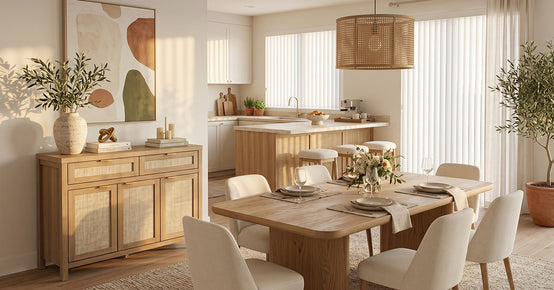
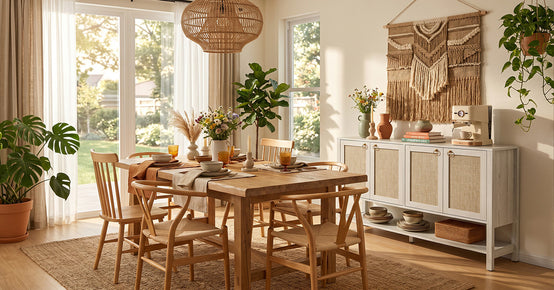



39 Modern Room Ideas That Actually Work
Honest version: most home design lists give you the same three suggestions in different fonts. Go neutral. Declutter. Add a plant. Which is fine — those things do help — but if you've already done all that and the room still isn't clicking, you need something more specific than "add a plant."
I've spent over ten years writing about furniture and home interiors. The one mistake I keep coming back to — the thing that derails more rooms than anything else — is sequencing. People do the right things in the wrong order. They paint before fixing the layout. They buy new pieces before removing what isn't working. They keep adding and adding while the room sits there, resisting.
A well-put-together modern room is mostly the result of good decisions about what stays and what goes. Get the layout right, get the light right, add the right textures — and honestly, pretty ordinary furniture can look great. Skip those steps, spend twice as much on the furniture, and the room will still bother you.
Here are 39 ideas. Some take five minutes. A few of them took me years to fully appreciate. None of them is vague.
Layout & Space (Ideas 1–6)
1. Take Things Out First

The advice everyone agrees with and almost nobody actually follows. Not a tidy — a real edit. Pull things out of the room and see what remains. The most effective room transformations I've watched didn't involve a single new purchase. A family removed two chairs that had been blocking traffic flow for years, hauled out a console nobody had opened in months, and the room was unrecognizable. Calm. Spacious. Like someone had finally exhaled.
If your room feels persistently wrong and you can't say why — more stuff isn't the answer. For each piece: is it here because it's useful, or because it's always been here? That second reason is not good enough.
2. Pull Everything Slightly Off the Walls

Two or three inches.
That's the whole tip. Rooms where every piece is pressed flat against every wall have a waiting-room quality — furniture around the perimeter, blank space in the middle, like everyone showed up for something that's not happening yet. Pull the sofa 3 inches from the wall, and it will look placed. Intentional. Chosen. Same sofa. Completely different room. I've seen people spend $2,000 on new furniture to solve a problem they could've fixed by moving the existing pieces four inches forward.
3. Measure the Walking Paths Before You Move Anything

36 inches on any main route through a room — front door to sofa, bedroom door to bed. 24 inches for secondary paths. These numbers are not style preferences. They're the gap between a room you navigate without thinking and one that makes you slightly irritated every single morning for years.
Most rooms that feel cramped aren't actually too small. They just have too little clearance between pieces. Measure. Then rearrange. Often, the fix is right there without buying a single thing.
4. Anchor the Seating Area With a Rug — The Right Size Rug

No rug: just furniture near each other. Rug where all front legs sit on it: a defined zone. That shift is harder to explain than it sounds, but you feel it immediately in a room that has it.
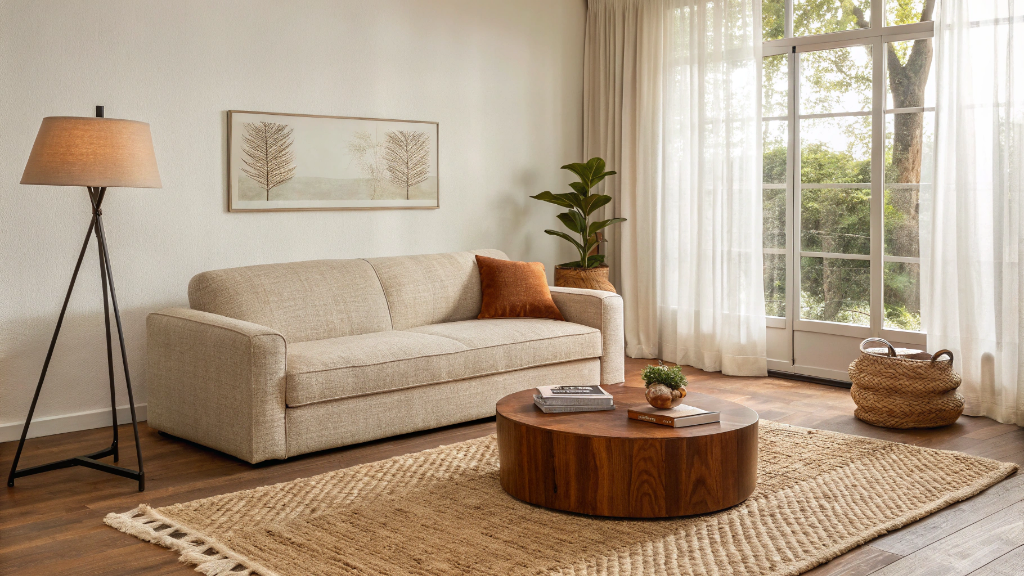
The sizing thing trips up almost everyone. A rug where only the coffee table sits on it — all the furniture hovering awkwardly off the edge — looks worse than no rug at all. When in doubt, size up. Bigger rugs make rooms look more expensive. Smaller rugs make rooms look like the owner was trying to save money. Which you might be! But it shows.
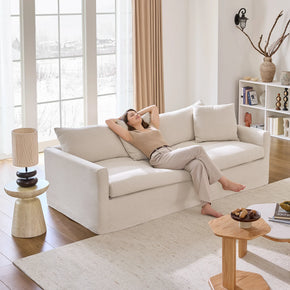
5. Pick One Focal Point and Stop Adding More

Modern rooms break down when multiple things compete for your attention at once. Big art and a gallery wall and a large television — three things all asking to be noticed, and the room never settles.
The bed wall in a bedroom. The TV wall is in the living room, next to the fireplace. Pick one, let everything else play supporting roles. This sounds simple. It is simple. What's hard is resisting the impulse to add just one more thing once you've already picked it.
6. Give Both Sides of the Bed Actual Space

Pushing the bed close to the side walls to save floor space is a reasonable-sounding move that makes the daily experience of the bedroom quietly worse for years. Getting in and out, making the far side, squeezing between the wall and the mattress every morning — it adds up.
24 inches on each side is the target. 18 works if the room genuinely doesn't allow more. The room will look more deliberate, feel more like somewhere you want to spend time, and — practically — you'll stop stubbing your toe on the bedframe at 7 am.
Color & Palette (Ideas 7–13)
7. Go Warm on the Neutrals — It Makes More Difference Than You'd Think

Cool gray. That blue-tinged white. These look sharp in editorial shoots where the photographer has equipment designed to make cool light look clean and deliberate. In a normal home, under normal artificial evening lighting, they often read as clinical, flat, and slightly off. I've been in rooms that were beautifully furnished — genuinely nice pieces — and they felt wrong because the wall color was pulling blue after 6 pm, and nobody had connected the two.
Warm off-whites, taupe, soft beige, warm greige — they hold across lighting conditions in a way cool neutrals don't. If you've painted a room neutral gray and felt dissatisfied with it ever since, without knowing why, there's a real chance you need warmer undertones rather than a different color entirely.
8. Try One Dark Wall — Just One, Before You Decide It's Not For You

People treat dark wall colors as dramatic, risky, and committing. And sure, they are — but they almost always land well. Deep charcoal behind a bed. Forest green on a living room wall. These colors make rooms feel anchored and, counterintuitively, warmer — often better than a fourth coat of the same pale neutral that's been quietly failing for two years.
Do one wall. See it in your actual room, in your actual light, at night. If it doesn't work, you repaint one wall. That's it. In my experience, it works more often than not.
9. Stop at Two Accent Colors

One or two accent tones, repeated in three or four spots. Terracotta in a pillow, picked up in a small vase, echoed in the spine of a book on the shelf — that repetition reads as intention. It says someone thought about this room.
Three unrelated accents and the room starts to look like it was assembled during five different shopping trips with no communication between them. (Which, to be fair, it probably was.) The individual pieces might be lovely. But without visual logic connecting them, they just coexist rather than forming a room.
10. Paint the Ceiling the Same Color as the Walls

Goes against standard painting advice. White ceiling, always — that's the conventional move. But taking the wall color up onto the ceiling creates a cocooning quality that modern rooms handle really well. The space feels more considered. More immersive, in a good way.
You don't need to go dark to try it. Even a pale warm neutral on the ceiling instead of flat builder's white shifts the feeling of the room. I've never met anyone who tried this and regretted it — which isn't something I can say about most decorating choices.
11. Warm Gray or Cool Gray — Check the Undertone

Two gray samples that look nearly identical in the store can land in completely different places once they're on the wall and you're living with them under evening light. Cool grays (with blue or purple undertones) can shift to a flat lavender or greenish-blue under artificial light. Warm grays — those with yellow, brown, or green undertones — stay steadier.
Test paint in your actual room. Under your actual bulbs. At night. The paint chip in the store is showing you the color under fluorescent retail lighting at midday, which tells you almost nothing about how it'll look in your bedroom on a Tuesday evening. This is not a small thing.
12. Fix the Bulbs Before You Repaint

Same wall. Same paint. Swap from 4000K (the cool, faintly clinical light in most stock ceiling fixtures) to 2700K (warm white) and the color shifts. Sometimes noticeably. I have genuinely watched someone go from "I hate this wall color" to "oh, actually it's fine" just from changing the bulbs.
$15. Ten minutes. Do it before you tape anything off. You might find the wall was never the problem.
13. Off-White Beats Pure White in Almost Every Home

Pure white is unforgiving in ways that only reveal themselves after you're already living with it. Every scuff shows, the color looks different under every lighting condition, and it requires architectural quality (crisp moldings, flawless surfaces, abundant natural light) that most ordinary rooms don't have. It also reads cold in north-facing rooms and yellow in south-facing ones, so it's essentially never neutral.
Off-white — something with a warm undertone, whatever direction your windows face — reads as white in most conditions, photographs identically, and creates a base that makes everything else in the room sit more comfortably. Finding the right off-white is harder than it sounds. But it's almost always the better choice over stark white.
Furniture Choices (Ideas 14–22)
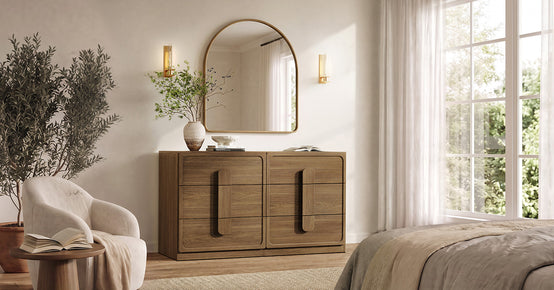
14. Get a Dresser That's Wider Than You Think You Need

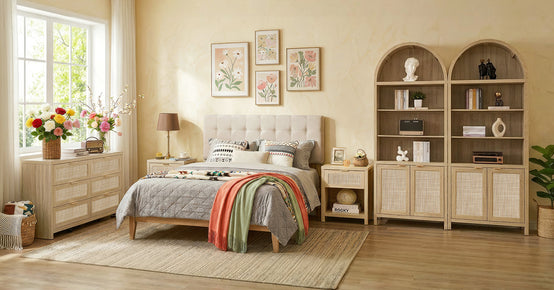
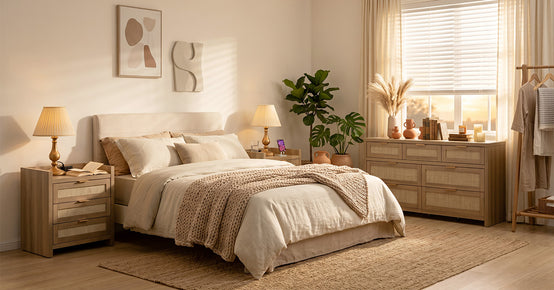
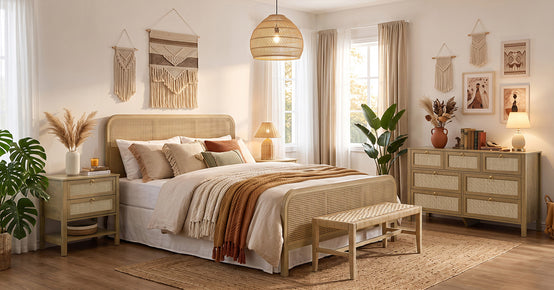
People treat dressers as storage solutions and shop accordingly — find the smallest one that holds the clothes, done. But a wide dresser does four things at once, and none of them is just storage. It fills a wall and anchors the room. It gives you a useful horizontal surface. It holds a real wardrobe without spilling into other furniture. And — this sounds abstract, but it's real — it gives the bedroom wall a sense of weight that makes the rest of the room settle around it.
The Savanna 6-Drawer Dresser measures side-to-side — wide enough to hold six drawers that genuinely hold clothes. Clean wood finish, no fussiness in the design. It doesn't try to be interesting. It just works every day, which is the correct ambition for a dresser.
15. Match the Nightstands — Yes, Even If It Sounds Boring

Mismatched nightstands peaked as a trend around 2018. In actual bedrooms, for actual people sleeping in them every night, it tends to create a low-level visual restlessness that's hard to name but easy to feel. Two different styles, two different heights, two different everything on either side of the bed — the room never quite settles.
The Crescent Nightstand, 3 Drawers is a reliable option: three drawers (I'd always take three over two — you fill two immediately and the third saves you), a flat top wide enough for a lamp and a glass of water at the same time, proportions that work alongside most dresser styles without arguing with them. One on each side. Done.
16. Low Bed Frames Make Rooms Feel Bigger

A platform bed, or any low-profile frame, gives the ceiling room to breathe. More visual space between the top of the bed and the ceiling means the room reads as more open, even when nothing about the actual dimensions has changed. High headboards and tall footboards compress that space. If the bedroom feels smaller than it should, the bed frame is worth looking at.
17. Skip the Matching Suite — Really, Skip It

The full matching suite — same tone, same finish, same hardware, everything from one collection — looks exactly like a catalog page. A hotel room. Not in an aspirational way.
Mix finishes within the same color family. Darker dresser with lighter-toned nightstands. Matte lamp alongside a brass pull on a drawer. That kind of variation reads as someone making choices, rather than someone handing a decision to a webpage and pressing add to cart. The rooms that look genuinely considered almost always have some material tension in them — not conflict, just variety.
18. Err on the Side of a Bigger Sofa

The most common sofa mistake isn't buying something too big. It's buying something too small and watching it look like it got lost in the room. An undersized sofa in a medium living room has a specific quality to it — like furniture was placed in a room rather than a room built around furniture. Those two things look different and feel different.
Measure the wall or the rug zone first, then go slightly larger than your instincts suggest. An oversized sofa is immediately obvious and returnable. An undersized one bothers you for years, and you never quite pin down why.
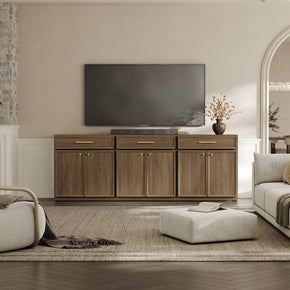
19. A TV Stand With Cabinet Doors Is a Life-Changing Purchase

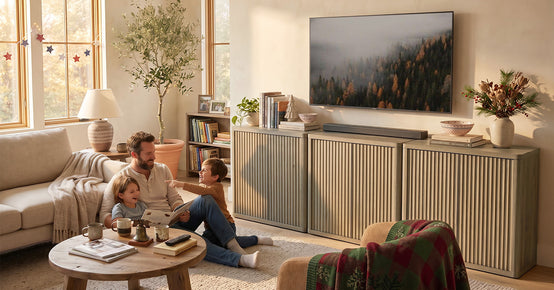
I'm only half joking. The back wall of most living rooms — the one with the television — is a disaster. Cables trailing down the wall, a streaming box, a games console, and a router all visible, remotes in a heap, the TV itself slightly too wide for the console underneath it. This is the first wall you see when you walk in. And it looks like chaos even right after the room has been tidied, because the chaos is structural.
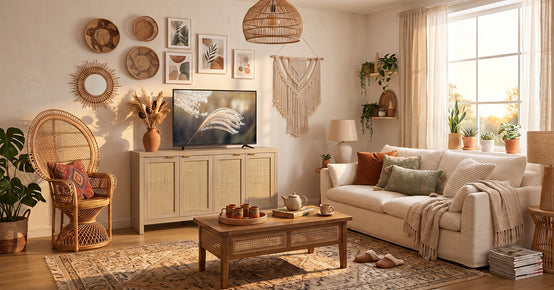
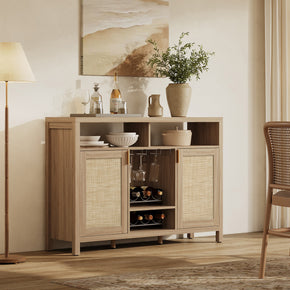
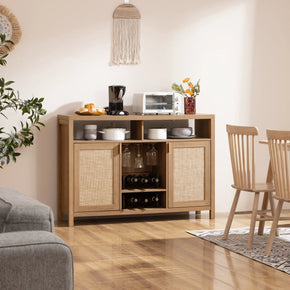
The Savanna TV Stand, 4 Doors, closes it all behind four rattan cabinet fronts. TV on top, everything else hidden. Handles up to 65-inch screens. The wall looks calm. Consequently, the room looks calm. This is one of those purchases that feels boring to describe and turns out to be one of the most impactful things in the room.
20. Furniture That Does Two Jobs Takes Up Half the Space

A storage bench at the foot of the bed — seating and hidden storage. A coffee table with a shelf below it. A dresser tall enough that you don't also need a wardrobe. A nightstand with a built-in charging port so there's no cable on the floor.
Every piece doing two jobs means one fewer piece in the room overall. Modern rooms stay uncluttered not because they're empty but because the furniture earns its keep.
21. Add a Curved Piece or Two

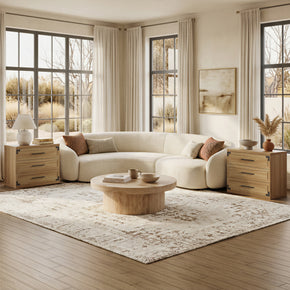
All straight lines and right angles eventually feel institutional. Hospital waiting room. Corporate lobby. The fix is contrast — one or two curved pieces that make everything else feel intentional rather than merely angular. An arched mirror. A rounded coffee table. A reading chair with soft arms. You don't need many. Two is enough to change the quality of the whole room.
22. Get the Coffee Table Height Right

Same height as the sofa seat cushion or one to two inches lower. That's it. That's the rule. Lower than that and you're reaching down uncomfortably. The proportion looks wrong immediately.
This gets wrong in a surprising number of rooms, and nobody says anything. Measure before you order. Thirty seconds saves a return.
Bedroom-Specific (Ideas 23–28)
23. Layer the Bed — It Takes About Five Minutes

Fitted sheet. Duvet or top sheet. Blanket folded at the foot. Two, maybe three pillows — one of them ideally in a different texture. That's the whole formula.
What makes a bed look styled isn't complexity. It's layering — different materials at different heights, which creates the kind of visual depth that a single flat duvet simply can't. Change one pillowcase to linen, add the folded blanket, and the same bed goes from budget hotel to somewhere you'd want to photograph. Five minutes. No new purchases necessary.
24. Nightstand Charging Changes the Whole Bedside Situation

Phone on the floor. The charger is blocking the only outlet. A cable trailing across the room to an extension cord under the bed. If this describes your current situation — which it does in the majority of homes I've been in — a nightstand with built-in USB-A, USB-C, and a power outlet fixes it all in one move, with no additional cable management required.
Not a luxury. A basic decision that makes the room look and function better every day.
25. The Bedroom Is Not for Storing Everything Else

Spare boxes. The exercise bike. Clothes on the chair that everyone has and nobody uses. Bags that haven't been unpacked from a trip three weeks ago. The bedroom absorbs everything that doesn't have a home elsewhere, making the room feel permanently unfinished — slightly stressful, never fully restful.
Discipline about what goes in the bedroom makes more difference than most decorating choices. If it's not for sleeping, dressing, or reading, it belongs somewhere else. That's the rule. It requires enforcement.
26. One Clear Nightstand Surface — Lamp, Water, Book. That's All.

Nightstands attract stuff. Receipts. Old phones. Books you finished months ago. Three chargers, a lip balm, and a glass you forgot about. Every extra object chips away at the bedroom's ability to feel calm, which, again, is what a bedroom is supposed to do.
Clearing the nightstand to its essentials takes two minutes. The effect on the room is immediate and disproportionate to the effort. Do it now if you haven't.
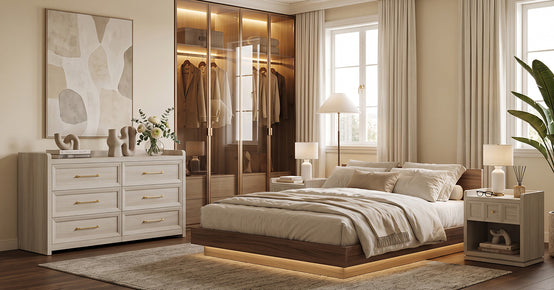
27. A Rug Under the Bed Finishes the Room

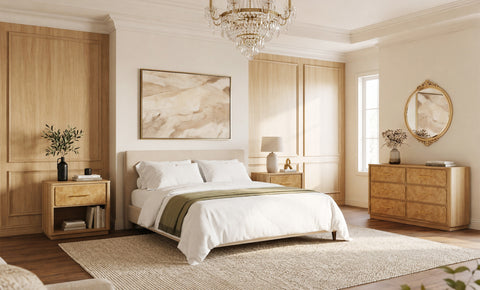
Starting about 18 inches below the foot of the bed, extending out past both sides — a rug positioned this way gives a bedroom warmth and definition that a bare floor doesn't. The room looks finished. Without it, even a well-furnished bedroom can feel slightly incomplete, and nobody can say exactly why.
Low-pile works better in bedrooms than high-pile: easier on bare feet, less dust. And if you're pulling together the full bedroom picture — dresser, wardrobe, the whole thing — the bedroom furniture collection is worth looking at before committing to individual pieces. Seeing how things proportion together saves a lot of returns.
28. Move the Mirror Before Buying Another One

A mirror in a dark corner that doesn't catch any light is just a reflective rectangle on the wall. The same mirror positioned across from a window — where it reflects natural light into the room — noticeably changes the space'sbrightness.
Before adding a second mirror, try relocating the first one. Free fix. Usually works.
Living Room Ideas (29–32)
29. Start With the Rug, Not the Furniture

Standard decorating order: buy the sofa, choose the chairs, then try to find a rug that works with everything. This produces rugs that look like afterthoughts. Because that's literally what they are.
Start with the rug. It sets the palette and defines the zone. Everything else gets chosen around it. Begin with something you genuinely like — not the safe one that coordinates with everything and excites you about nothing — and the rest of the room becomes considerably easier to pull together.
30. Closed Storage Doesn't Look Like Storage

Open shelving with visible clutter —remotes in a pile, gaming controllers, and cable boxes on display—this is why so many living rooms feel messy even immediately after being tidied. The things creating noise are still visible, just slightly more organized.
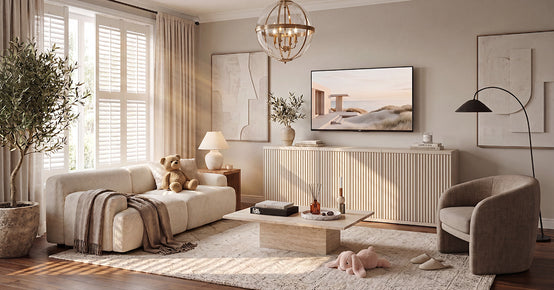
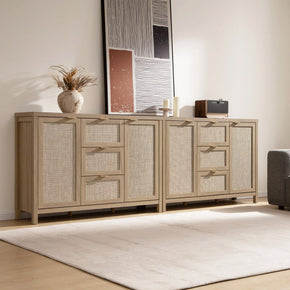
Closed-front pieces fix this structurally. A sideboard with doors. A TV console with cabinet fronts. For TV stands, sideboards, and consoles with closed storage, modern living room furniture has a solid range of pieces that hide everything without looking like they're hiding something.
31. Float the Sofa Away From the Wall

In any room larger than about 12 feet across — which covers most living rooms — a sofa pulled away from the wall looks dramatically better than one pressed flat against it. A wall-hugging sofa looks like it was moved temporarily and never moved back. Floating furniture looks like it was placed.
Even 8 inches makes a difference. Try it before you decide the room is too small. It rarely is.
32. Put a Console Table Behind the Floating Sofa

Once the sofa is pulled away from the wall, its back becomes visible from the room's entrance—the first thing you see when you walk in: the reverse side of your seating. A narrow console table against the back of the sofa — 12 to 15 inches deep, no more — gives that view something to land on: a lamp, a plant, a couple of objects. You walk in and see a layered vignette instead of the back of a cushion—small detail. Real difference.
Lighting (Ideas 33–36)
33. Layer Three Types of Light — Not Just Overhead

Ambient overhead. Directed task lighting where you actually need to see things. Accent light — floor lamps, table lamps, sconces — that creates atmosphere. Most homes have the first and nothing else.
One ceiling fixture blasting uniform light directly above is functional in the same way as a fluorescent tube is. It illuminates. It does not make a room feel good to be in at 9 pm. Adding a single floor lamp in a corner — just one — shifts the evening atmosphere of a room more reliably than almost any furniture purchase. And it costs a fraction of what furniture does.
34. Change the Light Bulbs Tonight — Before Anything Else

4000K: cool, slightly clinical, the default in most stock ceiling fixtures. 2700K: warm white, amber-ish, the color temperature that makes rooms feel welcoming after dark.
I'd change the bulbs before repainting. Before buying anything new. Before moving any furniture. $15 and ten minutes. Sometimes the room was never broken — just badly lit. You won't know until you try it.
35. Mount the Curtain Rod on the Ceiling

Not above the window frame. At the ceiling — or as close to it as the room allows, long curtains that fall from near the ceiling to the floor make ceilings look higher, windows look bigger, and walls look more architectural, even in rooms where nothing about the actual architecture warrants it.
This looks expensive. It costs the price of slightly longer curtain panels. It's one of the most reliable and repeatable visual tricks in interior design, and it works in virtually every room with windows.
36. A Floor Lamp in Every Dark Corner

Dark corners shrink rooms. They kill the energy of a space and make ceilings feel lower than they are. One floor lamp — cheap, nothing fancy required — in one dark corner reverses this immediately.
Two floor lamps, one in each back corner of a living room or bedroom, transform how the space reads in the evening. Best return on investment in home decorating, full stop. A $40 lamp in the right corner does more than a $400 sofa throw pillow.
Texture & Materials (Ideas 37–38)
37. Put at Least One Natural Material in Every Room

Wood. Linen. Rattan. Ceramic. Jute. Stone. Any of them. Rooms built entirely from synthetic materials have a quality that's hard to articulate but impossible to miss — slightly hollow, slightly flat, slightly wrong. Natural materials interact with light differently from manufactured surfaces, and that's what most people are reaching for when they say a room lacks warmth.
One piece is the minimum, not the goal. A ceramic lamp base. A rattan tray. A wooden bowl on the coffee table. These aren't statement objects. They're doing quiet, essential work — the kind you'd only notice if they weren't there.
38. Linen Curtains Change the Light Quality, Not Just the Look

Linen filters daylight differently from polyester or cotton — softer, diffused, slightly golden in the afternoon. The quality of light in a room with linen curtains hung at ceiling height is genuinely different from the same room with standard panels, and it affects how the space feels every single day, not just when someone notices the curtains.
Combine with ceiling-height mounting, and you've changed the room more than almost any furniture decision would. And before making bedroom furniture decisions in general,— the bedroom furniture collection is worth a look to understand how the pieces proportion together before committing to individual purchases.
Entryway (Idea 39)
39. Clear the Entryway Floor — All of It

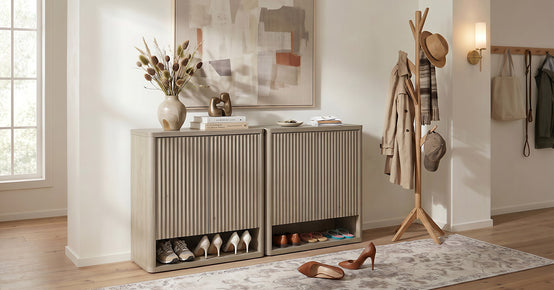
The first thing people see when they walk into your home — and the first thing you see every time you come back to it — is the entryway. Shoes on the floor, bags dropped in the corner, coats piled on an already-overloaded hook. For most people, this is just the reality of the entryway,y and they've stopped seeing it. But it sets a tone for the whole home, every single day, and it takes about 30 seconds to undo whatever calm you've built in the rooms beyond it.
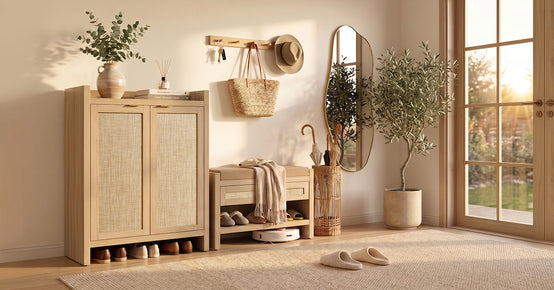
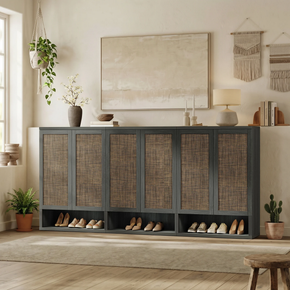
A proper shoe cabinet — one with actual doors that close — fixes the floor situation immediately. The Cas Shoe Cabinet holds 20 pairs behind closed doors. You add a narrow console, one mirror, and something green if you wait. The entry reads as the beginning of a considered home. That first impression carries further than you'd expect.
FAQs
What does 'modern room' actually mean?
In a design-history sense, it refers to a specific movement — early 20th-century, Bauhaus, Le Corbusier, the mid-century American designers who believed that good design should serve daily life before it decorates it: clean lines, natural materials, function-first furniture.
In regular conversation, it just means a room that feels current, uncluttered, and deliberately put together. Warm neutrals, open floor space, natural textures, light that's been considered rather than just installed. And warm can absolutely coexist with modern — anyone who tells you otherwise is working from a ten-year-old definition of the style.
What bedroom trends are heading into 2026?
Warm minimalism is the main one — a livable one has replaced the cold, stripped-back version of minimalism from the 2010s. Same clean structure, but with natural materials, earth tones, and soft textures that make rooms feel like someone actually sleeps in them. Architectural Digest covers this consistently: the strongest contemporary bedrooms right now balance one warm or organic element against a clean modern structure, which keeps things from tipping into sterile.
There's also a real trend toward bedrooms that function as actual retreats — enough storage to put devices away, a proper bedside reading light, and materials that are pleasant to be around before you're fully awake: less showroom, more sanctuary.
How do I make my room feel modern without spending a lot?
Four moves in roughly this order: clear the surfaces and remove anything that isn't earning its place; stop pinning the furniture to the walls; swap the bulbs to 2700K warm white; and mount the curtains near the ceiling rather than the window frame. The Spruce does the low-cost practical end of this well. These four changes cost almost nothing and move the room more than most furniture purchases would.
How do I fix a room that just feels boring?
Give it one focal point it doesn't currently have — a single large piece of art, a big mirror catching the window, a pendant over the seating area. Then add texture: a rug if there isn't one, a throw over the arm of a sofa, a ceramic object you genuinely like rather than one you settled for.
If it still reads flat after that, paint one wall a color that's different from the other three. Not necessarily dramatic — just not identical. One wall that reads differently changes a room's character more than ten new accessories.
Modern vs. contemporary — is there a difference?
Yes, though people use the words interchangeably and it doesn't matter. Modern refers to a specific design style with roots in the 1920s through 1960s — clean lines, natural materials, functional furniture, form following function. Contemporary means whatever's popular right now, which changes.
Currently, contemporary and modern overlap heavily, which is why the confusion persists. But contemporary in 2005 looked very different from contemporary today. IKEA's design aesthetic is a decent, accessible example of Scandinavian modern — one of the most widely adopted modern subcategories — functional, clean, accessible without being cold.
What separates a modern room from just an empty one?
Texture and intention. An empty room has nothing. A modern room has warm materials, correctly scaled furniture, layered light, and a sense that choices were made rather than things being accumulated. Elle Decor frames it well: the best modern spaces find beauty in practicality — using rich materials to give structure to what might otherwise just feel sparse. That's the distinction. Edited, not empty.
What's the single biggest mistake in modern room design?
Adding before editing. Every time.
New furniture in a room that hasn't been cleared and rearranged first just creates a more expensive version of the same problem. Take things out first. Look at what's actually there. Then decide what the room needs. That sequence sounds obvious. It gets skipped in the overwhelming majority of rooms I've ever been asked to look at.
Can modern design work in a family home?
Yes, but you need to be realistic about which version of modern you're going for. The all-white, nothing-on-the-surfaces, staged-for-a-photoshoot version doesn't last long when exposed to children or pets. But the underlying principles — clear space, functional storage, durable materials, furniture that does real work — actually suit family homes extremely well.
The goal is the livable version: pieces that handle genuine storage, surfaces that can take a glass of water, layouts that work for how the household actually moves through the space. Both Room & Board and House Beautiful cover family-friendly modern design, which is worth reading if you're approaching this with kids in the picture.
Sources
All sources below are from major editorial publications. Every link is clickable and opens the article or gallery referenced in the body of this piece.
- Architectural Digest – Contemporary Bedroom Ideas
- Elle Decor – 91 Modern Living Room Design Ideas
- The Spruce – 72 Modern Bedroom Design Ideas
- IKEA – Bedroom Inspiration Gallery
- House Beautiful – Living Room Design Ideas
- Room & Board – Modern Bedroom Furniture


Looking for something else?

Furniture Materials Guide: Picking the Right Material Room by Room
LEARN MORE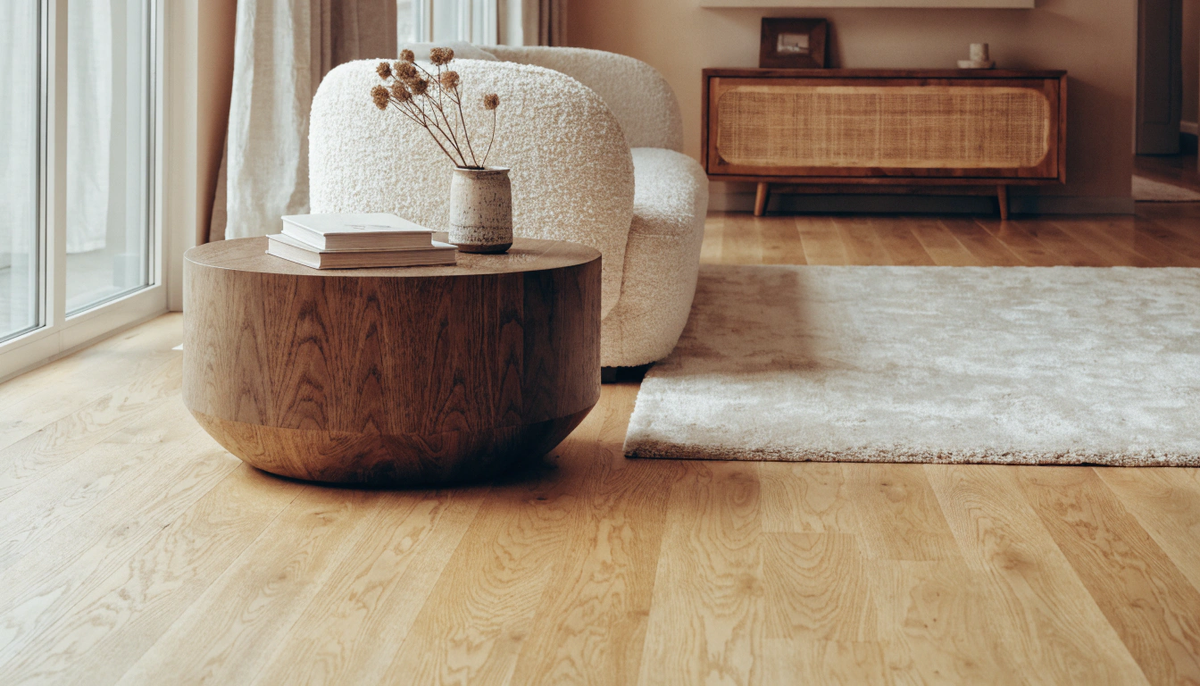
How to Mix Wood Tones Without Making a Room Look Mismatched
LEARN MORE
18 College Apartment Furniture Ideas That Save Space and Money
LEARN MORE
Types of Entertainment Centers: 11 Designs and How to Pick One
LEARN MORELooking for something else?

Curio Cabinet Decor Ideas: How to Style a Display Cabinet Without the Clutter
LEARN MORE
Curved Furniture: How to Style, Measure, and Buy It in 2026
LEARN MORE
What Is Rattan Furniture? A Buyer Guide to Types and Care
LEARN MORE


Further reading

How to Choose a Nightstand for a CPAP Machine

How to Choose a Shoe Cabinet for Men's Sizes, High-Tops, and Bulky Shoes


