



Best Vase for Tulips: A Florist's Honest Guide to Shape, Height, and Styling

Look, tulips are stunning. I've also wrecked enough bunches to know they're complete divas about it. They keep growing after you cut them. They lean toward the window like sunflowers in training. Pick the wrong vase, and your $15 grocery-store bouquet will be sideways by Wednesday.
Here's the short version. The best vase for tulips is one tall enough to actually hold the stems steady — and open enough to let the blooms curve the way they want to. Cylinder works—fluted works. Pitcher, tulipiere, all of it works. It's just about matching the shape to the look you're after. Get it wrong, though? Even the freshest bunch turns into a sad, sideways slump by midweek.
What follows is the actual playbook. Five vase shapes worth knowing. How tall should the vase be? How to arrange the stems so they don't faceplant. How to make cut tulips last longer than two days. And — this part gets ignored — where to put the finished vase in your house. The surface underneath matters more than people think.
What Makes a Vase Good for Tulips, Specifically
Tulips aren't like roses or carnations or anything else in the cut flower aisle. They keep growing after they're cut, and I bought a bunch at 14 inches. It's hitting 15 or 16 by Friday. They also lean toward the closest light source, like they're allergic to standing still. So the vase isn't just a container. It's basically a tiny scaffolding system that keeps everything upright throughout the week.
The rule itself isn't complicated. The vase covers about half the stem. That's the whole formula. Too short, and the heads droop sideways over the rim like they're embarrassed to be there. Too tall, and the blooms basically disappear into a glass tube. Half the stem is the sweet spot.
And the bending toward light part? Don't try to fight it. That's the personality of the flower. Pick a vase that lets them curve the way they want to instead of one that forces them straight.
The Best Vase Shapes for Tulips
Five shapes do most of the heavy lifting. Each one's better for a different feel. Match the vase to the mood you're after, not what's already sitting in your cupboard.
Cylinder Vase

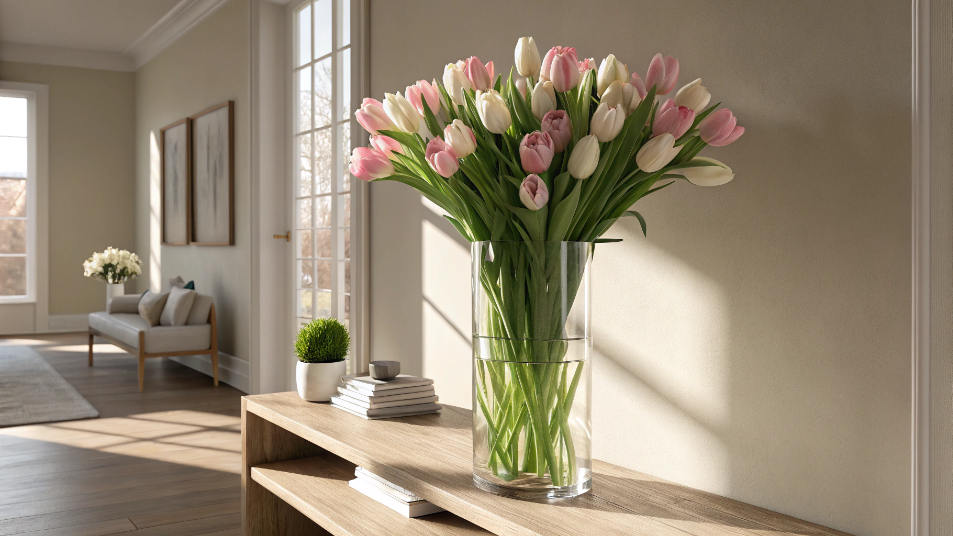
Boring? Maybe. Foolproof? Absolutely. A clear cylinder is what I'd hand to anyone arranging tulips for the first time. The straight walls keep the stems gathered in a neat little column, the blooms perch right above the rim, and the whole arrangement reads clean and modern without trying.
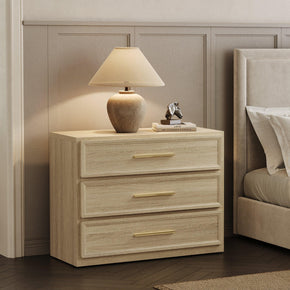
Where cylinders really shine is with one color of tulip. All white. All that bruised pink. The deep purple that pretends it's black until the light hits it. Simple vase plus simple bunch equals zero design decisions to second-guess. They look especially right on a small bedside surface — picture the Crescent Nightstand with three drawers with one of these next to the lamp. That's it. That's the whole moment.
Hourglass or Fluted Vase

Tulips already past their first day — petals splaying, stems doing that gentle bend — call for an hourglass. The pinched waist gathers everything at the bottom. The flared top lets the heads spread out without rubbing against each other. It just works.
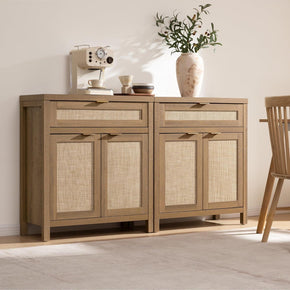
Softer overall. Romantic without trying too hard. And it's the most forgiving shape if your bunch is already a little wild — mixed colors, mismatched heights, the works. Pair a fluted vase with the Savanna Console Table with three drawers in a hallway, and you've got something that looks intentional without looking staged. Which is the hardest balance in styling, by the way?
Pitcher or Urn

A pitcher? Total cheat code. Wide mouth at the top, heavier base at the bottom, a handle that nobody actually uses but everybody loves looking at. The whole thing reads warm. Lived-in. Like the flowers wandered in from the garden and decided to stay. Kitchen counter, dining table, an open shelf — anywhere you don't want flowers that look like they're auditioning for a magazine spread.
Urns are pitchers' older sibling—same vibe, slightly more grown-up. An urn sitting on a Savanna six-drawer wood dresser makes the whole bedroom feel finished, even if the bed isn't made. Presence, not stiffness. That's the trick.
Tulipiere — the Original Tulip Vase

Quick history lesson. When people say "tulip vase," what they usually mean is a tulipiere. Ceramic. Multiple spouts. Each spout holds one or two stems. They've been around since the 1600s — same era as Tulip Mania, not a coincidence. The classic ones are Delftware blue. Modern ones come in white, terracotta, dusty pink, anything you can fire in a kiln.
Here's the move with tulipieres — don't fill every spout. Five or seven stems spread thoughtfully across the openings reads more designed than thirty tulips jammed into a regular cylinder. The vase becomes the showpiece. Place one on the Helio Sideboard with glass doors in a dining room, and it becomes part of the room's whole architecture, not just a flower vessel.
Wide-Mouth Vase

Wide-mouth vases promise that gorgeous "just walked in from the garden" look. Promise. They also routinely fail to deliver. Without enough stems or some structural trick to support them, the tulips just splay outward and lie flat across the rim like they gave up. Not the look.
The fix every working florist uses is a floral tape grid. Three or four strips of clear floral tape crisscrossed over the mouth of the vase. Once the stems are in, you can barely see them. Each stem stays exactly where you put it. People treat this like a trade secret. It's not. It's just the craft, and there's no reason you can't use it at home.
How Tall Should Your Vase Be?

Rule of thumb — vase covers a third to a half of the stem. That's basically the whole formula—no math degree required.
Most grocery store tulips run somewhere between 14 and 18 inches once you've trimmed the ends. So a 7- to 10-inch vase is your safe zone. Springing for those long Dutch tulips that show up around 20 inches? Scale up. 10 to 13 inches of vase height does the job.
Already in love with a vase that's too tall for your bunch? Easy fix. Drop a clean drinking glass or a jam jar inside it. Water level rises, stems rise with it, and from the outside, nobody can tell you cheated. Took me about three minutes of YouTube to learn that one. Now I do it constantly.
How to Arrange Tulips in a Vase, Step by Step
Most tulip disasters trace back to bad prep. The order below is the one that actually works.
Start with a Spotless Vase
Soap and warm water. Rinse twice. I know — the vase "looks" clean. Wash it anyway. Bacteria in the water kill cut flowers faster than anything else on this list. Faster than heat. Faster than the sun. Faster than whatever else you were going to blame.
Strip the Lower Leaves
Anything green that would end up underwater has to go. Strip those leaves all the way off. Why? They rot within 24 hours—the water clouds. The smell turns swampy by Thursday. Trust me on that one. Keep the leaves above the waterline, though — they fill out the bunch and make everything look fuller.
Cut the Stems on an Angle

Sharp knife. Or floral shears. Not the kitchen scissors that lived in your junk drawer for six years — those crush the stems and choke off the water uptake. Trim roughly an inch off the bottom at a 45-degree angle. The angle matters because it opens up more surface area for the tulip to drink from. Martha Stewart's own kitchen team uses the same 45-degree cut before any stem touches water, and pretty much every working florist will say the same.
One thing that gets overlooked here — cut the stems immediately before the vase. Not five minutes before. Right before. Every minute they sit dry on the counter, the cut starts to seal over. So fill the vase first. Then cut. Then place in that order.
Add Cold Water
Cold water. Not lukewarm. Not room temperature. Not whatever's already in the tap. Cold. Tulips are originally a cool-climate flower — Central Asian, technically, fun fact for your next dinner party — and warm water sends them into a full open-and-fade panic. Fill the vase about a third of the way up. Three or four inches deep. Enough to hydrate the stems. Not so much that the lower stems begin to soften at the base.
About flower food. If the bouquet came with a packet, dump it in. If it didn't? Skip it. Clean cold water plus the habit of swapping it every other day does 95% of what that sachet would do.
Let the Stems Lock In Loosely
A few stems at a time. Turn the vase between adds so the bouquet builds out evenly instead of growing on one side like a bad haircut. Let the stems cross inside the vase — they'll lock against each other and basically self-support. Resist the urge to pack them tight. Tulips need elbow room to grow and open.
How to Keep Tulips Upright and Fresh Longer

Tulips drooping by day two? It's rarely the tulips themselves. It's the water, the cut, or where the vase is sitting in your house. Tulips are phototropic — they actively reach toward light — and the Royal Horticultural Society's tulip growing guide points out that instinct doesn't quit just because the stem's been severed. So here's the maintenance routine that actually keeps them upright.
- Every two or three days, give the stems another trim—half an inch off the bottom, straight back into fresh cold water.
- Swap the water every other day. Cloudy water? Make it daily. Rinse the vase each time, no shortcuts.
- Direct sunlight is the enemy. Tulips open way faster in the heat and bend hard toward bright windows.
- The same goes for radiators, AC vents, and anywhere with a draft. All of them age the flowers fast.
- Keep the vase far from the fruit bowl. Apples, bananas, and ripening tomatoes all leak ethylene gas as they ripen. Ethylene is invisible. Ethylene is also tulip kryptonite.
There's a so-called pin trick going around — prick a tiny hole through the stem right below the bloom, supposedly releases trapped air, supposedly stops the head from drooping. Does it work? Sometimes. Marginally. But fresh water, a clean, angled cut, and the right vase do more to keep tulips upright than any single TikTok hack.
Where to Display Your Tulip Vase at Home
The surface underneath the vase is part of the arrangement. People miss this. Tulips on a cluttered shelf vanish into the chaos. Tulips on a clean, well-finished surface look like styling. Below are the spots that actually work — broken down by where you live in your house, not where some catalog says you should.
On a Bedside Nightstand

Small vase. Three to five tulips. Park it next to the lamp. That's the entire formula. Bedside flowers are the laziest, easiest way to make a bedroom feel cared for — and because the scale is small, even a slightly droopy bunch reads as "charming" instead of "sad."
On a Console Table in the Entryway

Entryway flowers are the first thing anyone notices walking in. So make them count. One tall arrangement does the trick. Two matched smaller vases also work if the table is wide enough. The console tables collection is full of narrow profiles built for exactly this — you get the visual impact without the hallway feeling cramped.
On a Dining Sideboard

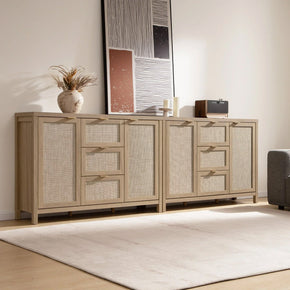
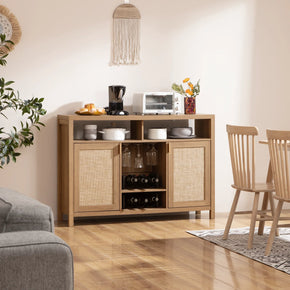
Go low here. A short, dense arrangement that doesn't block the sightline across the table when you're entertaining. Tulips are perfect for this because their height stays manageable even when they're fully open. The buffet sideboards collection has a range of widths if you're matching the piece to your specific dining room footprint.
On a Wide Dresser Top
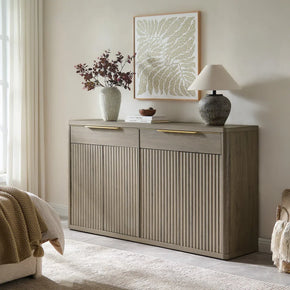
One statement urn or tulipiere on a wide dresser becomes the visual anchor of a bedroom. Single piece, breathing room around it. Where people mess this up is cramming five candles, three books, and a tray onto the same surface. Let the vase be the star. Browse modern dressers for surfaces wide enough actually to actually pull off this kind of singular styling.
On Top of a Tall Bookcase

Almost nobody uses this real estate. The top of a tall bookcase is a wide horizontal surface that's sitting empty in most homes. Stick a tulip arrangement up there, and the eye is drawn upward, which makes the whole room read as taller. A bookcase with an arched top — like the Savanna Arched Bookcase — basically gives the vase its own sculptural frame to live inside. Half the magic is that frame doing the work for you.
Beside a Living Room Bookshelf

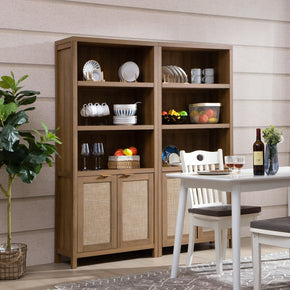
The side table next to a tall reading shelf is another underrated spot. The flowers soften all those rigid vertical lines from the book spines — it works almost like a textural counterweight. The Willow Tall Bookshelf is great for this because it mixes open shelving with closed cabinetry. Books get their zone. Styling pieces get theirs. The tulip vase gets its own moment on the table next to it. Everyone's happy.
One last thing on this. Fresh flowers are genuinely the cheapest and fastest way to refresh a room. Twelve bucks at the grocery store, fifteen minutes of arranging, and the entire vibe of the space shifts. Rotate the vase and the bunch with the seasons, and your home pretty much follows along. For more surfaces designed to play well with flowers and decorative objects, browse Sicotas's full home furniture lineup.
Mistakes That Quietly Kill Your Tulips
- A dirty vase. Yes, even the one that "looks" clean. Bacteria shorten vase life faster than anything else on this list.
- Leaving any leaves underwater. They rot inside a day—the water clouds. The stems suffer. Just strip them off at the start.
- Going too tall on the vase. The blooms get swallowed, and the arrangement looks unfinished from the moment it goes in.
- Going too short on the vase. The heads flop over the rim, and there's basically no recovery once they bend that way.
- Put the bunch next to the fruit bowl. Ethylene gas is invisible. Doesn't make it less deadly to cut flowers.
- Skipping the water change. Even with flower food in the mix, day-four water has to go straight in the sink.
- Trimming too aggressively on day one. You can always cut more later. You can't add length back. Start cautiously.
Final Thoughts
The best vase for tulips? Not one specific product. It's whichever shape supports the actual stems you brought home, without choking out the movement that makes tulips beautiful to begin with. Cylinders for cleaning. Fluted for softness. Tulipieres when you're showing off—pitchers, when you're not. Match the vase to the stem length, give it cold water and a spotless rim, and put it somewhere someone can actually see it.
And the surface underneath does as much work as the vase. A polished console. A wide dresser top. A styled sideboard. The top of a bookcase. All of it counts. The arrangement is the whole picture, not just what's in the vessel.
As for those tulips bending toward the window over the week? Let them. That's the look. That's the whole charm of tulips. Your job was the vase. They'll take it from here.
FAQs
What kind of vase do tulips look best in?
Tall enough to hold the stems steady, open enough to let the blooms move. That's the test—cylinder vases lean, clean,modern. Hourglass and fluted vases suit a fuller, softer look — especially good for mixed bunches. Tulipieres are the most decorative pick if you want the vase itself to be the showpiece. For most everyday bunches, covering about half the stem height is the safe call.
What is a vase that holds tulips called?
Tulipiere. That's the proper name — a vase actually designed for tulips. Traditional ones have multiple spouts, so each stem gets its own little chamber. The Dutch invented them in the 1600s, around the same time tulips were trading like gold bars. Loosely, though, any tall vase with a decent opening for a generous bunch can also be called a tulip vase. The spouts aren't mandatory.
How do I keep cut tulips fresh longer?
Spotless vase. Cold water — not lukewarm. Sharp 45-degree cut at the bottom of every stem. Pull off any leaves that'd sit underwater. After that, swap the water every other day, recut the stems every few days, and keep the bunch away from sunlight, heat vents, and ripening fruit. Stick to that routine, and you'll easily add two to three days. Sometimes more.
What flower was once used as money?
Tulips. Specifically Dutch, tch tulips during the 1630s. The phenomenon's called Tulip Mania — for a stretch, a single rare bulb traded for more than an Amsterdam townhouse cost. Then the market crashed in 1637. Still gets cited today as one of the earliest recorded asset bubbles in finance textbooks.
Do tulips need a big vase?
Nope. Tulips just need a vase that matches the actual stem length and bunch size — not the biggest thing in your cupboard. Drop a small bunch into an oversized vase,and the tulips fall outward like deflating umbrellas. Cram a big bunch into a tight vase and you crush the leaves. The sweet spot is a vase that covers a third to a half of the stem,leaving a little room for the bouquet to spread.
What shape vase is best?
Honestly, depends on what you're going for. Cylinder, if you want clean and upright. Hourglass or fluted, if you want soft and full. Pitch, er, if you want casual and warm. Tulipiere, if you want structured and decorative. Working with mixed-color tulips? The fluted shape is the most forgiving — it handles the differences in stem height best.
How long will tulips last in a vase?
Five to seven days is the standard with proper care. You can push that toward ten if the bunch was very fresh when you brought it home. Cold water, regular swaps, recutting the stems midweek, and keeping the vase in a cool spot away from the sun all extend the life of the flowers.
Can I use any vase for tulips?
Technically yes. Practically? Results vary. The bare minimum is a clean container that holds water, supports at least a third of the stem, and has an opening big enough not to crush the leaves on the way in. Beyond that, the shape dictates whether the arrangement reads modern, romantic, casual, or full-on decorative.
Sources
- University of Minnesota Extension – Fresh Cut Flower Care
- Holland Ridge Farms – Tulip Care Tips and Bloom Life
- StoneGable – How to Care for Cut Tulips So They Last Longer
- Neroli Blume – How to Arrange Tulips in a Vase
- Heinen Delfts Blauw – Tips: Flower Arranging in a Tulip Vase
- Simplemost / KSBY – Floral Experts Share How to Make Cut Tulips Last Longer
- Mayflowers Online – The Ultimate Guide to Tulip Care


Stay In The Know
Expert advice. Very good deals. The absolute best (and worst) things we've tested lately.
Looking for something else?

New Home Furniture Checklist: What You Need Room by Room
LEARN MORE
Feng Shui Living Room Layout With TV Stands and Storage Furniture
LEARN MORE
Couch to TV Distance: How Far Should Your Sofa Be From the TV?
LEARN MORE
Average Dresser Height: How to Choose the Right Dresser for Your Bedroom
LEARN MORERead more from Blogs
Looking for something else?
What Is Organic Modern Style? How to Use Warm Wood, Rattan, and Storage Furniture
LEARN MORE
Rug Under Bed Guide: How to Style Rugs With Dressers and Nightstands
LEARN MORE
Rug Bed Placement: Bedroom Rug Rules for Size, Layout, and Style
LEARN MORERead more from Blogs
You may also like


Further reading
Armchair Dimensions: A Complete Size Guide for Every Room
Standard Recliner Dimensions: Sizes, Clearance, and How to Measure