




















TV Stand Leg Height for Robot Vacuums: Measure Before You Buy
It's 2 a.m. and something under your TV stand is beeping — your robot vacuum rolled in at 9 p.m. and never came out. The product page said six-inch legs — plenty for a robot barely three and a half tall. Except it's not stuck under the legs. It's wedged under a center rail you never measured, hanging an inch lower, with a power cable draped across it like a tripwire.
This is the number-one way a TV stand and a robot vacuum end up fighting, and it's almost never the robot's fault — know which number matters, then measure it yourself before spending a cent.
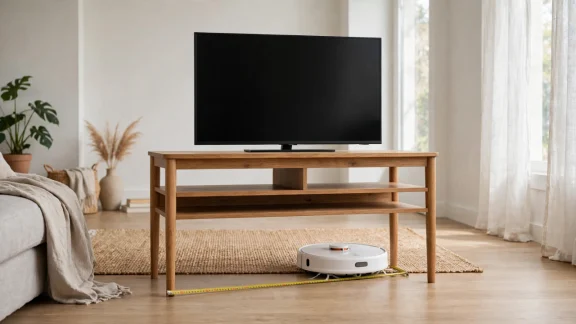
Image: Robot vacuum under a raised TV stand.
The Spec Sheet Number Isn't the One That Counts

Furniture listings love one big number. "6-inch legs" sounds generous until you learn what it leaves out. The robot doesn't care about leg height — it cares about the lowest thing it has to squeeze under, and most stands hide structures the listing never mentions.
The usual clearance thieves: center support rails (often lower than the corner legs — the most common culprit); front aprons and stretcher bars (a decorative apron can hang an inch below the leg line); leveling feet (the lowest hard point, growing each time you level on uneven floor); sagging cables (a drooping power strip grabs brushes and turrets); the rug (a half-inch rug donates half an inch of clearance).
Forget leg height — find the lowest solid point across the whole underside. The 2 a.m. test: slide a hardcover book under the stand at five spots — front corners, middle of the front edge, both back corners. If a book as thick as your robot catches anywhere, your robot gets stuck there too.
Start With the Robot, Not the Furniture
Here’s where most people go wrong with the math: they measure the furniture and completely forget about the robot. And the tallest point usually isn’t the body itself — on mapping robots it’s that little LiDAR turret sticking up top, while on the older bump robots it’s just the body. Grab a ruler and measure on a flat floor yourself, don’t just trust the number in the manual.
|
Robot model |
Height |
Navigation type |
|
eufy 11S MAX |
2.85 in |
Bump (no turret) |
|
eufy Omni C20 |
3.35 in |
LiDAR |
|
Roborock Saro 10R |
3.14 in |
LiDAR |
|
Dreame X60 |
3.13 in |
LiDAR |
|
Roomba Q0120 |
Just over 3 in |
Bump |
|
Roomba j9+ |
3.4 in |
Camera |
|
Roomba s9+ |
3.5 in |
Camera + LiDAR |
|
Roborock Qrevo S Pro |
3.8 in |
LiDAR |
That spread means a stand that suits a Eufy can trap a Roborock — measure for the robot you might buy.
Image: Measuring a robot vacuum's highest point.
Add a Real Margin, Not a Wish
A 3.5-inch robot and a 3.6-inch gap technically fit — until it wedges in sideways one random Tuesday. Clearance isn't static: the robot tilts on rug edges and floors are never level.
Working rule: robot height plus half an inch minimum, a full inch for comfort. The widely repeated guideline puts the happy zone around four inches.
Under 0.5 in of margin: expect stuck alerts — only fine with a smooth underside and bare floor. 0.5 to 1 in: workable in most homes; rug edges and cables eat margin first. Over 1 in: set-it-and-forget-it.
How to Measure a TV Stand's True Lowest Clearance

Whether you’re standing in your living room or staring at a product page — hunt down the lowest point, not the prettiest number they advertise.
Start with a clear floor — shove the rug aside and get your raw number first. Then check the front edge in three spots: left, middle, right, and go with whichever is smallest. Don’t forget the middle support — run your hand underneath and feel for a center leg, rail, or stretcher bar. That’s the measurement most people skip, and it’s usually the lowest one. Swing around back and check for the lowest-hanging cable loop or power strip too. If your stand has leveling feet, measure at the setting you’ll actually use, not cranked all the way in. Then do it all again on your real flooring — rug back in place, minus the pile height. The math is simple: take the lowest underside measurement, subtract your robot’s height, and you want at least half an inch left over. A full inch is even better.
Here’s the annoying part — product pages will happily tell you the overall height, width, and depth, but almost never the floor-to-underside gap you actually need. If that clearance number is missing, don’t just assume it’ll work. Treat it as a question to ask the seller.
Image: Checking floor-to-underside clearance.
Rugs and Thresholds Quietly Steal an Inch

There are two things working against your measurements here. First, the rug — the robot sinks down into the pile which shrinks the gap, and it tilts a bit climbing over the edge. Always measure with the rug in place, and actually watch the robot cross that edge under the stand once before you trust your numbers.
Then the threshold between rooms. Most robots handle a half-inch transition fine; around 0.7 to 0.8 inches, success depends on the robot and the edge shape.
Image: A robot vacuum crossing a rug edge beneath a TV stand.
Leg Spacing and Turning Room Matter Just as Much as Height

Think of clearance as a tunnel, not a doorway. Just because your robot squeezes under the front edge doesn’t mean it’s fine — it still needs room to get all the way under there, turn around, and come back out. Most of these things are 13 to 14 inches across, so if the leg gap is only barely wider than that, you’ve turned cleaning into a parking maneuver.
Front approach: drive straight under — a diagonal entry narrows the opening. Side exits: in the front, out the side — closed sides force a three-point turn in the dark. Center legs: a middle leg splits one tunnel into two — measure each side. Dock space: the dock needs open floor in front, not a lane beside the stand.
Image: Robot vacuum turning between widely spaced legs.
Cords Are a Second, Lower Ceiling

Ask owners what traps their machines and cables win by a landslide: A power cable draped from the TV to a floor outlet hangs at turret height; brushes grab thin cords, the robot drags them, the stuck alert follows. Worse — a sagging cable silently lowers your clearance after you measured it.
Fix cables before blaming furniture: lift the power strip off the floor and mount it behind the stand; clip cables to the underside; bundle slack — coiled HDMI excess is a snare; route side-exiting cables out the back. Audit twice a year. Cables migrate.
When a Solid-Base Stand Is the Better Answer
There's a respectable alternative: refusing to play. A solid plinth base or recessed toe kick leaves no gap — the robot can't go under and can't get stuck. The trade: no automated cleaning under the stand, and dust collects along the base edge.
Go solid-base if your robot is tall (3.8 in and up), rugs are thick with tall edges, you've had multiple stuck incidents, or you value zero maintenance over coverage. A monthly five-minute sweep along the base covers the gap the robot can't reach.
Image: TV stand with a solid plinth base, no gap.
Two Real Stands, Measured the Right Way

Spec pages give overall dimensions; the method above turns them into a buying decision. Two real TV stands from SICOTAS — note what the listings say and what they don't.
Savanna TV Stand for 65Inch TV

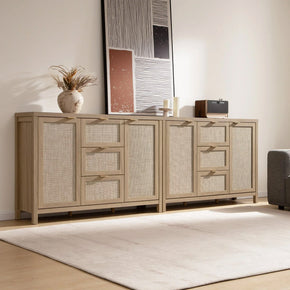
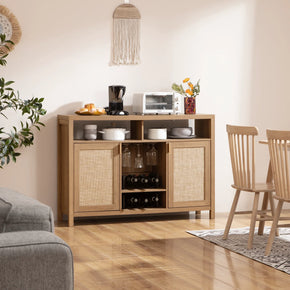
At 25 inches high, 61.5 wide, and 15.6 deep, the Savanna TV Stand for 65Inch TV — four rattan doors, a raised design — is the right shape for robot access. Before buying, confirm three things the listing doesn't publish: the floor-to-lowest-underside measurement, whether a center support sits lower than the corner legs across that 61.5-inch span, and where the cable holes exit.
Stria TV Stand with Storage up to 100Inch TV
The Stria TV Stand with Storage up to 100Inch TV is a different shape: 30.9 inches wide, 34.1 inches high, and 15.6 inches deep — a vertical storage cabinet, not a low console. Fewer legs and a shorter tunnel, but everything rests on one number: the lowest point under a taller, heavier cabinet. Check the leveling feet carefully — taller cabinets get leveled aggressively, and every turn eats clearance.
The honest summary: both pages publish overall dimensions, not the floor-to-underside gap. Treat it as an in-person measurement or a customer-service question. A stand whose lowest point clears your robot's height plus a full inch is one you'll never rescue at 2 a.m.
Image: Two TV stand styles — low wide rattan console and tall narrow cabinet.
Quick Compatibility Check

Shortcut once you have both numbers — find your robot's height class, read across, compare with the lowest underside measurement.
|
Robot height |
Minimum clearance |
Comfortable clearance |
Verdict |
|
Under 3 in (slim bump) |
3.5 in |
4 in |
Most raised stands work |
|
3 to 3.5 in (most LiDAR/camera) |
4 in |
4.5 in |
Verify the center rail |
|
3.5 to 4 in (tall LiDAR) |
4.5 in |
5 in |
Measure twice; consider risers |
|
Over 4 in |
4.5 in+ |
5.5 in+ |
A solid-base stand may be saner |
If the numbers don't work: furniture risers under the legs add the fraction of an inch a borderline stand needs, invisible from sofa height. More than an inch short? Risers change the look and the stability math — pick a different stand instead.
FAQs
How much clearance does a robot vacuum need under a TV stand?
Grab a tape measure and find the tallest spot on your robot — that’s usually the little LiDAR dome on top. Add at least half an inch to that number, though a full inch is better if you can swing it. In practice, most people end up needing somewhere between 4 and 5 inches of real clearance under the lowest point.
Is 4 inches of clearance enough for a robot vacuum?
Yeah, four inches works for most of the popular models out there, with a bit of wiggle room to spare. Just make sure you’re measuring the actual lowest point under the entire stand — not just what the legs measure at the corners.
Why does my robot vacuum get stuck even though the legs look tall enough?
Nine times out of ten, it’s one of four culprits: there’s a center rail or apron hanging lower than the legs, the leveling feet got cranked out too far, a cable is sagging down, or your rug is eating into the gap. Rule all four out before you start blaming the robot.
Should I measure clearance with the rug in place or without it?
Definitely with the rug down. Here’s why — the pile squishes under the robot’s weight, and the edge can tilt it slightly, both of which shrink your working clearance. Measure the bare gap first, then knock off the pile height.
Can I raise my TV stand with furniture risers so the robot fits?
They can work if you’re only short by a little — risers typically buy you anywhere from a fraction of an inch up to a couple inches. But they’re a fix for borderline cases, not for stands that are inches too low.
Will a robot vacuum scratch the TV stand's legs?
The older bump-style robots? Yeah, they can scuff up legs over time since they literally feel their way around by bumping into things. The LiDAR and camera ones are smarter — they slow down before contact, so they hardly ever leave marks. Either way, stick some felt pads on there and you’ll protect both the furniture finish and the robot’s bumper.
Should I just block the space under the TV stand instead?
Blocking it off does kill the stuck alerts for good — but you’re also giving up on the robot cleaning under there at all. Honestly, it’s the right move if you’ve got a tall robot, thick rugs, or you’re just sick of fishing the thing out at midnight.
What should I check on the product page before buying a TV stand for a robot-vacuum home?
Keep an eye out for legs that actually lift the thing up, decent spacing between the legs, cables routed out the back, and any mention of a center support beam. Most listings won’t tell you the floor-to-underside gap — that’s just one of those things you’ve got to ask about in the Q&A section.


Looking for something else?

How to Choose a Bookcase for Plants Without Damaging the Shelves
LEARN MORE
How to Choose a Bookcase for Board Games: Shelf Depth, Height, and Access
LEARN MORE
7 Best Narrow Nightstands for Small Bedrooms With Real Storage
LEARN MORE
Chest of Drawers vs Dresser: Key Differences and Which One to Choose
LEARN MORELooking for something else?
Narrow Shoe Cabinet Buying Guide: Depth, Sizes and Styles That Fit a Small Entryway
LEARN MORE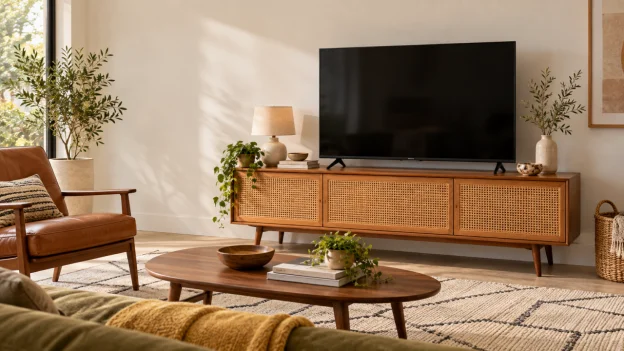
11 Best Mid-Century Modern TV Stands for Style and Real Storage
LEARN MORE
Mid Century Sideboard Guide: How to Choose the Right Size, Wood and Style
LEARN MORE


Further reading

Zen Bedroom Ideas for a Calmer Room

Sage Green Bedroom Ideas and Furniture That Suits It


