

















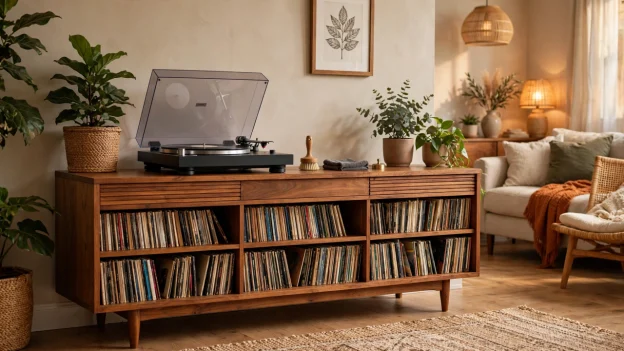

Picking the Right TV Stand for a Turntable and Vinyl Storage
The Question a Hi-Fi Dealer Asks First
My turntable lived on moving boxes for four months. It arrived on a Friday, and I parked it on stacked cardboard because the furniture could wait. Every record those four months came with a little background hiss of regret. Not from the pressing. From me.
Nobody tells you while you're deck-shopping: the TV is the easy half. A television will sit on a door laid across sawhorses and not complain. A turntable is the fussiest houseguest you'll ever host — it demands zero wobble, a lid that opens a full 180, shelves immune to a hundred pounds of vinyl, and speakers living in another room.
Before you spend a cent, work the real checklist — deck footprint, lid swing arc, honest interior shelf numbers, per-shelf weight ratings (ignore the big number on the listing), vibration paths, speaker placement, amplifier breathing room, cable routing. One console can genuinely handle the lot.
Measure the Lid Before Anything Else
Skipping the dust-cover measurement is the classic beginner blunder — nearly everyone commits it. The lid doesn't come off in your hands; it hinges up and back, needing sixteen to eighteen inches of empty air above the deck. Call it seventeen to be safe.
TV sitting on the stand behind the turntable? Shelf mounted above? Measure from the stand top to the bottom of whatever's up there — come up short and you'll remove the lid by hand every single time you play.
Then the footprint, because turntables photograph small. Full-size decks in the Technics SL-1200 family run about 17.7 by 13.9 inches, while the small belt-drives beginners usually buy land nearer fourteen by thirteen. Keep an inch or two of clearance all the way around the deck. On a 15.6-inch-deep top, a 13.9-inch deck rests easy; on a 12-inch top, the front feet dangle past the edge — bad news.
The 12-Inch Number That Fools Everyone

Twelve inches is the number that ruins vinyl storage. A record is twelve inches across, so a twelve-inch shelf should work. Perfect logic. Wrong object.
You're not shelving the disc — you're shelving the sleeve, which runs 12.3 to 12.5 inches square. So an upright LP needs thirteen and a half to fourteen inches of vertical clearance, and that last inch is finger room, not decoration. Without it, every record scrapes its sleeve top against the shelf above — my battered copy of Rumours has the scars.
Depth plays the same trick sideways. What matters isn't the listed depth — it's usable interior depth after the back panel, door frame, and shelf lip take their cut. You want about twelve and a half inches of clear space; shorter, and records sit proud of the front edge.
Bay width: nobody thinks about it until the records start domino-leaning. A 23-inch interior bay holds one clean row with flip-through room; two 15-inch bays hold two tidy shorter rows. An 18-inch bay is the cruel middle — too wide for one neat row, too narrow for two.
Do the Weight Math on a Napkin

Vinyl weight is a stealth tax. One record feels like nothing — five, six ounces. Run the napkin math: fifty records come in near eighteen pounds, a hundred push thirty-five, two hundred approach seventy, and past three hundred you're loading over a hundred pounds onto a single shelf.
The number that counts hides in the fine print — never up in the headline. That big bold number always describes the top surface; the per-shelf rating — the one your records actually live under — sits smaller and lower down the page. The Savanna TV Stand for 65-inch TVs rates 165 pounds up top but 33 per interior shelf. The 33 is your number.
Two habits keep shelves honest: store records low, where the frame is strongest, and give any shelf spanning more than two feet a center support. Long unsupported shelves don't fail dramatically — they sag, slowly, and lean the whole row at a permanent drunken angle.
Vibration Is the Problem You Can't See

A stylus is a precision instrument with zero sense of proportion. It reads the microscopic wiggle in the groove and your footsteps on a springy floor with exactly the same enthusiasm. Footfall. The subwoofer two shelves down. A humming transformer. All of it shows up as rumble under the music — or, on a bad day, the needle skating across the record mid-song.
Mass and rigidity do most of the work: heavy and solid shakes less than light and hollow. After that, the classic fixes earn their keep — sorbothane pads under the deck, matched to the deck's actual weight. The cheaper trick with a long track record: load the bottom shelf with records — a hundred pounds of vinyl is excellent mass damping.
And the biggest gain costs nothing: get the speakers off the turntable's furniture. Bass travels through shelf wood straight into the cartridge. Then level the deck — thirty seconds with a bubble level.
Give the Speakers a Different Address

Bass shakes whatever the speakers sit on. Physics, not folklore. When speakers share the stand with the turntable, every low note travels through the shelf and into the needle. Moving them apart buys more audible improvement than any cable upgrade you've ever read a forum thread about.
I learned this the fun way: during a loud chorus, the needle hopped — every single time. I spent a week suspecting the pressing. It was the speakers, eighteen inches from the deck.
Best case: bookshelf speakers on their own stands a few feet to either side, or wall brackets. If they must stay on the stand, push them to the far ends on isolation pads. And the subwoofer never parks near the turntable — low frequencies are the first to cause feedback.
The Amplifier Needs Real Estate Too

A turntable almost never travels alone — there's usually a receiver or integrated amp, and often a separate phono preamp. All of it needs an actual parking spot.
Receivers run hot — give the chassis two to three inches of clear air above and keep the back ventilated. They're also deeper than anyone guesses: chassis plus RCA plugs plus speaker wire can demand fifteen to seventeen inches of shelf depth. Measure assembled, cables attached.
The phono preamp gets one rule with no exceptions: it parks right beside the turntable. Long phono runs pick up noise like an antenna, so the cable stays short. This is where adjustable shelves earn their keep — one tall ventilated opening for the hot receiver, one exact fourteen-inch opening for upright LPs.
Do the Cable Math Before You Buy

Do the cable arithmetic before the furniture arrives, not after. Turntable RCAs and ground to the preamp, preamp out to the receiver, speaker wire to each speaker, the TV's HDMI and power, power for everything else — a dozen cables without even trying.
You want real, dedicated cable holes — not an open back pretending to be cable management. Four well-placed holes beat one big rectangle: power one way, signal the other, phono far from power cords.
And the hum diagnosis every vinyl owner eventually needs: if the turntable hums, check the ground wire first — that thin wire from deck to preamp or receiver, alongside the RCAs. Nine times out of ten it worked itself loose. I once spent an evening troubleshooting a hum that fixed itself the moment I bent down to look at the rack. Tighten both ends before touching a single setting.
Sketch the Layout Before You Spend

Before spending anything, sketch the layout — a rectangle with boxes is fine. TV centered on top or wall-mounted above, turntable on one end with clear lid air, speakers on their own stands flanking the console. Below: LPs upright in the low compartments, the receiver in a ventilated bay, the preamp beside the turntable. Cables through the back-panel holes, power routed far from phono signal.
Paper is free. Furniture is not.
Two Stands That Survive the Checklist

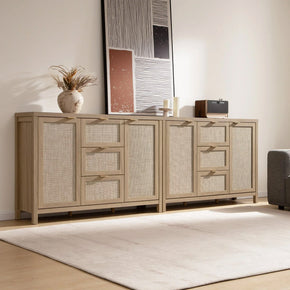
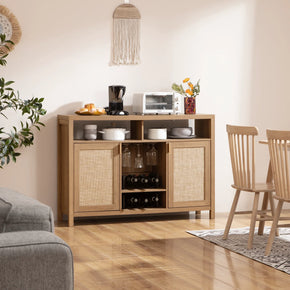
Two SICOTAS consoles survive this checklist. The Savanna TV Stand for 65Inch TV gives 61.5 inches of top width at 15.6 inches deep, rated to 165 pounds — room for a full-size deck and a TV. Inside, each shelf carries 33 pounds, four real cable holes sit in the back panel, and soft-close doors keep LPs dust-free.
The Savanna TV Stands with Shelves takes the open route: a 59-inch-wide low console whose 23-inch middle compartment swallows a full row of upright LPs, with two 15-inch end bays for shorter rows or the receiver. Open shelving lets the receiver breathe and keeps the collection visible.
Compare the TV Stands collection against these two before deciding.
|
Feature |
Savanna TV Stand for 65" TV |
Savanna TV Stands with Shelves |
|
Top |
61.5″W × 15.6″D, 165-lb top rating |
59″W × 15.5″D |
|
Height |
25 in tall |
26 in tall |
|
Record storage |
Sealed cabinets keep dust out |
Open shelves: 23-in middle bay + two 15-in end bays |
|
Weight rating |
33 lb per shelf |
70 lb total capacity |
|
Cables |
Four holes in the back panel |
Open back |
|
Best for |
Tidy, enclosed vinyl + TV setup |
Visible collection, ventilated electronics |
Enclosed for dust control; open-shelf for a visible collection and breathing electronics. Run this checklist before you order:
Pre-purchase checklist: 1. Measure the turntable, then add two inches per side. 2. Measure stand top to whatever hangs above — roughly 17 inches of lid clearance. 3. Confirm 13.5-inch shelf openings wherever LPs stand upright. 4. Match per-shelf ratings to what your collection weighs. 5. Plan the speakers off the stand entirely. 6. Confirm receiver depth with plugs and cables attached. 7. Count every cable and confirm its route. 8. Verify every single number on the product page before checkout.
FAQs
Can I put a turntable directly on top of a TV stand?
Yes — if the stand is up to it. The top must swallow the deck's footprint with an inch or two to spare on every side, you need roughly seventeen inches of clear air above for the dust cover, and the stand should be rigid and level.
My TV sits on the stand instead of the wall — how much room does the dust cover actually need?
Sixteen to eighteen inches of empty air above the deck, measured from the stand top to the bottom of the TV. Call it seventeen — come up short and you'll be removing the lid by hand forever.
I own about 250 records and the number keeps growing. How do I know the shelf won't sag?
Napkin math first: at five to six ounces per LP, 250 records weigh roughly 80 to 95 pounds. Check the per-shelf rating — not the big top-surface number — and keep heavy shelves low where the frame is strongest.
Will speakers on the same console really make the needle skip, or is that just audiophile paranoia?
More physics than paranoia. Bass energy moves through the shelf wood straight into the cartridge. Low volume might get away with it, but the first loud passage with real bass tells the truth — separate stands a few feet away fix it.
...okay wait, do I actually need a separate phono preamp, or does my receiver handle it?
One of the two has to handle phono equalization — no skipping it. Many modern receivers quietly dropped the phono input, so check the back panel for a PHONO input before assuming. Otherwise you need the small external box, parked next to the turntable on a short cable.
How tall do the shelves need to be so I can flip through records without a fight?
Thirteen and a half to fourteen inches of vertical clearance. The sleeve runs about 12.3 to 12.5 inches square, and the extra inch is finger room — without it, every record scrapes the shelf above.
My turntable hums when everything is plugged in. Where do I start?
The ground wire — the thin one from the turntable to the preamp or receiver, alongside the RCAs. It works loose more often than anything else in the chain, so tighten both ends before touching a single setting.
Can the TV and the turntable genuinely share one stand?
Yes — better roommates than people expect. The TV's electronics barely bother the turntable at all — every genuine conflict here is physical, never electrical. Hang the TV on the wall, shift the speakers onto their own stands, and the pair lives together happily.


Looking for something else?

How to Choose a Bookcase for Plants Without Damaging the Shelves
LEARN MORE
How to Choose a Bookcase for Board Games: Shelf Depth, Height, and Access
LEARN MORE
7 Best Narrow Nightstands for Small Bedrooms With Real Storage
LEARN MORE
Chest of Drawers vs Dresser: Key Differences and Which One to Choose
LEARN MORELooking for something else?
Narrow Shoe Cabinet Buying Guide: Depth, Sizes and Styles That Fit a Small Entryway
LEARN MORE
11 Best Mid-Century Modern TV Stands for Style and Real Storage
LEARN MORE
Mid Century Sideboard Guide: How to Choose the Right Size, Wood and Style
LEARN MORE


Further reading

Zen Bedroom Ideas for a Calmer Room

Sage Green Bedroom Ideas and Furniture That Suits It


