



Mismatched Nightstands: How to Pair Two Different Bedside Tables
Mismatched nightstands are the fastest way to make a bedroom look collected, notpulled straight from a catalog page. They also fix real problems. Maybe one side of the bed has less wall space. Maybe one of you needs three drawers, and the other just needs somewhere to drop a phone. This guide covers the height, visual weight, color, material, and lighting rules that keep two different bedside tables looking deliberate. You also get pairing ideas, small bedroom fixes, and a secondhand buying checklist. Designers have argued for years about whether bedside tablesneed to match. The short answer is no.
Do Nightstands Have to Match?

No. Matching is a preference, not a rule. A pair of identical tables gives you instant symmetry and a quiet, hotel-room calm. That is a genuine benefit when the rest of the bedroom already has plenty going on.
Trouble starts when people treat matching as the only correct option. It rules out the vintage piece you fell for. It rules out the little chest that happens to fit an awkward wall. It also doubles the spend when one good table would have done the job.
When a Matching Pair Still Makes Sense

Go matching when the room is small and busy, when the bed is heavily patterned, or when you simply like order. A two-piece bedside set takes the guesswork away. Both tops line up. Both lamps land at the same height—nothing to measure twice.
When Two Different Bedside Tables Work Better
Choose different pieces when the two sides of your bed are not the same. Uneven wall space. A radiator. A door swing that eats six inches. Very different bedtime habits. Mismatched bedside tables let each side answer its own problem instead of splitting the difference.
Balance Matters More Than Symmetry
Symmetry means the two sides look the same. Balance means they carry the same visual weight. You only need the second one.
That single distinction is most of this article.
The Rule That Makes a Mismatch Look Deliberate

Two night tables need a relationship, not a match. Somewhere in the pair there should be one repeated element the eye can lock onto. Without it, the room reads as unfinished.
Any of these will do the job:
- Similar height
- A shared wood tone or the same paint color
- The same metal on the handles
- Matching table lamps
- Related shapes, both rounded or both squared off
- The same design era
One strong connection usually carries the pair. Two is plenty. Three and you have quietly gone back to matching.
Start With the Bed, Not the Tables
The bed is the largest object in the room. Everything beside it is supporting cast. Judge your tables against the bed first, then against each other.
Measure the top of your mattress before you shop anywhere. That one number decides almost everything else. Most bedside surfaces land within two to four inches of it, above or below.
A Simple Bed Can Take More Contrast

Plain upholstered platform. Low wood base. A frame like that leaves you room to play, and a carved vintage table opposite a modern drawer unit will not fight anything. Worth browsing the wider bedroom furniture range with that freedom in mind.
A Statement Bed Needs Quieter Night Tables
Canopy frames—tall tufted headboards. Bold pattern. Those already hold the eye. Keep the bedside pieces simple, and keep the difference between them small.
7 Rules for Pairing Mismatched Nightstands
Run these checks before anything gets delivered.
1. Keep the Heights Close

Aim for both tabletops to sit within a couple of inches of the mattress top. Spills happen when you reach down for a glass of water in the dark.
A four-inch gap between two tables is visible from the doorway. Two inches is not. Nightstand height is the detail people notice without knowing why.
2. Match Visual Weight, Not Dimensions

Visual weight is how heavy a piece looks, not what it weighs. A narrow black cabinet often reads heavier than a wide table standing on thin legs.
Check four things: solid body or open base, dark or light finish, thick or slim legs, and how much floor you can see underneath.
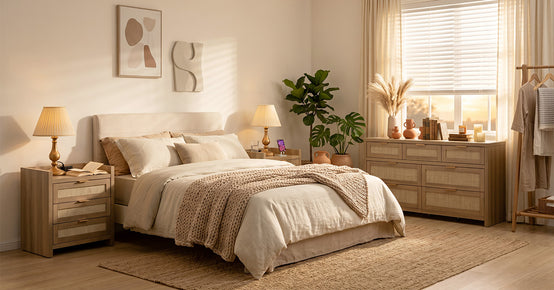
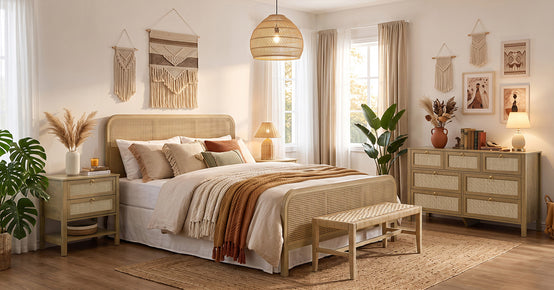
A wide, grounded piece such as this three-drawer bedside table needs a partner with some presence of its own. A tiny stool opposite it will look lost.
3. Coordinate the Hardware

Handles do a lot of quiet work. Brass knobs on both tables will connect two pieces that agree on nothing else. Black pulls do the same job. No pulls at all works too.
Swapping hardware is cheap and takes an afternoon. It is the most underrated fix on this list.
4. Vary the Shape on Purpose

Round beside rectangular. Leggy beside solid. Open beside closed. Deliberate contrast always reads better than a near-match that misses by an inch.
The worst pairing is two tables that are almost the same. Almost looks like a mistake.
5. Mix Materials Without Mixing Everything

Wood with metal. Painted wood with natural grain. Rattan against a smooth lacquer front. Two materials across the pair is plenty.
Then repeat those materials elsewhere in the room. A brass lamp base. A cane bench at the foot of the bed. A wood-framed mirror. Repetition is what makes a mix look planned rather than random.
6. Let Each Side Do a Different Job

One person keeps books, cables, a glasses case, and hand cream by the bed. The other keeps a phone. Give the first person drawers. Give the second a single-drawer table with an open shelf. Nobody has to compromise, and the room gets more interesting for free.
7. Leave Empty Space on Both Tops
Two different tables already hand the eye more to process. Crowded surfaces push it over the edge.
Three objects per table is a sensible ceiling: a lamp, one small stack, one useful thing.
How Different Can Two Nightstands Actually Be?
This is the question people get stuck on. The honest answer is that the gap can be enormous, as long as one thread holds.
Matching Height, Different Style
Easiest place to start. A modern drawer unit beside a vintage side table. A wood piece beside a painted cabinet. Matching height sets the order, and the styles supply the character.
One Material, Two Shapes
Two oak pieces in a similar tone, one square and one round. Subtle, quiet, hard to get wrong. Good option for anyone nervous about the whole idea.
One Color, Two Furniture Types

Color is the great equalizer. Paint or finish will tie a table, a small cabinet, a stool, and a low chest together even when they share no other feature. A black rattan-front night table will sit happily next to almost any dark piece, whatever shape it is.
Different Height and Different Style
Highest contrast, hardest to land. Make the difference obvious, not marginal. A tall narrow chest on one side and a low open table on the other looks like a decision. A three-inch mismatch looks like an accident.
How to Balance Nightstands of Different Heights

Height is the reason most mismatched pairs fail. Four fixes, in order of how often they work.
Fix the Sight Line With the Lamp
Put a taller lamp on the shorter table. Line up the bottom edges of both shades, and the eye stops noticing the furniture underneath. This works more often than people expect.
Add Height With Books or a Tray
A short stack of hardbacks lifts a lamp an inch or two without looking like a workaround. A shallow tray does the same for a low table. Both are free if you already own them.
Work the Wall Above Instead
Hang two pieces of art at the same level. Mount sconces at matching heights. Alignment higher up pulls attention away from the mismatch below.
Sometimes You Leave the Gap Alone
If one side is a tall chest and the other is a low stool, stop trying to disguise it. Own the asymmetry. Style each piece for what it is and let the room look collected.
Should the Lamps Match When the Nightstands Do Not?

Usually yes, though it isn't required.
Matching Lamps Are the Easy Answer
A pair of identical lamps restores symmetry at eye level while the furniture below stays different. For most people, this is the whole solution. It costs nothing in character and buys a lot of calm.
Two Different Lamps Can Still Work
If the tables already relate strongly through height or color, mismatched lamps add another layer. Keep them connected through scale, shade color, or era. Do not make every single element different at once.
Wall Sconces Sidestep the Problem
Sconces mounted at equal heights anchor two very different tables and free up surface space. Bedside brightness matters more than most decorating guides admit, since evening light exposure affects how quickly you fall asleep.
Warm bulbs. Dimmer switches. Both worth the small extra cost.
8 Mismatched Nightstand Pairings That Work

Copy any of these directly.
1. Nightstand Plus a Small Dresser
Best for couples with very different storage needs, or a bedroom where one side has more wall to spare. Keep the top surfaces roughly the same height and repeat one finish elsewhere.
2. Drawer Unit Plus an Open Side Table

Storage on one side, air on the other. Balance it by keeping both tops the same height, then repeat a wood tone or a metal finish across the pair. The wider bedside table collection is a useful place to compare footprints side by side.
3. Vintage Find Plus a Modern Table
The classic collected look. Do not try to match eras. Look for shared proportions, similar color depth, or a repeated detail such as a turned leg or rounded corner.
4. Round Table Plus a Rectangular Cabinet
Great in a bedroom full of straight lines. Similar surface height stops the shape difference from feeling arbitrary.
5. Natural Wood Plus a Painted Piece
Adds color without two statement pieces competing. Pull the paint color through the room with a cushion, a throw, or a piece of art so it doesn't sit there alone.
6. Floating Shelf Plus a Freestanding Table
For tight or oddly shaped bedrooms. Connect them with matching lamps or wall art, since they share nothing structurally.
7. Stool or Bench Plus a Storage Nightstand
Works when one person genuinely needs no storage. Keep the stool sturdy and at least as wide as a book. A tiny perch will annoy someone within a week.
8. Tall Chest Plus a Low Side Table
The boldest option on the list. Use it when the chest doubles as extra clothing storage. Balance the low side with a tall lamp and something on the wall above.
Mismatched Nightstands in a Small Bedroom

In small rooms, mismatching stops being decorative and starts being practical.
Let Each Side Fit Its Own Wall
One side might take a standard nightstand while the tighter side needs a slim table, a floating shelf, or a wall-mounted unit. Forcing a matching pair into unequal spaces usually blocks a door or a walkway.
Pick an Open Base for the Tight Side
Leggy tables and floating pieces show more floor, and visible floor makes a compact bedroom feel bigger. It is an old trick, and it still holds up.
Protect the Walkway
Leave at least 24 inches between the bed and any wall or piece of furniture you have to walk past. Measure it with the drawers open, not closed. That detail catches a lot of people out.
The Setup Details Most Guides Skip
Most articles on this topic stop at styling. These three things matter more.
Anchor Anything Tall

If one side of your bed is a tall chest or a narrow cabinet, strap it to the wall. Safety guidance points to anchoring furniture taller than 30 inches or heavier than 30 pounds, and a narrow piece with deep drawers is exactly the shape that tips.
Anchor kits cost very little. Fitting one takes about twenty minutes.
Plan for Outlets and Cords
Check where your outlets actually sit before you commit to two different footprints. A wide cabinet can cover the only socket on that wall. Pieces with a cable cutout in the back panel save a lot of irritation later.
Test for Wobble Before the Lamp Goes On
Assemble, then push gently at the top corner. Secondhand pieces and flat-pack pieces both loosen over time. Tighten every fixing before a lamp and a full glass of water go anywhere near it.
Buying One Half of the Pair Secondhand

Half the appeal of mismatched bedside tables is that one of them can be old. Vintage shopping has its own checks.
Measure the Top Surface, Not the Whole Piece
Overall height tells you whether it works beside the mattress. Usable top area tells you whether a lamp and a book will actually fit. Old side tables are frequently narrower than they look in photos.
Open Every Drawer
Pull each one fully out. Sticking runners, split bases, and drawers that drop at the end of their travel are all common. Some are fixable in an hour. Some are not worth it.
Check the Back, the Feet and the Smell
Look for water marks on the feet, a bowed back panel, and any lingering musty smell. Smell is the hardest of the three to remove. Everything else is usually cosmetic.
How to Style Two Different Bedside Tables

Accessories can pull a pair together without turning both surfaces into copies of each other.
Repeat One or Two Small Things
A matching pair of lamps—the same tray on both. Related ceramics. One repeated accent color. Pick one or two, not five.
Match the Clutter Level, Not the Objects
One table does not need the same number of items as the other. Their overall density should feel similar, though. A bare surface opposite a crowded one looks like an argument.
Give Small Items Somewhere to Live
Chargers, jewelry, lip balm, hair ties. A shallow dish or a drawer divider keeps them off the top. Nightstand styling falls apart fastest at the everyday clutter level.
Mismatched Nightstand Mistakes to Avoid
The most common failure is choosing two pieces that share absolutely nothing. Difference alone is not a design decision. Find one connecting feature before you buy.
Ignoring the bed comes second. Small tables beside an oversized upholstered bed look weak, and a heavy cabinet next to a narrow frame swallows the room.
Then there is the awkward height gap. Three or four inches reads as a purchasing error rather than a choice. Either close it or widen it.
Too many finishes is another one. Two different night tables don't require five woods, three metals, and a handful of unrelated colors in the same room. Keep the material list short.
Function gets forgotten surprisingly often. A beautiful stool is not a working nightstand if there is nowhere to put your glasses.
Last one: overloading both tops. A varied pair plus a pile of frames, candles, books, and plants quickly turns into visual noise.
Nightstand Trends Worth Knowing in 2026
Bedroom furniture has steadily moved away from fully matching suites. Rooms assembled over time, from different sources, are the look most designers are chasing right now.
Wood tones have gone deeper. Warm walnut, coffee oak and near-black finishes are showing up alongside pale oak rather than replacing it, which suits a mismatched pair perfectly.
Shapes have loosened up too. Curved fronts, cylindrical bases and softly rounded corners are everywhere, and a sculptural piece beside a plain one is an easy contrast to pull off.
Painted furniture is back after a long quiet spell. Paint is still the least expensive way to make two unrelated pieces belong together.
Vintage and secondhand bedside furniture continues to gain ground, partly because of cost and partly because it is the only reliable route to a room that doesn't look like a showroom.
Storage-led design rounds it out. Deep drawers, cable holes, uncluttered tops. Function first.
A Three-Step Test Before You Buy
Run any potential pair through these three questions.
First, compare height. Are both surfaces comfortable to reach from the mattress, or is the difference clearly intentional?
Second, compare visual weight. Do the two pieces have enough presence to hold their own on either side of the bed?
Third, find the connection. Can you name one shared feature out loud, whether that is color, material, shape, era, hardware, or lighting?
Three yeses, and the nightstands don't need to match.
Final Takeaway
Successful mismatched nightstands are related, not identical. One can be vintage while the other is brand new. One can hold four drawers while the other holds a lamp and nothing else. Heights can even differ.
The deciding factor is whether the bed, the tables, the lighting, and the wall above read as one balanced composition.
The best mismatch looks collected on purpose. Never incomplete by accident.
FAQs
Is it okay to have mismatched nightstands?
Yes. Two different bedside tables look balanced and intentional when they relate through height, visual weight, color, material, shape, or styling. Identical furniture is a personal preference, not a decorating requirement, and plenty of designers now prefer the mixed version.
How to mismatch nightstands?
Pick two pieces that share at least one visual connection and sit at compatible heights. Work through it in this order:
- Measure your mattress top and keep both surfaces within a couple of inches of it
- Compare visual weight so neither side looks lost
- Choose one repeated element such as wood tone, paint color, or hardware
- Decide what each side needs to store
- Add matching lamps if you want extra order at eye level
Is it okay to mismatch bedroom furniture?
Yes, and it usually produces a more personal room than buying a full matching collection. Keep a limited palette of materials and colors running through the space so the mix feels coordinated. Two or three wood tones is a good working limit.
What are the different styles of nightstands?
Common styles include traditional, modern, contemporary, mid-century modern, Scandinavian, farmhouse, industrial, rustic, coastal, boho, vintage, and minimalist. They also vary by construction rather than look:
- Drawer nightstands for hidden storage
- Cabinet nightstands with a door
- Open shelf tables for a lighter footprint
- Plain side tables with no storage at all
- Floating or wall-mounted units for tight rooms
How can I style bedrooms with mismatched nightstands?
Start with the bed as your anchor, then balance the two tables by scale and visual weight. Repeat one or two elements through lighting, color, hardware, or artwork. Keep both tops relatively clear so the difference between the pieces stays the interesting part.
What are common bedside table mistakes?
Common mistakes include the wrong height, ignoring the bed's scale, too little usable surface, an overcrowded top, and lamps positioned to shine straight into your eyes.
For mismatched pairs, add one more. Choose two pieces with no visual relationship at all.
Should both bedside tables match?
They can, if you want strong symmetry. They can also differ successfully as long as the overall composition stays balanced. Think symmetry versus coordinated variety, not right versus wrong.
What are the trends for nightstands in 2026?
Collected pairings over full matching suites, mixed furniture types beside the bed, sculptural and curved shapes, deeper wood tones, painted pieces, vintage finds, practical drawer storage, and cleaner surfaces. None of that means replacing furniture you already like.
Sources
- Homes & Gardens – Should Bedside Tables Always Match? Interior Designers on Whether to Mix Things Up
- Apartment Therapy – The Remixed Rule of Threes Makes Mixing Wood Tones Simple
- Woman & Home – How to Mix Wood Tones: 5 Rules of Thumb Designers Follow
- Decoist – How to Create an Inimitable Bedroom with Mismatched Nightstands
- U.S. Consumer Product Safety Commission – Anchor It! Preventing Furniture and TV Tip-Overs
- Consumer Reports – Best Furniture Anchor Kits to Prevent Furniture Tip-Overs
- Sleep Foundation – Light and Sleep: Effects on Sleep Quality


Looking for something else?
How to Organize Your Jewelry Collection: 12 Smart Ways to Keep Every Piece Tangle-Free
LEARN MORE
How to Decorate a Bathroom Sink: 15 Easy Ideas That Work
LEARN MORE
How to Choose a Pet-Friendly Sofa: A Guide to Fabric, Color, and Care
LEARN MORE
Thanksgiving Table Setting Ideas: A Step-by-Step Tablescape Guide (15 Looks)
LEARN MORELooking for something else?
How to Decorate a Small Living Room: Ideas and Layout Tips (2026 Guide)
LEARN MORE
Spring Table Setting: 15 Fresh Ideas for a Bright, Welcoming Table
LEARN MORE
Unique Storage Solutions for Your Kitchen: Smart Ideas to Maximize Every Inch
LEARN MORE


Further reading

20 Small Media Room Ideas for a Cozy, Space-Smart Setup

15 Bookshelf Styling Ideas for a Collected, Designer Look


