




















How to Sit in Bed With Good Posture: 10 Simple Tips
Most people asking how to sit in bed with good posture didn't set out to ask the question. They handed it back to them. You prop up against the headboard with a book or your laptop, you're fine for a bit, and then — maybe twenty minutes in — the lower back starts nagging, and your neck's gone tight. I've heard this from people for years. And here's what I tell all of them: it isn't the bed's fault, not really. A bed is for lying down. Flat. It was never built to hold a person upright, so the moment you sit up against it without setting anything up, your spine quietly takes over a job it was never meant to have. Sorting it out isn't a big project. A few pillows where they actually belong, a couple of habits, and a rough idea of what your back is asking you for. A lot of this is just plain old good posture — bent a little to fit the one piece of furniture in the house that works against you the whole time you're on it.
So — 10 tips. Recovering from something and stuck in bed a while, propping up to fall asleep, or just one of those people who does their best reading there: doesn't matter, these cover you. Nothing here is complicated either. Most of it you could sort out tonight before you turn off the light.
What Good Posture in Bed Actually Means
Let's get one thing straight first. Good posture in bed isn't you sitting up rigid and square, like someone's about to take your photo. If anything, it's the reverse of that. What you're after is a neutral spine — the loose, natural S-shape your back settles into on its own when it's relaxed, and something's actually holding it up. Head over shoulders, shoulders over hips, nothing wrung out or caving in. And when someone tells me their back's killing them from sitting in bed? It's rarely the sitting. It's what happens after. The slouch that creeps in around the fifteen-minute mark. The head is sliding forward toward the screen without you noticing. The lower back just hangs there with a gap behind it and nothing to lean on. Keep the spine in the shape it wants, and most of that ache never even turns up.
10 Tips to Sit in Bed With Good Posture
Right, the useful part. First time through, do these in order — they build on each other, so it makes sense that way. After a night or two, you won't be thinking about it; you'll just build your setup on autopilot.
1. Recline Slightly Instead of Sitting Bolt Upright

A perfect right angle feels like it should be correct. It isn't. It's tiring for the spine, and you slide down the mattress anyway, so what was the point? Lean back a bit instead — call it 30 to 45 degrees, you don't need a protractor — and your back gets to rest against something rather than holding itself up all night. Takes a genuine load off the lower spine, too. Propped and easy. That's the feeling. Not stiff, not straight.
2. Always Support Your Lower Back

If you do nothing else on this whole list, do this. Your lower back curves inward — and sitting in bed, there's almost always an empty pocket behind it with nothing in it. So the curve flattens out, and the muscles end up holding what the bed should. Wedge something into that hollow. Small pillow, cushion, a rolled-up towel, whatever's nearby. It's a little nothing adjustment, and it does more than anything else here by a mile.
3. Put a Pillow Under Your Knees

Legs out straight, pull on your lower back. Bend them a little,e and the back lets go. Stick a pillow under your knees — you'll feel it pretty much right away. Hips settle, lower back lengthens out, and you stop that slow creep down the bed. It's one of those things physios keep telling people, over and over, and it costs you a pillow you already own.
4. Keep Your Head and Neck in Line

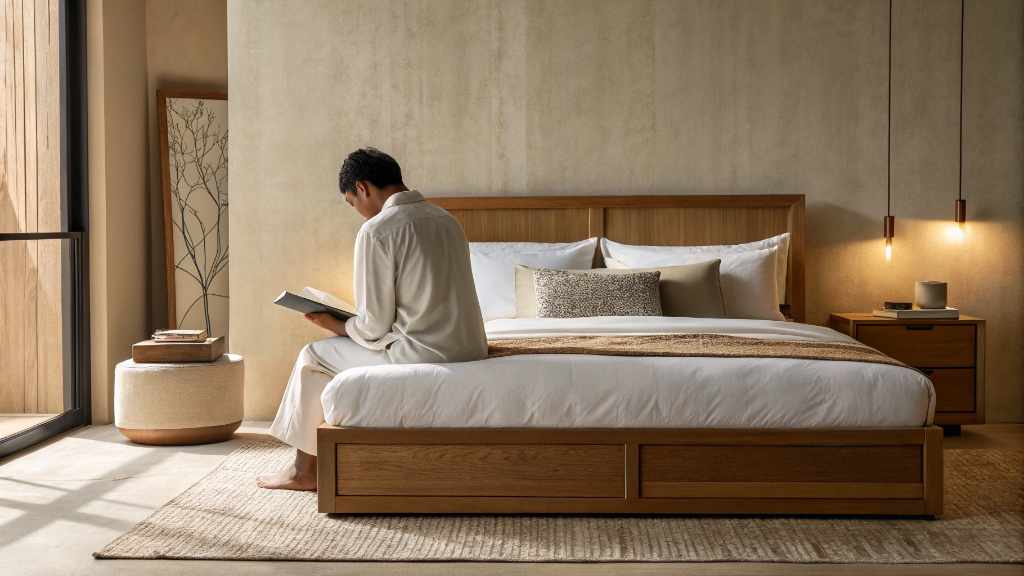
Your head wants to rest, not reach out for something. Stack up enough pillows behind you that it sits level with your spine — ears about over the shoulders, chin not dropped into your chest, and not poking out front either. If you sit up to sleep and wake with a stiff neck, that's the tell: a pillow too many, or one short. A queen bed frame with a solid headboard gives that pillow stack something solid to press into, and that alone makes holding the head-and-neck line far less of a fight.
5. Use a Pillow to Support Your Arms

Give your arms nowhere to land and watch what happens — the shoulders climb, they roll forward, and the upper back hunches over to keep them company. So give them somewhere. A pillow across the lap works, or one tucked under each elbow. Arms have a home now, shoulders drop back down where they belong, and your neck stops hauling around tension that was never its problem to begin with.
6. Bring Things to You, Not the Other Way Around

The whole setup falls apart the second you start reaching for things, leaning sideways for a book, twisting around for the phone, and stretching after a water glass that's sat just slightly too far away. Every one of those undoes what you built. So don't make yourself reach — keep the stuff close. A three-drawer nightstand within arm’s reach puts your essentials right there next to you, so you're not twisting your spine fifty, sixty, or a hundred times across one evening just to grab what you need.
7. Look Down With Your Eyes, Not Your Whole Neck

Read or watch something in bed, and your head pretty much always ends up dragged down and forward toward the screen. That forward tilt adds up on the neck — it's fine for a minute, less fine over an hour. So lift the thing instead. Book or tablet up onto a lap pillow, a stand, or your knees if they're bent — get it closer to eye level and let your eyes do the looking down, not your neck. A nightstand set with a built-in charging station pulls its weight here, too — a charged device sitting right beside you means you're not folding over to chase a cable somewhere down by the floor.
8. Choose Firm Pillows Over Soft, Squashy Ones

A soft pillow feels great for about ten minutes. Then it gives up, flattens, and your spine sinks right along with it. Firm pillows hold their shape — they keep doing the job. Two firm ones stood up behind your back will beat a whole heap of soft, squashy ones, no contest. And if sitting up in bed is a regular thing for you, I'd genuinely keep a couple of firm pillows set aside just for that. Don't use the ones you sleep on.
9. Shift Position Every 20 to 30 Minutes

No position is the right one if you never get out of it. Even a back that's perfectly propped goes stiff once it stops moving — that's just how bodies work. So every 20 or 30 minutes, do something. Doesn't have to be much. Roll the shoulders, push your legs out and pull them back, twist side to side, and get up for more water. Those little resets keep the blood moving, and they straighten you out before the slouch gets a proper grip.
10. Know When to Get Out of Bed Altogether

And this is the honest one, the one people don't love hearing. The bed is fine for reading, for relaxing, for recovering, for being propped up while you drift off. It is a bad office. It really is. It's not where you want to spend eight hours folded over a laptop, no matter how good your pillow game is — a proper chair wins that one every single time, every time. Have a look at the rest of your bedroom furniture collection while you're at it. A chair in the corner, a small desk — that'll do more for your back than any clever in-bed trick ever will.
How to Arrange Your Pillows for the Best Support
Once the ten tips land, the pillow sets up more or less and arranges itself, honestly. Two firm pillows stood up against the headboard — that's the back. One small one, or a rolled towel, into the curve of the lower back. One under the knees. One more across the lap for the arms. And that's it, that's the whole thing: four pillows, maybe five, each with one job. The Bone Health & Osteoporosis Foundation lays out a pretty similar layered approach — the point being to keep the spine lined up and the whole body actually held, not just balanced.
Common Mistakes to Avoid
A few habits will quietly wreck all of it. Leaning forward into nothing instead of back into your support. Piling up soft pillows that tip your head off and squash flat under you. Sitting up too straight with the lower back left bare. Locking into one position and staying there for hours. And the reaching — always, always the reaching — for things you've left parked just out of arm's range. The MS Trust points out one more that's easy to miss: pile too many pillows under your head, and you shove the neck out of line, which strains the exact muscles you were trying to take care of in the first place.
Final Thoughts

So, what to actually take away from all this? Sitting up in bed doesn't have to leave you stiff and sore. It just wants a bit of support in the right spots. Lean back a little, back up the lower back. Bend the knees over a pillow. Keep the head in line. Get up and move every half hour or so. That, genuinely, is most of the job.
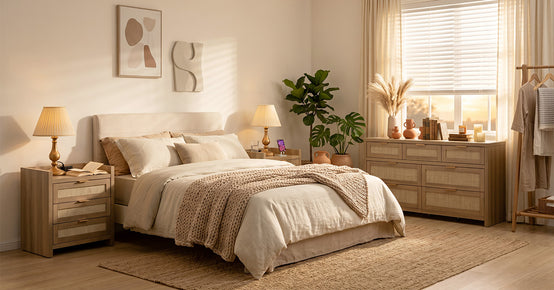
So tonight, before you settle in to read or whatever it is you do — give it the extra minute. Build the pillow setup properly, as laid out up there. Your back will tell you the difference by morning, I promise you that. And if sitting up in bed is just part of your normal routine — reading, recovering, winding down at the end of the day — it's worth making sure the bed itself is pulling its weight. A matching bed frame and nightstand set gives you a firm headboard to lean into and your bits and pieces sitting right where you can grab them — and that's half the battle, right there. One last thing, though, and I mean this. If the back or neck pain keeps turning up even after you've got a good setup going, see a doctor or a physio. That's the right next move, every time.
FAQs
What is the correct posture for sitting in bed?
It's a neutral spine — your back's own natural curve, not slumped over and not forced dead straight. Lean back a little, somewhere in the 30 to 45 degree range. Back up the lower back with a small pillow. Put a pillow under the knees. Then stack the rest so your head sits level with your shoulders — ears roughly over your shoulders, chin level, neither tucked down nor jutting out. The whole point is letting the bed hold you up, instead of your muscles fighting to do it all evening.
Can posture affect the vagus nerve?
There's some evidence that it can, yeah. The vagus nerve runs from the brainstem down through the neck and chest, and it has a hand in digestion, heart rate, and the body's whole calm-down response. Slump forward, and you compress the chest, which may affect how freely that nerve and everything packed around it can do its thing. Sit with an open, upright chest, and there's just more room. It's not some dramatic switch you're flipping. But it is one more reason a lined-up, unslouched posture tends to leave you feeling steadier than a hunched one does.
How to sit up correctly in bed?
Sit back into firm support, don't lean forward into thin air. Two firm pillows stood up behind your back, a small one in the curve of your lower back, and a pillow under your knees so your legs bend a bit. Keep the head level with the spine. Bring books or your phone up toward you instead of folding down to meet them halfway. And then shift around every 20 to 30 minutes so nothing gets a chance to seize up on you.
How to fix posture when lying in bed?
Lying down, you're trying to keep the spine in line. Just enough pillow under your head to fill the gap between your head and the mattress — not a great stack that bends your neck upward. On your back, pillow under the knees. On your side, place a pillow between your knees. Lie as symmetrically as you can, rather than twisted off to one side. And steer clear of sleeping on your front — it pins your neck turned to one side all night, and there's no good way around that.
What is the most unhealthy sitting position?
The worst one for your body is the slumped, hunched-forward sit,with nothing behind your lower back and your head dropped toward your chest or a screen. It rounds the spine off, strains the back and neck, and, given enough hours, it feeds into pain that just lingers. Sitting twisted to one side is rough, too. So is staying frozen stock-still in any position for hours, even a decent one. Movement and support — those are the two things that actually keep sitting healthy.
Can you correct years of bad posture?
You can, yeah. Posture is mostly habit and muscle memory, and both of those will retrain at pretty much any age — it's not locked in. What it takes is consistency, not some quick fix—paying attention to how you sit, supporting your spine properly, moving regularly, and slowly building up the core and back muscles over time. The progress is gradual. But it's real, it adds up. And if you've got long-standing pain in the mix, a doctor or physio can put together a plan that actually fits your body rather than a generic one.
What is the 90-90-90 rule for sitting?
It's an ergonomic guideline for sitting in a chair: hips, knees, and ankles each bent at around 90 degrees, feet flat on the floor. For desk work, it's the gold standard. In bed, though, you just can't hit those angles; it's not possible. This is the whole reason a slight recline with a pillow under the knees is the realistic stand-in for bed. And it's the same reason a proper chair still wins anytime you're settling in for a long working session.
Sources
- Jon Cinkay, physical therapist and coordinator for body mechanics, Hospital for Special Surgery — 8 Tips for Better Posture When You Don’t Have a Desk
- MS Trust Information Team, health information specialists, MS Trust — Tips for Good Posture When Lying Down
- MedlinePlus, health information service of the National Institutes of Health, MedlinePlus — Guide to Good Posture
- Cleveland Clinic Medical Team, medically reviewed health library, Cleveland Clinic — Posture: What It Is and Why It Matters
- American Chiropractic Association, professional chiropractic association, ACA — Maintaining Good Posture
- Bone Health & Osteoporosis Foundation, patient education resource, BHOF — Proper Body Alignment
- Oak Tree Mobility, mobility and adjustable bed specialists, Oak Tree Mobility — How to Be Comfortable Sitting Up in Bed


Looking for something else?

Furniture Materials Guide: Picking the Right Material Room by Room
LEARN MORE
How to Mix Wood Tones Without Making a Room Look Mismatched
LEARN MORE
18 College Apartment Furniture Ideas That Save Space and Money
LEARN MORE
Types of Entertainment Centers: 11 Designs and How to Pick One
LEARN MORELooking for something else?

Curio Cabinet Decor Ideas: How to Style a Display Cabinet Without the Clutter
LEARN MORE
Curved Furniture: How to Style, Measure, and Buy It in 2026
LEARN MORE
What Is Rattan Furniture? A Buyer Guide to Types and Care
LEARN MORE


Further reading

How to Choose a Nightstand for a CPAP Machine

How to Choose a Shoe Cabinet for Men's Sizes, High-Tops, and Bulky Shoes


