



















How to Put on a Sofa Slipcover: A Simple Step-by-Step Guide to Sofa and Couch Slipcovers
A tired sofa does not always mean a new sofa. The frame under there is usually fine. The fabric is what gave up. Swapping that fabric takes a slipcover and one free afternoon, at a small share of a new couch's price. Where people go wrong is the fit. No plan means a baggy, wrinkled cover halfway to the floor by the weekend. Careful fitting gets it close enough to pass for real upholstery. The full guide to putting on a sofa slipcover properly is below: measuring, choosing between stretch and loose-fit styles, installing the couch slipcover, and the tricks that keep it tucked and smooth. Whether you are working through a stretch sofa cover fitting or a multi-piece set, the same core sequence gets it looking tailored.
Why a Sofa Slipcover Is Worth It

Several jobs can be done with one slipcover. Spills, crumbs, claws, and daily wear stop reaching the upholstery underneath. Old stains and faded fabric vanish from sight. The room looks new for little money, and a season change can bring a color change if you feel like it. The washable side might matter most of all, since the Asthma and Allergy Foundation of America cites washable covers as a key way to control indoor allergens such as pet dander and dust mites. No washing machine will ever take upholstery that's been fixed. A machine-washable couch cover fits right in.
Measure Your Sofa Before You Buy

The tape measure comes out before the wallet does. Width goes first: one arm's outside edge straight across to the other. That arm-to-arm width sets the size you order. After width comes seat depth, back height, and the front-to-back depth. Multi-piece buyers also measure each cushion, including length, width, and thickness. Sectionals get measured one section at a time, since most sectional sofa covers ship in separate pieces. Getting the sofa slipcover size right is the first real step in putting on a sofa or couch slipcover correctly, since even a perfect-fitting technique cannot save a cover that was the wrong size to begin with. The shape deserves a look while the tape is out. Rolled arms, square arms, T-cushions, box cushions, loose back pillows, recliners, everyone fits differently, and plenty of covers only suit a single shape.
Choose the Right Type of Sofa Slipcover

The slipcover style follows your sofa and your patience. A one-piece slipcover covers frame and cushions in a single throw, quick to fit but greedy for tucking. A multi-piece set includes the base, with each cushion having its own cover, and the finished look resembles a fitted sofa slipcover. A stretch sofa cover is made of spandex blends, hugs almost any shape, and is the easiest starting point if you need a sectional sofa cover for an odd footprint. A loose-fit slipcover keeps things casual, at the cost of regular smoothing. Custom pin-fit covers hold the top spot for looks and for effort. Match the style and color to yourstylish living room furniture, and the covered sofa keeps looking like it belongs in the room.
Prepare the Sofa Before You Start

Give the job ten minutes of prep, and it pays you back. Vacuum first, crumbs and pet hair included, or the lumps show through the new fabric. Slide the Stria black coffee table back a few feet so you can circle the couch. Seat cushions come off. Back pillows and throws too. Open the slipcover up and get familiar with its parts: the back tag, any separate cushion covers, zippers, Velcro strips, ties, elastic hems, or foam tucking sticks. One firm shake, a light steam where the label allows, and the worst folds drop out before the fitting even starts.
How to Put on a Sofa Slipcover Step by Step

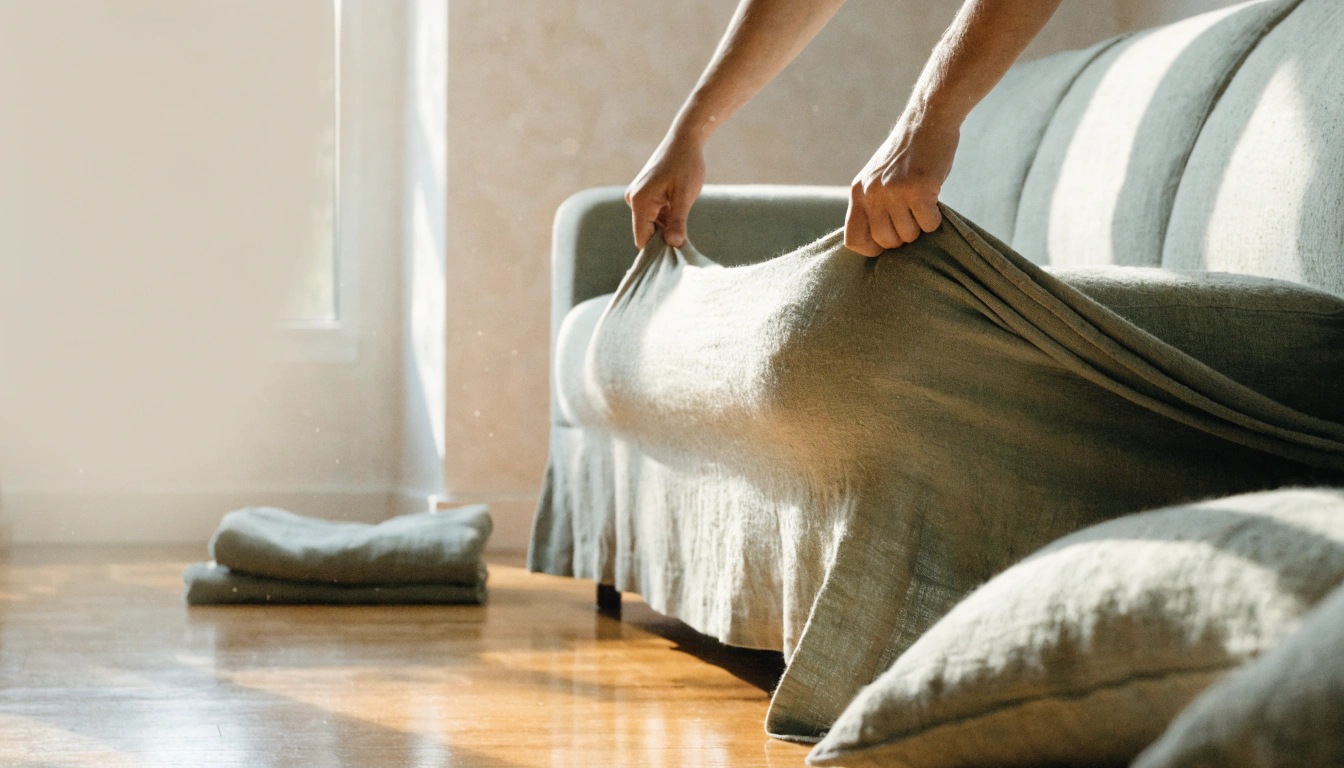
Bare sofa, sorted cover, ready to fit. Eight steps, in order.
Step 1: Drape the Cover Over the Back
From behind the sofa, lay the slipcover across the backrest. Line the tag marked back, or the center seam, up with the middle of the sofa.
Step 2: Pull It Down Over the Frame
Work the fabric down over the back, the front, and both sides. Keep the pull even. Yank one side tight now, and the seams sit crooked later.
Step 3: Work It Over the Arms
Take the arms one at a time. Each arm seam should trace the shape of the sofa arm, not sit halfway up it or twist around it.
Step 4: Line Up Seams and Corners
Walk one lap around the couch. Top seams ride the top edge; corner seams land on the corners. A small fix here saves re-tucking everything later.
Step 5: Fasten Straps, Ties, or Elastic
Raise the base and work through whatever fasteners the cover came with. Velcro grips underneath, ties a knot behind the legs, and an elastic hem wraps under the frame.
Step 6: Tuck the Extra Fabric Deep
Feed the spare fabric into the crevices between the seat, back, and arms, and go deep. A tight tuck is what makes the whole cover look fitted.
Step 7: Cover the Seat Cushions
For a multi-piece set, each cushion slides into its cover like a pillowcase. Zip it closed, then set it back so the zip faces the rear.
Step 8: Smooth and Adjust
Hands sweep every surface. Wrinkles get smoothed, the front skirt gets straightened, and then you step back. Anything the eye catches gets fixed.
Fitting a Slipcover on a Sofa With Loose Cushions

Loose back pillows sit behind almost every lumpy-looking cover. Straighten them out before anything goes on, then treat the whole back as one shape. Quilt batting or a folded towel fills a dip between pillows, and the fabric sits smooth again. The seat crevice wants the hardest tuck of all, since sagging starts there. Given the choice, go for a multi-piece set on this kind of sofa. Separate cushion covers manage loose shapes far better than one sheet of fabric.
Putting on a Stretch Sofa Cover

A stretch sofa cover forgives a lot, and an elastic couch slipcover like this still has a right way up. The back label gets found first, and the cover gets positioned before any stretching starts. Pull evenly over the arms and seat, then, with both hands, side to side. Drag one corner hard, and every seam shifts out of line. Once the body sits right, wrap the elastic hem down and under the base, all the way around. That under-wrap is what locks a stretch cover in place. The finish is foam rods or tucking sticks, driving the extra fabric into the crevices.
Fitting a Slipcover on a Sectional or L-Shaped Sofa

A sectional plays by its own rules. Sectional couch cover installation starts with measuring each section individually, including the chaise and corner, because most sectional covers arrive as separate pieces. That means one sectional sofa cover per section, so fit the largest section completely before moving on to the next one. In an L-shaped design like the Eira L-shape sofa with ottoman, the corner is the trouble spot, so keep the fabric flat where the two sections meet and never let it bunch. The built-in straps or connectors come last, after everything sits straight.
How to Keep a Sofa Slipcover From Slipping

Ask anyone with a slipcover what bugs them, and slipping comes up first, and low-cost fixes handle most of it. Foam tucking sticks go deep into the crevices and anchor the fabric. Slipcover stays add grip where it moves most. A cut pool noodle or a rolled towel stands in fine when nothing else is around. An anti-slip mat under the seat cushions stops the daily slide. Straps, ties, and elastic under the sofa can drift loose over time, so it's worth checking every so often. A loose-fitting cover in a family room still calls for a quick retuck now and then. Put two or three of these together, and they keep your sofa slipcover snug and slip-free, which is really all it takes to stop a couch cover from slipping for good.
How to Make a Sofa Slipcover Look Good

Baggy and tailored sit a few habits apart. Size comes first. Too big droops, too small pulls at every corner. Shape comes second, because a cover cut for square arms never sits right on rolled arms. Past those two, line up the seams straight, tuck firmly, and steam out wrinkles if the fabric allows. Style the result too. Two accent pillows and a throw make the sofa read intentional, and repeating a color from your dining room furniture knits an open-plan space together.
How to Pin Fit a Custom Slipcover

Pin fitting is the DIY path to a cover that fits like upholstery. The idea itself is simple. Fabric drapes over the sofa inside out, pins go along the natural seams, and the sewing follows where the pins sit. Take the arms, the back, and the seat deck one area at a time. Every edge keeps a seam allowance of extra fabric for sewing and adjustments. Corners and curves ask for plenty of pins, spaced close, or the finished cover puckers there. Closures get planned before sewing. Put a zipper or Velcro strip along one edge, and wash-day removal gets easy.
Slipcover vs. Reupholstery: Which Is Better?
The sofa decides the honest answer. Budget updates, rentals, pet-and-kid households, seasonal style swaps, and any couch with a solid frame under tired fabric all point toward a slipcover. Reupholstery is appropriate when the frame is valuable, the shape is unusual, or the goal is a permanent high-end finish. Cost is rarely close. Old fabric has to come off and skilled labor has to be paid, which puts reupholstery well above a slipcover on price. For the everyday sofa, the cover buys most of the look at a small slice of the cost.
Common Sofa Slipcover Mistakes to Avoid

The same short list explains most slipcover disappointments. Spills claim their share as well, and aSavanna rattan end table beside the arm keeps drinks off the cushions before trouble starts. Watch for these:
-
Ordering a cover before the sofa gets measured.
-
Paying no attention to arm shape and cushion style.
-
Leaving the tucking step out and living with loose fabric.
-
Wash according to the care label until the cover shrinks.
-
Stretching one side too hard and twisting the seams.
-
Expecting a loose-fit cover to pass for fitted upholstery.
Nearly all of these are common sofa slipcover and couch slipcover installation mistakes that show up during fitting, so measuring first and tucking properly prevents most of them.
Washing and Caring for Your Slipcover

Washability is the whole point of the thing, so use it. The care label leads. A gentle cycle in cool water does the job, and harsh bleach never comes into play. The cover dries completely before going back on, since trapped dampness invites mildew, and the EPA calls moisture control the key to stopping mold indoors. Refitting runs more easily while a little dryer warmth still sits in the fabric. A spare cover makes the rotation painless, and a Terra flip-open storage bench holds the clean one folded a few steps from the sofa.
Final Takeaway
Learning how to put on a sofa slipcover is really just a sequence, nothing more. Measure the sofa. Pick a cover built for its shape. Vacuum before anything goes on. Drape at the back, pull even, fit the arms, square the seams. Fasteners close underneath, extra fabric goes deep into the tucks, cushions get their covers, and the surface gets one last smoothing. Tucking sticks or grips keeps it anchored, and a regular wash with a full dry keeps it fresh. Run that order once, and the second time takes ten minutes. Your concrete first step: measure the sofa, clear off the cushions, then work the eight steps in order with foam tucking sticks ready before you start.
FAQs
How do you put a slipcover on a couch?
Three moves cover the whole job:
-
Cushions come off, then the cover drapes over the back.
-
It pulls over the arms, the seams square up, and it fastens underneath.
-
The extra fabric tucks deep, and the covered cushions go back.
Can you put a slipcover on any couch?
Most couches can take one. Not every couch takes every cover, though. Size, arm shape, cushion style, and recliners all narrow the field. Stretch covers fit the widest range, while sectionals or unusual shapes usually need custom covers.
How do I put a sofa cover back on after washing?
Start at the back tag or the center seam, then drape and pull evenly, as in the first install. Elastic or Velcro gets fastened, crevices get tucked, cushions go back. The second time runs faster, especially while the fabric holds a little warmth.
How to stick a cover on a sofa?
Fasteners make the grip, not luck. Whatever the cover shipped with gets used: Velcro, ties, straps, or the elastic hem. If it still creeps, foam tucking sticks in the crevices and anti-slip mats under the cushions settle it.
How to keep slipcovers in place?
Three anchors carry the load:
-
Foam rods or slipcover stays hold the deep tucks.
-
Straps, ties, and elastic under the base stay tight.
-
Every cover shifts a little, so re-tuck after heavy use.
Is it cheaper to slipcover or reupholster?
A slipcover usually costs far less. Reupholstery removes the old fabric and pays for skilled labor, and that adds up fast on a standard sofa. The cover route delivers most of the visual refresh for a small fraction of that price.
How can I make my sofa slipcover look good?
The right size for the sofa's shape does half the work. The small effort does the rest: seams straightened, fabric tucked firmly, wrinkles smoothed or steamed. A couple of accent pillows and a throw finish it so the sofa looks styled on purpose.
How to pin fit a slipcover?
Fabric goes over the sofa inside out, and pins follow the natural seams of the arms, back, and seat deck. Every edge keeps a seam allowance; corners and curves get extra pins; the pinned lines are then sewn, and a zipper or Velcro closure goes in.
Sources
- Asthma and Allergy Foundation of America – Control Indoor Allergens to Improve Indoor Air Quality
- U.S. Environmental Protection Agency – A Brief Guide to Mold, Moisture and Your Home
- Mayo Clinic – Allergy-Proof Your Home
- MasterClass – How to Use Scale and Proportion for Better Interior Design
- VDCI – Design Principles: Harmony, Scale, Proportion, Balance, Rhythm
- Utah State University Extension – Cleaning, Repairing, and Reconditioning Wood Furniture


Looking for something else?

Burl Wood Furniture: The Complete Buying Guide
LEARN MORE
What Is a Hope Chest? Meaning, History, and Modern Uses
LEARN MORE
What Is a Foyer? Meaning, Purpose and Design Guide
LEARN MORE
GREENGUARD Gold Certified Furniture: What It Really Means for Your Home
LEARN MORELooking for something else?

How to Clean a Mirror Without Streaks: Simple Step-by-Step Guide
LEARN MORE
21 Above-Bed Decor Ideas for a Stylish Bedroom Wall
LEARN MORE
Furniture Materials Guide: Picking the Right Material Room by Room
LEARN MORE


Further reading

18 Decorative Storage Box Ideas That Hide Clutter Well
ARTICLE BRIEF
Primary Keyword
decorative storage box ideas
Secondary Keywords
decorative storage boxes · decorative boxes with lids · stylish storage boxes · DIY storage boxes
...

How to Store Comforters Without Losing Space or Loft
Storing comforters comes down to four things. Clean and bone dry. Loosely folded, and sitting in something that breathes. Miss any one, and next season you pull out something that smells like a dam...

Furniture Distance From a Fireplace: How Far Is Safe?
Furniture distance from a fireplace answers two questions with one number. Keep anything that can burn at least 3 feet from heat sources.The U.S. Fire Administration gives that message for fireplac...


