


























How to Make a TV Stand Taller: Safe Ways to Raise Your TV
Figuring out how to make a TV stand taller almost always starts the same way. The screen sits too low, and your neck feels it by the end of a movie. If your TV stand is too low and you want to raise the TV without mounting anything to the wall, you have more options than you might think. Maybe a new sofa came in higher than the old one. Or a soundbar is now eating the bottom of the picture. The point is, you do not have to drill into the wall or replace everything to fix it. The pros say it plainly, and the folks atMount-It! Back it up: get the middle of the screen close to where your eyes sit. Below are seven safe ways to lift a TV stand, from a fast riser to a proper taller stand, and stability runs through all of them.
Why Your TV Stand Feels Too Low

A low TV stand is more than a looks problem. Your comfort takes a hit, the room looks off, and the screen gets harder to see straight on. A handful of things cause it, and once you spot yours, the fix is easy to see.
Your Sofa May Be Higher Than the TV Stand
Look at your seat. A deep sectional, a tall couch, a recliner, a high bed, they all push your eyes up higher. So a normal media console that looked just right in the store ends up feeling sunk once you sit down on the taller seat. The stand did not shrink. Your eye line moved up.
A Soundbar May Block the Screen or Sensor
Short TV feet are the usual suspects. The soundbar parks in front of a low TV and ends up covering the bottom of the screen, or worse, the remote sensor. Lift the TV a couple of inches, and both problems vanish.
The Room May Look Visually Unbalanced
Big TVs already add height on their own. Put one on a low stand, and the whole entertainment wall starts to look bottom-heavy. On a wide wall, that sunken look drags your eye down and throws the room off balance.
What Is the Right TV Stand Height?
Measure before you buy a single riser. Getting the target height right saves you from guessing and from the rookie move of raising the TV too far.
Measure Your Seated Eye Level

Sit where you actually watch TV. Get comfortable, face the screen, and run a tape measure from the floor up to your eyes. Write that number down. It guides every choice from here.
Align the Center of the TV With Eye Level

Aim to put the middle of the screen near your seated eye level. On a regular sofa, the height is around 42 to 48 inches off the floor. Dropping a bit under eye level is fine. Going way over it is what wrecks your neck. Getting the TV viewing height at seated eye level right is the whole ballgame here, and everything else is just fine-tuning.
Check the Height Difference Before Buying Anything
Then do the math. Compare where the screen center sits today against where you want it. That gap, in inches, tells you which fix you need. A 2-inch lift and a 6-inch lift are two very different jobs.
Consider Shared Viewing Positions
Family rooms, bedrooms, and open layouts hardly ever have just one seat. So go for a middle-ground height that suits the spots you actually use, not one perfect chair that nobody else touches.
Can You Make a TV Stand Taller?
Short answer: yes. TV stand risers, furniture risers, a TV stand height extender, or just buying a taller TV stand will all do it. The catch, every single time, is that stability comes before height.
Yes, But Stability Comes First
Raise a stand, and you move its balance point. That makes it tip more easily. So no matter which method you go with, the finished setup has to sit dead level, hold the full weight, and pass a good hard shove test before the TV touches it.
Small Lifts Are Easier Than Big Lifts
A 1- to 3-inch lift? Easy with risers. But once you are after 6 inches or more, move up to a full-width platform, a tabletop mount, or a new, taller stand. They hold steadier and look a lot less like a wobbly tower of blocks under your TV.
Some TV Stands Should Not Be Raised
Be honest about what you're working with. Flimsy, narrow, banged-up, a bit wobbly, or just thin particleboard? That kind of stand may not need to be lifted at all. And gambling with your TV, or with whoever happens to be standing next to it, isn't worth the couple of inches you'd gain.
7 Ways to Make a TV Stand Taller
These are the ones that actually work, roughly ordered from fastest fix to cleanest long-term upgrade. Pick the one that matches how many inches you need and how permanent you want it to be.
1. Use Furniture Risers

Furniture risers are the fast lane. Little blocks of plastic, wood, or metal that slide under the stand's legs cost next to nothing and require zero tools. People sell these as TV stand risers too, but it is the same idea, just little cups or blocks that sit under the stand's legs and lift the whole thing an inch or three. They'll add 2 to 6 inches in about a minute. Match the riser to your leg width and weight, stick on some anti-slip pads, and that's it. Renters and temporary setups, this one's for you.
2. Use a TV Stand Riser or Height Extender

Need something sturdier? A TV stand riser, sometimes called a height extender, is the wider, purpose-built cousin of a basic riser. Fixed-height ones hold steadier than the adjustable kind, mostly because nothing slides around. Look for a clear weight rating that covers the stand, the TV, and whatever you keep inside.
3. Build a Full-Width Wooden Platform

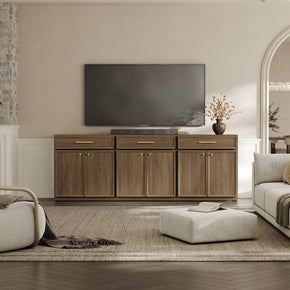
Do risers feel wobbly to you? Then go with a platform. Plywood or MDF, one solid base, and the weight rides evenly across it instead of balancing on four points. Make your cut a little wider than the stand on every side, run rubber pads along the bottom, and bring it home with paint or a stain that matches. This turns a plain board into a real TV stand platform, and that platform base doubles as a TV-stand height extender when it sits under the console. Take ablack media console. It already sits at a fine height on its own, sure, but tuck a matching platform underneath, and those extra inches just read as part of the design.
4. Add Replacement Furniture Legs

Got removable legs? Longer replacement legs or leg extenders raise the stand cleanly. The catch is the attachment. This works with solid-wood consoles or stands that have strong threaded inserts. Thin, angled legs or screws sunk into particleboard will not hold, so go with a platform there instead.
5. Use a Tabletop TV Mount

This is the move when you want the TV higher, but the stand can stay exactly where it is. A tabletop TV mount replaces the original TV feet and sits on the surface, lifting the screen clear above a soundbar without touching the cabinet height. A modular TV stand with drawers gives a tabletop mount a wide, stable base to clamp onto.
6. Use a Universal TV Stand With Mount

A universal or freestanding TV stand with a built-in mount fakes the wall-mounted look without a single hole. Most adjust up and down, so you dial in the exact height you want. The floor stays clear, and the base stays open for storage, which is why minimalist rooms love them.
7. Upgrade to a Taller TV Stand

Sometimes the cleanest answer is the obvious one: a taller stand built for the job. No stacking risers, no DIY, and it usually throws in storage and cable management for free. A two-door TV stand for a 65-inch TV with a higher build solves height, balance, and clutter all at once.
Best Option If You Need to Raise the TV for a Soundbar

A soundbar parked in front of a low TV is one of the top reasons people go looking for more height. The goal is simple. Lift the screen just enough to clear the speaker, no more, so it does not end up sky-high.
Measure the Soundbar Height First
Start with the soundbar. Measure its height with a tape measure, then give it a little breathing room on top so it doesn't creep over the screen or sit in front of the remote sensor. Take that figure, add it to wherever you normally want the screen for eye level, and there's your lift. That's the number to build around.
Use a Tabletop Mount for Clean Clearance
Need the screen above the speaker without raising the whole cabinet? A tabletop mount is the cleanest tool for it. It lifts only the TV, so the console stays put exactly where it is.
Avoid Stacking Books or Random Blocks Under the TV
Skip the pile of books, boxes, and loose boards under the TV. Yes, they lift the screen fast. They also shift under weight, turning a heavy screen into a tip-over waiting to happen. This is also how you end up with a soundbar blocking the TV, so reach for proper risers or a tabletop mount instead, and anchor the whole thing with anti-tip straps.
Check Remote Sensor and Speaker Placement
One last step once it is all in place: test it. Make sure the power button, volume, and remote all respond, and confirm that the soundbar no longer cuts in and out of the picture.
How to Raise a TV Without Mounting It
Renting, or just allergic to drilling? Several options raise the screen with zero wall damage. The one rule that ties them together: keep the base wide, level, and stable.
Try an Adjustable Tabletop TV Stand
An adjustable tabletop TV stand replaces the original TV feet and lets you set the height yourself: no holes, no studs to find, just a clean lift right on the surface.
Place a Freestanding Mount Behind the TV Stand
Another route: a floor-standing or console-backed mount that sits behind the cabinet and holds the TV from below. You get height and adjustability while the wall stays completely untouched.
Use a Stable Platform Under the TV Stand

Need a bigger lift? A full-width platform beats small riser blocks every time. It carries the weight more evenly and feels solid under a heavy console. Browse living room storage furniture if you would rather solve the height and the storage in one piece than build a base from scratch.
Choose a Taller Media Console
When the whole setup feels low and out of proportion, a taller media console is the simplest solution. It fixes the height with no DIY at all.
DIY Ways to Raise a TV Stand Safely
DIY shines when you keep both safety and looks in mind. A few approaches give you the height you want without the makeshift result nobody wants.These DIY routes double as a solid TV stand height extender when a store-bought fix is not worth it, and each one is built to raise the TV stand safely without wobbling.
Wooden Blocks
Cut wooden blocks to the exact height you need. Sand the edges, and make sure every block is identical. Go wider than the original feet so the weight is not balanced on a narrow point, then add non-slip pads to keep them put.
Plywood or MDF Platform
One plywood or MDF platform spreads weight more evenly than four separate blocks ever will. It is the steadier DIY choice for a bigger lift, and it hands you a single clean surface to finish.
New Legs or Leg Extenders
New legs or leg extenders are at their best on solid-wood furniture or stands with strong threaded inserts. Double-check that the new legs match the existing bolt holes, and keep the TV's weight in mind before you commit to them.
Paint or Stain the Added Base
Finish what you build. A coat of paint or stain that matches the stand and the room is the whole difference between a raised stand that looks planned and one that looks like a weekend hack.
Safety Checklist Before Raising a TV Stand

Run through this before the TV goes back on. The U.S. Consumer Product Safety Commission is blunt about it: tip-overs are real, and preventable, and raising a stand only raises the stakes.
- Check the weight capacity. Count the TV, the stand, the devices, the books, and anything stored inside.
- Make sure the base is level: uneven risers or a sloped floor causes wobble.
- Add anti-slip pads under the risers, legs, or platform to stop sliding.
- Use anti-tip straps to anchor the stand, especially with kids, pets, or a heavy screen in the mix.
- Test for wobble. Push from several angles before the TV ever touches the surface.
When Should You Replace the TV Stand Instead?

DIY is not always the right call. A few signs point straight to a new stand being the smarter buy. The stand sits too narrow under the TV, so it cannot hold the screen safely. It still wobbles even after you raise it, and that is a real warning, not a looks thing. It has no proper storage or cable management, and a fresh console would sort out both height and clutter. Or the raised version just looks thrown together, with risers and blocks leaving the room half-finished. An extra-wide TV stand with storage handles it all in one buy.
TV Stand Size and Proportion Rules

Height is only half the story. Width and proportion keep the whole setup safe and balanced. Here is the big one: the stand should be wider than the TV, never narrower. Shoot for a stand 8 to 16 inches longer than the screen, which leaves room on each side for stability and a balanced look. Match the height to your seating too, since a low sofa and a high sofa want different stand heights. And give big TVs wider, heavier furniture so they never go top-heavy on you.
|
Question |
Quick Answer |
|
Can I put a 50-inch TV on a 40-inch stand? |
It might physically fit, but it is not a good idea. The stand should be wider than the TV for balance and safety, so a 55-to 66-inch stand works better with a 50-inch screen. |
|
How wide should the stand be? |
Roughly 8 to 16 inches wider than the TV, with a little extra on each side. |
|
How tall should it be? |
Tall enough that the middle of the screen lands near your seated eye level. |
Alternatives to TV Risers

Risers are not the only way up. If you want a cleaner finish, these alternatives lift the TV or the stand and look better doing it. A tabletop TV mount raises just the TV, not the furniture. A freestanding TV mount is great for renters who want height with no drilling. A full-width platform base gives a custom, built-in look when the stand under it is solid enough. A taller TV console is the best long-term pick when the old stand is too short, narrow, or shaky. And a wall mount works when you are allowed to drill and can tuck the cables away neatly. The Andy media furniture line is worth a look if you end up with a taller console.
Common Mistakes to Avoid When Raising a TV Stand
A few easy-to-miss mistakes turn a smart fix into a shaky, ugly one. Keep an eye out for these.
- Stacking books, boxes, or loose boards that shift under weight and make the TV easy to tip. Instead, grab a proper riser or a sturdy shelf built to hold the load.
- Raising only one side, which stresses the stand and leaves the TV leaning. Instead, lift both sides the same amount and check it with a level, or just your eye against the wall trim.
- Ignoring cable length, because HDMI, power, and speaker cables may need rerouting after the lift. Instead, measure your runs before you commit and leave a little slack so nothing pulls tight.
- Blocking ventilation, since consoles, receivers, and gaming systems all need airflow.
- Chasing height over comfort, because a TV raised too high strains your neck just like one set too low.
Final Takeaway
To raise a TV stand the right way, first measure your seated eye level, then choose the method that closes the gap. Risers and platforms handle quick lifts. New legs and tabletop mounts cover the specific cases. A taller TV stand is the cleanest long-term fix when the old one feels low, narrow, or shaky. Whatever you go with, keep stability first: check the weight, level the base, add anti-tip straps, and shove-test it before the TV goes back on. Get the height right, and every movie night just feels easier on your neck.
FAQs
Can you make a TV stand taller?
Yes, and a few methods get you there:
- Fast lifts: furniture risers or a TV stand height extender.
- DIY: a wooden platform or replacement legs.
- Cleaner fixes: a tabletop mount or a taller TV stand.
Just keep it level, stable, and inside its weight limit.
What to do if a TV stand is too short?
Start by measuring your seated eye level, then match the fix to the gap. Small lifts work with risers or new legs. Bigger lifts call for a platform, a tabletop mount, or a new stand.
How to adjust the TV stand height?
Depends on the stand. Some come with adjustable mounts or movable shelves. Fixed stands need risers, leg extenders, or a platform, since the frame itself will not budge.
How to raise a TV without mounting?
No drilling required. Try one of these:
- A tabletop TV mount or a freestanding TV mount.
- A TV riser stand or a full-width platform.
- A taller console that does the lifting for you.
Can a TV stand be too low?
Yes. A stand is too low when the screen center sits well below your seated eye level, or it makes you tilt your head down. That angle strains your neck over long viewing sessions.
Can I put a 50-inch TV on a 40-inch stand?
It may fit, but it is not ideal. The stand should be wider than the TV for balance, safety, and looks, so a stand around 55 to 66 inches is far better for a 50-inch Tr.
What are the alternatives to TV risers?
Plenty to choose from:
- A tabletop TV mount or a universal, freestanding TV stand.
- A full-width platform base or replacement legs.
- A taller TV console, or a wall mount if drilling is allowed.
Sources
- Mount-It! – Optimal TV Height Guide
- MantelMount – Optimal Viewing Angles and Best TV Mounting Height
- U.S. Consumer Product Safety Commission – Anchor It! Tip-Over Prevention
- TV Dimensions – TV Mounting Height Chart
- Bright Force Electrical – Creating the Ideal Viewing Height for Your TV
- Family Furniture Galleries – Finding the Optimal TV Positioning
- Geeks On Site – Finding the Optimal TV Mounting Height


Looking for something else?

Burl Wood Furniture: The Complete Buying Guide
LEARN MORE
What Is a Hope Chest? Meaning, History, and Modern Uses
LEARN MORE
What Is a Foyer? Meaning, Purpose and Design Guide
LEARN MORE
GREENGUARD Gold Certified Furniture: What It Really Means for Your Home
LEARN MORELooking for something else?

How to Clean a Mirror Without Streaks: Simple Step-by-Step Guide
LEARN MORE
21 Above-Bed Decor Ideas for a Stylish Bedroom Wall
LEARN MORE
Furniture Materials Guide: Picking the Right Material Room by Room
LEARN MORE


Further reading

18 Decorative Storage Box Ideas That Hide Clutter Well

How to Store Comforters Without Losing Space or Loft


