




How to Create a Gallery Wall (2026 Step-by-Step Guide)
Effortless is the look a gallery wall fakes, and almost none are. A plan hides behind every good one: a chosen gallery wall layout, matched spacing, frames that speak to each other. Drop the plan, and the whole wall turns to clutter.
Learning how to create a gallery wall: pick a layout, gather the pieces, lay them out on the floor, and hang them using paper gallery wall templates. That last step is where most people learning how to hang a gallery wall save themselves a wall full of patched nail holes. The gallery wall ideas below all lean on the samescale and proportion rules designers rely on. Spacing and balance follow from there. An afternoon covers it.
Pick the Right Wall

The wall comes first, not the frames. A gallery wall lands best where the eye already goes anyway: behind a sofa, up a staircase, along a hallway, or above a console. One clear, uninterrupted surface gives the display room to breathe. A living room gallery wall usually starts behind the sofa, though a picture wall works just as well in a bedroom, an office, or a dining nook.
Measure the usable area before anything else. Roughly two-thirds to three-quarters of the wall or the furniture below it is the sweet spot for a gallery wall, with a margin of blank wall left as a frame around the whole thing. Hallways work beautifully, so a run ofentryway furniture below a stair-step gallery turns a plain corridor into a first impression.
Choose a Gallery Wall Layout
Gallery wall layout ideas all come down to one decision, and it outweighs the rest. The mood is set before a single frame goes up. Three simple gallery wall templates cover almost every wall.
The Grid

Equal frames, even rows and columns, the same spacing running throughout. Clean, calm, modern. A grid suits a set of similar prints, photos, or art, and it forgives almost no sloppiness in the gaps, so measure with care.
The Salon Style

Many frame sizes are packed tightly into an organic cluster. Rich, collected, full of personality. A salon wall grows over time and hides imperfection well, since the eye takes in the whole group rather than each gap.
The Straight Line

One row of frames on a single shared axis, top edges or centers aligned. Simple and tidy, and the pick for a hallway or a staircase where a tall cluster would only crowd the space.
Gather Your Art and Frames

Think mix, not a matched set. Framed prints, personal photos, canvas pieces, and a few non-framed objects, a mirror, a woven disc, and a small shelf, all belong together. Variety is what keeps the wall from looking like a store display.
Pull colors and tones that echo the room. A gallery wall over a sideboard or console reads as one composition, so let the art nod to the modern living room furniture already in the space, the wood tones, the textiles, the metal finishes.
Gather more pieces than the wall seems to need. A layout always turns out better with a few extras to swap in than with too few stretched thin across the space.
Mix Frames the Right Way

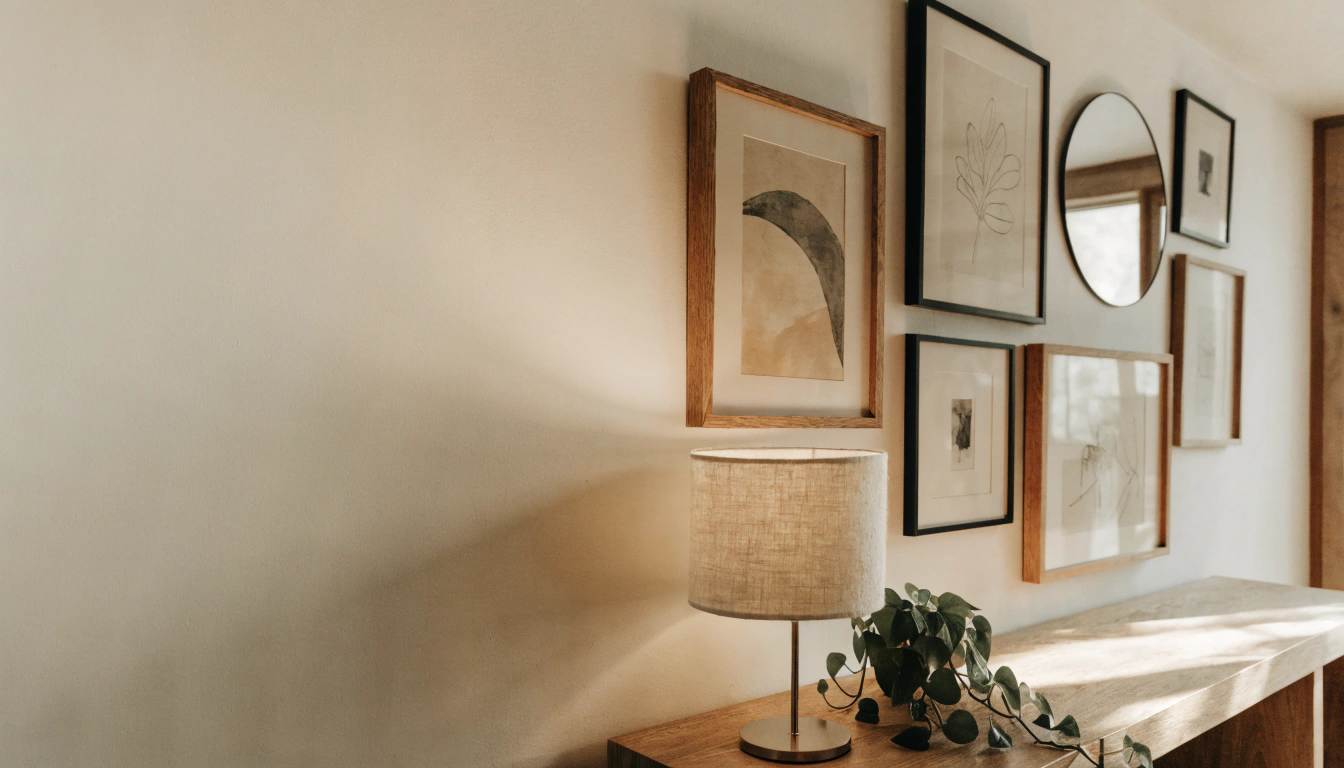
Mismatched frames read as either intentional or accidental, and one repeated element draws the line between them. Pick a thread and hold it: all warm wood, all black metal, or all thin gallery frames in a range of colors.
The mats do the quiet, calming work. A generous white mat around a print rests the eye and lifts budget-friendly art toward the expensive. Matching mat width across the wall pulls very different pieces into one family.
Size variation is deliberate, not accidental. A wall of identical frames falls flat, while one or two larger anchor pieces, ringed by smaller ones, lend the arrangement a clear center and a rhythm.
Lay It Out on the Floor First

Hanging straight on the wall is the mistake. Every piece goes on the floor first and gets arranged there, where sliding a frame around costs nothing. Match the same overall size and shape as the wall area you measured.
The largest piece leads, set a little off-center, and the rest builds outward from it, big against small, light against dark. Even gaps throughout, usually two to three inches between frames, and a step back every so often to read the whole shape. Nothing matters more when planning a frame wall than this step, and getting gallery wall spacing right on the floor means you'll never have to fix it on the wall.
A console gives you a natural staging surface and a home for the finished display. A piece like theSavanna console table with shelves anchors the gallery above it and holds a lamp or a plant to soften the bottom edge of the arrangement.
Get the Spacing and Height Right

Gallery wall spacing is what separates polished from chaotic. The same gap sits between every frame, two inches for a tight modern look, three for a relaxed one. Repetition like that reads as intentional to the eye.
Most gallery walls stumble on height. Anyone asking how to hang a gallery wall at the right height gets one number back: the whole arrangement centers around 57 to 60 inches from the floor, gallery height, so it lands at natural eye level instead of creeping toward the ceiling.
Over furniture, the rules bend a little. Four to ten inches between the top of the sofa or console and the bottom row of frames keeps them close enough that the two read as one connected group.
Hang It With Paper Templates

Paper gallery wall templates trade guesswork for tracing. Cut kraft paper or newspaper to the size of each frame, mark the hook spot on each one, and tape them to the wall with painter's tape in the layout you chose.
Run a level over the paper layout, nudge it until it looks right, then drive the hooks straight through the paper. Tear the paper off and hang. Every nail sits exactly where you planned it. That sequence is the whole step-by-step way to hang a gallery wall, minus the patched-over nail holes.
Match the hardware to the weight. Heavy or oversized frames need proper wall anchors or a stud, since theCPSC's Anchor It campaign ties falling wall-mounted items to weak fixings. A falling frame can damage far more than the wall.
Add Depth With Non-Frame Pieces

Frames alone do not make the best gallery walls. A round mirror bounces light and breaks up the rectangles. A woven basket, a small shelf, a clock, or a piece of dimensional art brings texture that the flat frames cannot.
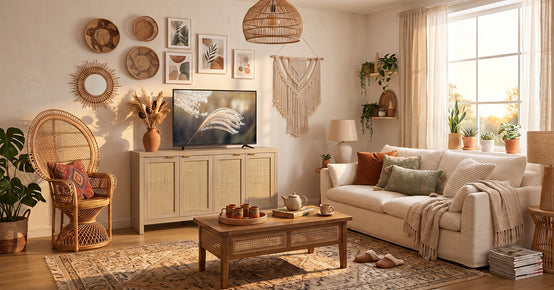
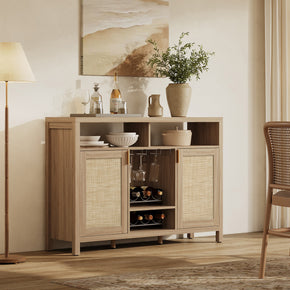
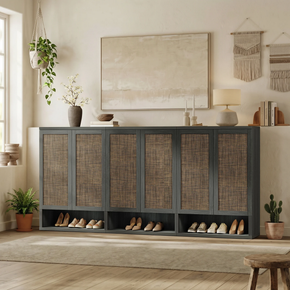
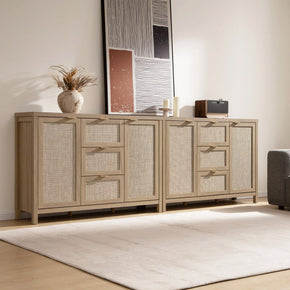
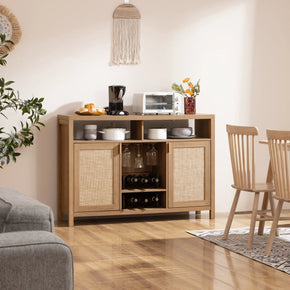
Let the wall play off the furniture, too. Over a credenza like the Terra rattan sideboard cabinet, the woven texture below and the mixed frames above trade off each other, so the whole vignette reads richer than the art alone.
Keep the extras in the same palette. One- or two-dimensional pieces lift the wall, but too many turn it into a flea-market shelf instead of a gallery.
Tie It Together With a Theme
A loose theme keeps a varied wall from feeling random. It can be a color story, black-and-white photos, a subject like travel or botanicals, or simply a shared frame finish carried across every piece. The same gallery wall ideas for living rooms, hallways, or stairways all lean on this one habit, whatever the space.
Repeat at least one element three times. One color, one frame finish, or one recurring shape echoed across the wall is what tells the eye that the whole thing was planned as a group.
Balance the Wall With What Sits Beside It

A gallery wall does not float in isolation. What stands on either side frames it. Tall storage or shelving flanking the art gives the arrangement visual bookends and stops it from drifting across a bare wall.
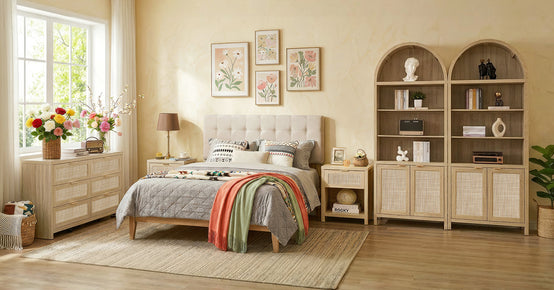
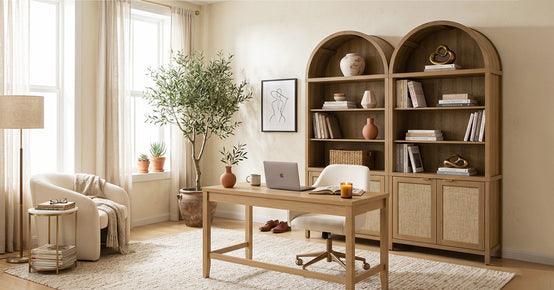
A tall piece like the Cas modern arched bookcase beside a gallery wall balances the height and repeats the display idea, its shelved objects echoing the framed pieces on the wall next to it.
Frame a TV Into the Gallery

A television need not fight the art. Ring the screen with framed pieces, and it reads as one element in the gallery, not a black rectangle stranded on the wall. Keep the frame tones close to the TV's bezel.
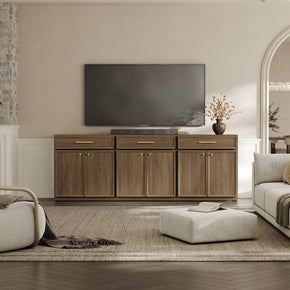
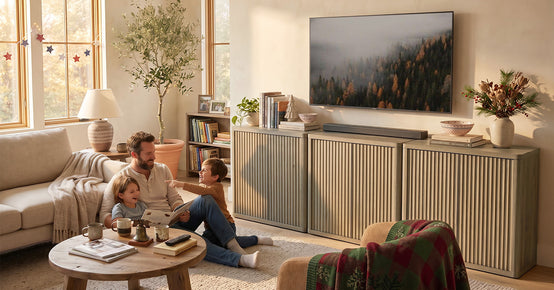
Ground the whole wall on a low media unit. A Savanna TV stand with shelves keeps the screen at seated eye level and gives the framed pieces around it a solid visual base to build from.
Common Gallery Wall Mistakes
A few habits trip up most first gallery walls. The common gallery wall mistakes below are mostly layout and spacing issues that make a picture wall look off, and each one is easier to avoid than to fix. Watch for these:
- Hanging everything before laying it out on the floor.
- Spacing frames unevenly so the wall looks scattered.
- Hanging the whole group too high above eye level.
- Mixing frames with no repeated colors, finishes, or mats.
- Using too few pieces stretched thin across a big wall.
- Ignoring the furniture below and floating the art too high.
- Skipping proper anchors on heavy or oversized frames.
Final Takeaway
One order runs the whole job. Pick the wall, choose a layout, and gather more art than you need. Mix frames around one repeated element, then lay the whole thing out on the floor before a single nail goes in.
Keep the spacing even, center it at gallery height, and hang with paper templates and the right anchors. Add a mirror or a shelf for depth, tie it together with a theme, and balance it with the furniture beside and below—planned beats random every time.
FAQs
How do I start a gallery wall?
Working out how to create a gallery wall starts on the floor, not the wall. Before a nail goes anywhere:
- The wall is picked, and the usable area is measured.
- A gallery wall layout gets chosen: grid, salon cluster, or straight line.
- Every piece lands on the floor first.
What is the correct spacing for a gallery wall?
Most gallery wall ideas fall apart on spacing alone. Keep the gap consistent everywhere. Two inches between frames reads tight and modern, while three inches feels more relaxed. Above furniture, leave four to ten inches between the top of the piece and the lowest frames so the two read as one group.
How high should a gallery wall be hung?
Gallery height centers the arrangement, about 57 to 60 inches off the floor, so its middle meets natural eye level. Over a sofa or console, hang the bottom row a few inches above the furniture instead and let the group climb from there.
Do frames have to match on a gallery wall?
No, and matching every frame usually falls flat. One repeated element is the trick:
- All the same frame finish in different sizes.
- Consistent white mats tie together different frames.
- A single color story runs through the art.
How do I plan a gallery wall layout?
Trace each frame onto kraft paper, cut it out, and arrange the paper shapes on the wall with painter's tape. Move them around until the balance looks right, then hang them through the paper. It is the no-risk way to plan before making any holes.
What can I use besides frames on a gallery wall?
A lot of things add welcome depth: a round mirror, a woven wall disc, a small floating shelf, a wall clock, a hanging plant, or a piece of dimensional art. Keep them on one palette so they read as part of the gallery rather thanas clutter.
How many pictures should be on a gallery wall?
No fixed number exists, only balance. Five to seven pieces might fill a small wall, twenty or more a large salon wall. Collect extras, lay them out, and add or subtract until the shape fills the space without crowding it.
Sources
- MasterClass – How to Use Scale and Proportion for Better Interior Design
- U.S. Consumer Product Safety Commission – Anchor It! Prevent Furniture Tip-Overs
- HOMES&GARDENS – Interior Design Color Theory
- VDCI – Design Principles: Harmony, Scale, Proportion, Balance, Rhythm
- Utah State University Extension – Cleaning, Repairing, and Reconditioning Wood Furniture
- National Park Service – Caring for Framed Works and Photographs


Looking for something else?

Burl Wood Furniture: The Complete Buying Guide
LEARN MORE
What Is a Hope Chest? Meaning, History, and Modern Uses
LEARN MORE
What Is a Foyer? Meaning, Purpose and Design Guide
LEARN MORE
GREENGUARD Gold Certified Furniture: What It Really Means for Your Home
LEARN MORELooking for something else?

How to Clean a Mirror Without Streaks: Simple Step-by-Step Guide
LEARN MORE
21 Above-Bed Decor Ideas for a Stylish Bedroom Wall
LEARN MORE
Furniture Materials Guide: Picking the Right Material Room by Room
LEARN MORE


Further reading

18 Decorative Storage Box Ideas That Hide Clutter Well

How to Store Comforters Without Losing Space or Loft


