









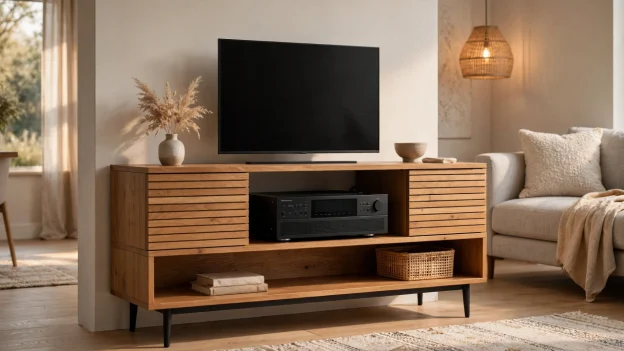

How to Choose a Media Console That Fits an AV Receiver
Most people buy a media console like a sideboard: measure the wall, fall for a finish, assume the cabinet swallows everything. The trouble starts the day an AV receiver enters the picture.
A receiver is the deepest, heaviest, hottest box in a living-room setup — deeper still once wired. Get the fit wrong and you own a gorgeous console slowly cooking your gear, or a receiver jutting off the shelf.
This guide hangs on one idea: measure the receiver as it will live — plugged in, ventilated, reachable — then judge the console.
Measure the Receiver As Installed, Not As Listed
The spec sheet is only the start: a typical chassis runs about 15 inches deep until you plug in. Binding posts and banana plugs add roughly another inch, a straight HDMI plug one to two more. One owner's 15-inch chassis needed nearly 18 inches wired behind a closed back.
Memorize this: minimum internal shelf depth = receiver body depth + deepest plug or cable + a small service gap. A 16-inch receiver needs two to three more inches once connected. Never hard-bend cables against a back panel — you'll be back there again.
Measure in the working state: tape from the front knobs to the longest plug tip, or add two to three inches to the spec-sheet depth if buying blind. Keep three numbers: installed depth, height with feet, chassis width.
Don't forget the front: knobs and bezels can stick out a half inch past the face — critical when a door must close. Keep rear antennas upright; flat against a back panel they lose signal.
Shelf Opening vs Usable Interior: Where the Inches Disappear
A console listed at 20 inches deep can still fail a receiver needing 17, because clear internal shelf depth is what counts — not the outside measurement. Doors, face frames, shelf lips, rear panels each shave a little; together they steal several inches. Before ordering, confirm the clear depth behind the doors, the rear cable openings, and the space between console and wall.
Height plays the same trick: the opening you slide the receiver through is often shorter than the interior, since face frames and door rails crowd the front.
Adjustable shelves help only if you check pin positions: bay height minus shelf thickness minus installed receiver height equals your air gap.
Ventilation: Read the Receiver Manual Before the Furniture Listing

A receiver can fit inside a cabinet and still fail if its heat has nowhere to go. The amp works hardest during long movies and gaming, and all that heat rises through the top vents. Trap it under a low shelf and the protection circuit cuts out — one owner traced his dead receiver to a spacious cabinet starving its vents.
Your receiver's manual is the final authority, not the furniture listing. Widely cited Denon guidance calls for about five inches of open space above the receiver and two inches on each side — more than most bays offer.
Build an air path, not a box: cool air in low, warm air out high. Look for rear vents or cutouts plus clear space above — never push the console flush against the wall. Owner-tested rules:
● - Keep the feet on — the bottom vents are intakes.
● - Exhaust hot air out; don't just blow cool air at it.
● - Dust vents and rear openings every few months.
● - A clip-on fan helps only once clearance and airflow are right.
If the manual wants more space than the bay provides, pick a taller bay, an open shelf, or a different console. Heat damage is cumulative and invisible.
Shelf Load: Receivers Are Heavier Than They Look

A mid-range AV receiver weighs 20 to 30 pounds; flagships push past 40. That load sits on one shelf for years, so check the per-shelf rating — not the top panel number. Fixed shelves are usually fine; adjustable shelves are a mixed bag.
For reference, a 61.5-inch SICOTAS TV stand rates its top at 165 pounds and each interior shelf at 33 pounds. Favor consoles that publish per-shelf figures, especially with adjustable shelves.
Center the receiver so the load spreads across the shelf pins; never stack a game console on top — that blocks the vents.
Doors, Glass, and IR: The Everyday Trade-Off

Once depth, air, and load check out, the console still has to work on a Tuesday night — switching inputs and grabbing the remote without moving furniture.
Open shelves are the easy answer: full ventilation, full access, zero remote drama. Slatted or rattan doors are the compromise — they hide clutter while passing air and usually IR. Glass doors generally pass IR too, though dark tints get fussy.
Solid wood doors are where the trade-off gets real: they block IR remotes completely — leaving doors-open viewing, an IR repeater kit, or an RF or app-based remote. They also trap the most heat — a receiver behind solid closed doors needs this guide's most generous clearances.
Give the receiver its own bay when you can — a game console sharing the compartment fights for the same air and cable cutouts.
Removable Backs and Cable Routing That Stay Serviceable

The back of the console is where good installations go to die: speaker wire, HDMI, power, Ethernet and audio cables converge behind the receiver, and a solid back panel with one small hole turns cable fishing into guesswork. Look for generous rear cutouts or a removable back panel.
Plan routing before plugging in: power down one side, signal down the other. Leave a short service loop near the receiver, bundle runs with hook-and-loop ties, and mount the power strip with its switch reachable.
Angled HDMI adapters can shrink a straight plug's two-inch projection to almost nothing — handy when the receiver won't slide fully back.
Future-Upgrade Allowance: Leave Room for the Next Receiver

Receivers don't stay put: today's model is replaced in a few years by something deeper, taller, or both. A console that fits it with zero margin becomes tomorrow's furniture-shopping problem.
Buy more bay than you need: an inch or two of spare depth and one adjustable shelf position cost nothing today and save a furniture purchase later. Keep the console inches off the wall — that rear gap is cheap insurance for thicker cables and a future fan.
Two SICOTAS Consoles Compared for Receiver Duty

Here's how two real SICOTAS consoles hold up for AV receiver duty, checked against live product pages.
|
Check |
Savanna TV Stands with Shelves |
Savanna TV Stand for 65Inch TV |
|
Overall size |
59" W x 26" H x 15.5" D |
61.5" W x 25" H x 15.6" D |
|
Bay layout |
Open center shelf, two side cabinets; middle bay 23" wide, end bays 15" each |
Wide low console, enclosed storage bays |
|
Receiver fit |
Open shelf: full front access, no trapped heat |
Enclosed bays suit smaller receivers; check bay height vs manual clearance |
|
Ventilation |
Open shelf breathes freely |
Run the ventilation math; keep the back off the wall |
|
Cable routing |
Open back keeps runs reachable |
Rear cutouts handle routing; plan a service loop |
|
Best for |
A full-size receiver as the setup centerpiece |
Mixed gear spread across a wider wall |
An honest note on depth: at 15.5 to 15.6 inches deep, both consoles are snug for a full-size receiver needing 17 to 18 inches installed. Angled HDMI adapters reclaim rear inches, keeping the console inches off the wall does the rest — the open shelf is the receiver's natural home. Compact receivers fit with room to spare.
Savanna TV Stands with Shelves suits the buyer whose receiver is the system's heart — it deserves the open, breathable center bay. Savanna TV Stand for 65Inch TV suits gear spread across a wider wall: receiver in one bay, game console in another, media tucked behind the remaining doors.
Your AV Receiver Fit Worksheet

Work through these steps with the tape measure in hand. If any step fails, stop — fix it before moving on.
● 1. Installed depth: front knobs to longest plug tip, or spec-sheet depth + 2-3 inches.
● 2. Installed height: chassis plus feet, plus the manual's top clearance (about 5 inches).
● 3. Bay check: clear internal shelf depth and bay height — not exterior dimensions.
● 4. Load check: the per-shelf rating must cover the receiver's weight with margin.
● 5. Air path: rear vents or cutouts must exist; keep the console inches off the wall.
● 6. Door check: solid doors? Decide now — IR repeater, RF remote, or doors-open viewing.
● 7. Cable plan: power one side, signal the other; service loop plus a reachable power strip.
● 8. Upgrade margin: spare depth and one adjustable shelf position for the next receiver.
A console that passes all eight steps serves for years. One that fails early is telling the truth before you spend money.
Ready to compare? Take your worksheet numbers to the TV stand collection and check interior depth, bay height, and ventilation cutouts against your receiver's measurements.
FAQs
Can I put an AV receiver inside a closed cabinet?
Yes, if it passes the fit test: installed depth for connected cables, the manual's top clearance, and a real air path in and out. A closed cabinet with a solid back and no vents is the riskiest setup — favor slatted doors and keep the back off the wall.
How much ventilation does an AV receiver need inside furniture?
Follow your receiver manual first. Widely cited Denon guidance: about five inches open above, two inches on each side. Cool air in low, warm air out high — never block top vents or remove the feet.
How deep should a media console be for an AV receiver?
Deep enough for installed depth: spec-sheet depth plus plug projection (one to two inches) plus a service gap. A 15-inch chassis commonly needs 17 to 18 inches of clear internal depth.
Will my remote control work through cabinet doors?
Through open shelves, always; slatted, rattan, or glass doors, usually. Solid wood doors block IR completely — then you need a repeater kit, an RF or app-based remote, or doors-open viewing.
Can I drill ventilation holes in the back panel of my console?
Many owners do — a row of holes or a cutout behind the receiver gives heat a direct exit. Check the panel isn't structural first, and consider a removable panel so future cable changes stay easy.
How much weight can a media console shelf hold?
Check the per-shelf rating, not the top-panel rating. For reference, a 61.5-inch SICOTAS TV stand rates its top at 165 pounds and each interior shelf at 33 pounds. Adjustable shelves deserve extra scrutiny — ratings depend on pin positions.
Should the receiver sit on top of the console or inside it?
On top is easiest thermally but collects dust and dominates the look. Inside a ventilated bay looks cleaner and is safe when depth, clearance, and air path check out. Avoid a sealed box with no vents.
Do I need to leave space behind the console?
Yes — a few inches between the console's back and the wall, so cables bend naturally, warm exhaust escapes instead of recirculating, and future swaps stay easy.


Looking for something else?

How to Choose a Bookcase for Plants Without Damaging the Shelves
LEARN MORE
How to Choose a Bookcase for Board Games: Shelf Depth, Height, and Access
LEARN MORE
7 Best Narrow Nightstands for Small Bedrooms With Real Storage
LEARN MORE
Chest of Drawers vs Dresser: Key Differences and Which One to Choose
LEARN MORELooking for something else?
Narrow Shoe Cabinet Buying Guide: Depth, Sizes and Styles That Fit a Small Entryway
LEARN MORE
11 Best Mid-Century Modern TV Stands for Style and Real Storage
LEARN MORE
Mid Century Sideboard Guide: How to Choose the Right Size, Wood and Style
LEARN MORE


Further reading

Zen Bedroom Ideas for a Calmer Room

Sage Green Bedroom Ideas and Furniture That Suits It


