




How to Choose a Buffet Cabinet for Dinnerware: Shelf Height, Load, and Door Access
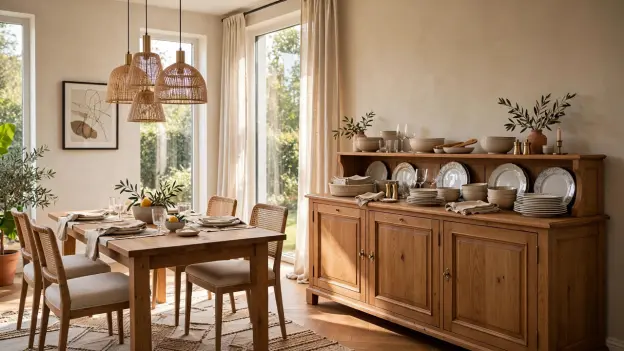
Every Thanksgiving my mother hauls out this enormous oval turkey platter — hand-painted, roughly nineteen inches end to end — and every year the question comes up: where does it live the other eleven months. Three years ago I "solved" it with a handsome walnut buffet, measured the wall, admired it for a week — then tried the platter. Half an inch too wide. Doors wouldn't close. Back on top of the wardrobe it went.
Cabinet shopping happens in a showroom mindset — wall measurements, wood tones, legs — while the pass/fail test comes later, with your biggest serving piece in your hands and a door that won't shut. Usable interior depth, adjustable shelf spacing, per-shelf load ratings: the three numbers that matter.

Find Your Collection's Troublemakers
Before anything else, pull out the pieces that cause trouble — the outliers, not the everyday cereal bowls. Your biggest dinner plate (standards 10–12 in; chargers 12–14), the longest serving platter (big oval holiday ones land around 16–20 in, always longer than you remember), and the tallest thing with its lid on — tureen, punch bowl, pitcher. These three decide the cabinet.
Then the stack math, because stacks are the quiet killers. Eight stoneware plates stand about 4–5 in tall; twelve climb to 6–7. A service for twelve wants a shelf zone around 7–8 in just for plates, before finger room. Write it down:

● - Biggest plate diameter — everyday plates 10–12 in, chargers 12–14 in
● - Longest platter — oval holiday platters usually 16–20 in
● - Tallest lidded piece — tureens, pitchers, punch bowls, lid on
● - Full stack height — plate count × about 0.6 in per plate, plus 2 in of finger room
The Depth on the Tag Isn't the Depth Inside
A listing says 14 inches deep and your brain files that as "fits a 14-inch platter." It doesn't — this is where most returns start. The tag number is the outside; your dishes live inside, between the closed door's inner face and the back panel, and that gap is always smaller. On a typical 14-inch-deep sideboard, door and hinges swallow roughly half an inch, the back panel takes another half, leaving something like 12.5–13 inches of working depth. A 12-inch charger slides in. A 14-inch platter does not. Width and height bend with adjustable shelving; depth is a wall.
That's why seasoned buyers obsess over depth: those extra two inches on a 16-inch cabinet are what let platters lie flat. If anything you own runs past 14 inches, treat 16 inches of exterior depth as the floor. And when the product page only gives exterior numbers — most of them — knock about 1.5 inches off for door, hinges, and back panel, then ask the seller for the interior figure before you pay.

Shelf Heights: Plan the Zones Before You Shop
Once depth clears, the next gate is shelf height — and fixed shelves are the enemy, because the factory's spacing has never met your punch bowl. One layout ships to a thousand homes; your collection is one specific, weird one. Map your zones first: plate and bowl stacks for 8–12 settings want roughly 7–9 in of clearance; tall pitchers and punch bowls demand 12–14; wine glasses need 9–10 — rims don't negotiate; folded linens are content with 4–6 in.
|
Dinnerware item |
Clearance to allow |
|
Stack of 8–12 dinner plates |
8 in (stack plus finger room) |
|
Nested serving bowls |
7 in |
|
Tall pitcher or punch bowl |
13 in |
|
Wine glasses / tall goblets |
10 in |
|
Folded table linens |
5 in |
|
16-in serving platter, lying flat |
4 in of height — plus full depth |
Spacing around 10–12 in between adjustable shelves covers most stacks, and the genuinely useful trick is asymmetry — one shelf opened two inches for the punch bowl while the plate stacks stay tight. That's why the number of adjustable positions matters when comparing listings: three or more height options means the shelves can actually follow your collection.

Plates Are Absurdly Heavy in Bulk
Nobody respects the weight of plates until the twelfth stoneware one lands on the stack. A single dinner plate runs about 1.5–2 pounds — twelve of them means 18–24 pounds on one shelf, every day, for years. Add the bowls and salad plates and one shelf zone is quietly carrying 30-plus pounds while you think of it as "the plate shelf."
This is the number that separates a good cabinet from a bowed one: the per-shelf rating. Plenty of flat-pack buffet shelves rate 60–70 pounds each — comfortable headroom, if the rating is honest. The failure mode is the thin fixed shelf with no center support, which bows under a constant 30-pound load and spends years working toward dumping your grandmother's china at 3 a.m. Get the stated per-shelf number; on wide cabinets prefer center supports or thicker panels. Then load it right: heaviest stacks low and centered, never near a shelf edge. Heavy low, light high.

Never Buy Fixed Shelves for Dinnerware
I'll say it flat: a fixed-shelf cabinet is the wrong cabinet for dishes. Collections move — new platters arrive, somebody gives you bowls, eight settings grow into twelve — and a shelf bolted at one height can't move with any of that. Two years from now you'll own something needing 13 inches and the cabinet will offer 9.
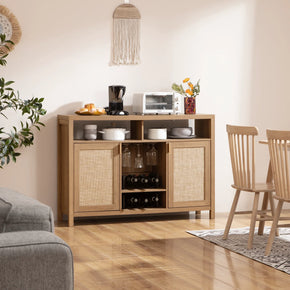
Look for shelves that move across at least three height positions, solid pegs or metal brackets, and panels thick enough not to flex when pressed. Both SICOTAS sideboards below made the shortlist partly on this — adjustable shelving throughout.

Glasses Are Fussy; Linens Are Not
Tall goblets are the divas of the cabinet: 9–10 in of clearance, uncrowded, and they punish crowding — rims chipping when glasses knock together. The right address is an upper zone, eye level or above, where a slipped glass drops a short distance onto a shelf instead of raining onto the plates below.
Linens are the opposite tenant: folded tablecloths and placemat stacks ask for only 4–6 in and complain about nothing, making them natural top-shelf residents. Napkins, the corkscrew, the daily things — those belong in a drawer near the table, reachable one-handed while carrying something hot.

Doors for the Big Stuff, Drawers for the Daily
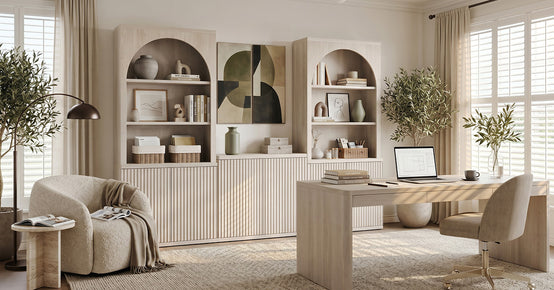
The doors-versus-drawers debate narrows when dinnerware is the cargo: can you get a loaded shelf in and out without a fight. Doors win, because the whole front opens — sliding a 16-inch platter on is a different operation without a drawer box blocking the angle. The tax on hinged doors is swing room: on a 43-inch-wide cabinet they sweep an arc around 14–16 in deep, and if the cabinet sits behind the dining chairs that arc has to clear pulled-out chairs. Fluted fronts don't change the geometry. Measure the swing, mark it on the floor, argue with your layout before delivery — not after.
The setup I've seen work best is a mix: doors on the wide platter bays, a drawer or two up top for flatware and linens.

The Dining Room Has to Cooperate
Two clearances that don't exist in showrooms. The walkway: at least 24 in between the cabinet front and the table or traffic path, so someone can pass while a door stands open. The chair zone: chairs pull out 18–24 in, and if doors need to open while people are seated you want 36–44 in of total space behind them. Thirty-two inches is the tight-but-workable minimum for a room where nobody opens the cabinet mid-dinner.
Chair test before the truck arrives: pull the chairs out as if someone's sitting down, then mime opening the doors. Knees hitting the doors means that wall wants a shallower cabinet.
Your Ten-Minute Fit Check
All of this is preventable with a tape measure and ten unglamorous minutes. Inventory first — every category with its count. Then the three troublemakers: biggest plate, longest platter, tallest lidded piece. Stack heights: plate count times about 0.6 in per plate, plus 2 in of finger room. Usable depth: knock roughly 1.5 in off the exterior figure, because the longest platter must lie flat and nothing else compensates if it doesn't.
Then map shelf zones to categories off the clearance table, total each zone's weight against the shelf rating, and walk the door swing on the actual floor — walkway and chairs. Pass everything and buy with confidence. Fail the depth step and stop: no hinge style, finish, or sale price fixes a cabinet too shallow for your platters.
Two Sideboards That Fit Real Dinnerware
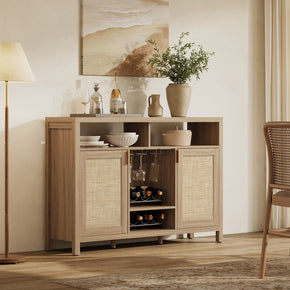
I ran two SICOTAS sideboards through this whole checklist — both door-front cabinets with adjustable shelving, both in the depth range that handles real platters.
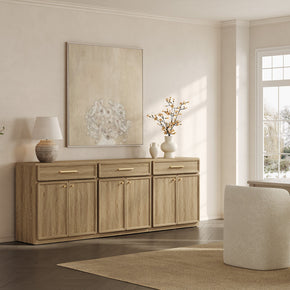
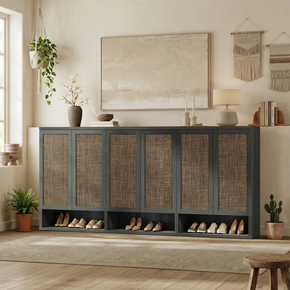
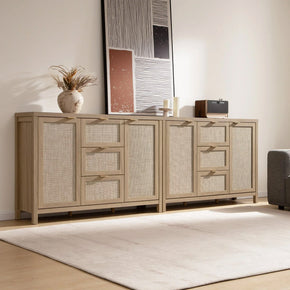
Savanna Sideboard with Doors — 33.9 in H × 43.5 in W × 14 in D . The balanced pick: four doors over adjustable shelves, a footprint for most dining walls, and interior depth for 12-inch chargers lying flat — provided serving pieces stay under 13 inches.
Savanna Sideboard Cabinets — 35.43 in H × 51.57 in W × 14.02 in D. Better for 12-setting collections and holiday pieces, with room for serving pieces alongside daily plate stacks.
|
|
Savanna Sideboard with Doors |
Savanna Sideboard Cabinets |
|
Width |
43.5 in |
51.57 in |
|
Height |
33.9 in |
35.43 in |
|
Depth (exterior) |
14 in |
14.02 in |
|
Shelves |
Adjustable |
Adjustable |
|
Best for |
Everyday 8-setting collections |
12-setting collections plus holiday serving |
Compare the full Sideboards collection yourself, or start from the SICOTAS homepage for the rest of the dining room.
FAQs
Is 12 inches really enough for dinner plates?
For standard 10–12 in plates and 12 in chargers, yes: knock about 1.5 in off for door and back panel and they still clear. But platters over 14 in? That cabinet is a no — look for 16+ in of exterior depth.
Between shelves, how much room do plates actually need?
Around 8 in for a stack of 8–12 plates — the 5–6 in stack plus finger room under the top one. And keep one bay at 12–14 in for the tall pitchers, which never shrink.
Do buffet shelves really sag under plates, or is that a myth?
Avoidable, not mythical. Buffet shelves commonly rate 60–70 lb each and a twelve-plate stoneware stack is only 18–24 lb, so the rating usually covers you. Sag strikes thin unsupported shelves loaded to the edge — keep heavy stacks low and centered.
My big serving platter is 16 inches — will any normal sideboard take it?
Only if the inside clears 16 in, and most don't: a 14-in-deep cabinet leaves about 12.5–13 in usable. You need roughly 17–18 in of exterior depth — filter listings by depth first.
For dinnerware, doors or drawers — which works better day to day?
Doors for the wide and tall stuff — platters, pitchers, stacked bowls get the whole front open. Drawers for the small flat things: placemats, napkins, flatware. A mix is the practical answer.
What keeps a loaded shelf from bowing over time?
A stated load rating with center support on wide spans, weight low and centered rather than at the edges, and permanent loads at about two-thirds of the rating. All three, and shelves stay flat for decades.
Where do wine glasses belong — top shelf, bottom, somewhere else?
Upper shelf, eye level or above, uncrowded, 9–10 in of clearance. A slipped glass should fall inches onto a shelf, not a foot onto plates — and glasses chip when they knock together.
How much room in front of the cabinet is enough?
Twenty-four inches of walkway with doors closed; 36–44 in behind dining chairs if doors open while people are seated. Measure with chairs pulled out.


Looking for something else?

How to Choose a Bookcase for Board Games: Shelf Depth, Height, and Access
LEARN MORE
7 Best Narrow Nightstands for Small Bedrooms With Real Storage
LEARN MORE
Chest of Drawers vs Dresser: Key Differences and Which One to Choose
LEARN MORE
Narrow Shoe Cabinet Buying Guide: Depth, Sizes and Styles That Fit a Small Entryway
LEARN MORELooking for something else?
11 Best Mid-Century Modern TV Stands for Style and Real Storage
LEARN MORE
Mid Century Sideboard Guide: How to Choose the Right Size, Wood and Style
LEARN MORE
Fluted Nightstand Guide: Meaning, Sizes, Styles and Care Tips
LEARN MORE


Further reading
SICOTAS Brings Joy to Children with Donation of Drawing Books and Game Sets

Zen Bedroom Ideas for a Calmer Room


